Chapter 1: The Silence of the Tropics
I woke to a room that was aggressively, cheerfully normal.
Morning light bled through the edges of the blackout drapes,
painting golden slivers across the teakwood floor of our Thailand resort.
The air conditioner maintained the steady, rattling hum it had produced all week.
Somewhere down below, near the azure sweep of the infinity pool,
metal chair legs scraped against stone tiles.
Everything was ordinary,
except for the sprawling,
immaculate emptiness on the left side of the mattress.
My husband, Greg, was gone.
I blinked against the grit of sleep, assuming he’d taken an early walk.
But when I rolled over, my hand brushed against a jagged edge of paper resting squarely on his pillow.
I picked it up.
The handwriting was unmistakably his—sharp, hurried, slanting downward.
Figure it out yourself.
For three seconds, my brain refused to process the syntax. I sat up, a sudden rush of vertigo blurring the edges of the room, and reached blindly for the nightstand to grab my phone.
My fingers met bare wood.
I tossed the duvet aside, my pulse beginning a slow, heavy thud against my ribs. I checked beneath the pillows. I tore through the bathroom vanity, yanking open drawers. I dumped the contents of my canvas tote bag onto the rug. Nothing.
Panic is a cold, metallic taste in the back of the throat. It spiked sharply when I lunged for my carry-on luggage, unzipping the concealed inner pocket where I kept a waterproof red document pouch.
The pouch was gone. My passport was gone.
The fog of morning confusion evaporated, replaced by a crystalline, terrifying clarity. I stood barefoot in the center of the room, wearing only sleep shorts and a faded Ohio State University t-shirt, waiting for the walls to offer an explanation. They didn’t.
I bolted into the hallway, slamming my palm against the heavy oak door directly across from mine. “Diane!” I called out. No response.
Two doors down was his daughter’s room. I hammered on the wood. “Ashley! Are you in there?”
Still nothing. A woman in a housekeeping uniform paused pushing her cart, eyeing my bare feet and frantic expression with professional concern. I ignored her and sprinted toward the elevators.
The woman working the front desk recognized me instantly. Her name was Knock. In just forty-eight hours, she had navigated the exhausting dynamic of our four-person travel party with saintly patience.
“Mrs. Bennett,” she said, her welcoming smile faltering as she took in my appearance.
“Where is my husband?” My voice trembled, despite my desperate attempt to lock it down.
Her expression shifted from hospitality to a guarded, professional caution. “Mr. Bennett completed checkout procedures early this morning, ma’am.”
“What time?”
She tapped her keyboard. “At approximately 4:50 a.m.”
I gripped the edge of the marble counter. “By himself?”
Knock swallowed hard, her eyes darting downward. “No, ma’am. He departed with the elder Mrs. Bennett and Ms. Bennett. The hotel shuttle transported all three of them to the Phuket International Airport.”
A dry, hollow bark of laughter tore from my throat. It wasn’t humorous; it was the sound of a mind fracturing. Of course they left together.
Knock shifted her weight, clearly distressed. “Would you permit me to dial Mr. Bennett’s cellular device for you?”
“Yes. Please.”
She dialed. The call routed immediately to a sterile voicemail recording. She tried Ashley, but I had to provide the number from memory. It was the wrong number. I knew my stepdaughter’s obscure coffee order, her severe aversion to cilantro, and the exact date of her birth, but I had absolutely no idea what her phone number was. My entire existence—banking applications, dual-factor authentication, flight itineraries—was trapped inside a six-inch rectangle of glass currently flying over the Pacific Ocean in Greg’s pocket.
Knock gently suggested I return upstairs while she reviewed my reservation. I nodded numbly, suddenly hyper-aware of the freezing marble beneath my bare soles.
When I returned to the suite, housekeeping had already entered. A young woman approached me, holding up a second piece of hotel stationery. “Found on floor, ma’am. Near desk.”
I took it. The handwriting this time wasn’t Greg’s. It was round, sweeping, and aggressively bold—the penmanship of a woman who treated every sentence like a royal decree. It belonged to my mother-in-law, Diane.
Let’s see who comes for you now.
That sentence struck with the force of a physical blow. Diane was intimately aware that I was an orphan. She knew I lacked siblings, that I had no children of my own. She had always viewed my lack of a sprawling, chaotic family tree as a character defect. Years ago, during a petty holiday dispute, she had sneered, “You don’t comprehend family loyalty because you never had an army of your own.” I had coolly replied that quantity rarely guaranteed quality, earning myself two weeks of blissful silence from her.
Standing in a foreign country, completely stripped of my identity, her cruel little joke hit its mark.
This entire anniversary trip had morphed into a Bennett family occupation. First Greg invited his mother, then Ashley demanded to tag along. The friction had started back in Ohio. Ashley wanted a $410,000 new-build townhouse. Greg wanted to “help.” I didn’t object to helping, but I fiercely objected to draining our joint savings without a concrete financial plan. Diane had intervened, declaring that marrying a father meant financing his lineage. I had told her I didn’t marry a blank check.
The night before they vanished, Greg and I had fought bitterly. He accused me of keeping one foot out the door. I told him boundaries weren’t abandonment. I went to sleep assuming we would wake up, eat a tense breakfast, and act like adults.
Instead, they orchestrated an evacuation.
The room phone shrilled, startling me. I snatched the receiver.
“Mrs. Bennett,” Knock said softly. “I reviewed your airline itinerary.”
I sank onto the edge of the mattress. “And?”
“Your return segment… it is no longer active in the system.”
I rubbed my temples. “Meaning I missed the flight?”
“No, ma’am,” Knock whispered. “Meaning the ticket was permanently canceled. Yesterday afternoon.”
My husband hadn’t just left me; he had actively severed my lifeline before the sun even went down.
Chapter 2: Protocol Blue Lantern
Missing a flight is an act of negligence. Leaving a spouse after an argument is an act of impulsive rage.
Canceling an international return ticket twelve hours in advance is an act of calculated malice.
I sat in the oppressive silence of the hotel room, staring at the two malicious notes until the sheer absurdity of the situation fractured my paralysis. I am a senior corporate auditor. My entire career is constructed upon anticipating disaster, mitigating liability, and tracing fraudulent behavior. I had spent a decade teaching executives how to survive supply-chain collapses and data breaches.
Suddenly, an old, seemingly useless piece of data floated into the forefront of my mind. A seven-digit sequence.
Years ago, my former director, Martin Shaw, had instituted a mandatory safety drill. He forced every senior consultant to memorize one international emergency contact number. I had mocked him relentlessly for it. No one memorizes numbers in the digital age, Martin, I had teased. Exactly, he had replied, utterly humorless.
I still remembered his Cincinnati area code.
I threw on a pair of linen trousers and practically ran back to the lobby. Knock looked up, her eyes wide.
“May I borrow a house phone for an outgoing international line?” I asked, my voice finally steady.
She pushed a sleek black handset across the granite. I dialed. The line clicked and hissed over the oceanic cables.
Martin answered on the fourth ring, his voice thick with sleep. “Hello?”
“Martin. It’s Clare Bennett.”
A beat of heavy silence. “Clare.”
I looked down at the two pieces of damning stationery crumpled in my fist. Then, I uttered the phrase I had prayed I would never need. “Blue Lantern.”
The atmosphere on the line shifted instantly. The grogginess vanished from Martin’s tone, replaced by the icy precision of a military tactician. “Clare. Do not explain the narrative yet. First, provide your exact geographical coordinates.”
“Phuket. The resort we discussed before my departure.”
“Full name of the property?” I gave it to him. “Room number?” I provided that as well.
“Are you currently suffering from any physical injuries?”
“No.”
“Do you have access to physical currency or credit lines?”
“Some cards are still in my wallet, yes.”
“Do you possess your passport?”
“No.”
“Cellular device?”
“Taken.”
He paused, the silence humming with calculation. “Clare, this may sound overly cautious, but are you in immediate, physical danger from anyone in your current vicinity?”
“No.”
“Good.” The tension in my chest loosened fractionally. Martin possessed the unique ability to take a burning skyscraper and reduce it to six actionable bullet points on a legal pad. “Now. Walk me through the event.”
I gave him the surgical version. I woke up. Husband, mother-in-law, and stepdaughter vanished. Communications and identification stolen. Flight terminated. Two mocking notes left behind.
When I finished, Martin exhaled slowly. “Okay.”
“‘Okay’ means we have a logistical puzzle, not a tragedy,” I noted dryly. “It feels rather tragic from this side of the hemisphere.”
“You haven’t lost your sarcasm,” he noted. “That indicates your prefrontal cortex is still engaged. We follow the protocol. Blue Lantern dictates I execute three actions: I authenticate your location, I secure emerging evidence, and I alert your designated domestic proxies. I do not make emotional choices for you. Do you copy?”
“I copy.”
“First directive: Do not leave the property.”
“I wasn’t planning on swimming back to Ohio.”
“Second: Instruct property management to archive all checkout ledgers and security surveillance from the morning window.”
“Already requested.”
“Third: We initiate a stolen passport claim through the consulate. You will require local police documentation.”
I closed my eyes, a wave of exhaustion threatening to pull me under. “Martin, I know the procedure. I used to draft the manuals for this.”
“And now you are enjoying the premium immersive experience,” his voice softened just a fraction. “Listen to me, Clare. Your primary objective right now is not to dissect the autopsy of your marriage. Your objective is to reclaim your identity, secure your liquidity, and facilitate extraction. Greg can rot until you are on domestic soil.”
He was right. A hysterical loop in my brain kept screaming Why? Why would he let Diane do this? But those questions couldn’t forge a passport.
I approached Knock again. “I require a significant favor.”
She braced herself. “I suspected you might.”
I explained the necessity of sequestering the security footage of Greg’s departure. Knock nodded sympathetically. “We can preserve the digital files, yes.”
“I need to view them.”
Her face tightened into an apologetic grimace. “That presents a complication. Property policy explicitly forbids distributing surveillance media to guests without a formal police subpoena.”
A hot spike of irritation pierced my chest. The singular piece of evidence that could prove my husband had actively stolen my documentation was locked behind a bureaucratic firewall. “I don’t want to upload it to YouTube, Knock. I just need to verify what he was carrying.”
“I cannot display it,” she whispered, glancing over her shoulder. “But I will ensure the server does not overwrite the timestamp.”
It was a small victory, but a necessary one.
By late morning, I was stationed in a quiet corner of the lobby with a borrowed legal pad, surviving on black coffee. Using a hotel computer, I attempted to breach my email server.
The password was accepted. Then, the screen flashed: A six-digit authentication code has been sent to your mobile device.
I stared at the monitor with dead eyes. I clicked Try another method. The system cheerily informed me it was routing a backup text to the exact same stolen device. My entire adult existence was cryptographically tethered to a piece of hardware Greg was carrying.
Martin called back forty minutes later. “I’ve mobilized Ellen Price. She’s bypassing internal IT to verify your identity and force a backdoor into your corporate communications.”
“Beautiful.”
“I also woke up Rachel Kim. You listed her as your legal proxy.”
Rachel was the attorney who had drafted my estate plan a decade ago, right before I married Greg. “Thank God twenty-eight-year-old Clare was obsessively neurotic.”
“Thirty-eight-year-old Clare is still neurotic,” Martin replied.
An hour later, thanks to Ellen’s digital sorcery, I breached a temporary, restricted version of my inbox. It was flooded with spam, out-of-office replies, and vendor newsletters.
But sitting near the top, unread, was an automated alert from our joint banking institution.
I clicked it.
LARGE TRANSFER NOTIFICATION. AMOUNT: $82,000.00. STATUS: CLEARED.
The date of the transfer was exactly three days before we boarded our outbound flight to Thailand.
I stopped breathing. The air in my lungs turned to stone. I had not authorized an eighty-two-thousand-dollar hemorrhage.
I scrambled for the phone and dialed Martin.
“Something is critically wrong,” I gasped.
“Specify.”
“Eighty-two thousand dollars was siphoned from our joint savings three days before the trip.”
Silence stretched over the line. “Did you authorize it?”
“No.”
“Do you know the destination account?”
“No.”
“Screenshot every pixel of that ledger,” Martin commanded.
But where does eighty-two thousand dollars disappear to in the middle of a marital war?
Chapter 3: The Ghost in the Ledger
Rachel Kim’s voice was a soothing balm of absolute, unshakeable competence.
“Martin gave me the operational summary,” she said, bypassing pleasantries entirely when she called the hotel an hour later. “First directive, Clare: Do not initiate any retaliatory financial movements. Do not drain accounts out of spite. We secure your assets legally, not impulsively.”
“I’m not trying to launder money, Rachel. I just want to know who robbed me.”
“I say it because grief makes intelligent people do profoundly stupid things,” she replied smoothly. “I am currently forensically tearing apart your prior statements. Send me the routing numbers from the alert.”
While Rachel hunted the ghost money, Knock approached my alcove in the lobby, her posture rigid with significance.
“Mrs. Bennett,” she murmured, ensuring no other guests were in earshot. “Management has officially archived the video files.”
I stood up. “Tell me what it depicts.”
She chose her vocabulary with excruciating care. “I remain unauthorized to project the media for you. However… I can verbally confirm that your husband is clearly visible traversing the lobby during the checkout window.”
“Was he carrying my belongings?”
Knock swallowed. “He is holding a distinct, red waterproof document pouch.”
My stomach plummeted into an icy abyss. I knew that pouch intimately. I had purchased it during a layover in Chicago because Greg relentlessly mocked the battered plastic folder I used to carry. You audit luxury brands, and you carry your life in a Ziploc, he had laughed, buying himself a bespoke leather case. I bought the red pouch.
Now, there was high-definition digital proof of him marching it out of the country.
I retreated to the sanctuary of the hotel bathroom, locked the door, and sank onto the edge of the porcelain tub. For the first time since waking up to the empty bed, I cried. It wasn’t a theatrical, weeping breakdown. It was a silent, suffocating wave of grief. I wept not because I was trapped—I knew I would eventually escape—but because the man who had promised to protect me had meticulously engineered a scenario where I would feel entirely powerless.
When I emerged, my eyes red but dry, Knock signaled me from the desk. “A message from your attorney.”
I grabbed the phone. “Rachel. Tell me.”
“I traced the eighty-two grand,” Rachel stated flatly. “It didn’t go to Greg. Not directly.”
My grip on the plastic receiver tightened. “Then where?”
“Tennessee.”
I leaned against the cool granite counter, my mind racing. “What does the state of Tennessee have to do with…”
The realization hit me with the force of a freight train.
“Ashley,” I breathed.
“Bingo,” Rachel said. “The funds were wired directly into an escrow account affiliated with a new construction property in Franklin, Tennessee.”
Ashley’s dream townhouse. The white shaker cabinets, the microscopic fenced yard. The $410,000 price tag she had strategically forwarded to us for six months. Greg had endlessly lobbied to ‘assist’ her with the down payment, but he had conveniently omitted the part where he unilaterally drained our safety net three days prior to international travel.
“Are you telling me my husband stole my money to buy his adult daughter a house?”
“That is exactly what the ledger indicates,” Rachel confirmed. “And Clare… there’s an escalating factor.”
At this point, I had lost the capacity for shock. “Hit me.”
“Do you recall a digital document package Greg pressured you to sign right before the trip? He framed it as minor financial housekeeping.”
A cold sweat broke out along my hairline. I did remember. I had been buried in a brutal audit report when the link popped up on my phone. I had opened the first page, frowned at the dense legalese, and closed it, intending to review it over the weekend. When I asked him about it later, he became highly defensive, accusing me of treating our marriage like a corporate deposition.
“I never signed it,” I told Rachel. “I refused.”
“Past Clare is a genius,” Rachel sighed in relief. “I pulled the metadata on that un-signed packet. It was an application for a Home Equity Line of Credit. He was attempting to leverage your primary residence in Columbus.”
The room spun. My house. The two-story brick colonial in Worthington with the sprawling maple tree. I had purchased it four years before Greg ever learned how to pronounce my name. I had spent six months personally sanding the kitchen cabinets. He moved in after the wedding, and while we shared expenses, he had no legal authority to drain its equity without my signature.
“He needed the cash for Ashley,” I said, my voice eerily calm. “And I was the financial blockade. So, he took the cash anyway, and left me stranded so I couldn’t stop the closing.”
“That appears to be the prevailing theory,” Rachel said.
I hung up and spent the next hour documenting every subtle, manipulative conversation from the past two months on my legal pad. The pieces locked together with sickening precision.
Later that afternoon, Rachel forwarded me a horrifying piece of correspondence. It was an email Greg had dispatched to our family and close friends while sitting on his connecting flight.
It read: Clare became highly emotional following a minor family disagreement and impulsively decided to extend her stay in Thailand to decompress. I am certain she will reach out when she cools down.
I read it three times. The sheer, sociopathic confidence of the lie was breathtaking. He was assuming I would be too humiliated, or too deeply ensnared by the lack of technology, to counter his narrative.
Martin called an hour later. “How are the rations?”
“I am subsisting on rage and imported saltines.”
“Good. Clare, I must inform you of a secondary protocol that has been triggered. One that directly implicates me.”
I frowned. “Meaning what?”
“Greg’s employer, Hion Medical Systems, is an active client of my risk management firm.”
I sat up straight. I knew Martin handled corporate security for medical conglomerates, but I had never connected the dots.
“Because of the severe nature of this incident—an executive actively stealing a spouse’s passport and abandoning them in a foreign jurisdiction—I have a strict, legal obligation to file an incident report with Hion’s internal HR and ethics board.”
My heart hammered. “Martin, wait. Greg is up for his Vice President promotion on Monday. He’s been bleeding for that job for three years. If you file that…”
“I do not determine their punitive response, Clare,” Martin said gently. “I merely document the liability.”
“I don’t want his career incinerated because of a marital dispute!”
“This is not happening because of you,” Martin replied, his voice unyielding. “It is happening because of him.”
Will the truth cost Greg his empire, or will his lies bury me first?
Chapter 4: The Sound of Silence
Getting home was not a cinematic triumph.
There was no sweeping orchestral score, no dashing consulate official arriving in the lobby with a freshly stamped booklet. There was only the brutal, grinding bureaucracy of international replacement documentation. Endless forms, repeated interrogations, redundant identity verifications, and an agonizing amount of waiting in plastic chairs.
I had spent my career lecturing executives on the necessity of patience during overseas crises. I quickly discovered that patience is vastly easier to prescribe when you aren’t wearing the same t-shirt for three consecutive days.
By the second afternoon, I felt less like a guest at the resort and more like a disgruntled employee. I approached Knock at the desk to ask about an incoming fax.
“I owe you a profound apology, Knock,” I said wearily. “My matrimonial collapse has essentially become your administrative burden.”
She paused her typing and offered a wry, sympathetic smile. “Madam, this property routinely hosts destination weddings.” She leaned in, her voice dropping. “Your marriage is not even our strangest Tuesday.”
I laughed. It was a genuine, startling sound that lasted precisely five seconds, but it reminded me I was still alive.
With my office patching me into critical systems, Rachel securing the breached accounts, and Martin navigating the consulate, I had forged a path home. Yet, a heavy, toxic sludge sat in my gut. I wasn’t terrified of Thailand. I had shelter, capital, and people treating me with profound kindness.
What broke me was the knowledge that Greg had meticulously calculated my suffering. He wanted me crippled, dependent, and frightened enough that I would crawl back to Ohio willing to overlook an eighty-two-thousand-dollar theft.
Then, Greg finally attempted to make contact.
The first message arrived via the hotel switchboard while I was at the local police precinct. Mr. Bennett requests you return his call. I threw the slip of paper in the trash. Two hours later, a second message. Then a third.
By evening, Knock handed me a fourth slip. “He sounds… agitated,” she noted.
The next morning, armed with a fresh legal pad and a cup of scalding tea, I retreated to the business center and picked up the receiver.
Greg didn’t bother with a greeting. “What the hell are you playing at, Clare?”
Hearing his voice—the man whose boots were currently sitting in our mudroom, the man who knew I hated mayonnaise and adored Motown—almost shattered my resolve.
“I am currently attempting to evacuate a foreign country,” I said, my voice glacial. “You know perfectly well what I am doing.”
He exhaled, a harsh, dismissive sound. “Why is Martin Shaw filing reports with Hion Medical? Do you know what kind of firestorm you’ve started?”
“I didn’t instruct Martin to do anything. You stole my passport, Greg.”
“Oh, for God’s sake!” he groaned. “You are making this sound like a kidnapping! Did I take it? Yes. But it wasn’t supposed to escalate into an international incident!”
I dragged my pen across the legal pad. “What exactly was it supposed to escalate into?”
“You were supposed to sit in a five-star luxury resort and cool off for a few days!”
“Without my phone. Without my identification.”
“You had your credit cards, Clare!”
“That is entirely irrelevant to international travel law!” I snapped, my composure cracking. “You stole my documentation to trap me here!”
“You always do this!” he deflected, a classic abuser’s pivot. “You interrogate me like a hostile witness! Do you have any earthly concept of what this HR probe is doing to me? My VP review is completely frozen, Clare!”
There it was. The absolute core of his being. Not a single inquiry regarding my safety. Only terror over his corporate ascendancy.
“What would you like me to tell HR, Greg? Should I tell them it was a wacky misunderstanding?”
“Tell them it was a family argument that got blown out of proportion! Because that is all it was!”
“If it was merely an argument, why did you explicitly email Rachel stating I chose to stay behind?”
Silence descended on the line. “That was before I realized you were going to unleash your corporate hounds on me.”
I pressed the phone harder against my ear. “Greg. Where is my passport?”
He didn’t answer.
“Greg. I am asking you a direct question.”
“It’s… safe,” he muttered.
I almost laughed at the sheer absurdity. “I am absolutely thrilled to hear my passport is in good health. Now, where is it?”
“Mom said…” he started, then stopped, his voice dropping into a petulant mumble. “Mom said that once you realized nobody was coming to rescue you, you’d finally understand.”
My pen stopped moving. I stared blankly at the wall. “Understand what?”
“That you can’t just act like you’re vastly superior to everyone in this family because you make more money and have your little rules!”
My chest tightened. I reached into my pocket and unfolded Diane’s handwritten note. Let’s see who comes for you now. Greg hadn’t written it, but he had actively facilitated its execution. He was fully complicit in his mother’s sick psychological experiment.
“I have to go,” I whispered, and hung up before he could argue.
The flight back to Columbus was a grueling twenty-four-hour gauntlet. By the time I cleared domestic customs, I felt as though my skeleton was made of lead.
Rachel was waiting near the baggage carousels. She offered a single, fierce hug, devoid of pity.
Then, I saw him.
Greg was lingering twenty feet behind her, looking haggard and unshaven. He took a hesitant step forward, his arms opening in a gesture of reconciliation.
I stepped backward, raising a hand. His arms dropped to his sides.
I didn’t ask about his mother. I didn’t ask about the stolen money. I looked him dead in the eye and asked the only question that mattered. “Where is my passport?”
Greg shifted his weight, his eyes darting nervously toward Rachel.
“Mom has it.”
With the physical proof of his crime sitting in his mother’s purse, how do you destroy the people who tried to erase you?
Chapter 5: The Conference Room Tribunal
Upon my return to Ohio soil, Greg rapidly deduced that the only mechanism to salvage his imploding career was a grand, performative summit. I should have predicted Diane would view this as her ultimate moment of vindication.
Three days after I landed, Rachel summoned me. “Greg has formally requested a mediated sit-down before Hion Medical finalized their internal investigation.”
“He genuinely believes he can charm his way out of a federal crime?”
“He thinks you will capitulate to save the marriage,” Rachel corrected.
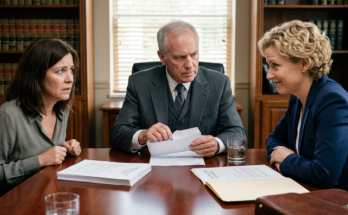
The meeting was convened on a dreary Thursday afternoon in a sterile, glass-walled conference room at a business hotel near Easton. Hion Medical’s senior HR director, Linda Alvarez, was already on-site for a corporate retreat and agreed to moderate. Martin flew in from Cincinnati, sitting as the author of the incident report. Rachel flanked my right side.
Then, the opposition entered.
Greg took his seat at the head of the table. Beside him sat Diane, draped in a formidable navy blazer adorned with a gaudy gold brooch—her armor of respectability. Ashley slunk into the chair across from them, her eyes fixed firmly on the polished mahogany table, refusing to look in my direction.
Linda Alvarez wasted no time. She opened a thick leather binder. “Let me establish the parameters immediately. This is not a legal deposition, nor is it a disciplinary hearing. I am here solely because grievous allegations involving Mr. Bennett’s conduct have been formally logged, and the company requires absolute clarification.”
“Exactly,” Greg interjected, attempting an easy, persuasive smile. “Because this situation has mutated completely out of hand.”
“Mr. Bennett,” Linda said smoothly, shutting down his charm offensive. “You provided a written statement to Hion HR characterizing the events in Thailand as a ‘private marital disagreement.’ You further stated your wife voluntarily chose to remain at the resort.”
Greg shifted uncomfortably in his ergonomic chair. “Essentially, yes.”
“Did Mrs. Bennett voluntarily remain in the country?”
Greg’s jaw clenched. “She is a highly resourceful woman. She knew how to arrange alternative transit.”
“That does not answer the question, Greg,” I said quietly.
He shot me a look of desperate pleading. “Clare, please.”
Diane, entirely incapable of suppressing her own ego, snapped. “She had access to corporate credit cards! She was hardly abandoned in a ditch!”
Rachel turned her predatory gaze on Diane. “So, you acknowledge you were aware she was being left behind?”
Diane’s mouth snapped shut. Greg groaned, “Mom, please stop talking.”
“Don’t you dare silence me, Gregory!” Diane barked. “She needed a lesson in humility!”
The air in the room vanished. Linda’s pen hovered over her legal pad.
I leaned forward, locking eyes with my mother-in-law. “What exact lesson was that, Diane?”
Diane squared her shoulders, looking at me with undisguised contempt. “That you do not possess the right to dictate this family’s trajectory simply because you generate a higher income. You treat us like subordinates.”
“No!” Greg shouted, slamming a hand on the table. “I am exhausted by this narrative! We didn’t leave her destitute! She was in a luxury resort!”
“Without her international identification,” Rachel corrected softly.
Diane looked at Greg. Greg looked at Ashley.
Ashley kept her eyes glued to the table, her face burning with shame.
Rachel opened her own slim folder and began the execution. “Let us formalize the timeline. Hotel server logs confirm Clare’s return flight was manually canceled prior to dawn. Security surveillance timestamped at 4:50 a.m. clearly shows Mr. Bennett exiting the lobby carrying Mrs. Bennett’s red document pouch. Furthermore, we have an email from Mr. Bennett asserting his wife stayed voluntarily.”
Rachel looked at Greg. “Was that email a factual statement, Mr. Bennett?”
Greg stared at his hands. “I… I believed she could handle herself.”
“That is a ‘no’,” Linda noted, writing swiftly.
“The secondary component,” Rachel continued relentlessly, “is the unauthorized transfer of eighty-two thousand dollars from joint assets.”
Ashley’s head snapped up.
“That is entirely irrelevant to Thailand!” Greg protested loudly.
“It is the catalyst for Thailand,” Rachel countered.
Ashley looked frantically between her father and me. “Dad… Dad told me you approved the transfer, Clare. For the townhouse.”
The room plunged into a suffocating silence.
I looked at Greg, my expression utterly blank. “Did I approve it, Greg?”
He rubbed a hand aggressively over his face. “I… I knew you would eventually come around to the idea! It’s an investment!”
Ashley’s face crumpled. The illusion of her benevolent father shattered in real-time. “You lied to me,” she whispered. “You said she was fine with it. You said she still had her passport in Thailand.”
Diane scoffed loudly. “Oh, grow up, Ashley. She survived, didn’t she?”
Ashley turned on her grandmother, tears finally spilling over. “You told me she had her documents! You told me it was just a time-out!”
I looked at Ashley, recognizing the exact moment her complicity morphed into horror. “When did you know they were leaving me, Ashley?”
She swallowed a sob. “That morning. When they woke me up to get in the van. But I swear, Clare… I didn’t know he took the passport until we were already in the air.”
Greg pointed a finger at me. “I didn’t plan on keeping it! I was furious! I made a mistake!”
“You had an eighteen-hour layover to correct that mistake,” I reminded him. “You chose to fly it across the ocean.”
Diane crossed her arms defiantly. “This is a witch hunt. You have punished this family enough, Clare.”
I didn’t yell. I didn’t cry. I simply reached into my blazer pocket, retrieved my phone, and opened a high-resolution photograph. I slid the phone across the mahogany table until it rested directly in front of Diane.
It was her handwritten note.
I read the words aloud, my voice echoing in the silent room. “Let’s see who comes for you now.”
Diane’s face drained of color.
“You wanted to demonstrate that without your son’s family, I was entirely alone in the world,” I said softly. I gestured to the room. I pointed to Martin, who had orchestrated a global response from his living room. I pointed to Rachel, who had locked down a lifetime of assets in an hour. I thought of Knock, who had defied hotel policy to preserve the evidence.
“As it turns out, Diane,” I said, a cold, victorious smile touching my lips, “quite a few people came for me.”
Linda Alvarez closed her binder with a definitive, echoing snap.
“Mr. Bennett,” Linda said, her tone devoid of all warmth. “The inconsistencies between your written statements and the documented reality are severe. Your promotion review is suspended indefinitely. You are hereby placed on administrative leave pending a full ethical review.”
Greg stared at her, horrified, before turning his betrayed eyes on me.
When the empire burns, what is left in the ashes?
Chapter 6: The Inventory of a Life
The divorce was not finalized for another nine excruciating months.
Cinema conditions us to expect a singular, explosive climax where the protagonist walks away in slow motion while the bridge burns behind them. Reality is infinitely more administrative. It is a grueling marathon of financial disclosures, mediator appointments, tedious arguments over household appliances, and attorney fees.
As Rachel had warned me, the dissolution of a life is rarely dramatic on a Tuesday. It is mostly paperwork.
The eighty-two thousand dollars was eventually clawed back through the settlement negotiations. A significant portion had not yet been locked into Ashley’s closing, and Greg was legally compelled to surrender alternative assets to cover the remainder.
He did not lose his job at Hion Medical. This deeply confused Diane, who had spent a solid month telling her country club social circle that I was a vindictive harpy trying to force her son into homelessness. The truth was, I hadn’t asked for his termination. Hion stripped him of the Vice President promotion, permanently removed him from the executive leadership track, and quietly relocated him to a terminal, low-visibility management role.
When Rachel delivered the news, I simply nodded.
“You’re allowed to be satisfied, Clare,” she noted over her reading glasses.
“I didn’t want him destroyed,” I admitted. “But I won’t pretend to grieve the loss of his ambition.”
“Both truths can co-exist,” she said.
That became my guiding philosophy. I could mourn the man who had sat by my father’s hospice bed seven years ago, and I could simultaneously sever all ties with the man who had stolen my identity in a foreign country. A decade of beautiful memories did not negate the ugliness of the end, just as the ugly ending did not render the good years fraudulent.
Ashley reached out to me once, six months after the hotel tribunal. We met at a dimly lit coffee shop in Worthington on a torrential Saturday morning.
She looked exhausted, carrying a thick manila envelope which she slid across the table.
“If that is a manifesto from your grandmother, I am throwing it in the trash,” I warned.
“It’s not,” Ashley said quietly. “It’s printouts. Text messages between Dad and Grandma from the days leading up to the flight.”
I pulled out the pages. The premeditation was staggering. Diane complaining that my financial boundaries were castrating Greg. Greg agreeing I needed to be “knocked down a peg.” Diane suggesting the passport theft as a mechanism to force my submission.
“I gave copies to Rachel,” Ashley murmured. “I thought you needed to see that they planned it. And… I needed you to know that I downgraded my townhouse. I didn’t use a dime of the stolen money.”
I looked at my stepdaughter. She wasn’t begging for absolution. She was simply presenting the ledger, balancing her own moral account.
“I don’t forgive you yet, Ashley,” I said honestly.
“I know,” she nodded. “I wouldn’t either.”
We didn’t hug when we parted ways. Some endings shouldn’t be forced into neat, comfortable bows.
Diane did eventually write me a letter. Three pages of cramped, furious handwriting accusing me of fracturing her lineage, humiliating her son, and choosing sterile corporate rules over the warmth of family. I spent two hours drafting a venomous, flawlessly argued, legally cited rebuttal.
Then, I shredded it. At fifty-two years old, I had finally learned that not every accusation is an invoice that requires payment.
A year after Thailand, I found myself sitting across from Martin Shaw at a steakhouse in Cincinnati.
“I never properly thanked you for saving me,” I said, raising my wine glass.
Martin shook his head, slicing into his ribeye. “I didn’t save you, Clare. I answered a telephone.”
“You activated Blue Lantern.”
He paused, looking at me with those sharp, analytical eyes. “Do you understand the fundamental mechanism of that protocol? It doesn’t magically deploy helicopters. It works entirely because you spent years building the infrastructure. You memorized the data. You maintained the professional relationships. You gathered the evidence. We didn’t rescue you; we just provided the ladder you built.”
That realization anchored me.
I still travel internationally. The first trip was to Vancouver—a mild re-entry. I carried a burner phone, three photocopies of my passport distributed across different bags, and a laminated card of emergency contacts. Trauma and risk management are functionally identical; one simply uses better stationery.
I keep a few physical mementos from the marriage. A photo of Maggie, our late Labrador. A picture of Greg on a beach in Mexico, looking young and entirely unburdened.
But I also keep the photograph of Diane’s note on my phone.
I don’t keep it to harvest bitterness. I keep it because it serves as the ultimate audit of my life. Diane sought to prove that without her son’s bloodline, I was an island, vulnerable and alone.
Instead, she proved the exact opposite.
When the people bound to you by law and blood abandon you in the dark, you discover the absolute, unbreakable strength of the people who show up simply because you called their name.
Let’s see who comes for you now.
Quite a few people, Diane. Quite a few.