When the judge asked if I accepted the charges, my mother was in the front row, her eyes swollen,
mouthing the words silently just so I would understand. “Say yes.”
My father had his eyes glued to the floor.
My older brother, Ethan, glared at me as if he could still boss me around.
On the other side of the courtroom,
the victim’s family held a black-and-white portrait.
A twenty-six-year-old young man who never made it home.
And next to my parents was her: Olivia.
My adoptive sister.
In a wheelchair, wearing hospital clothes, pale,
acting as if the whole world had wronged her.
For four years, Olivia had lived using my identity to go to college.
Under my name, she collected scholarships.
Under my name, she got into law school.
Under my name, she landed an internship at one of the most prominent law firms in Chicago.
And now, after driving drunk, running over a man, and fleeing the scene, my family expected me to be the one to go to prison for her.
“Clara,” my mother had told me the night before, “your life is already ruined.
We can’t let Olivia’s be ruined too.” What none of them imagined was that I had been waiting four years for this exact moment. When the clerk finished reading the indictment, my lawyer, Mr.
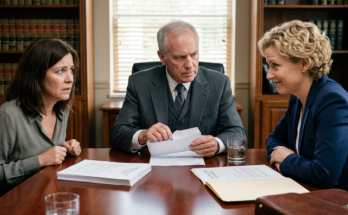
Collins, slid a cardboard folder toward me. My fingers brushed against the envelope inside. My college acceptance letter.
The one that arrived four years late. Then, I smiled. Because this time, the guilty ones weren’t going to get away.
The courtroom was in absolute silence until Olivia burst into tears. She placed a hand over her chest, trembling as if she were about to faint. My mother stood up abruptly.
“Your Honor, my youngest daughter is in very fragile health. She can’t withstand this kind of pressure.” The judge banged his gavel.
“Order in the court.” My mother sat down, but she didn’t stop looking at me. With that look I knew all too well.
When Olivia broke something, my mother looked at me. When Olivia stole something, my mother looked at me. When Olivia failed a class and said she couldn’t repeat the year because she would “die of embarrassment,” my mother looked at me too.
It always meant the same thing. Clara, you are the oldest. Give in.
The prosecutor read the charges: “The defendant, Clara Bennett, was driving under the influence of alcohol, struck the victim, and fled the scene, causing his death.” Every word was a blow. The mother of the deceased young man broke down.
“My son was only twenty-six years old! Why didn’t you help him? Why did you just leave him lying there?”
I looked at the photo in her hands. I hadn’t been the one driving. I hadn’t been the one who fled.
But for four years, my life had been trampled on by the people who claimed to love me. Olivia lifted her head, perfect tears rolling down her cheeks. “Clara…
forgive me. If you hadn’t gone out looking for me that night, none of this would have happened.” The courtroom began to murmur.
“Poor girl… and she’s still defending her sister.” My mother seized the moment.
“Clara, say something. Your sister isn’t sleeping, she isn’t eating, she’s living on pills because of you.” My father raised his voice.
“In this family, we take responsibility for our actions.” I almost laughed. They were talking about taking responsibility.
The same family that took away my ID, my acceptance letter, my future… and now wanted to take away my freedom too. Ethan leaned toward me from his seat.
“Don’t make a scene. Olivia has her whole life ahead of her.” I looked at him.
“And mine?” He frowned. “Are you going to be selfish now?”
Then the judge stared at me. “Miss Bennett, how do you plead? Guilty or not guilty?”
I heard my mother’s ragged breathing. Olivia’s wheelchair creaked slightly. Ethan’s fist clenched.
I stood up. My voice came out firm and calm. “Not guilty.”
Everyone froze. I looked straight at Olivia. “Because I wasn’t the one driving that car.”
Then I turned to my family. “And because it’s not the first time someone here has stolen my life.” The blood drained completely from Olivia’s face.
My mother whispered: “Clara, no…” But I had already waited too long. Attorney Collins opened the folder.
And what he pulled out of it made my brother jump to his feet.
The morning of the hearing, Mr. Collins had told me not to look at my family when the plea was entered.
“Look at the judge.”
I had laughed.
“As if that will make them disappear.”
“No. It will remind you who is actually deciding whether you leave this courtroom free.”
That mattered.
My mother’s face had controlled me for years.
One raised eyebrow.
One disappointed breath.
One whispered sentence.
Clara, please.
That morning, I tried to treat those signals as noise.
Not authority.
It was harder than I expected.
My father had once taught me to drive.
Ethan had walked me to school when I was little.
Olivia had slept in my room during thunderstorms.
These were not strangers asking me to destroy myself.
That was what made the pressure dangerous.
Love can be used as leverage most effectively by people you actually love.
When I said “Not guilty,” I was not declaring that I hated them.
I was refusing to let love rewrite fact.
That distinction became the foundation of everything that followed.
The night before court, I had packed a small bag.
Not because I expected to be taken into custody immediately.
Because for four years I had learned not to assume anything would go my way.
Clean shirt.
Toothbrush.
Medication.
A notebook.
Mr. Collins saw the bag in the morning.
“You may not need that.”
“I know.”
I carried it anyway.
The bag represented what my family wanted me to accept.
A false guilty plea had practical consequences.
Not symbolic ones.
A record.
Possible incarceration.
Employment loss.
A future built around a crime I did not commit.
When my mother mouthed “Say yes,” that bag sat beside my chair.
It kept the request real.
She was not asking for a little family sacrifice.
She was asking for my life.
When Mr. Collins asked whether I understood the risk of pleading not guilty, I said yes.
Trial.
Public attention.
More time.
More scrutiny.
None of that frightened me as much as a false conviction.
For four years, my family had trained me to think peace meant giving in.
That morning, I finally understood the difference between peace and surrender.
A quiet family can still be built on injustice.
A loud courtroom can still be the first place where the truth is allowed to exist.
I chose the truth.
Even if it made everyone angry.
Even if it took longer.
Even if they called me selfish again.
PART 2 – Mr. Collins opened the folder, and the first evidence he showed the court made Ethan panic before the crash was even discussed
Mr. Collins did not pull out a photograph of the car.
He did not produce a blood test.
He did not begin with the dead man whose family sat across the courtroom.
He held up a certified digital-recovery report from my old university.
Ethan stood so fast his chair scraped hard across the floor.
The judge looked at him.
“Sit down.”
Ethan’s face had gone pale.
My mother whispered his name.
Mr. Collins waited until the room settled.
Then he said, “Your Honor, before this court can determine who drove the vehicle, we need to address why the defendant’s name appears on records belonging to another person.”
The prosecutor frowned.
My family already knew.
That was the point.
Four years earlier, I had been accepted to Northbridge University.
The letter never reached me.
My mother told me I must not have gotten in.
My father said sometimes life closes doors for a reason.
Olivia cried because she had been rejected from the program she wanted.
Three months later, someone enrolled at Northbridge under my name.
Someone used my Social Security number.
My transcript.
My birth certificate.
My scholarship eligibility.
That someone was Olivia.
At first, I did not know.
I was working full-time by then.
Trying to save money.
Trying to understand why every application I submitted seemed to lead nowhere.
Then tax records started appearing that did not make sense.
A student loan inquiry.
A health insurance notice from a city I had never lived in.
I called the university.
They told me I was already enrolled.
When I said I was not, the woman on the phone became very quiet.
That was the beginning.
Mr. Collins handed the judge the recovery report.
It showed that my original admissions email had been redirected from my email account four years earlier.
The recovery address belonged to Ethan.
Not a stranger.
My brother.
The report also contained login records tied to a device registered at my parents’ home.
Ethan shouted from his seat.
“That proves nothing.”
The judge’s eyes narrowed.
“I warned you.”
Mr. Collins continued.
“We also have a preserved cloud folder recovered through lawful process. The folder is titled CLARA DOCS.”
Olivia started crying harder.
My mother grabbed her hand.
The folder contained scans of my identification.
My birth certificate.
My school records.
My signature copied repeatedly on practice sheets.
Some files had metadata associated with Ethan’s laptop.
Others with Olivia’s.
I watched my father stare at the floor.
My mother kept looking at me.
Clara, stop.
That look.
Always the same.
But the courtroom was not our kitchen.
The judge did not care who was oldest.
Mr. Collins said, “This evidence is not offered today to prove the hit-and-run charge by itself. It is offered to establish a documented pattern of identity substitution that predates the collision by four years.”
The prosecutor asked for a recess.
The judge granted twenty minutes.
My family exploded the moment we stepped into the hall.
My mother grabbed my arm.
“How could you do this?”
I pulled away.
“How could I?”
“Your sister is injured.”
“She killed someone.”
Olivia sobbed from the wheelchair.
“I didn’t mean to.”
I looked at her.
“That is not the same as I did not do it.”
Ethan stepped toward me.
“You’re destroying everyone.”
I almost laughed.
Four years of my life had been stolen piece by piece.
Now that records were being read aloud, I was somehow the destructive one.
My father finally spoke.
“Clara, we can still fix this.”
“How?”
He looked around.
Then lowered his voice.
“You take the plea. Olivia recovers. Later we deal with the other issues privately.”
Mr. Collins, standing ten feet away, heard every word.
He walked toward us.
“No,” he said.
My father looked offended.
Mr. Collins continued.
“There will be no private arrangement involving my client pleading guilty to an offense she did not commit.”
My mother’s face hardened.
“This is a family matter.”
Mr. Collins looked at the courtroom doors.
“A man is dead. It stopped being only a family matter a long time ago.”
That was the first time anyone outside me said it plainly.
Noah Whitaker was dead.
Not an obstacle.
Not a complication in Olivia’s future.
A person.
His parents were sitting behind those doors.
And my family had spent days discussing which daughter could “afford” to lose her life.
When court resumed, the judge looked at the prosecutor.
The prosecutor looked less certain.
Then Mr. Collins placed a second document on the table.
My original university acceptance letter.
The physical one.
Still sealed when I finally received it four years late.
My mother had hidden it.
She admitted that much during a recorded interview.
She claimed she was trying to protect Olivia from humiliation.
The judge read the date.
Then looked directly at my mother.
For the first time, she looked afraid of someone other than me.
The recess after the acceptance letter was worse than the courtroom.
My mother cornered Mr. Collins first.
“You don’t understand our family.”
He answered, “I understand my client has been using her legal name while another person used it without permission.”
My father tried a softer route.
“Could we have ten minutes with Clara alone?”
“No.”
“I’m her father.”
“That does not create a right to private access during an active criminal case when family members may be witnesses.”
My father looked stunned.
In our house, father had always meant authority.
In court, it meant relationship.
Not control.
That distinction changed everything.
Olivia was crying beside the vending machines.
I watched people glance at her wheelchair.
She had learned how quickly visible pain attracts protection.
I do not say that to mock her injuries.
She was injured.
She was also using those injuries as part of a story that erased Noah and me.
Both were true.
Ethan paced.
He whispered to my mother.
I caught only fragments.
Email.
Laptop.
Old files.
Delete.
Mr. Collins noticed too.
He later asked the prosecution to preserve certain devices.
That request mattered.
The family had spent years treating digital records as disposable.
They were not.
Backups existed.
Cloud timestamps existed.
Service-provider logs existed.
Even deleted things leave traces.
The courtroom was the first place where their confidence met a system that did not accept “family explanation” as evidence.
When we returned, the prosecutor asked for time to review the identity-fraud material.
The judge allowed it.
My mother glared at me.
I looked away.
For years, I had measured my decisions against her face.
Was she disappointed?
Angry?
About to cry?
That day, I practiced not looking.
It sounds small.
It was one of the hardest things I had ever done.
Mr. Collins leaned toward me.
“You do not owe anyone a performance.”
I nodded.
Then I looked at Noah’s photograph instead.
That kept the case anchored where it belonged.
The admissions letter itself became evidence in another way.
The envelope had been forwarded through an old address record, then intercepted.
Postal markings showed when it had entered my parents’ house.
My mother claimed she had hidden it after Olivia “had already committed” to Northbridge.
That timeline was false.
The letter arrived before Olivia enrolled.
That meant the decision was not only about avoiding embarrassment after the fact.
Someone had the chance to stop the substitution before it became a semester, a scholarship, a student ID, a transcript.
They did not.
When confronted with the date, my mother changed her explanation.
She said Olivia had been in a fragile state.
She was afraid rejection would trigger another breakdown.
Mr. Collins asked whether any doctor had recommended giving Olivia my identity.
The prosecutor objected to the sarcasm.
The judge still looked toward my mother.
I almost smiled.
There it was again.
A real emotional problem treated as permission for an unrelated violation.
Olivia may have been distressed.
That did not make my name available.
My family had always treated resources as transferable toward the person in greater visible pain.
Bedroom.
Money.
Attention.
Opportunities.
Eventually identity.
The courtroom forced a limit where our house never had one.
The document Mr. Collins produced first was a certified digital-recovery report.
Not dramatic.
No bloody photograph.
No crash reconstruction.
Just email routing data.
My original admissions account had been changed so recovery messages went to an address linked to Ethan.
The change had been made from a device associated with my parents’ house.
Mr. Collins asked the court to note the date.
Four years earlier.
Before the crash.
Before Noah.
Before any excuse about panic.
The identity theft had not begun that night.
It had already been a family system.
Ethan stood because he understood what the date meant.
His lawyer pulled him back down.
The prosecutor requested time to review.
My mother whispered:
“This has nothing to do with the accident.”
Mr. Collins heard her.
“It has everything to do with whose name was attached to the car.”
That was the first crack in the case against me.
Not because it proved Olivia drove.
Because it proved my identity had already been compromised by people close to me.
Once that became plausible, every record with my name had to be examined again rather than accepted at face value.
The courtroom changed from asking why Clara Bennett fled a crash to asking which Clara Bennett the evidence actually described.
That difference saved me.
PART 3 – The crash evidence began to separate my name from Olivia’s body, and each ordinary detail made my family’s story harder to maintain
The state had built the original case around identity.
The rental car was in my name.
The insurance information was in my name.
The law-firm badge found in the vehicle displayed my name.
A witness heard someone called Clara at a reception earlier that night.
On paper, it looked simple.
That was what my family had counted on.
Olivia had lived as Clara Bennett for four years.
Why not one more night?
Mr. Collins attacked the physical evidence.
First, my phone.
At the time of the collision, my phone had been connected to the Wi-Fi network at the hotel where I worked evening events.
My employee badge had been scanned twice.
Once entering a staff area.
Once leaving nearly an hour after the crash.
There was security video.
Me.
In uniform.
Carrying a tray.
Forty miles away.
The prosecutor asked whether someone else could have carried my phone and badge.
Technically, yes.
Then came the video.
My face.
My body.
Timestamp.
Not perfect alone.
Strong together.
Next, the rental counter footage.
The car had been rented using my identity.
But the woman standing at the counter was Olivia.
Same height.
Same hair.
Her left wrist had a small tattoo I did not have.
The clerk had checked a driver’s license bearing my information and Olivia’s photo.
That license became its own problem.
Mr. Collins asked when it had been produced.
The investigation traced the image file to a print shop order linked to Ethan’s email.
Ethan’s lawyer objected to several implications.
The judge allowed the records for limited purposes.
I watched my brother sink lower.
Then the phone data.
Olivia’s actual phone.
The one registered under her legal name.
Her family had claimed she left it home.
She had not.
Location records placed it at the law firm’s reception.
Then along the route the rental car traveled.
Then near the crash.
Then near the place where the vehicle was abandoned.
The prosecutor’s entire posture changed.
No longer:
Clara Bennett drove.
Now:
Someone using Clara Bennett’s identity drove.
That difference was everything.
The Whitaker family watched in silence.
Mrs. Whitaker still held Noah’s photograph.
I could not look at her for long.
I understood why she hated me.
For weeks, she had been told my name.
Seen my photograph from records.
Heard my family repeat a story built around me.
Truth does not arrive politely.
It hurts people again when it corrects the first lie.
Then came the hospital records.
Olivia had been treated hours after the crash at a private urgent-care clinic.
Her family said she had fallen down stairs.
She had bruising consistent with a seat belt.
A fracture in her right wrist.
Airbag abrasions.
And a blood-alcohol result over the legal limit.
My mother’s attorney argued medical privacy.
The court handled admissibility carefully.
The relevant records were lawfully obtained.
The timing was devastating.
Olivia cried.
My mother cried with her.
I did not.
Not because I was stronger.
Because I had spent four years crying in places nobody watched.
The prosecutor requested additional testing of blood preserved from the driver-side airbag.
Weeks later, the result came back.
It matched Olivia.
Not me.
That should have ended the case against me.
It did not end everything.
The state needed to understand the full chain.
But for the first time since my arrest, I slept six hours without waking.
The rental-car footage became especially important because Olivia had built so much of her false life around documents.
On paper, she was Clara.
On camera, she was herself.
The clerk remembered nothing unusual.
Why would he?
The license looked legitimate.
The credit card matched the name.
The reservation existed.
Fraud works best when it looks boring.
That frightened me.
For years, I had imagined identity theft as something dramatic.
Someone breaking into an account.
A stranger.
Instead, my own family had assembled enough ordinary documents to let Olivia pass through systems without attracting attention.
The law firm made the same mistake.
They believed the university.
The university believed the records.
Each institution trusted the previous one.
One false identity gained authority by repetition.
Mr. Collins explained that later.
“Systems often confuse consistency with truth.”
I never forgot it.
The crash broke that consistency because bodies do not follow paperwork.
My face was at work.
Olivia’s blood was on the airbag.
Her phone traveled with the car.
Her injuries matched the driver’s side.
Physical reality forced the paperwork to answer.
That was why the evidence felt so powerful.
Not because any single item was perfect.
Because independent pieces pointed in the same direction.
For the first time, my name stopped being stronger than my actual presence.
The investigators also examined the rental-car seat position.
I did not know cars stored things like that.
The driver’s seat had been pushed forward compared with settings associated with my height.
Olivia was several inches shorter.
Not decisive alone.
Another piece.
Door sensors showed the driver’s door opened near the crash, then later near where the vehicle was abandoned.
Telematics recorded a hard impact and braking pattern.
The data could not identify a face.
But it could tell a sequence.
Crash.
Stop.
Drive.
Abandon.
The more technical the case became, the less space there was for my family’s emotional version.
Olivia was scared.
Clara went looking.
Everyone was confused.
Machines did not care.
They recorded.
I began to appreciate boring systems.
Not because they are always fair.
They are not.
But because independent records can protect a person when the humans closest to them lie.
The prosecutor did not drop the case that afternoon.
That would have been too simple.
Instead, the judge ordered a pause while both sides reviewed the new material.
Mr. Collins warned me before we left the courtroom.
“This is good evidence. It is not magic.”
I knew what he meant.
One document could expose a lie.
It could not automatically reconstruct four years.
So we built the timeline.
Admissions emails.
Scholarship applications.
University login history.
Internship records.
Tax forms.
Every place Olivia had used my name left another trace.
Some records were clean.
Some were messy.
Some contradicted others because my real life and her false one had overlapped.
That overlap created absurd problems.
Two addresses.
Two employment histories.
Classes I had never taken.
An internship I had never applied for.
A scholarship award attached to my identity but not my bank account.
The state had treated those contradictions as proof I was dishonest.
Now they became evidence that more than one person had been living under the same name.
Ethan’s role emerged through recovery accounts and device records.
My mother’s through old mail scans.
One acceptance letter had been redirected.
Another had been physically intercepted.
I learned that my original Northbridge acceptance packet had arrived at my parents’ home.
My mother had hidden it.
When Mr. Collins showed me the envelope scan, I felt more anger than I had felt at the murder charge.
Strange.
But that letter represented the first theft.
Before law school.
Before the crash.
Before anyone died.
They had decided my opportunity could be transferred.
Everything later grew from that permission.
The university records were emotionally harder than the criminal evidence because they showed how long the theft had been normalized.
Someone had uploaded a copy of my birth certificate.
My ID.
My school transcripts.
There were even practice signatures.
Pages of them.
My name written over and over.
Some shaky.
Some almost right.
I stared at the scans.
Mr. Collins asked if I wanted a break.
“No.”
I needed to see.
One file had been labeled:
CLARA DOCS.
Created from a device tied to Ethan.
Another had been accessed later from Olivia’s laptop.
The metadata did not tell us every conversation that happened in the house.
But it showed access.
Possession.
Use.
Ethan eventually admitted helping scan records.
He claimed he believed Olivia needed them “temporarily” to resolve enrollment problems.
I asked later:
“What temporary problem requires practicing my signature?”
He had no answer.
The practice sheets destroyed the idea that this was one accidental paperwork shortcut.
Someone knew impersonation was happening.
Someone prepared for it.
That mattered.
PART 4 – My father’s SUV placed him near the abandoned rental car, and the evidence showed he had helped Olivia after the crash
My father had always been the quiet one.
My mother decided.
Ethan pushed.
Olivia cried.
Dad watched.
For years, I mistook silence for neutrality.
The crash investigation changed that.
His SUV had a built-in navigation system.
The kind he complained about because it stored too much.
It stored enough.
Thirty-nine minutes after the collision, his vehicle traveled to a road less than half a mile from where the rental car was abandoned.
Then it returned toward my parents’ home.
He said he had gone for coffee.
At two in the morning.
No receipt.
No shop on the route.
Then a traffic camera showed his SUV slowing near a woman walking along the shoulder.
The image was poor.
But the timing matched.
My father eventually admitted he had picked Olivia up.
His first version:
She called crying and said she had an accident.
Second version:
She said she may have hit something.
Third:
He saw the damaged car and understood someone could be hurt.
Each revision came after evidence.
That pattern mattered.
My mother’s phone contained a message sent to Olivia that night.
Do not talk to anyone.
She later insisted she meant until they found a lawyer.
Maybe.
But another message to Ethan read:
We have to keep Clara’s name on this until we know what happened.
I read that sentence three times.
Until we know what happened.
My name was not an accident.
It was a temporary shield.
A shield they were willing to make permanent once they understood Noah had died.
Ethan’s role in the crash night was less clear.
That mattered too.
There was strong evidence he had helped build Olivia’s false identity over four years.
There was no evidence he had been at the crash scene.
No evidence he knew immediately Noah had been struck.
I hated Ethan.
At that point, I truly did.
But hatred is not evidence.
Mr. Collins reminded me constantly.
“Do not ask the case to carry more than it can prove.”
That sentence protected me from becoming like my family.
They had always filled gaps with whatever story served them.
I would not.
My father eventually gave a fuller statement.
Olivia called him.
She was hysterical.
She said she hit a man.
He drove to get her.
When he saw the rental car and blood on the deployed airbag, he panicked.
He took her home.
My mother helped clean blood from Olivia’s sleeve.
They discussed calling police.
Then someone said the rental was in my name.
My father would not say who first suggested leaving it that way.
Maybe he did not remember.
Maybe he did.
But by morning, the family had a plan.
Olivia would be injured.
Confused.
Traumatized.
I had supposedly gone looking for her.
I had supposedly driven.
They would tell me I had no future to lose.
That sentence returned over and over.
Your life is already ruined.
The cruelty of it was almost efficient.
They had helped ruin my life.
Then used the damage as proof I could absorb more.
My father’s statement also revealed something I had not understood.
He did not drive straight home with Olivia.
He stopped in a grocery-store parking lot.
They sat there for nearly twenty minutes.
Olivia was crying.
He was deciding what to do.
That detail haunted me.
Twenty minutes.
Enough time to call 911.
Enough time to call a lawyer.
Enough time to return to the scene.
He did none of those things.
He later told investigators he was afraid Olivia would go to prison.
That fear was real.
It was also the reason he made the wrong choice.
I learned something difficult from that.
Panic is not the absence of choice.
Sometimes panic is the condition under which a choice is made.
My mother later said:
“Your father wasn’t thinking.”
He was thinking.
He was thinking about Olivia.
Not Noah.
Not me.
That was the problem.
The family had a habit of describing selfish priorities as helplessness.
We could not help it.
We panicked.
We were scared.
She was fragile.
Those phrases made agency disappear.
The investigation put it back.
My father had options.
He chose one.
That did not make him evil.
It made him responsible.
My father’s pickup also contained one detail that hurt more than the navigation history.
A towel.
Police recovered trace blood from it.
Olivia’s.
My father admitted my mother had given him the towel when he left to get her.
That meant my mother knew enough before he returned home to prepare for an injured Olivia.
The timeline tightened.
This was not a family slowly discovering the truth after sunrise.
They were responding in real time.
My mother later said:
“I thought she had cut herself.”
Maybe at first.
But then my father returned with a daughter showing seat-belt bruising and airbag burns.
They knew.
Or knew enough.
The difference between knowing everything and knowing enough became important.
People hide inside uncertainty.
We didn’t know he was dead.
We didn’t know how badly he was hurt.
We didn’t know whether Olivia was over the limit.
Fine.
But they knew there had been a collision with a person.
They knew Olivia fled.
They knew the car was in my name.
They knew I was elsewhere.
That was enough to choose honesty.
They chose something else.
My mother tried to explain the acceptance letter in the courthouse hallway.
“Olivia was devastated.”
I stared at her.
“So you hid mine?”
“She had been rejected everywhere.”
“That was not my doing.”
“She was fragile.”
There was the family word.
Fragile.
Olivia’s pain had always been treated as urgent.
Mine as absorbable.
My mother said:
“You were stronger.”
Mr. Collins stood nearby but did not interrupt.
I asked:
“Do you hear what you are saying?”
She started crying.
“I thought you would find another path.”
“And if I didn’t?”
“You always did.”
That answer stayed with me for years.
My family had turned resilience into permission.
Because I usually survived, they decided taking from me caused less harm.
That logic is dangerous.
A person’s ability to endure a violation does not make the violation smaller.
Ethan approached later.
He said he had only helped with “technical things.”
Resetting accounts.
Creating recovery emails.
Printing documents.
He insisted he had not known every use.
Mr. Collins asked him to preserve his devices.
Ethan refused.
A preservation order followed.
That was when his confidence disappeared.
The family had always treated digital actions like invisible favors.
The court treated them as records.
That difference changed everything.
The acceptance-letter discovery changed my relationship with my mother more than any courtroom argument.
She had hidden it in a storage box.
Still sealed.
My name.
My future.
Sitting under old tax files.
When she finally admitted it, she said:
“I thought if you saw it, Olivia would fall apart.”
I asked:
“So you decided I should?”
She looked confused.
“No.”
“But someone had to lose.”
Silence.
That was the family pattern.
Olivia’s collapse was imagined in advance.
Mine was treated as manageable.
My mother had not believed I felt less pain.
She believed I could carry more of it.
That was supposed to be a compliment.
It had functioned like punishment.
Later, in therapy, I learned to challenge that idea directly.
Strength is capacity.
It is not consent.
A person can survive a loss and still have been wronged.
That sounds obvious.
It had not been obvious in my family.
PART 5 – The state stopped treating me as the driver, but clearing my name did not mean the Whitakers were ready to trust me
The prosecutor moved to suspend the case against me while the investigation shifted.
Later, the charges were formally abandoned.
People congratulated me.
I hated that word.
Congratulations.
Noah was still dead.
Olivia was still my sister.
My parents had still tried to send me to prison.
What exactly had I won?
I walked out of court without handcuffs.
That mattered.
It was not joy.
Mrs. Whitaker stood across the steps.
Her husband, Michael, beside her.
They did not approach.
I did not either.
For months, they had believed I killed their son.
They had seen my name in headlines.
People online had called me a monster.
Then suddenly news reports said identity fraud.
Sister.
Wrong woman.
I could not expect them to emotionally reverse direction in a day.
Their lawyer contacted Mr. Collins later.
They wanted documents.
Not friendship.
Proof.
We provided what we legally could.
My work records.
Phone location.
Airbag DNA result.
Rental video.
They reviewed.
A month later, Karen Whitaker requested a meeting.
Neutral office.
She brought Michael.
I brought Mr. Collins.
Karen looked exhausted.
“I said things about you publicly.”
I said nothing.
“I believed the police.”
“That makes sense.”
She shook her head.
“I also believed your family.”
That was harder.
My mother had spoken to the Whitakers early.
She told them I had “always been reckless.”
She told them Olivia had tried to stop me from driving.
Complete fiction.
Karen’s mouth trembled.
“I repeated some of it.”
I could have told her she should have checked.
But her son had just died.
My family had given her a villain.
Grief grabbed it.
She said, “I’m sorry.”
I believed her.
Not because apologies erase.
Because she did not make excuses.
She did not ask me to comfort her.
She said what she had done.
Then stopped.
Michael asked, “Why would your family do that to you?”
I looked at the table.
“Because they had practiced choosing Olivia over me for years.”
That was the most honest answer.
Not because Olivia was evil from birth.
Not because my parents woke up wanting to destroy me.
A family habit became a system.
Clara gives in.
Olivia needs.
Ethan manages.
Dad avoids.
Mom decides.
Then one night, a man died.
The old habit was suddenly being used to assign a felony.
That is how terrible things sometimes happen.
Not with a grand plan.
With a pattern nobody stopped when the stakes were small.
Karen Whitaker later told me what the first weeks after Noah’s death had been like.
Police at the door.
Identification.
Phone calls.
Reporters.
Then my mother.
My mother had called her.
I did not know that until the case turned.
She told Karen I had been troubled for years.
Impulsive.
Jealous of Olivia.
She said Olivia was trying to protect me.
I felt physically sick hearing it.
My mother had not merely stayed quiet.
She had actively built me into someone Karen could hate.
When I confronted her later, she said:
“I was trying to keep Olivia from collapsing.”
As if destroying my character was a medical treatment.
Karen apologized again for repeating those claims online.
I told her:
“You were grieving. My mother gave you a story.”
She shook her head.
“I still repeated it.”
That mattered to me.
She took responsibility without using grief as total exemption.
I had seen so little of that in my own family that I noticed every time someone else did it well.
The Whitakers received hate too once the truth changed.
People online accused them of attacking an innocent woman.
As if they had invented the original police case.
Karen told me she deleted social media for months.
“I couldn’t stand strangers telling me how I was supposed to grieve correctly.”
I understood.
Public stories flatten everyone.
At first I was the villain.
Then my family.
Then some people wanted Karen to apologize perfectly.
Reality is uglier.
She had believed false information.
She had repeated some.
She apologized.
She was also a mother whose son was dead.
I did not want her turned into another target on my behalf.
Mr. Collins helped release a statement emphasizing that the Whitakers had cooperated once new evidence emerged.
That mattered to me.
Clearing my name did not require creating new unfairness.
I had experienced enough of that logic.
The crash evidence came in layers.
The rental company had counter footage.
Olivia appeared on it.
Same hair.
Same wrist tattoo.
Using identification with my name.
The false license image had been printed through an order tied to Ethan’s email.
Then there was my actual location.
Work badge entry.
Security video.
Phone records.
I was forty miles away when Noah Whitaker was struck.
That should have ended the question.
Instead, the investigators kept going because the identity fraud had contaminated the original case.
Olivia’s phone showed movement from the reception to the road where Noah died.
Then to the area where the rental car was abandoned.
The hospital urgent-care record showed she was treated later that night for bruising consistent with a seat belt and airbag.
Her blood-alcohol level was over the legal limit.
The driver-side airbag carried DNA.
Olivia’s.
Not mine.
Telematics showed the driver’s seat positioned much closer than I would have used.
Each clue alone could be argued.
Together, they formed a path.
Reception.
Car.
Impact.
Abandonment.
Pickup.
Urgent care.
I asked Mr. Collins:
“How did they miss all of this?”
He answered carefully.
“They started with an identity document and built outward. Once the name said Clara Bennett, everything was interpreted through that assumption.”
That frightened me.
A wrong identity can make correct evidence point at the wrong person.
The system had not invented the crash.
It had attached it to the wrong life.
The rental-car clerk testified months later.
He remembered Olivia because she had been nervous and impatient.
He did not remember me.
Why would he?
I had never been there.
The video showed Olivia signing with my name.
The false license photograph was good enough at a glance.
Similar coloring.
Similar age.
Not identical.
But no one at the counter expected identity fraud involving sisters.
That assumption helped her.
Most systems are built around ordinary dishonesty.
Not someone borrowing a sibling’s entire legal identity for years.
The clerk said:
“If I had known to compare the wrist tattoo, I would have seen it.”
Olivia’s tattoo was visible on camera.
Mine did not exist.
One small detail.
Missed originally.
Powerful later.
That was a recurring theme in the case.
The truth had often been present.
People just looked at it through the wrong name.
Investigators also compared the rental agreement signature with other known examples.
Not only mine.
Olivia’s false signatures from school records.
The shapes matched her practice patterns more closely than my real hand.
That evidence did not stand alone.
But it reinforced the larger picture.
The more investigators compared actual sources, the more the single-name assumption fell apart.
I began to understand why Mr. Collins had insisted on rebuilding everything from original records.
Not summaries.
Not database labels.
Original evidence.
That discipline turned a story into facts.
PART 6 – Olivia’s guilty plea forced her to say in plain language what my family had spent years softening, excusing, and shifting onto me
Olivia was arrested after the evidence was reorganized around her.
By then, the wheelchair was gone.
So were the hospital clothes.
She appeared in court wearing navy.
Hair tied back.
No performance that I could see.
At first, she pleaded not guilty.
Her lawyer challenged the phone data.
The medical records.
The chain of custody on the airbag sample.
That was her right.
I had spent months needing process to protect me.
I was not going to complain because she received process too.
But eventually, the evidence narrowed the options.
The rental video.
The phone path.
The DNA.
The urgent-care alcohol result.
My father’s pickup.
The false license.
The identity fraud.
A plea agreement was negotiated.
Not a secret deal.
Not my family deciding in a hallway.
A legal agreement with the prosecutor.
Olivia had to state what she had done.
The judge asked questions slowly.
“Were you operating the vehicle?”
“Yes.”
“Had you consumed alcohol?”
“Yes.”
“Did you strike Noah Whitaker?”
Her voice broke.
“Yes.”
“Did you remain at the scene?”
“No.”
“Did you provide aid?”
“No.”
“Did you later allow another person’s identity to remain associated with the vehicle?”
Long pause.
“Yes.”
The judge asked:
“Whose identity?”
Olivia looked toward me.
“Clara Bennett’s.”
My stomach turned.
For four years, my name had been a costume she wore.
That day, she had to say it while I sat ten feet away.
There were additional admissions related to false identification and identity fraud.
The exact legal labels were complicated.
The meaning was not.
She had used my identity.
She had driven drunk.
She had hit Noah.
She had left.
She had allowed me to face the consequences.
Karen Whitaker cried quietly.
Michael held her hand.
My mother sobbed openly.
My father stared straight ahead.
Ethan did not attend that day.
His own lawyer had advised him not to.
When Olivia finished, the judge asked whether anyone had forced her to plead.
“No.”
“Are you pleading because you are in fact guilty?”
“Yes.”
That sentence mattered to me.
Not because I needed revenge.
Because my whole life had been built around family language that blurred responsibility.
She was overwhelmed.
She made a mistake.
You are stronger.
Be the bigger person.
Do not embarrass her.
Think of her future.
In court, the language became clear.
Guilty.
That word did not make me happy.
It made the room honest.
Olivia’s plea did not answer every emotional question.
Why did she keep using my name after the first semester?
Why law school?
Why the internship?
Why not stop once she was an adult living away from home?
Her attorney advised her not to discuss everything publicly.
That was appropriate.
But later, in letters, she answered some.
At first, though, the courtroom only had facts.
The judge asked whether she understood that her plea could affect professional licensing.
“Yes.”
Whether she understood the immigration consequences if applicable.
Not applicable.
Whether she had discussed sentencing ranges.
“Yes.”
The formality felt almost surreal.
My family had treated her future as something sacred.
The court treated it as one consequence among many.
No one said:
But she is promising.
But she worked so hard.
But she is sensitive.
The law did not care that Olivia had an internship at a prestigious firm.
If anything, her legal education made some choices harder to excuse.
I watched her answer.
Adult.
Competent.
Capable of understanding.
Exactly the person my family had spent years describing as too fragile to face consequences.
That contradiction finally became impossible to maintain.
At sentencing, Olivia’s lawyer spoke about her age, lack of prior record, rehabilitation, and genuine remorse.
Those were legitimate factors.
Karen listened.
So did I.
Part of me resisted every mitigating sentence.
Then I reminded myself:
I had demanded precision for my own case.
I could not abandon precision when it benefited Olivia.
She was responsible for terrible acts.
She was also a human being with a whole record.
The judge’s job was to weigh.
Not perform my anger.
That discipline was difficult.
But afterward, I was relieved the proceeding had not become revenge theater.
No one needed to scream.
No one needed a sentence designed to satisfy social media.
The facts were serious enough.
The most painful evidence was not technical.
It was Noah.
A traffic camera did not clearly show his face.
But medical reconstruction indicated he survived the initial impact.
For some period of time.
Minutes mattered.
Karen Whitaker sat through that testimony with both hands locked together.
Michael kept one hand on her shoulder.
I could barely look at them.
For years they had believed I had left their son.
Now the evidence said Olivia had.
That did not make their grief easier.
It redirected it.
Karen approached me after court.
I expected anger.
Instead she said:
“I repeated things about you.”
I said nothing.
“I called you heartless in interviews.”
“I know.”
“I believed the police.”
“I know.”
She swallowed.
“I am sorry.”
I did not comfort her.
She did not ask me to.
That mattered.
An apology can be real without demanding immediate emotional labor from the person harmed.
Later, Karen corrected several public statements.
Not dramatically.
Simply accurately.
She said the person charged under my name was not the person who drove.
That correction helped more than she probably understood.
My name had spent years attached to a dead man’s last moments.
Untangling that publicly was part of getting my life back.
Karen Whitaker and I eventually had coffee.
Not friendship.
Something quieter.
She brought one photograph of Noah.
Color this time.
He was laughing.
I had only known the black-and-white courtroom portrait.
Karen told me he hated mushrooms.
Loved old motorcycles.
Called his mother every Sunday.
Ordinary details.
I appreciated them.
Noah had become an evidentiary fact in my case.
Victim.
Twenty-six.
Impact.
Time of death.
I needed to remember he had been a person outside the case.
Karen said:
“I don’t want you carrying him like a punishment.”
I looked at her.
“I’m not the one who hit him.”
“I know.”
“Sometimes I still feel like I owe him something.”
She shook her head.
“Accuracy. That’s all.”
That word again.
Accuracy.
It became the ethical center of everything after the trial.
Tell what happened.
Do not add.
Do not subtract.
Do not use grief to create another false story.
Michael Whitaker spoke less than Karen.
When he finally approached me, he said:
“I was angry at you for four years.”
“I know.”
“I don’t know what to do with that now.”
Neither did I.
He had built grief around the wrong face.
Learning the truth did not refund those years.
I told him:
“You don’t have to do anything for me.”
He nodded.
That was enough.
Sometimes repair begins by removing the demand to repair immediately.
We could let reality settle before deciding what relationship, if any, came next.
PART 7 – The consequences spread beyond the crash, because four years of living under my name had created records that could not simply be erased overnight
People assumed that once Olivia pleaded guilty, my identity would snap back into place.
It did not.
Systems remember.
Credit files.
Student loans.
Scholarships.
School transcripts.
Employment records.
Background checks.
Insurance.
Tax records.
I had spent four years living beside a second Clara Bennett who was legally and digitally louder than me.
Cleaning that up became its own job.
Mr. Collins connected me with an identity-restoration specialist.
We built a list.
University.
Loan servicers.
Credit bureaus.
State licensing records.
IRS.
Insurance databases.
The law school.
The Chicago firm.
Some institutions responded quickly.
Others did not.
One loan servicer asked me three times to prove I was not the person who signed documents under my own name.
I laughed the third time.
Then cried after hanging up.
Olivia’s law school placed her record under review.
The internship ended.
The university opened a formal investigation into the original enrollment and scholarship awards.
No one simply handed me her credits.
That would have been another lie.
She took classes.
Even under my name.
I had not.
The school could correct identity records.
It could not pretend I had earned a degree.
That distinction hurt at first.
I wanted something back.
Four years.
A place.
A version of myself.
But institutions cannot return time.
They can correct records.
They can offer pathways.
Northbridge eventually offered me re-admission consideration with financial support based on the extraordinary circumstances.
I did not accept immediately.
I was twenty-six.
Not eighteen.
I had a job.
Bills.
A life built around surviving the loss.
Going back was not a magical reset.
I needed to decide whether I still wanted that life.
That was surprisingly hard.
My employer helped.
They had suspended me when the criminal charges first became public.
Once I was cleared, they restored my position.
Later, they apologized for how quickly they had assumed.
I accepted the apology.
Not because their concern was unreasonable.
Because they admitted where their process failed.
Eventually, I was promoted.
Not as compensation.
Because I had done good work before and after.
That mattered.
I did not want every good thing to become a pity prize.
The identity cleanup took more than a year.
Some entries lingered longer.
Every corrected record felt small.
A line deleted.
A name restored.
A debt removed.
But together, they gave me something I had not felt in years.
Administrative reality matching actual reality.
My name belonging to me again.
The university’s internal review took months.
They interviewed administrators.
Scholarship offices.
IT staff.
People who had unknowingly taught Olivia under my name.
One professor wrote me an apology.
He said he remembered “Clara” as an excellent student.
I stared at that sentence for a long time.
Excellent student.
True of Olivia’s academic work.
Attached to my name.
I did not know whether to feel anger or grief.
I eventually replied:
“Thank you. Please refer to her as Olivia in corrected records.”
That became important to me.
I did not want to erase her work and claim it.
I wanted my name detached.
That is different.
The university corrected transcripts to reflect identity fraud.
Financial-aid records were reviewed.
Some awards were rescinded or recalculated.
Agencies handled repayment issues according to their own rules.
Not every consequence came back to me.
That mattered.
For years, everything had been shoved into my identity.
Now responsibility was being redistributed to the actual actors and institutions.
Slowly.
Imperfectly.
But visibly.
The credit restoration process created absurd moments.
One bureau sent me a letter addressed to:
Clara Bennett / Olivia Bennett.
I stared at it.
Then called.
The representative said their system had “merged identity indicators.”
I laughed so hard I scared myself.
Merged.
That was exactly the problem.
For years, institutions had merged two people because documents said so.
Untangling required more than a police report.
Birth records.
Driver’s licenses.
Employment verification.
Court orders.
Affidavits.
Every system had its own process.
Some staff were kind.
Some suspicious.
I learned to ask for escalation without apologizing.
I learned reference numbers.
I learned to document calls.
Those skills later influenced my work.
Not because I was grateful for the experience.
Because once you see how administrative harm happens, it is hard not to care about design.
The evidence involving my father was narrower.
His SUV navigation placed him near the abandoned rental car.
A private camera caught the vehicle.
He admitted picking Olivia up.
At first, he said she had called because she was scared.
Then prosecutors confronted him with a message.
Olivia:
I hit someone. Please come.
My father’s answer:
Stay there.
He arrived.
She told him again.
He drove her home.
He did not call police.
That choice had legal consequences.
My mother’s role appeared in texts too.
Do not talk to anyone.
Another message to Ethan:
We have to keep Clara’s name on this until we know what happened.
When I read that line, I felt physically sick.
Until we know what happened.
As if my identity were a temporary tarp they could throw over the scene.
My mother later said she meant they needed time to understand.
I answered:
“You used my name to buy that time.”
She had no response.
The towel from that night still existed in stored evidence.
A small blood trace matched Olivia.
My mother had handed it to her after she came home.
Nothing about that required a huge conspiracy.
That was what made it worse.
No master plan.
Just one frightened decision followed by another.
Protect Olivia.
Delay.
Say nothing.
Use Clara.
By morning, silence had hardened into a story.
My father’s admission came after hours of questioning.
At first, he said Olivia had not told him anyone was hurt.
Then investigators showed the text.
I hit someone.
Please come.
He sat very still.
“I was scared.”
No one disputed that.
Fear explained.
It did not erase.
He had driven to her.
Seen the damaged car.
Brought her home.
Stayed silent.
My mother provided the towel.
Later she told the Whitakers a version where I had been unstable and reckless.
That lie hurt in a different way.
It was not just silence.
It actively moved suspicion toward me.
I asked her:
“Did you believe I was capable of that?”
She cried.
“No.”
“Then why did you say it?”
“Because people were asking questions.”
That answer made no sense until I understood her priority.
She was not trying to describe reality.
She was trying to create breathing room around Olivia.
My life was the material she used to build it.
The prosecutor asked my father why he did not call an ambulance after seeing the damaged car.
He said he did not know where the victim was.
The prosecutor answered:
“You knew enough to know there might be one.”
That sentence stayed with me.
Family panic had narrowed everyone’s attention to Olivia.
Was she hurt?
Would she be arrested?
How could they protect her?
No one centered the unknown person she might have hit.
That tunnel vision explained much of the night.
It did not excuse it.
Fear can shrink morality if you let it.
Someone has to widen the frame again.
PART 8 – My parents faced consequences for helping after the crash, but I refused to let the case become a fantasy where everyone received identical blame
My mother wanted me to describe the family as equally guilty.
I would not.
That surprised her.
She thought I was protecting them.
I was protecting the truth.
Olivia drove.
That was Olivia’s act.
My father picked her up and helped remove her from the scene.
That was his.
My mother helped manage the story afterward and gave false information.
That was hers.
Ethan’s strongest proven involvement was the identity fraud that began years earlier.
Different acts.
Different evidence.
Different consequences.
The prosecutor treated them separately.
My father eventually entered an agreement related to obstruction and false statements.
My mother faced her own consequences for misleading investigators and assisting the cover story.
Neither received the same punishment as Olivia.
That was appropriate.
I could be furious without demanding symmetry.
Ethan’s case focused heavily on digital identity fraud.
The CLARA DOCS folder.
The redirected admissions email.
The false license production.
The scans.
The metadata.
He entered an agreement too.
He lost his job.
Paid restitution connected to certain fraudulent activity.
Spent years rebuilding his professional life.
People asked if that satisfied me.
Again, wrong question.
I was not a vending machine for punishment.
Insert sentence.
Receive closure.
What mattered was that no one could legally insist anymore that nothing had happened.
The facts had names.
Consequences.
Records.
My family could still emotionally minimize.
The public record did not.
My parents’ cases forced me to confront another temptation.
I wanted the prosecutor to bring every possible charge.
Not because every charge fit.
Because I wanted the size of the case to match the size of my pain.
Mr. Collins stopped me.
“Criminal law is not an emotional measuring device.”
I hated that sentence.
Then understood it.
A parent can devastate a child in ways that are not separately criminal.
A brother can betray you beyond what a statute captures.
The court should not stretch simply because family harm feels enormous.
So I learned to accept narrower legal outcomes without calling them inadequate.
My mother’s biggest damage to me was not only what she told investigators.
It was twenty years of conditioning.
No prosecutor could charge that.
My father’s silence over decades was not a crime.
It still mattered.
Ethan’s contempt was not itself chargeable.
His digital fraud was.
The legal record handled what it could.
The rest belonged to relationships, therapy, boundaries, and time.
Ethan’s employment consequences were also complicated.
He had not used my identity to obtain his own job.
But his employer learned about the fraud investigation.
They placed him on leave.
Then terminated him after his agreement established conduct inconsistent with his position.
My mother called me.
“Can’t you tell them he helped you later?”
He had not.
I said no.
She cried.
Old pattern.
Use me to soften someone else’s consequence.
I refused.
Ethan later admitted losing the job was one of the first moments he understood that family secrecy does not stay contained.
He had thought helping Olivia was private.
Then one lie touched a university.
A law school.
A rental car.
A fatal crash.
A courtroom.
His employer.
Systems connect.
That lesson arrived late.
Still arrived.
The prosecutor formally abandoned the charges against me weeks later.
Not “forgiven.”
Not “dismissed because of doubt.”
Abandoned because the evidence showed I was not the driver.
The order mattered.
Words matter when records follow you.
Mr. Collins insisted the written disposition be precise.
My employer needed it.
Insurers needed it.
Credit agencies needed it.
Background-check companies needed it.
For years, vague language had hurt me.
Now precision became part of repair.
I walked out of court expecting relief.
I felt empty.
People assume exoneration feels like winning.
Sometimes it feels like discovering how much remains broken.
My credit file contained accounts I never opened.
My tax records had conflicting education information.
One student-loan record pointed to coursework I never took.
An employment screen still flagged the arrest.
My life was no longer in immediate danger.
But it was not clean.
Mr. Collins told me:
“Now we do the boring part.”
He meant letters.
Disputes.
Certified copies.
Follow-ups.
Months of them.
The boring part became freedom one correction at a time.
The day the charges against me were formally abandoned, I went to work.
People expected me to celebrate.
My manager closed the office door.
“You can take the day.”
“I know.”
“Then why are you here?”
“Because I want one normal thing.”
He understood.
My employer had placed me on restricted duties during the case.
Not fired.
Not fully trusted either.
After the order, human resources began restoring my position.
Background vendors still showed old data.
That took months.
One report listed:
Pending vehicular homicide matter.
Even after the court order.
I sent the correction.
Waited.
Followed up.
Sent it again.
The first clean report arrived almost a year later.
I printed it.
Then stared at my own name like I had never seen it before.
Clara Bennett.
Only me.
That piece of paper felt more triumphant than the courtroom.
My employer’s legal department helped clean one category of records.
Not out of charity.
Because the company needed accurate personnel files too.
We corrected internal notes, background screens, and security documentation.
I received a short letter confirming that the criminal charge had been wrongly associated with me.
I kept that letter for years.
At first, I carried copies everywhere.
Job interview.
Apartment application.
Insurance meeting.
Always ready to explain.
Eventually I stopped.
That was another sign of recovery.
For a long time, my identity required a defense packet.
Then one day it didn’t.
The systems finally caught up with the truth.
The cleanup process taught me how many systems copy information from other systems without checking the original source.
One database still showed the arrest because it had imported from an older vendor.
Another had already corrected it.
A third wanted a certified court order.
A fourth wanted a notarized statement.
It was exhausting.
But it also became strangely methodical.
List the system.
Find the error.
Identify the proof.
Submit.
Track.
Escalate if needed.
That process later influenced my work.
Not because I wanted to live inside the case forever.
Because I understood exactly how a bad data point can follow a person long after the truth changes.
The technical problem was not abstract to me anymore.
Correcting the public record also meant dealing with old articles.
Some outlets updated headlines.
Some added notes.
Some ignored requests.
Mr. Collins warned me not to make total erasure the goal.
“The internet rarely gives perfect erasure.”
I hated that.
But he was right.
The goal became accurate current records and enough correction that a reasonable search no longer presented the false version as uncontested truth.
That was less satisfying than deleting history.
More realistic.
Eventually, the first page of search results reflected the exoneration.
I stopped checking every week.
That was another kind of freedom.
One correction took six months because a vendor kept asking for the same document in a different format.
I nearly gave up.
Mr. Collins said:
“You do not have to finish everything in one week.”
That became my approach.
One record.
Then another.
Some days I did nothing.
Recovery did not need to become a second full-time prosecution.
I learned to pace the work so my life could exist beside it.
That mattered more than perfect speed.
PART 9 – Noah’s parents asked the court for accuracy instead of revenge, and that changed how I understood what accountability could look like
At Olivia’s sentencing, Karen Whitaker spoke.
I expected anger.
There was some.
How could there not be?
But she surprised me.
She did not ask the judge to destroy Olivia.
She asked the judge to name what happened accurately.
“My son was alive after impact,” she said. “He was left there. I need that choice not to disappear inside language about a tragic accident.”
The room went still.
She continued.
“I am not asking for vengeance. I am asking that his death not be reduced to something that simply happened to everyone.”
I looked at Olivia.
She was crying.
For once, I did not know whether the tears were for herself.
Maybe both.
People are rarely emotionally pure.
The judge imposed a significant prison sentence, followed by supervision and restitution obligations.
I am not going to reduce the story to a number of years.
The important thing was that the sentence reflected the death, the leaving, and the fraudulent conduct.
There were consequences.
Not a life magically over.
Not a slap.
Reality.
After court, Karen came to me.
“I hope you don’t feel you have to forgive her because she’s your sister.”
I almost laughed.
That was the first time someone said exactly the opposite of my mother.
I answered:
“I don’t know what I feel yet.”
Karen nodded.
“That’s allowed.”
That phrase stayed with me.
Allowed.
I had spent my life being told what the correct family feeling was.
Love her.
Protect her.
Understand.
Give in.
Karen, the mother of the man Olivia killed, gave me more emotional freedom in one sentence than my family had in twenty years.
Karen’s statement also affected Olivia.
At least, she later said it did.
For months, Olivia had described the crash as:
the accident.
what happened.
that night.
Karen used Noah’s name.
Again and again.
Noah was alive.
Noah moved.
Noah needed help.
Noah did not receive it.
Specific language.
Olivia later wrote that hearing Karen speak broke through something.
I cannot verify an internal transformation.
I only know her later letters changed.
That was enough.
I also began using Noah’s name when speaking to my parents.
My mother once said:
“What happened with Olivia—”
I interrupted.
“Noah’s death.”
She flinched.
Good.
Not because I wanted pain.
Because vague language had protected everyone for too long.
Specific words put people back into the story.
Karen asked the court for one more thing.
Not legally complicated.
She wanted the record to reflect that Noah had not died instantly.
That detail mattered to her.
It meant he had been there.
Needing help.
Olivia later wrote that this was the hardest fact to live with.
Not the sentence.
Not the lost career.
The minutes.
Time during which she might have acted differently.
I never used that against her in letters.
There was no need.
She already carried it.
Accountability did not require me to press on the wound every time we spoke.
Northbridge contacted me after the case became public.
Their compliance office had reviewed the old admissions history.
The original acceptance had been mine.
Olivia later used my identity to enter a different academic path.
The university could not simply hand me her credits.
Good.
I did not want a fake degree built from someone else’s classes.
They offered a re-admission pathway and financial support tied to the harm.
I was twenty-six.
Returning felt humiliating at first.
Everyone else seemed younger.
I had spent four years fighting a life I had not chosen.
Now I was sitting in orientation with people complaining about parking permits.
I almost left.
Then I remembered why I was there.
Not to reclaim the exact life stolen from me.
That life was gone.
To choose a new one.
I studied public administration and eventually focused on digital identity systems.
Not because trauma gave me a gift.
I hate that phrase.
The experience showed me a problem I understood intimately.
I chose to work on it.
Choice mattered.
At thirty, I finished the degree while working.
My family attended.
Olivia did not.
She was incarcerated.
My mother cried.
This time, the ceremony belonged to me.
Returning to school also forced me to face younger versions of myself.
Students complained about classes I had once wanted.
Deadlines.
Group projects.
Internships.
Normal problems.
I felt jealous.
Then ashamed of being jealous.
A counselor told me:
“You are allowed to grieve the timeline you lost.”
That helped.
I did not need to pretend returning at twenty-six was the same as entering at eighteen.
It was not.
There were costs.
Lost time.
Lost income.
Different friendships.
But I also refused to let grief turn the new path into second-best.
It was different.
Mine.
That word mattered more than perfect timing.
One professor eventually invited me to research digital identity verification.
I told him I did not want to become a case study.
He said:
“Then don’t. Be the researcher.”
That respect helped me choose the field on my own terms.
School also forced me to accept help without interpreting it as pity.
Northbridge assigned an adviser.
Flexible scheduling.
Tuition support.
At first, I resisted everything.
“I don’t want special treatment.”
The adviser said:
“This is not special treatment. This is remediation for documented harm.”
Different.
I accepted.
That distinction mattered.
Fairness does not always mean pretending the damage never happened.
Sometimes accurate repair requires recognizing what was lost and building a path around it.
I still did the work.
Took the exams.
Wrote the papers.
Earned the degree.
Support did not make the achievement less mine.
I made friends at school slowly.
At first I avoided telling anyone my age or history.
Then one classmate asked why I worked full-time and carried a folder of certified documents everywhere.
I told her part of the truth.
Not the whole story.
Enough.
She said:
“That sounds awful.”
Then asked:
“Do you want coffee?”
No dramatic reaction.
No fascination.
That normal response helped.
For years, my story had entered rooms before I did.
At school, I learned I could choose how much of it came with me.
Privacy became different from secrecy.
I was not hiding guilt.
I was deciding what belonged to me.
My promotion at work came before graduation.
I almost refused it.
The role involved managing a small team.
I worried people would think the company was compensating me for the case.
My manager said:
“You earned it before the case ended. The case delayed it.”
That distinction mattered.
Not charity.
Not redemption.
Work.
I accepted.
Standing in front of my team on the first day felt strange.
For years, other people had defined my name.
Now my name was attached to responsibilities I had actually chosen.
A classmate once asked whether I regretted going back to school so late.
I almost answered yes.
Then I realized the question assumed there was one correct timeline.
There wasn’t.
I regretted what was taken.
I did not regret the choice I made afterward.
Those are different things.
My degree did not replace the lost years.
It gave the present somewhere to go.
That was enough.
PART 10 – I went back to school part-time at twenty-six, not to reclaim the life Olivia stole but to build one that was actually mine
I eventually accepted Northbridge’s offer.
Part-time.
Two classes first.
I kept working.
I did not move into a dorm.
I did not pretend I was eighteen again.
The first day was awful.
Students younger than me.
Buildings I had imagined four years earlier.
A library Olivia had entered under my name.
I nearly left.
Then I went to class.
Public administration.
Not the original major.
That surprised everyone.
Four years of identity fraud had made me interested in systems.
How records fail.
How institutions verify.
How one bad assumption can spread.
I wanted to understand.
I took courses in public systems, digital identity, administration, and policy.
Slowly.
Some semesters one class.
Some two.
I finished at thirty.
No dramatic graduation revenge.
My parents were not there.
Olivia was still incarcerated.
Ethan sent a short message.
Congratulations.
I stared at it.
Then replied:
Thank you.
That was all.
My employer attended.
Mr. Collins attended.
Karen sent flowers.
That made me cry.
I did not post a photograph with a caption about taking back what was stolen.
I had learned something.
My degree was not the old acceptance letter repaired.
It was a new thing.
Earned by the person I had become.
That mattered more.
Returning to school exposed another wound I had not expected.
Some classmates knew my case.
Not everyone.
A few searched my name.
One student asked after class:
“Are you the identity-theft woman?”
I said, “That depends which one.”
He turned red.
I regretted the sharpness.
But I was tired of being a headline.
The university offered privacy support.
I used some of it.
I also made a decision.
I would not hide the whole story.
I would not center it either.
When relevant in a seminar about records, I spoke from experience.
When irrelevant, I did not.
That boundary helped.
Trauma can become a credential people ask you to display.
I refused.
I was a student.
Coworker.
Friend.
Eventually graduate.
Not only victim.
That mattered as much as getting the degree.
At Northbridge, I joined a student group focused on digital access and privacy.
At first, I stayed quiet about my history.
Then one discussion centered on identity verification failures affecting low-income students.
I spoke.
Not my whole story.
Enough.
A professor later asked if I wanted to help with a small research project.
I did.
That became the first time the experience moved from something done to me into knowledge I could use professionally.
Again, I refuse the phrase everything happens for a reason.
No.
Noah did not die so I could find a field.
My identity was not stolen to give me purpose.
But people still make choices after harm.
I chose to use what I understood.
That is different.
Olivia’s plea hearing was quieter than my trial had been.
No wheelchair performance.
No family pressure.
No one asking me to save her.
The judge required clear admissions.
She had driven after drinking.
She had struck Noah.
She left.
She did not call for help.
She allowed my identity to remain attached to the car and investigation.
She had used my identity in education and employment records.
The judge asked:
“Are you pleading guilty because you are guilty?”
“Yes.”
That yes mattered.
For years, my family had wanted mine.
A false yes to protect her.
Now the correct person said it.
I watched Karen Whitaker.
She did not smile.
Neither did I.
Accountability is not entertainment.
A man was dead.
A family was shattered.
My own life had been damaged.
There was no satisfying courtroom victory hiding inside that.
Only accuracy.
Olivia received a significant prison sentence, supervision requirements, and restitution obligations.
The exact number of years mattered less to me than the record.
Her name.
Her acts.
Her consequences.
Mine removed.
At Olivia’s plea hearing, my mother reached for my hand.
I moved mine away.
Not dramatically.
Just enough.
She noticed.
I whispered:
“Today is not about comforting you.”
She nodded.
That was new.
Years earlier, every family crisis had turned me into emotional support.
Even when I was the person being harmed.
This time, my mother sat with her own grief.
Karen sat with hers.
I sat with mine.
No one had to merge.
When Olivia admitted seeing Noah move, the room changed.
That was the hardest fact.
She had known he might still be alive.
She left anyway.
I closed my eyes.
Not because I doubted her guilt.
Because one human choice had become irreversible.
The judge asked whether anyone had pressured her to plead guilty.
“No.”
Another important word.
No one was sacrificing themselves now.
The plea belonged to the person who committed the acts.
Before sentencing, Karen Whitaker gave a statement.
She did not ask for the maximum punishment.
She asked for accuracy.
She described Noah.
Then the minutes after impact.
The possibility he could have been helped sooner.
The choice to leave.
Her voice shook only once.
She said:
“My son was still a person after he was hit. He deserved someone to stop.”
No courtroom speech affected me more.
The case had become huge.
Identity theft.
Family betrayal.
Fraud.
But at the center remained a simple human duty.
Stop.
Call.
Help.
Olivia had not.
No amount of family fear could erase that.
Olivia’s sentencing also included restitution discussions.
No amount could equal Noah’s life.
Everyone knew that.
Restitution was about measurable costs.
Not moral value.
Karen said that clearly.
“I do not want a number placed on my son.”
The court separated financial obligations from punishment and from grief.
That precision mattered to me because my own family had confused categories for years.
Money as love.
Sacrifice as loyalty.
Silence as protection.
Now every thing had its own name.
A fine was a fine.
Restitution was restitution.
A sentence was a sentence.
An apology was an apology.
None automatically substituted for the others.
After sentencing, I did not visit Olivia immediately.
My mother asked me to.
I said no.
Olivia did not ask.
That helped.
Months later, I sent one short message through the approved system.
I have read the plea record. I need time.
She replied:
I understand.
No explanation.
No pressure.
That was the first interaction between us that did not require me to absorb her emotion.
The distance was not cruelty.
It was space where a different pattern might someday form.
After the plea, Olivia’s academic record was reviewed separately.
The university examined admissions, scholarships, credits, and identity documents.
Some people assumed those credits would somehow become mine.
They did not.
Nor should they.
She attended those classes.
Even under my name, the coursework was hers.
The identity use was fraudulent.
The academic labor still did not become mine.
That distinction mattered because repair should not create another fiction.
I wanted my own degree.
My own transcript.
My own work.
PART 11 – Ethan finally admitted that he helped Olivia because he assumed I would survive whatever the family put on me
Ethan asked to meet two years after the trials ended.
I almost refused.
Then I accepted.
Neutral coffee shop.
He looked thinner.
Less certain.
He started badly.
“I never thought it would go this far.”
I laughed.
“Which part?”
He looked down.
“The crash.”
“That’s not the beginning.”
“I know.”
We sat in silence.
Then he said:
“I thought you’d be okay.”
That sentence made me angrier than an excuse.
“What does that mean?”
“You were always tougher.”
I stared at him.
He continued.
“Olivia fell apart over everything. Mom panicked. Dad avoided. I fixed things. You… you just kept going.”
“So you thought that gave you permission.”
He closed his eyes.
“Yes.”
There it was.
The family’s central logic.
Clara is strong.
Therefore Clara can absorb.
A stolen college place.
A stolen identity.
A criminal charge.
Because I survived earlier injuries, they treated survival as proof I could carry the next one.
Ethan cried.
I had never seen my brother cry.
“I’m sorry.”
I believed he was sorry.
That did not make us close.
He asked if restitution and his legal consequences meant I could forgive him.
I said:
“No.”
He flinched.
I continued:
“They mean you took responsibility for some things. Forgiveness is not a receipt.”
He nodded.
We finished coffee.
Months later, we spoke again.
Then occasionally.
Our relationship became limited.
Civil.
More honest.
Not repaired to childhood.
I no longer wanted childhood back.
Ethan also told me something I had never known.
The first year Olivia used my identity, he expected it to be temporary.
One semester.
Maybe two.
Then she performed well.
My mother said stopping would expose everyone.
So they continued.
That pattern was familiar.
One bad decision creating pressure for another.
Ethan said:
“Every year, it became harder to undo.”
I answered:
“Harder is not impossible.”
He nodded.
“I know.”
That was another family phrase dismantled.
Too late.
Too complicated.
Too much damage already.
Those phrases often mean:
I do not want to pay the cost of stopping.
Four years passed because each person chose the next easier concealment over the harder correction.
By the crash, my false identity had become infrastructure.
That is what terrified me most.
Fraud did not stay one act.
It became a system people organized around.
Ethan eventually showed me the old laptop.
The one tied to CLARA DOCS.
It had been returned after legal proceedings.
He was planning to destroy it.
“Do you want to see?”
I almost said no.
Then yes.
The folder was gone from the working drive, preserved elsewhere in evidence.
The machine looked ordinary.
Scratched.
Cheap sticker.
That bothered me.
I had imagined some dark object.
Instead, years of fraud had been managed from a boring laptop at the dining table.
Ethan said:
“I don’t know why I’m showing you.”
“Maybe because you want me to see it wasn’t magic.”
He nodded.
We did not ceremonially smash it.
He took it to certified electronics recycling.
That felt better.
No drama.
Just disposal.
Ethan’s consequences were different.
They had to be.
He had helped build and maintain the digital identity fraud.
But evidence did not show he was at the crash scene.
There was no proof he immediately knew Noah had been struck.
I refused to claim otherwise.
That surprised my mother.
“You’re defending him?”
“No. I’m being accurate.”
Ethan lost his job.
Faced restitution and legal consequences.
His professional reputation collapsed.
Months later, he asked to meet.
Neutral café.
He looked exhausted.
“I thought you would survive.”
I stared at him.
“What?”
“When Mom asked for help with Olivia, I always thought—you’re tougher. You’ll figure it out.”
There it was again.
Strength as permission.
“You used my ability to recover as justification for hurting me.”
He nodded.
“I know.”
“No. You know now.”
He did not argue.
That meeting did not restore our relationship.
But it gave me a sentence I could use.
I am strong.
That does not make me available for sacrifice.
Ethan’s apology came in pieces.
The first one was useless.
“I’m sorry for everything.”
I said:
“What is everything?”
He got defensive.
“You know.”
“No. Say it.”
He left angry.
Months later, he tried again.
“I helped Olivia use your records.”
Better.
“I reset accounts to keep you from getting alerts.”
Better.
“I told myself you would recover because you always did.”
There.
Specific.
I could work with specific.
I told him:
“I may never trust you with private information again.”
He nodded.
“That’s fair.”
That was the beginning of a limited relationship.
Not restoration.
He stopped asking for immediate forgiveness.
Started accepting consequences as ongoing.
That mattered.
Ethan eventually returned copies of every digital file he still had.
Then deleted his access under legal supervision.
He sent me a list.
Accounts.
Recovery addresses.
Stored documents.
Old devices.
For the first time, I could see the architecture of what had been done to my name.
It was extensive.
But finite.
That mattered.
For years, the theft had felt endless because I did not know where my identity existed.
Once mapped, it could be dismantled.
One account at a time.
One correction at a time.
One deleted copy at a time.
The problem became work instead of fog.
Ethan’s rebuilding took years.
He found lower-level work.
Smaller salary.
Less status.
Our mother wanted me to help.
I said no.
Not because I wanted him punished forever.
Because his employment was not my responsibility.
He found his own path.
That mattered more.
When he eventually got a better position, he told me himself.
No request for praise.
No expectation that I celebrate.
I said:
“Good.”
And meant it.
That small exchange felt healthier than the old family pattern where every achievement needed collective emotional management.
Ethan eventually asked whether he could attend my graduation.
I did not answer immediately.
He said:
“If no, I’ll accept it.”
That changed my answer.
Not because he earned a reward.
Because he finally understood the question belonged to me.
I invited him.
He sat near the back.
Did not approach until I walked over.
No family performance.
No speech.
Just:
“Congratulations.”
“Thank you.”
That was enough.
Ethan later asked if I wanted copies of his apology letters for my records.
“No.”
He looked surprised.
“I thought you kept everything.”
“I used to.”
That answer marked another change.
Not every emotional document needed preservation.
Legal proof was one thing.
A relationship could not be reduced to archived evidence forever.
If Ethan changed, I wanted to experience it in behavior.
Not build another box of paper.
One year after Ethan lost his job, he asked me to review a document before he submitted it to a new employer.
For a second, I almost said yes automatically.
Then I stopped.
“What kind of document?”
“A disclosure about the case.”
I read only that page.
Nothing else.
He had written:
I participated in unauthorized access to my sister’s digital identity records and accepted legal consequences.
No excuses.
No family context.
No attempt to make Olivia responsible for his part.
I handed it back.
“That is accurate.”
He nodded.
“Would you change anything?”
“No.”
That interaction mattered because it showed how different our relationship had become.
He asked for a limited thing.
I agreed to a limited thing.
Neither of us treated the request as permission for broader access.
That was the kind of boundary our family had never understood before.
Later, Ethan told me the employer had asked follow-up questions.
He answered them.
He did not use my name as proof that he had been forgiven.
He did not say:
My sister is okay with me now.
Good.
My relationship with him was not a professional reference.
His consequences belonged to him.
His rebuilding did too.
Months later, he got the job.
A modest role.
When he told me, I said congratulations.
No more.
No less.
And that was enough.
PART 12 – Olivia’s letters from prison changed only when she stopped asking me to understand her fear and started naming what she had done
Olivia wrote almost immediately after sentencing.
Her first letters were terrible.
I was scared.
I was drunk.
I didn’t know what to do.
Mom told me.
Dad panicked.
Ethan had already used your name.
Every sentence spread responsibility outward.
I did not respond.
Months later, another letter.
Then another.
I kept them in a drawer.
Eventually, the language changed.
I knew using your identity was wrong long before the crash.
I accepted the benefits because I wanted them.
That was different.
Another letter:
When I hit Noah, I saw him move. I still left.
I sat on my kitchen floor after reading that.
No excuse.
Just fact.
Another:
My first fear was prison. Not Noah. I hate admitting that.
Another:
Part of me wanted your identity because everyone saw you as the capable one. I thought if I had your name, I could become that person without doing what you did.
That one hurt in a new way.
For years, I thought Olivia only wanted what I had.
Maybe she also wanted what she thought I was.
Competent.
Stable.
Strong.
She took the symbol.
Not the work.
Eventually, I wrote back.
One page.
I have read your letters. I appreciate when you are specific. I am not ready to forgive you. Do not ask me to.
She replied:
I won’t.
That was the beginning of the first honest relationship we had ever had.
Very small.
Mostly letters.
No demands.
The letters from Olivia eventually stopped using “if.”
If I hurt you.
If Mom pressured you.
If you felt replaced.
That language disappeared.
She began writing:
I hurt you.
Mom pressured you.
I replaced you in records.
Specific.
Direct.
I noticed.
I told her once:
“The letters are easier to read when you stop asking me to grade your intentions.”
She wrote back:
I understand.
Whether she fully did or not, she respected the request.
That was new.
Our childhood relationship had always centered her feelings.
Even her apologies required me to reassure her.
Now I refused that role.
If she apologized and felt awful, she had to carry the awful herself.
I could receive words without becoming caretaker.
That boundary made the correspondence possible.
One of Olivia’s later letters contained no apology at all.
It described a prison education class.
A woman there had used her sister’s identity for medical bills.
Olivia wrote:
I wanted to judge her. Then I heard myself.
That line almost made me laugh.
Self-recognition can be ugly.
She did not ask me to respond.
I did anyway.
What did you hear?
She wrote back:
Every excuse I used. Family. Fear. Need. As if those words changed ownership.
That was one of the first exchanges that felt like two adults thinking rather than one person begging and the other withholding.
Still limited.
But real.
My parents faced consequences too.
My father’s pickup.
False statements.
Failure to report.
My mother’s cover story.
False information.
The legal outcomes were not identical because their actions were not identical.
That upset relatives who wanted one simple family verdict.
Either everyone was innocent because they were scared.
Or everyone was monsters.
Reality was more precise.
My mother pressured me for years.
She hid the acceptance letter.
She participated in keeping my identity attached to the crash.
Those facts mattered.
My father made different choices.
Ethan made different choices.
Olivia made the most devastating ones.
Different responsibility.
Different consequences.
I refused to flatten them.
That became part of how I healed.
For years, my family had flattened me into one role.
The strong daughter.
The selfish sister.
The accused driver.
I would not answer that harm by flattening everyone else.
My mother struggled more.
She wanted a family dinner.
Everyone together.
Like before.
I said no.
She cried.
I still said no.
Eventually, we met one-on-one.
Neutral café.
She asked:
“How long are you going to punish us?”
I answered:
“This is not punishment. This is the amount of contact I can handle.”
That distinction changed the conversation.
Boundaries are often interpreted as revenge by people who benefited from access.
But I was not trying to hurt her.
I was regulating my own life.
She could dislike it.
That did not make it cruel.
Over time, she stopped treating access to me as something she was owed.
Then I could give some of it freely.
That was healthier for both of us.
My mother once asked whether I would ever trust her again.
I answered:
“With some things.”
She looked hurt.
I continued.
“I trust you to show up for dinner when you say you will.”
She almost smiled.
“I do not trust you to speak for me.”
That hurt more.
But she nodded.
Trust by category was new in our family.
We had always treated relationships as all-or-nothing.
Either close or estranged.
Either loyal or selfish.
Either forgiven or unforgiven.
Real life had more settings than that.
That flexibility made limited repair possible.
My mother’s first successful boundary test came on my birthday.
She asked if I wanted dinner.
I said no.
She answered:
“Okay. Maybe another week.”
No guilt.
No “after everything we’ve been through.”
No calling Ethan.
No crying voicemail.
I stared at the message.
Then laughed.
It looked so ordinary.
That was the point.
Respect often looks boring.
A person asks.
The other says no.
The world continues.
Our family had spent years making that simple exchange nearly impossible.
Now it was becoming normal.
My parents’ home changed too.
The old family rule had been:
Handle problems privately.
Protect the family image.
After the case, secrecy itself became suspicious.
We replaced it with something healthier.
Privacy without deception.
You did not owe every relative every detail.
But the people affected by a decision deserved the truth.
That principle sounds simple.
It would have prevented almost everything.
My mother eventually admitted that “keeping things in the family” had often meant keeping the harmed person uninformed.
Naming that changed how we communicated.
My father started calling me directly after medical appointments instead of letting Mom summarize.
Not because I needed every detail.
Because he wanted to practice direct communication too.
Sometimes the call lasted two minutes.
“Everything’s fine.”
“Good.”
That was it.
The point was not information volume.
The point was removing the old family habit where one person controlled the story for everyone else.
One of the hardest habits to break was my mother’s urge to explain herself before acknowledging what happened.
Whenever she started with:
“I only did it because…”
I stopped her.
“Fact first.”
She learned.
“I hid the letter.”
Pause.
“I let Olivia use your records.”
Pause.
“I pressured you in court.”
Only after the facts were named did we discuss fear, loyalty, or panic.
That order mattered.
Explanations can become escape routes when they arrive too early.
Once the action was clear, context could help us understand without shrinking responsibility.
That changed the quality of every later conversation.
My parents eventually asked whether they should destroy copies of old documents connected to the case.
I said:
“Keep what your lawyers require. Destroy what you have no reason to keep.”
That answer surprised them.
For years, every piece of paper had carried power.
Now I wanted proportion.
Records for accountability.
Not a family archive built around my worst years.
My mother shredded duplicate copies of my ID and old applications.
She told me afterward.
I thanked her.
No ceremony.
No symbolic speech.
Just fewer copies of my name living where they did not belong.
PART 13 – My mother’s apologies improved only after she stopped explaining why she chose Olivia and started naming the choices themselves
My mother apologized many times.
The first apologies were useless.
“I was trying to keep the family together.”
“I was scared for Olivia.”
“You know she’s fragile.”
“I didn’t realize how much it hurt you.”
Every apology contained a door back to justification.
I stopped listening.
Then she began therapy.
I know because she told me.
I did not praise her.
Therapy is not restitution.
Over time, her language changed.
“I hid your acceptance letter.”
“I let Olivia use your records.”
“I pressured you to plead guilty.”
“I told the Whitakers things about you that were not true.”
“I treated your ability to cope as permission to hurt you.”
That last sentence sounded like Ethan.
Maybe they had all finally understood the same thing.
My father changed differently.
Fewer words.
He admitted that silence had been a choice.
“I kept telling myself your mother would handle it.”
“And that was easier for you.”
“Yes.”
“Even when she was wrong.”
“Yes.”
He looked older.
“I thought not choosing sides meant I was not hurting anyone.”
I said, “You chose the person who was already getting what she wanted.”
He nodded.
No defense.
We did not become a close family.
That was not the goal.
We created limits.
Neutral meeting places.
No discussing Olivia unless I agreed.
No parents carrying messages between us.
No “your sister needs.”
If my mother slipped, I left.
She learned.
Slowly.
My mother’s therapy also changed how she spoke about strength.
She once told me:
“I thought you needed less.”
I answered:
“I needed different things.”
She cried.
I continued.
“Olivia cried loudly. I left rooms.”
That was true.
When I was hurt, I became quiet.
My family interpreted quiet as fine.
Then rewarded the person whose pain was visible.
My mother admitted she had confused expression with need.
That mattered beyond our family.
Some people collapse publicly.
Some function.
Functioning does not mean unhurt.
I had been competent enough to become invisible.
My mother said:
“I should have asked.”
“Yes.”
Not dramatic.
Just yes.
That conversation did not repair childhood.
It did make future conversations less stupid.
My parents also learned that apologizing to me did not buy immediate access.
My mother once said:
“We have apologized. What else can we do?”
I answered:
“Live differently.”
She looked hurt.
There was no task list.
No guaranteed reward.
They wanted a way to complete repair and receive the old relationship back.
I did not have one.
Trust is not customer service.
You do not submit the correct form and receive restoration in ten business days.
They had to accept uncertainty.
So did I.
Over time, I saw changes.
My mother stopped speaking for Olivia.
My father answered direct questions instead of looking at her.
They respected when I ended visits.
Those behaviors mattered more than repeated sorry.
Olivia wrote from prison.
The first letters were terrible.
Long explanations.
Her fear.
Her shame.
Her childhood.
How much pressure she felt.
How sorry she was that everything “got out of control.”
I did not answer.
Months passed.
The letters changed.
She stopped asking me to understand.
She started naming things.
I knew using your identity was wrong.
I accepted scholarships that were not mine.
I let Mom hide your letter.
After the crash, my first fear was prison, not Noah.
I saw him move.
I left.
That sentence made me stop reading for a week.
When I returned, I finished the letter.
She wrote:
I wanted your name partly because everyone thought you were capable. Being Clara felt like being someone who could not fail.
For the first time, the letter was not asking me to carry her shame.
It was describing her choices.
I answered once.
Short.
I told her I had read it.
I told her accuracy mattered.
I did not say I forgave her.
She stopped asking.
That was the beginning of a different kind of contact.
The prison letters became a record of Olivia’s change.
Not a perfect one.
Some months she slipped back into explanation.
Then corrected herself later.
I did not grade her progress.
That was not my job.
One letter said:
I used to think saying why I did something made it less mine.
That sentence stayed with me.
Explanation is useful.
Responsibility still remains.
I eventually replied with one question:
What do you think you owe Noah’s family that cannot be paid with money?
Months later, she answered:
Truth without asking them to comfort me.
That was the first answer that felt mature.
I forwarded nothing to Karen.
Olivia’s relationship with the Whitakers was not mine to manage.
Again, separation.
Again, boundaries.
Olivia’s letters eventually stopped arriving every week.
That was healthy too.
At first, she had written constantly because silence frightened her.
Later, she could let a month pass without trying to manage my reaction.
One letter simply said:
I hope you are well. You do not need to answer.
I did not.
Nothing terrible happened.
That was growth.
She was learning that another person’s silence is not an emergency to solve.
Given our family history, that was no small thing.
Olivia eventually asked whether I wanted her to stop writing entirely.
I thought about it.
Then answered:
“No. Write when you have something real to say. Do not write to make me answer.”
She accepted that.
The letters became less frequent and better.
Sometimes about responsibility.
Sometimes about ordinary life inside prison.
Books.
Work assignments.
A class.
That ordinariness mattered too.
If every conversation stayed inside the crime, neither of us would ever become anything else.
Boundaries made room for limited humanity without pretending intimacy had been restored.
One prison letter included no apology at all.
Olivia wrote about a class she was taking.
A book.
A woman she worked beside.
At first, I resented the normal tone.
Then I realized normality was not disrespect.
She was living the consequences.
She was also still a person.
Allowing that did not minimize Noah or me.
It simply stopped the crime from becoming her only identity.
That understanding helped me later when we met in person.
Accountability and humanity do not cancel each other.
Olivia eventually wrote one sentence I never expected.
You do not owe me a relationship just because we share a family.
I read it several times.
For years, family had been used as a claim.
A right to access.
A reason to sacrifice.
Now she was naming the opposite.
Relationship required consent too.
That sentence did not restore sisterhood.
It made a smaller, more honest form possible.
Olivia also stopped asking whether I had forgiven her.
That question had once appeared in nearly every letter.
Eventually it disappeared.
I noticed months later.
The absence felt respectful.
Forgiveness had been treated in our family like a deadline.
A good daughter forgives.
A good sister forgives.
A good family moves on.
I rejected that framework.
What mattered more was whether behavior changed and whether contact felt safe.
Some days I felt compassion.
Some days anger.
Neither required a final label.
That flexibility made continued contact possible without forcing a conclusion I did not actually feel.
PART 14 – I eventually met Olivia face-to-face again, but the meeting worked only because neither of us treated forgiveness as the price of being there
Our first in-person meeting happened years later.
Supervised.
Neutral.
No parents.
Olivia looked older.
So did I.
For several minutes, we talked about nothing.
Weather.
Books.
Food.
Then she said:
“I don’t know what I’m supposed to say.”
I answered:
“Then don’t perform.”
She looked at me.
That word mattered.
Olivia had performed fragility for years.
Sometimes consciously.
Sometimes because the family rewarded it.
She took a breath.
“I’m sorry I used your name.”
I waited.
“I’m sorry I took the university place.”
Wait.
“I’m sorry I let you be arrested for Noah.”
Wait.
“I’m sorry I left him.”
The last one was not about me.
Good.
We talked for an hour.
I did not hug her.
She did not ask.
When I left, I felt no great release.
Just tired.
That was fine.
We met again months later.
Then rarely.
I discovered something important.
A relationship can restart in a smaller form.
It does not need to become sisterhood as if nothing happened.
I could know Olivia.
I did not need to trust her with my life.
I did not need to hate her every day either.
Those were not the only options.
The second time I met Olivia in person, she looked healthier.
That made me unexpectedly angry.
She noticed.
“What?”
“Nothing.”
She waited.
I decided to be honest.
“You look okay.”
She understood.
“I’m not supposed to?”
“I don’t know.”
That was the truth.
Part of me had spent years believing consequences should look visible.
Pain should show.
Otherwise maybe it had not been enough.
That thought scared me.
I did not want to need Olivia destroyed in order to feel restored.
She said:
“I have bad days.”
“I know.”
“But I also have normal ones.”
I nodded.
“So do I.”
That became an important moment.
Accountability does not require permanent visible misery.
Olivia could serve her sentence, face consequences, and still laugh someday.
I could accept that without forgiving everything.
That freed me too.
At our third meeting, Olivia asked whether she could ever attend a family event if I was there.
I said:
“Maybe. But no surprises.”
She nodded.
We eventually attended one birthday for our father at the same time.
Neutral restaurant.
Separate arrivals.
No forced seating.
My mother looked nervous enough for all of us.
Nothing happened.
Olivia asked about my work.
I answered.
I asked about hers.
Ordinary.
When she left, she said:
“Thank you for not making me leave.”
I replied:
“I didn’t invite you. Dad did. I just agreed to be there.”
That distinction mattered.
I was not granting her existence.
I was deciding what I could tolerate.
The event belonged to Dad.
Not to our conflict.
My mother’s apologies changed too.
At first:
I was trying to keep the family together.
Then:
I was scared for Olivia.
Eventually:
I hid your acceptance letter.
I allowed your records to be used.
I pressured you to plead guilty.
I lied to the Whitakers.
I treated your ability to cope as permission to take from you.
That final version I could hear.
My father reached his own admission more quietly.
“I thought silence would give us time.”
I asked:
“Did it?”
“No.”
“What was silence?”
He looked at me.
“A choice.”
Exactly.
We started meeting in neutral places.
No surprise visits.
No parent carrying messages from Olivia.
No family ambushes.
Sometimes we talked about ordinary things.
Sometimes the past.
Sometimes we ended early.
Repair became smaller than the family I remembered.
That was okay.
Smaller can be healthier.
My father and I repaired differently.
He was less verbal.
He started showing up on time.
Asked before offering help.
Stopped defending Olivia in every conversation.
One day, while fixing a loose cabinet hinge, he said:
“I chose silence because I thought action would destroy the family.”
I waited.
He added:
“Silence did that anyway.”
That was his apology.
Short.
Accurate.
I accepted it.
Not as erasure.
As evidence of change.
My mother needed words.
My father needed behavior.
Different people repair differently.
The standard was not performance.
It was whether the harmful pattern stopped.
My parents also stopped using Ethan as a messenger.
For years, family communication had moved sideways.
Mom tells Ethan.
Ethan tells Clara.
Clara reacts.
Someone reports back.
I ended that.
If my mother wanted to tell me something, she told me.
If my father wanted to ask something, he asked.
No relay system.
It reduced misunderstandings immediately.
More importantly, it stopped people from recruiting allies before a conversation even began.
Direct communication felt uncomfortable at first.
Then much calmer.
My parents also learned not to discuss Olivia unless I brought her up.
That rule took practice.
My mother would begin:
“Your sister—”
Then stop herself.
“Sorry.”
At first, every correction felt awkward.
Later, automatic.
That protected my time with them.
I did not want every dinner to become an update from prison.
Olivia had her own relationship with them.
I had mine.
Separating those relationships let me reconnect with my parents without being pulled constantly back into the role of injured sister.
My mother eventually stopped introducing the story to new people.
For a while, whenever someone learned I was her daughter, she would rush to explain.
“She was falsely accused—”
I asked her to stop.
My identity was not an anecdote she needed to correct before people met me.
She understood eventually.
Let people know me first.
If the story became relevant, I could choose whether to tell it.
That was another piece of ownership returning to me.
The first holiday I attended with my parents after the case had rules.
No Olivia updates unless I asked.
No discussing court.
No surprise relatives invited to “talk things out.”
My mother followed every rule.
We ate.
Watched a movie.
Argued about dessert.
Normal.
I went home tired but not destroyed.
That evening proved contact did not have to mean returning to the old family system.
My mother’s relationship with Olivia continued separately.
At first, that was difficult for me.
Part of me wanted her to prove loyalty by choosing me.
Then I recognized the old family pattern inside that wish.
I did not want another competition.
Mom could love Olivia.
She could visit her.
She could support her rehabilitation.
What she could not do was make me responsible for that relationship or ask me to participate.
Once those lines were clear, I stopped monitoring how often they spoke.
Their connection no longer needed to threaten mine.
The first time my mother visited my apartment after all the new boundaries were in place, she paused at the door.
“Can I come in?”
Such a small question.
Years earlier, she would have walked in carrying food, advice, and assumptions.
I said yes.
She entered.
Did not open cabinets.
Did not comment on bills.
Did not ask about Olivia.
We drank tea.
For ninety minutes, nothing dramatic happened.
That ordinary visit showed me how much our family had changed.
Respect was no longer something we discussed only after harm.
It had become behavior.
By then, I no longer measured progress by whether every conversation felt warm. I measured it by whether people respected the answer they were given. That was a better standard. Clearer. Safer. And, over time, much more peaceful.
PART 15 – Noah’s family created a memorial scholarship, and I helped only after making sure the project would never turn his death into my redemption story
Karen and Michael later created a scholarship in Noah’s name.
Emergency response.
Road safety.
Students training in fields connected to saving lives after crashes.
They asked if I wanted to help.
My first answer was no.
Not because I did not care.
Because I was afraid the project would become:
Woman wrongly accused turns tragedy into purpose.
I hated that.
Noah was not a plot device in my life.
Karen understood.
“We don’t want that either.”
So we set boundaries.
The scholarship centered Noah.
His interests.
His family.
Students.
I helped with administrative systems some years.
Not every year.
No speeches unless asked.
No dramatic public story.
That felt right.
I became friendly with Karen and Michael over time.
Not replacement family.
Not forced closeness.
Respect.
We could talk about Noah.
Sometimes about nothing.
The relationship belonged to the truth, not to a need for emotional symmetry.
The scholarship’s first recipient was a nursing student whose brother had survived a roadside collision because a stranger stopped.
Karen chose the student with the committee.
Not me.
At the small ceremony, she spoke about response time.
Emergency care.
Noah.
Not Olivia.
Not me.
Exactly right.
Afterward, the student thanked me.
I corrected gently:
“This is Noah’s family’s scholarship. I only help with some administration.”
That boundary mattered.
I did not want public praise attached to someone else’s loss.
Karen heard me.
Later she squeezed my arm.
No speech.
We understood.
The healthiest things in my later life often came with fewer words.
Karen and Michael also refused to let the scholarship become anti-drunk-driving propaganda built only around punishment.
They wanted prevention.
Education.
Emergency response.
Decision-making.
That nuance impressed me.
Karen said:
“I don’t want every student to leave thinking bad people crash cars. I want them to understand ordinary people make catastrophic choices.”
That was harder and more useful.
Olivia had not been a movie villain before that night.
She had been selfish.
Entitled.
Protected.
Then drunk.
Then afraid.
Then she made choices that killed and concealed.
Understanding that progression matters because prevention happens before the final act.
I helped the committee build application questions around responsibility and response, not morality theater.
Karen and Michael Whitaker later created a memorial scholarship in Noah’s name.
Emergency response.
Road safety.
Public-service work.
They asked whether I would help with administration.
I hesitated.
I did not want Noah’s death turned into my redemption story.
Karen understood immediately.
“This is about Noah.”
“Yes.”
“If you help, you are helping. Not becoming the symbol.”
That boundary made it possible.
I reviewed systems.
Helped with application integrity.
Stayed out of publicity.
The scholarship existed because Noah had lived and mattered.
Not because my suffering needed meaning.
That distinction protected all of us.
Years later, Olivia was released.
She found modest administrative work under her own name.
That detail mattered to me.
Her name.
Her record.
Her consequences.
No borrowed identity.
Ethan rebuilt too.
Slowly.
Not everything was restored.
Some opportunities stayed gone.
That was real.
Consequences can end legally while continuing professionally.
Again, no simple reset.
The memorial scholarship’s first recipient was a nursing student who had stopped at a highway crash before emergency crews arrived.
Karen cried during the small ceremony.
Michael spoke.
I stayed in the back.
That was intentional.
Afterward, Karen hugged me.
No cameras.
No speech.
She said:
“This is what I wanted.”
Not redemption.
Not justice.
Something useful carrying Noah’s name forward.
I understood.
The scholarship did not make the crash meaningful.
Noah’s life had already been meaningful.
The scholarship was simply something his parents chose to build afterward.
That distinction kept tragedy from becoming a lesson machine.
Sometimes loss is just loss.
What we build after belongs to us.
The first time I saw Noah’s scholarship application system running smoothly, I realized my work had become bigger than my own case.
Not because the trauma had been useful.
Because the skill I built afterward was useful.
There is a difference.
I could have chosen another field.
Another life.
I chose this one.
That choice kept the work from becoming a monument to what happened.
It became employment.
Expertise.
Service.
Ordinary professional identity.
Exactly what I had wanted from the beginning.
A life that belonged to me.
Years after the scholarship began, Karen invited me to a small planning meeting.
No reporters.
No memorial speech.
Just budgets and applications.
At one point, she complained about a broken spreadsheet formula.
I fixed it.
We both laughed.
That moment mattered because Noah’s name could exist in a room without only grief.
The scholarship had become a functioning program.
Still rooted in loss.
Also ordinary work.
That was healthier than preserving every interaction as tragedy.
Life continued around the absence.
Not over it.
Around it.
At work, I helped design a process that required conflicting identity records to trigger human review instead of automatic assumption.
Not because one rule could prevent every case like mine.
It could not.
But systems can be made less careless.
The first time a colleague said:
“This could stop one bad record from defining the whole person,”
I had to step away for a minute.
That was the work I wanted.
Not revenge against a system.
Better friction.
A chance for contradiction to be noticed before it becomes a life.
My work on identity systems later included training staff to pause when records conflict.
Not assume fraud.
Not assume innocence.
Pause.
Verify.
Trace the source.
That pause was what my own case had lacked.
Everyone saw my name and kept moving.
A small procedural hesitation might have redirected the investigation much earlier.
I cannot know for certain.
But I know what better practice looks like now.
That became enough reason to keep doing the work.
The more I worked in identity systems, the less interested I became in telling my personal story publicly.
Early on, people wanted interviews.
Podcasts.
Panels.
Some were respectful.
Some wanted the dramatic version.
The sister who stole my life.
The family that sacrificed me.
I declined most of them.
My expertise did not require performing my trauma every time I entered a professional room.
I could discuss verification, conflicting records, audit trails, and human review without turning myself into evidence.
That boundary gave me back something I had lost for years.
The right to be known for what I knew, not only for what happened to me.
My professional work also taught me humility.
No verification system is perfect.
A stronger process can still fail.
A careful reviewer can still miss something.
That truth kept me from turning my experience into certainty.
I did not want to build a system that treated every contradiction as guilt.
I wanted systems that slowed down enough to ask better questions.
Who created this record?
What is the original source?
Does another record conflict?
Is a human review needed?
Those questions sound procedural.
To me, they are personal.
A question asked at the right time can protect a life from being forced into the wrong story.
PART 16 – I stopped carrying every document of what happened once I understood that proof had done its job and my name belonged to me again
When Olivia was released, she did not return to law.
That path was gone.
Appropriately.
She found administrative work.
Entry-level.
Under Olivia’s real name.
The first time she mailed me a pay stub copy as a strange joke, I stared at it.
OLIVIA.
Not Clara.
I texted:
Good.
She replied:
I know.
She lived modestly.
Probation.
Restitution.
Therapy.
No public redemption tour.
I appreciated that.
Ethan also rebuilt.
Different work.
Smaller life.
My parents aged.
Our family never returned to what it was.
Thank God.
What it was had nearly killed the wrong person’s future and had helped bury the truth about a dead man.
We built something less close.
More direct.
Better.
At one gathering years later, my mother began:
“Olivia has had such a difficult—”
Then stopped herself.
Looked at me.
“Sorry.”
I nodded.
Small change.
But real.
No one needed to turn Olivia’s consequences into my responsibility anymore.
When Olivia started working after release, she struggled with background checks.
Not unfairly.
Her record existed.
She wrote me once:
“I finally understand what it feels like for a file to enter a room before you do.”
I stared at the sentence.
Then replied:
“Yes.”
No lecture.
She knew the parallel.
For years, my false record spoke before I could.
Now her true record did.
The situations were not identical.
Hers reflected her acts.
Mine did not.
But she finally understood something about administrative identity.
That understanding did not erase consequences.
It made our conversations more grounded.
When Olivia found stable administrative work, she sent my mother her first paycheck.
Not the money.
A photograph.
My mother forwarded it to me.
I replied:
Please don’t send me Olivia updates unless I ask.
My mother apologized.
Another old habit.
Using me as audience for Olivia’s progress.
Even positive news could become pressure.
See, she is doing well.
See, forgive.
I did not want that.
Later, when Olivia wanted me to know something, she told me directly.
Much healthier.
No intermediaries.
No emotional campaign.
For years, I kept everything.
Acceptance letter.
Police reports.
Identity-theft reports.
Court records.
University emails.
Copies of the CLARA DOCS metadata.
Airbag result.
Work logs.
Every corrected credit file.
An archive.
At first, I needed it.
Evidence kept me sane.
When your own family tells you a different version long enough, paper becomes a kind of anchor.
But one day, years later, I looked at four storage boxes and felt tired.
Mr. Collins had retired.
I called him anyway.
“Do I need all of this?”
He laughed.
“Legally? No.”
So I kept the essentials.
The original acceptance letter.
A few court records.
My final identity-restoration file.
Not every wound.
I shredded duplicates.
Boxes became one.
That felt important.
I did not need permanent evidence of every betrayal to know it happened.
The truth no longer depended on convincing my mother.
Or Ethan.
Or strangers online.
It existed.
Publicly.
Privately.
Administratively.
In my own life.
I now work around identity-verification systems.
Not because trauma gave me a magical purpose.
I hate that idea.
I would rather none of it happened.
But since it did, I became interested in how systems can make this harder.
Better verification.
Better alerts.
Better ways for a real person to challenge a false record before four years pass.
I am good at the work.
That is enough.
My relationship with Olivia remains limited.
We speak sometimes.
My parents more often than before, less than they want.
Ethan occasionally.
Karen and Michael at scholarship events or coffee.
No perfect ending.
No family photograph where everyone finally understands.
What I have instead is ownership.
My name.
My choices.
My mistakes.
My successes.
My consequences.
For most of my childhood, being “the strong one” meant other people decided I could carry what they did not want to carry.
I no longer accept that definition.
Strength is not agreeing to absorb someone else’s consequences.
It is not pleading guilty because your sister is fragile.
It is not losing a college place because your mother cannot tolerate Olivia’s disappointment.
It is not being quiet because your father is uncomfortable.
Strength, for me, became much less dramatic.
Saying no.
Keeping records.
Waiting for facts.
Leaving when a boundary is crossed.
Returning only when I choose.
Letting other adults face what belongs to them.
The past is still true.
It simply does not get a vote in every decision I make now.
The acceptance letter sits in a drawer in my apartment.
Not framed.
Not displayed.
I used to think it represented everything stolen.
Now it mostly looks like paper.
Four years late.
Still mine.
That is how I feel about my life too.
Delayed in places.
Damaged in others.
But not transferred.
Not inherited by Olivia.
Not owned by my parents.
Mine.
I also stopped keeping screenshots of every old article.
At first, I saved them to prove how the story had changed.
Clara Bennett charged.
Clara Bennett denies.
Identity theft alleged.
Sister implicated.
Charges dropped.
Olivia pleads.
Dozens.
One afternoon, I realized I had built a digital museum of strangers being wrong about me.
I deleted most.
The internet still remembers.
I do not need to.
That distinction felt powerful.
The goal had never been to make every stranger correct their opinion.
The goal was to stop institutions from forcing me to live under a false identity.
Once that was done, I could let unknown people misunderstand if they wanted.
My life did not require unanimous public agreement.
Years later, I requested a fresh copy of my background report.
Not because I needed one.
Because I wanted to see.
I opened it slowly.
My employment.
My education.
My address history.
No Olivia.
No false arrest record tied as conviction.
No fraudulent degree.
Just me.
Ordinary information.
I sat at the table and smiled.
That document meant more than any dramatic court moment.
Systems had finally stopped arguing with reality.
I filed it.
Not in the trauma box.
In my normal records.
Exactly where it belonged.
Eventually, Olivia and I met in person.
Neutral room.
No parents.
No dramatic hug.
She looked older.
So did I.
She said:
“I don’t expect us to be sisters the way we were.”
I almost laughed.
“We were never sisters the way people thought.”
Fair.
We talked for an hour.
She did not ask for forgiveness.
I did not offer it as a prize.
We discussed boundaries.
Contact by message first.
No using Mom as messenger.
No unexpected visits.
If I stopped responding, she would wait.
She agreed.
The relationship restarted smaller.
That was the only version I wanted.
My parents had spent years forcing closeness.
Now closeness had to be chosen.
I also changed how I kept records.
For years I saved everything.
Screenshots.
Articles.
Certified copies.
Emails.
Every scrap felt like protection.
Eventually, the legal cases ended.
My records were corrected.
A fresh background report came back clean.
Only my real education.
My real work.
My real history.
I sat at my kitchen table with two boxes of documents.
I kept what mattered legally.
Then shredded the rest.
Not because the past disappeared.
Because proof had done its job.
The original acceptance letter stayed.
I had recovered it years earlier from my mother’s files.
For a long time, it felt sacred.
Evidence of what was stolen.
Eventually it became something simpler.
Paper.
Four years late.
Still mine.
That was enough.
When Olivia and I met again a year after her release, the conversation was easier.
Not warm exactly.
Less tense.
She told me about work.
A supervisor who was strict.
A tiny apartment.
Public transportation.
Ordinary adult life under her own name.
I felt relief I did not expect.
Not because she was suffering.
Because there was finally no substitution.
No borrowed records.
No family clearing obstacles.
Her life had weight.
Mine did too.
We could sit in the same room without one being used to rescue the other.
That was the closest thing to peace I wanted.
I no longer needed the old family shape back.
I needed a life where my name, choices, failures, successes, and consequences belonged to me.
And theirs belonged to them.
Years after everything ended, I applied for a new apartment.
Routine background check.
Routine credit check.
Routine employment verification.
No warning.
No explanation letter.
No extra phone call.
Approved.
I stared at the email longer than necessary.
Then closed it.
That was the final measure of repair for me.
Not applause.
Not a courtroom.
Ordinary systems treating me as ordinary.
Clara Bennett.
One person.
One life.
Mine.
The final time I opened the old evidence archive, I found a screenshot of my mother mouthing “Say yes” in court.
Someone had captured it from a news clip.
For years, that image represented everything.
Pressure.
Fear.
Family expectation.
I deleted the duplicate.
Kept the certified records that still mattered.
Then closed the folder.
My mother no longer spoke for me.
Olivia no longer used my name.
Ethan no longer controlled my accounts.
The court no longer listed me as the driver.
The systems no longer confused our lives.
That did not erase the years.
It put them where they belonged.
Behind me.
Fully mine.