“We are bulldozing that north fence line first anyway, so that old tree doesn’t matter,” my nephew Greg said, tossing his leather folder onto our kitchen table.
He didn’t even look out the window toward our back forty.
He just wanted the commission from the commercial developers.
My husband Harold sat in his vinyl recliner, his bad knees locked straight.
He didn’t say a word, but his hand gripped the worn armrest so hard his knuckles went white.
He has always been a man of few words, but lately, the silence in our house had grown heavy.
We were selling the farm this fall.
Forty-one years of hauling hay, milking in the freezing dark, and mending barbed wire is enough for one pair of human knees.
Harold’s joints were bone-on-bone, and my own back protested every time I bent to gather eggs.
But we weren’t selling to Greg’s developers. We couldn’t.
To Greg, the farm was just a parcel of land near Coshocton, Ohio.
He saw it as acreage, road access, and a quick payout.
He didn’t remember when we bought this place back in 1978.
He wasn’t there when we cleared the brush, or when we lived on potato soup for a winter just to afford the seed for the spring.
I remember the day we signed the original mortgage.
I wore my good yellow sundress, and Harold had splashed on some of his expensive cologne.
We were young, and we believed the soil would keep every promise we made to it.
Our plan had been simple. We would raise cattle, grow alfalfa, and fill the small farmhouse with children’s laughter. We even set up a nursery in the small room off the kitchen.
Harold spent three weeks hand-sanding a pine cradle he made from a fallen tree in our woods. He painted it a soft, pale yellow.
But then came the autumn of 1979.
I was thirty-eight weeks pregnant when the rains started. It was a cold, driving rain that turned our gravel road into a soup of gray mud. I felt the first sharp pain on a Tuesday evening while Harold was out checking the heifers.
By the time we got to the county hospital, my stomach felt like it was full of hot stones. The doctors rushed me down a long hallway with bright fluorescent lights that made my eyes water. I remember staring at a water stain on the ceiling tile, counting the rings to keep from screaming.
We never got to bring him home.
Our boy, Tommy, lived for only three hours. He was too small, his lungs too weak to fight the cold October air. They let me hold him once, wrapped in a coarse hospital blanket that smelled of bleach. He felt as light as a handful of dry leaves.
On the drive back to the farm, the backseat was empty. The little yellow cradle sat in the small room, casting a long shadow across the pine floor. We didn’t talk. Harold kept his eyes fixed on the road, his hands locked on the steering wheel of our old Buick.
The next morning, Harold didn’t come in for breakfast. I watched him from the kitchen window. He had grabbed his post-hole digger and a small, fragile walnut sapling he had dug up from the creek bed.
He walked all the way to the north fence line, near the old oak tree. I saw him digging in the cold, wet clay. He worked for hours, his jacket soaked through with rain, until the little sapling was secure in the earth.
Then, he did something strange. He gathered scrap cedar posts and some leftover chicken wire. He built a small, perfect square fence around the young tree. He even made a little gate, securing it with an iron latch he had forged himself in the barn.
When he came inside, he took off his wet boots and sat at the table. I poured him a cup of black coffee.
“The stock won’t rub it now,” he said.
That was all. That was the only explanation he ever gave.
In all the forty-one years that followed, we never spoke of Tommy. We never used his name. If a neighbor asked why we didn’t have kids, Harold would just mutter something about bad luck and walk out to the barn. The yellow cradle was moved to the attic, covered with an old canvas tarp.
We lived our lives around that walnut tree. Every summer, it grew taller. Every winter, its branches went bare, standing like a dark hand against the gray Ohio sky. The small cedar fence began to rot, and the iron latch grew thick with red rust. But we never touched it.
Then, Harold’s knees gave out. The doctor told him he was finished with tractor work.
That was when Greg started showing up. He came with folders from a commercial gravel company. He told us our soil was mostly stone anyway, and we could retire in Florida with a million dollars.
“You’re holding onto dirt,” Greg sneered, pouring himself a glass of our iced tea without asking. “The house is falling apart, the barn needs a roof, and you’re sitting here like kings on a pile of gravel. It’s stupid.”
“We aren’t selling to a gravel pit, Greg,” I told him. My hands were shaking as I wiped the counter.
“Then who are you going to sell to?” Greg laughed. “No real farmer wants this rocky hill. You’re going to lose it to the bank if you don’t take this deal.”
But we waited. We listed the farm ourselves, putting a small ad in the local paper.
On Tuesday, Ben showed up. He drove a rusty Ford F-150 that had a dog crate in the back. He didn’t have a leather folder. He just had a notebook and a pair of boots that had seen real work.
Harold stayed in the house. His knees were too swollen to walk the hills, so he sat by the window, watching us.
Ben walked the pastures with me. He knelt down in the south field, dug up a handful of dirt, and squeezed it. He smelled it, then let it crumble through his fingers.
“Good loam under the stone,” Ben said. “My granddad had land like this near Millersburg. You have to work it, but it treats you right if you do.”
My heart did a strange little flutter. He spoke like a real farmer. He didn’t use words like “development potential” or “subdivision.”
We walked past the old barn, down to the creek, and finally up to the north fence line. The wind was coming from the west, carrying the smell of woodsmoke and damp earth.
At the north fence, Ben stopped. He looked at the walnut tree. It was massive now, its canopy reaching over the fence line, dropping green husks onto the grass.
But what caught his eye was the little square fence. The cedar posts were gray and sinking into the earth. The rusted iron latch was barely holding the small gate shut.
“Why is there a fence around just one tree?” Ben asked. He turned his cap in his hands, looking at the latch.
I felt a cold sweat break out on the back of my neck. My jaw locked. I could hear my own pulse in my ears. I opened my mouth to say the old lie. I was going to tell him it was for the cattle.
But then I looked at his eyes. They were the same quiet gray as the autumn sky.
“It was 1979,” I said. My voice sounded small, like dry grass rubbing together. “We had a baby boy. Tommy. We never got to bring him home from the county hospital.”
Ben stopped turning his cap. He looked at me, his face completely serious.
“My husband planted this walnut tree the same week,” I whispered, my fingers gripping the rusted wire of the main fence. “He built this little fence so the cows wouldn’t rub the bark. And in forty-one years, he and I have never once spoken of it out loud.”
I looked down at my shoes. I was embarrassed. I felt like I had spilled something private and messy onto the clean grass.
Ben didn’t say anything for a long time. The silence stretched out, and I started to regret opening my mouth. I thought he would think we were crazy, sentimental old fools.
Then, Ben took off his cap. He held it against his chest with both hands. He looked at the massive trunk of the walnut tree, then down at the little rotted fence.
“The tree stays,” Ben said. His voice was steady and quiet. “As long as I own this land, this square stays. Nobody is touching this fence. I’ll write it into the contract.”
Something cracked inside my chest. Not broke. Cracked. Like a window letting in fresh air after a long, dark winter.
I turned my head away so he wouldn’t see the tears running down my cheeks.
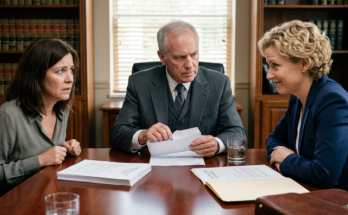
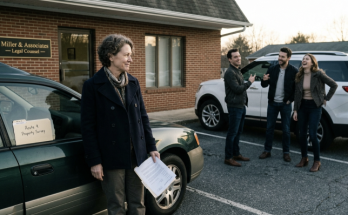
On Friday, we went to the lawyer’s office in town to sign the final papers.
Greg was there. He had brought his developer friends, and they had a new contract. It was thirty thousand dollars higher than Ben’s offer. Greg looked at us like we were children who didn’t understand arithmetic.
“This is your last chance,” Greg said, tapping the paper with his expensive gold pen. “You sign with Ben, and you’re throwing away thirty thousand dollars. For what? For some kid who wants to plant alfalfa?”
Harold didn’t look at Greg. He didn’t look at the developers. He leaned heavily on his wooden cane, reached out his thick, scarred hand, and took the pen from the lawyer.
He signed his name on Ben’s deed.
“There’s a covenant in there, Greg,” the lawyer said, adjusting his glasses. “The north fence line cannot be altered. The walnut tree and the surrounding enclosure are protected in perpetuity. The buyer insisted on it.”
Greg stood up so fast his chair scraped against the linoleum. “You old fools,” he muttered. He grabbed his leather folder and stormed out of the room, his friends following close behind.
We moved into our new cottage in town last month. It’s a small place, with no stairs and a little porch where Harold can sit without hurting his knees.
Yesterday, Ben sent a photo to my phone.
He had painted the little square fence a clean, bright white. The old iron latch had been cleaned of its rust, oiled, and fastened securely back in place.
I showed the picture to Harold. He stared at the screen for a long time, his thumb tracing the white fence on the glass.
Then, he looked up at me. He didn’t say Tommy’s name. He didn’t have to.
“He did a good job on that paint,” Harold said.
He smiled, and for the first time in forty-one years, his eyes looked clear. We win, and then it’s just a Tuesday again, but the silence doesn’t feel so heavy anymore.