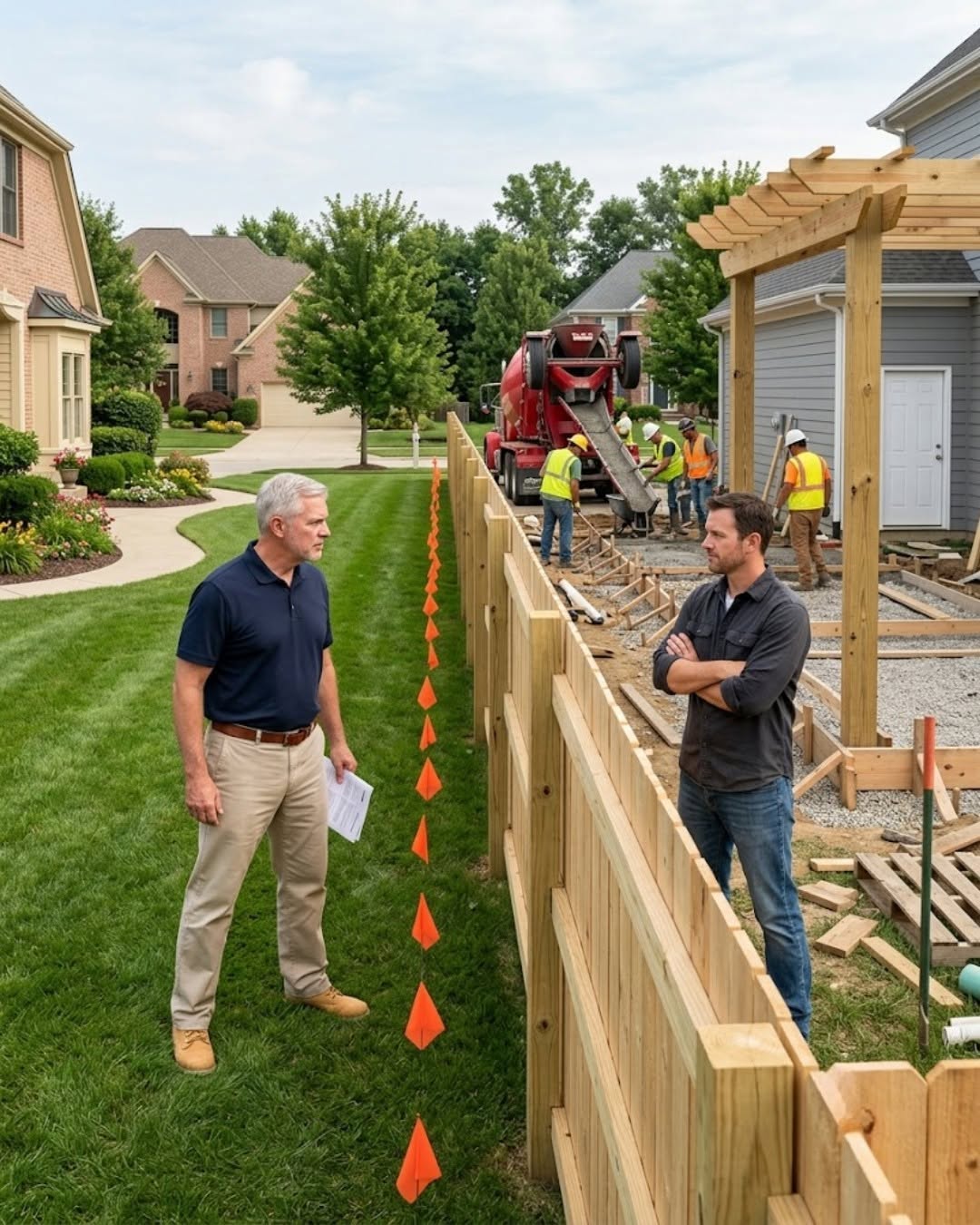
The first cedar post of the new fence sat exactly eight feet inside my property line, its raw, yellow-white wood looking like a stake driven into the lawn.
Through the open window, the sharp, sweet smell of fresh-cut wood drifted over the stove where I was frying eggs.
Emma dropped a heavy textbook into her blue duffel bag on the kitchen table. “Mom, why are those men digging holes in our grass?”
I turned the heat down on the burner and adjusted my glasses, pushing them up the bridge of my nose.
“They must be starting Tyler’s fence. He mentioned he wanted some privacy back there.”
“Privacy on our side of the lilac bushes?” Emma twisted her silver ring around her finger,
her brow furrowing as she leaned against the counter. “That doesn’t look right at all.”
“I am sure it is just a misunderstanding,” I said, though my chest felt tight.
“Tyler is a commercial real estate agent, so he knows how these things work.”
“He knows how to take whatever he wants,” Emma said, zipping her bag with a sharp yank.
“You need to go out there before they dig any more holes.”
I looked at the three workers in the yard, their shovels biting into the turf I had mowed myself for eleven years.
The main question was whether a professional surveyor would confirm my memory of where my land actually ended, or if I had been mistaken all this time.
That afternoon, the lawn was dry enough for the first cut of the week. I pulled the starter cord on my green mower and guided it along the familiar path near the edge of the property.
The engine roared, but I had to cut the throttle and pull the machine to a halt eight feet short of my usual turning spot. The newly completed cedar fence, solid and smelling of fresh sap, blocked my path like a wall.
I stood there behind the vibrating mower, looking at the pristine cedar boards that stretched from the back corner of Tyler’s house all the way to the edge of my garden shed. A fence like this, custom-built and sturdy, easily cost eighty-two hundred dollars.
My mind kept returning to the cost of a proper county survey, which my friend at the library told me would run about nine hundred and fifty dollars.
If I paid that money, would the surveyor find that the new fence was actually sitting on my property?
The silence after I shut off the mower engine was heavy, broken only by the sound of a car door shutting next door. Tyler was home.
He was lifting two plastic grocery bags out of the back of his clean SUV when I walked over to the edge of his asphalt driveway.
“Hi, Tyler,” I said, keeping my voice level and slow. “I wanted to talk to you about the new fence. It seems to have come quite a bit over onto my lawn.”
Tyler did not look up immediately; he adjusted his grip on the bags and jingled the loose change in his pocket, a fast, metallic rhythm. “Joan, great to see you. The fence is top-notch, isn’t it? Cedar, seventy-two inches, absolute peak curb appeal. It really elevates the whole block’s valuation.”
“It is very nice,” I said, adjusting my glasses again. “But it appears to be eight feet past our actual boundary line.”
“The contractors used the county plat map and their own digital layout,” he said, speaking in a rapid-fire clip that left no room for pause. “They are licensed professionals, Joan. They don’t make mistakes like that. It is all about maximizing the footprint.”
“I have lived here eleven years, Tyler, and my lawn has always gone all the way to the old telephone pole.”
“The old markers are usually wrong anyway,” he said, taking a step toward his side door. “Trust the digital plots. They are accurate to the inch.”
“I might have to call a county surveyor to verify,” I said.
Tyler stopped, his fingers tightening on the grocery bags. “Fences end up a little off all the time, Joan.”
He turned his back and walked inside his house, the change in his pocket jingling with every step.
In the living room after dinner, the evening light was fading, casting long shadows across the carpet. Emma had cleared the kitchen table and sat on the sofa with our old leather-bound photo albums spread open.
“Look at this one from my seventh birthday,” Emma said, pointing to a glossy print of her in a bright yellow sundress. “You can see the garden shed and the old oak tree.”
I sat beside her and took the photograph, holding it close to the lamp to study the background. In the frame, the old wooden swing hung from a thick branch of the oak tree, its thick hemp ropes worn gray by the weather.
“That swing has been there since Emma was six years old,” I said softly, my finger tracing the edge of the wooden seat in the photo.
“It’s still there,” Emma said, her voice dropping as she looked toward the backyard window. “But you can’t get to it now.”
I stood up and walked to the sliding glass door, looking out into the dim yard.
The thick oak branch reached out over the new lawn boundary, and the wooden swing hung motionless, trapped on the wrong side of the high cedar boards.
Carl Henderson did not look at the wooden swing trapped behind the new cedar fence. He dragged a heavy yellow metal locator through the tall clover near my garden bed, the machine giving off a low, rhythmic hum that ticked like an old kitchen clock. I watched him from the edge of my patio, holding my coffee cup with both hands to keep them steady.
“There should be an iron pin right about here,” Carl said.
His voice was a low, gravelly drawl that sounded like stones sliding down a wooden chute. He stopped, wiped his forehead with a faded blue handkerchief, and stuffed it back into his rear pocket.
“The county records show the original parcel was split in nineteen seventy-four,” I said, adjusting my glasses on my nose.
Carl did not answer right away. He turned a black dial on his machine and swept the plastic disk back and forth over a patch of wet dandelions. He shook his head, his brow furrowing as he looked at the display.
“These new digital maps the county uses are always half a yard off,” Carl muttered. “They rely on satellites instead of getting their boots dirty in the grass. You cannot find a true corner from space.”
The steady hum spiked into a sharp, high-pitched squeal that made me step back.
“Found it,” Carl said.
He knelt in the damp grass, pulled a small hand trowel from his canvas bag, and began to scrape away the thick sod. I stood close to his shoulder, watching his calloused fingers dig into the dark Ohio clay until they scraped against something hard and rusted.
It was the top of an old iron pipe, no wider than a quarter, buried three inches deep.
“Is that the actual corner of my property?” I asked.
Carl pulled a heavy steel tape measure from his belt and hooked its brass end to the rusted pipe.
“This is the southeast corner pin,” he said. He walked toward the new cedar fence, letting the steel tape hiss out of its metal case. “Now we see where eighty-two feet puts us.”
He stopped well before he reached the cedar boards. The yellow tape measure stretched tight between his hands, hovering six inches above the green grass. Carl looked down at the numbers on the tape, then looked up at the heavy cedar posts Tyler Bennett had set into the ground.
“The fence is eight feet inside your line,” Carl said.
My stomach tightened. “Eight feet?”
“Eight feet and four inches, to be exact,” Carl said. He made a pencil mark on a yellow notepad. “But I need to run the line from the front pin near the road before I can sign off on a certified survey.”
“How long does that take?” I asked.
“I will have the official drawings ready by Thursday afternoon,” Carl said, hooking the tape measure back onto his leather belt. “I have to verify the road easement first.”
“Thank you, Carl,” I said.
He picked up his metal locator and walked toward his truck, his work boots sinking slightly into the soft earth. I stayed by the rusted pin, looking at the distance between the iron pipe and the raw, sweet-smelling cedar wood.
Emma was sitting at the kitchen table when I walked inside, a cardboard box of college textbooks resting on the chair beside her. She was twisting her silver ring around her thumb, her eyes fixed on the white paper tax assessor map I had spread across the Formica.
“If the pin is there, then Tyler built the whole thing on our grass,” Emma said.
“Eight feet of it,” I said.
I pointed to the county map, where our house was drawn as a neat rectangle with a dotted line marking the property boundary. Beside the drawing, I had written Carl’s preliminary measurement of eighty-two feet in blue ink.
“He must have known,” Emma said, her voice rising with that quick energy she got when she was anxious about leaving home. “You don’t just accidentally miscount by eight feet, Mom.”
“He had a contractor do it,” I said, trying to keep my voice even. “It was probably just an honest mistake.”
“A mistake that takes away our swing?” Emma asked.
She stood up and walked to the kitchen window, looking out at the bright cedar wood that blocked our view of the old oak tree.
“We need to tell him today,” Emma said.
“I want to speak with a lawyer first,” I said. “Just to make sure I understand the deed.”
Emma turned back to the table, her finger tracing the edge of the cardboard box.
“A lawyer is going to cost money we don’t have, Mom,” she said.
“Nine hundred and fifty dollars for the survey is already gone,” I said, folding the paper map into a neat square. “But we cannot leave this alone.”
“What if he won’t move it?” Emma asked.
“We will see what the lawyer says,” I said, placing the folded map into my purse.
“You have to stand up to him,” Emma said, her voice dropping. “He is just going to keep pushing if you don’t.”
“I am going to handle it,” I said, though my hands were cold.
The office of Monroe and Associates sat between a pediatric dentist and a dry cleaner in the brick strip mall on State Route Three. Inside, the air smelled of old paper and carpet cleaner.
Rachel Monroe took the folded tax assessor map from my hand and laid it next to a copy of my property deed. She was forty-eight, with sharp grey eyes and a navy blazer that looked freshly pressed.
“Your deed is very clear, Mrs. Miller,” Rachel said. She tapped her silver pen on her notepad with a steady, rhythmic click. “The boundary line runs straight from the iron pin at the road to the pin Carl found in your backyard.”
“So the fence is definitely on my property?” I asked.
“Based on these preliminary numbers, yes,” Rachel said. “But a preliminary measurement is not a legal document. We need Carl’s certified survey before we can take any formal action.”
I adjusted my glasses on my nose, my throat suddenly dry. “What kind of action?”
“A formal letter demanding they remove the encroachment,” Rachel said. She stopped tapping her pen and wrote a quick note on her pad. “If he refuses, we file for an injunction in county court.”
“I don’t want to go to court,” I said. “Tyler seems like a reasonable young man. He just bought the place.”
Rachel sighed, looking out the window of her office toward the parking lot.
“Our local zoning officials are incredibly slow to respond to these kinds of permit violations,” she said, her voice carrying a quiet edge of frustration. “If we wait for the county to act, the fence will be the least of your worries.”
“What do you mean?” I asked.
“People can surprise you when eighty-two hundred dollars of cedar fencing is on the line,” Rachel said.
She slid the deed back across the desk toward me.
“Talk to him tonight,” Rachel said. “But do not sign anything he gives you, and do not make any deals without me looking at them first.”
“I just want to show him the numbers,” I said.
“Just remember,” Rachel said, leaning forward. “The law does not protect people who sit on their rights.”
“I understand,” I said.
“Call me as soon as Carl delivers the certified survey,” Rachel said, her silver pen hovering over her pad.
Tyler’s silver SUV was idling in his gravel driveway when I walked over, the headlights throwing long yellow beams across the lawn. He was lifting a blue plastic cooler from the back seat, his movements quick and efficient.
“Tyler,” I said, stopping at the edge of the asphalt.
“Joan, hey,” he said, shutting the car door with his elbow. He wore a golf shirt with a small logo on the chest, and his pockets jangled with the sound of loose coins. “Fabulous evening, isn’t it? I was just getting some things ready for the weekend.”
“I wanted to talk to you about the fence,” I said, holding out the yellow notepad where I had written Carl’s measurements. “The surveyor was out this morning.”
Tyler did not look at the notepad. He leaned against the side of his SUV and smiled, his teeth very white in the twilight.
“Oh, the surveyor,” Tyler said, his words coming in a rapid-fire rush. “Great guys, very thorough. But you know how those old county maps are, Joan. They use technology from the dark ages. It is all about modern parcel optimization these days.”
“He found the original iron pin,” I said, my voice sounding small even to me. “The fence is eight feet onto my side.”
Tyler let out a short, easy laugh that did not reach his eyes.
“Fences end up a little off all the time, Joan,” he said. He reached into his pocket, his hand moving as he jangled his loose coins. “It is a standard margin of error in residential developments. We are talking about a few inches of grass.”
“It is eight feet,” I said. “And it blocks the wooden swing.”
“Tell you what,” Tyler said, picking up his cooler. “Once the pool excavation starts next week, we will get some landscaping in there. A few nice arborvitae will make that line look completely seamless. It is a win-win for both of our properties.”
“But the fence needs to be moved,” I said.
“Moving a cedar fence like that is a ten thousand dollar headache,” Tyler said, already stepping toward his side door. “Let’s not get bogged down in technicalities when we are trying to build a beautiful neighborhood here.”
He turned his back to walk inside his house while jingling the coins in his pocket.
The metal tip of Carl Henderson’s brass surveying pole clinked against a buried iron pin at eight o’clock the next morning.
Carl, the retired county surveyor, bent down and wiped his brow with a blue handkerchief. He spit a stream of dark tobacco juice near the base of my lilac bush.
“Found the original northwest corner pin,” Carl said in his low, gravelly drawl. “It is exactly where the county parcel plat map from 1974 said it would be.”
He stood up, his joints popping in the quiet morning air, and unrolled the heavy paper map across the hood of his truck. He traced a faded blue line with a thick, calloused finger before walking back toward the new cedar fence.
“Your neighbor did not just miss the line by an inch or two,” Carl said, shaking his head. “This entire cedar run is eight feet inside your property.”
My hand went to my glasses, pushing them up the bridge of my nose. Seeing the actual distance marked out in black and white made my stomach tighten.
“Eight feet,” I repeated, my voice barely carrying over the sound of a distant lawnmower.
“Eight feet on the nose,” Carl said. He reached into his canvas bag and pulled out a bundle of wire stakes topped with square, orange plastic flags. “I am going to drive these into your grass every ten feet along the true legal boundary so there is no confusion.”
He walked the line with a heavy hammer, pounding the metal stakes into the sod. The bright orange plastic fluttered against the dark green of my lawn, creating a straight, artificial wall of warning signs just feet away from Tyler’s new fence.
I reached into my purse and pulled out the checkbook, writing a check to Carl for nine hundred and fifty dollars. My hand felt unsteady as I handed him the paper, the cost of his signature on the certified map representing three months of my grocery budget.
“You have the official seal on this map now, Joan,” Carl said, tucking the check into his flannel shirt pocket. “If he does not like it, he can hire his own man, but they will find the same iron pin.”
I took the rolled copy of the certified survey, the paper thick and stiff in my hands, and walked across the damp grass toward Tyler’s driveway. The orange flags seemed to glow in the morning light, drawing a sharp, jagged line through what I had always considered my peaceful sanctuary.
Tyler was standing on his front porch, a ceramic mug in his hand, watching me approach with a tight, practiced smile.
“Morning, Joan,” Tyler said, his voice loud and quick as he jingled the loose change in his pocket. “I see you hired some local muscle to play in the dirt.”
“This is the certified survey, Tyler,” I said, holding the rolled paper out toward him. “Carl Henderson found the original property pins. The cedar fence is eight feet inside my yard.”
Tyler did not reach for the paper. He took a slow sip of his coffee, his eyes tracking the row of orange flags fluttering in the breeze.
“Carl is using equipment from the seventies, Joan,” Tyler said, a small laugh escaping his nose. “My guys used a modern digital layout. A satellite does not lie.”
“The county iron pins do not move,” I said, my voice firmer than I expected. “The fence has to be moved back to the actual line.”
“Do you know what it costs to pull concrete footings and reset thirty panels of tongue-and-groove cedar?” Tyler asked, his eyes narrowing as he stepped down one porch stair. “We are talking thousands of dollars because of a clerical discrepancy.”
He turned his shoulder slightly, looking back toward his front door as if he had already spent too much time on the conversation.
“I am not looking at your paper, Joan,” Tyler said. “My contractor is pulling the permits for the next phase today, and we are moving forward.”
He walked back inside his house, the heavy wooden door clicking shut behind him before I could offer another word.
By two o’clock that afternoon, I was sitting in the quiet office of Rachel Monroe, the real estate attorney. Her office smelled of old paper and furniture polish, a sharp contrast to the fresh cut cedar scent that had taken over my backyard.
Rachel sat behind her dark walnut desk, tapping her silver pen on a yellow notepad as she studied the certified survey map.
“Carl Henderson is the best in the county,” Rachel said, her voice calm and measured. “His seal on this map means we have all the leverage we need for a court order.”
“He refuses to even look at it,” I said, adjusting my glasses as I watched her write. “He says his contractor is moving ahead with more construction.”
“Then we make it official,” Rachel said, her pen stopping. “I am going to draft a formal letter demanding the immediate removal of the fence from your property.”
She pulled a fresh sheet of letterhead from her drawer and began typing, the sound of the keys filling the quiet room.
“We will give him ten days to respond to the demand,” Rachel said, looking up at me over her reading glasses. “If he ignores this, we file for an injunction to halt any further work on his side of the line.”
I felt a cold weight settle in my chest as I watched her sign the bottom of the page with a thick black stroke. The quiet, predictable life I had built after my divorce was slipping away, replaced by registered mail and legal threats.
“How much will the injunction cost?” I asked.
“Fifteen hundred dollars for the retainer,” Rachel said, folding the letter into a crisp white envelope. “But we have to establish that you are protecting your boundary immediately.”
I took the envelope from her hand, the paper feeling heavy, and drove back home with the window rolled down to let the warm afternoon air clear my head.
When I pulled into the driveway, Emma was waiting on the front porch, her fingers twisting her silver ring around and around.
“A flatbed truck just backed down his driveway, Mom,” Emma said, pointing toward the side yard. “They are unloading giant wooden beams.”
We walked around the side of the garage together, the grass still holding the deep tracks from Carl’s truck from earlier.
Three construction workers in dusty boots were lifting heavy, pressure-treated cedar posts from the back of a flatbed. They were stacking them in a neat pile right next to the disputed fence, well within the eight-foot strip of my lawn.
“They are building a pergola,” Emma said, her voice rising with a quick, nervous energy. “It is going to cover the whole side of his patio, right over your grass.”
One of the workers carried a heavy post toward the orange surveyor flags, tossing it onto the grass with a dull thud that shook the ground.
“Excuse me,” I called out, taking a step toward the fence. “Those orange flags are legal boundary markers.”
The worker did not look up. He picked up a shovel and began marking out a square on the turf, his spade cutting through the roots of my hostas.
“We just follow the layout on the permit drawing, ma’am,” the worker said, pointing toward a white clipboard sitting on the hood of the truck.
Emma took my hand, her grip tight and cold.
“Mom,” Emma whispered. “He is doing this on purpose. He is trying to build it before anyone can stop him.”
I looked at the bright orange flags fluttering in the row, then at the heavy cedar beams stacked on my lawn.
“I am not going to let this slide, Emma,” I said, my voice steadying as I looked at the worker cutting into my grass.
The worker reached into his truck bed and lifted a heavy pneumatic tool, connecting it to a noisy yellow compressor that sputtered to life with a roar.
The sound of a nail gun firing on the other side of the cedar fence echoed across the yard.
The cedar boards were already up, blocking the morning light from reaching the hostas along my foundation. Tyler Bennett stood on my side of the orange plastic flags, tipping a plastic bag of dark hardwood mulch onto the grass I had mowed for eleven years. The smell of damp wood chips filled the air, thick and sweet, competing with the scent of fresh-cut cedar from his new fence.
“Tyler, that is my grass,” I said, stepping closer to the line of orange markers Carl Henderson had set.
He did not stop pouring. He gripped the bottom corners of the bag, shaking the last of the black shreds onto the lawn, burying the thin wire stems of the surveyor flags under a heavy, dark mound.
“It is a finished edge, Joan,” he said, tossing the empty plastic sack onto his patio steps. “My contractor said we need to grade the runoff, or the new pool patio will drain right into my crawlspace. I am just leveling the low spots.”
“The survey shows the line is eight feet back,” I said, my voice shaking slightly as I adjusted my glasses. “You need to move the fence.”
Tyler took a step toward me, his hands deep in his pockets. The sound of loose coins jingling in his khaki trousers was sharp in the quiet morning air. He shook his head, a quick, dismissive twitch.
“I am not moving eight thousand two hundred dollars of custom cedar because of some rusty pins in the dirt,” he said. “Do you have any idea what that would cost me? The labor alone would run three thousand. I am not doing it.”
“It is my land, Tyler,” I said, pointing to the tip of an orange flag still poking through his mulch.
“Take another step and I will call the cops, Joan.”
He took his phone out of his pocket and tapped the screen with his thumb. He did not look up when he spoke, his thumb hovering over the glass.
“You are trespassing on an active construction site,” he said, his voice flat and hard.
“This is my yard,” I said, but my voice came out thin, barely louder than the rustle of the empty plastic bag.
He did not answer. He simply held the phone near his ear, his eyes fixed on my face, waiting to see if I would cross the invisible line he had drawn with his mulch.
I stepped backward, my sneakers slipping slightly on the loose wood chips. I turned and walked toward my back porch, my shoulders tight, expecting to hear his boots on the grass behind me.
I went inside and filled a glass with cold tap water, but my hand shook so hard the water sloshed over the rim onto the counter. I wiped it with a yellow dish towel, trying to slow my breathing.
Emma sat at the kitchen table, a half-empty box of packing tape sitting next to her college trunk. She turned her silver ring around her finger, her eyes fixed on my hands.
“What did he say to you?” Emma asked.
“He said he would call the police,” I said.
I sat down opposite her and pressed my palms flat against the wooden table to keep them still. The thought of a squad car parking in front of my house, the neighbors watching from their windows, made my chest feel tight. I had spent eleven years building a quiet, respectable life here after my divorce, and the idea of becoming the subject of neighborhood gossip felt like a physical weight.
“He is trying to scare you, Mom,” Emma said, her voice rising with that quick, sharp energy she used when she was anxious. “He cannot have you arrested for standing on your own lawn. You have the survey map right there.”
“He looked so sure of himself,” I said, adjusting my glasses. “He had his phone out, Emma. He was going to dial.”
“We need to call Rachel,” Emma said, reaching for her own phone. “Right now. We cannot let him think he can bully us.”
“I do not want a scene,” I said, looking out the kitchen window at the blank cedar boards. “I have lived here eleven years without a single cross word with anyone on this block. Now I feel like a prisoner in my own kitchen.”
“He is counting on that,” Emma said. She reached across the table and touched my wrist, her fingers warm and steady. “He thinks you will just let him have the eight feet because you do not want to fight. He is a salesman, Mom. He uses pressure.”
“I spent nine hundred and fifty dollars on that survey,” I said, looking at the blue lines on Carl’s map sitting near the toaster. “That was my grocery money for two months.”
“Then let Rachel do her job,” Emma said. “That is what we are paying her for.”
Rachel Monroe did not look up from her legal pad when we walked into her office. She tapped her silver pen on her notepad, three quick clicks, before gesturing for us to sit. The small office in the brick strip mall smelled of old paper and cold coffee, a quiet place that felt miles away from the noise of Tyler’s backyard construction.
“The police will not arrest you, Joan,” Rachel said, her voice dry and steady. “Property line disputes are civil matters. If Tyler Bennett calls the non-emergency line, the dispatcher will tell him to hire a surveyor or a lawyer.”
“But he was so aggressive,” I said. “He said I was trespassing.”
“He is trying to build a fence and a sixty-four thousand dollar pool before we can get a hearing,” Rachel said. “It is a common tactic in real estate development. If the concrete is already poured, judges are sometimes reluctant to order a full demolition because of the economic waste.”
“So what do we do?” Emma asked, leaning forward in her chair, her hand twisting her silver ring again.
“We document everything,” Rachel said. “Every post they sink, every bucket of dirt they move. I want you to take photos of the backyard three times a day. Morning, noon, and evening.”
She wrote a phone number on a small white slip of paper and pushed it across the desk toward me.
“This is the direct line for the county building inspector,” Rachel said. “His name is Miller, no relation to you. Call him first thing tomorrow and ask about the pool permit.”
I took the paper, my fingers tracing the handwritten numbers.
“Will they actually stop him from building?” I asked.
“If he is violating his setback requirements, they have to,” Rachel said. “But we need to prove he is doing it knowingly. Otherwise, he will just claim it was a contractor’s mistake and ask for a variance after the fact.”
“How do we prove he knew?” Emma asked.
Rachel tapped her pen again, her eyes narrowing slightly as she looked at the window.
“We start with the permit records,” Rachel said. “I will need to request his original application files from the city zoning office. That will take some time, and it will require a formal records request.”
“How much time?” I asked.
“A week, maybe two,” Rachel said. “In the meantime, keep your camera ready. Do not let him see you looking afraid.”
The sun was low behind the maple trees when I walked out onto my back porch with my digital camera. The air was still warm, smelling of fresh sawdust and the damp, dark mulch Tyler had spread over my grass.
On the other side of the cedar fence, the wooden framing for the pool deck was already taking shape. Heavy yellow pine joists were bolted together, extending several feet past the orange surveyor flags Carl had driven into the ground. It was clear they were planning to pour the concrete right up to the new fence line.
I raised the camera and pressed the shutter button, the quiet click sounding loud in the quiet evening. I took a picture of the joists, then another of the orange flags buried under the black mulch.
“Are you enjoying the view, Joan?”
Tyler was standing on his concrete patio, a red plastic cup in his hand. He had his sleeves rolled up, his watch catching the last orange rays of sunlight as he stood near his patio table.
“I am just taking some photos for my records, Tyler,” I said, keeping my voice as steady as I could.
He walked slowly down his patio steps, his leather shoes crunching on the gravel path his workers had laid. He stopped two feet from the cedar fence, his face visible through the narrow gap between the end post and my house.
“You are wasting your time,” he said, jingling the coins in his pocket. “The pool contractor is coming on August fifteenth. That concrete is getting poured whether you like it or not.”
“The survey says this is my land,” I said, pointing the camera toward the fence line.
“Your survey is wrong,” Tyler said, his voice dropping to a low, hard pitch. “And if I catch you taking pictures of my house again, I will make sure the county sheriff handles it.”
He did not move. He stood there by his patio, his arms crossed over his chest, glaring at me through the gap in the wood.
My chest felt tight, the weight of his stare pushing me back toward the house. I lowered the camera, my fingers cold against the plastic grip.
I retreated back into my kitchen and locked the sliding glass door.
The legal pad on Rachel Monroe’s desk remained blank while I wrote out the check. My hand felt stiff, but I managed to sign my name on the bottom line, committing fifteen hundred dollars of my savings to a fight I had never wanted.
Rachel picked up the check, turned it over, and slid it into a yellow folder. She adjusted her reading glasses and looked at me with her usual calm.
“This retainer covers our initial filings, Joan, but we are going to need more than just your surveyor’s report to stop him,” Rachel said.
I adjusted my own glasses, pushing them up the bridge of my nose. “What else could we possibly need when Carl’s orange flags are sitting right there on my grass?”
“We need to see what he told the county before he started digging,” Rachel said. “I want the municipal permit files for his property, specifically the site plans for the pool and the fence.”
“Can you just call the zoning office and ask for them?” I asked.
“They will take their time for an attorney,” Rachel said, closing her folder with a quiet snap. “But you are a taxpayer. Go down to the county records office in town, stand at the desk, and do not leave until they hand you the complete physical file.”
By noon, the humidity inside the county records building felt twice as heavy as the air outside. The fluorescent lights overhead hummed a low, irritating note that made my temples throb.
The clerk behind the counter, a woman named Martha with a faded name tag, did not look up from her computer screen when I approached. She had a stack of manila folders to her left and a half-eaten bran muffin on a paper napkin to her right.
“I need to request the building permit files for twenty-four West Maple Drive,” I said, my voice sounding smaller than I intended.
Martha clicked her mouse twice, very slowly. “Property owner name?”
“Tyler Bennett,” I said.
“That file is currently in the active review bin,” she said, finally looking at me. “You will have to file a written public records request and wait ten business days.”
“I have the right to view active permit files under the municipal code,” I said, remembering Rachel’s exact instructions. “I am an adjacent property owner, and construction is already underway.”
Martha stared at me for five long seconds, then let out a heavy sigh that blew a loose crumb off her napkin. She stood up, her knees making a loud cracking sound, and walked through a heavy grey door into the back room.
I stood at the counter for twenty minutes, watching the minute hand on the wall clock tick toward twelve-thirty. A man in a dirt-stained safety vest came in, leaned against the far wall, and started scrolling on his phone.
When Martha returned, she carried a thick, blue plastic binder with a metal latch. She dropped it on the counter with a heavy thud that kicked up a small cloud of paper dust.
“You can look at it here,” she said, sliding a yellow notepad and a stubby pencil toward me. “No taking pages out, and no phone cameras.”
I opened the binder, my fingers slipping on the plastic cover. The first dozen pages were standard plumbing and electrical specifications, filled with numbers and technical terms that made no sense to me.
But near the back of the binder, tucked behind a yellow divider, was a large, folded blueprint of Tyler’s backyard layout. I unfolded it carefully, my eyes searching for the property lines.
The drawing showed his house, his proposed concrete pool, and the cedar fence. It looked clean and official, but I needed a copy of the actual signed site plan to prove what he had submitted.
“I need copies of these three pages,” I told Martha, pointing to the blueprint and the two pages of application text behind it.
She shook her head without looking up. “The copier is for staff use only, and there is a fee of fifty cents per page.”
I pulled a five-dollar bill from my purse and laid it flat on the counter. “I have the cash, and I am happy to wait.”
Martha took the bill, grabbed the three pages, and walked over to a grey copy machine in the corner. She took her time, aligning each page perfectly on the glass before pressing the start button.
When I got home, Emma was in the dining room, sorting her college textbooks into two neat piles on the table. She looked up when I let the screen door click shut behind me.
“Did you get them?” she asked, her eyes wide.
“I have the copies right here,” I said, laying the warm paper on the mahogany table.
Emma dropped a heavy biology textbook and came over, her silver ring twisting rapidly around her middle finger. She helped me smooth out the creases on the copied blueprint.
“Look at the date on the bottom,” Emma said, pointing her finger at the title block in the corner. “He submitted this three months ago, before he even closed on the house.”
“He was planning this pool while the house was still empty,” I said, leaning closer to read the small print.
The blueprint showed a clear black line labeled as the eastern property boundary. Right next to it, written in neat draftsman’s lettering, were the words eight-foot easement.
“Mom,” Emma said, her voice dropping to a whisper. “Look at the signature line on the second page.”
At the bottom of the application form, right below a paragraph warning about the penalties for submitting false zoning information, was a signature. The ink was dark and bold, written with a heavy hand.
“He signed this drawing himself, which means he knew,” I said.
“He knew exactly where the line was before he ever dug the first hole,” Emma said, her ring clicking against her fingernail. “He knew he was taking your grass.”
“I am calling Rachel,” I said, reaching for my purse.
The sun was setting by the time I walked back into Rachel’s office, the air conditioning blowing cold air across my neck. Rachel was alone at her desk, her desk lamp casting a sharp circle of light over her paperwork.
She took the copied pages from my hand and laid them flat under the lamp. She did not say a word for three minutes, her eyes scanning the lines of the blueprint and the signature page.
“This is his personal signature,” Rachel said, her voice quiet and steady. “He verified under penalty of perjury that the site plan was accurate to his deed.”
“But the fence he built is eight feet past that line,” I said, adjusting my glasses. “He told me it was just a contractor’s mistake.”
“He lied to you, Joan,” Rachel said. “And he lied to the county zoning inspector.”
She pointed her finger at a small detail on the blueprint near the edge of the proposed pool deck. There was a hand-drawn alteration on the copy, a tiny pencil mark that moved the pool edge closer to my yard.
“He knew his pool would not fit the setback requirements if he kept the fence on the true line,” Rachel said. “So he moved the fence to create a false boundary on the ground, hoping you wouldn’t notice until the concrete was poured.”
“Can we stop him?” I asked.
Rachel reached for her silver pen on the desk organizer. “With this signed application, we have proof of willful encroachment. The county can freeze his permit tomorrow morning.”
“Will Tyler try to buy the disputed strip of land to save his project?” I asked, looking at the drawing.
Rachel did not answer right away. She placed her silver pen firmly on the blueprint, right over Tyler’s signature.
By nine the next morning, I was retrieving my empty green trash bin from the curb when Ashley, Tyler’s wife, stepped across the damp grass toward me. She was holding a shallow wicker basket filled with heavy, dark red tomatoes, their skins dusty with soil.
“The heat is turning them all at once,” Ashley said, her voice dropping to a near whisper as she held the basket out. “I cannot use them fast enough.”
I took the basket, its wooden handle rough against my palm. The tomatoes smelled of warm vines and split earth, reminding me of the garden my mother used to keep behind her house in Toledo.
“Thank you, Ashley,” I said, adjusting my glasses on my bridge. “That is very kind of you.”
She looked back at their garage, where the metal door was half-open, revealing stacks of folded cardboard boxes and a plastic lawn mower.
“I wanted to apologize for the tension lately,” she said, her voice dropping another octave. “Tyler gets very focused on his projects. He has a lot of people pushing him on this one.”
“The pool project?” I asked.
“The contractors have a strict window,” she said, her fingers tightening around the edge of her shirt. “If they do not pour the concrete by the middle of August, they forfeit the deposit to the next job on the list.”
I looked down at the bright red tomatoes in the basket, their skins smooth and warm.
“That sounds like a tight schedule,” I said.
“It is twenty-two thousand dollars if we lose the slot,” she said, then quickly pressed her hand to her throat as if she had revealed a family secret. “Anyway, he really wants to make things right with you.”
She turned and walked back toward her porch, her steps quick and silent on the lawn.
The noon whistle from the county courthouse was still echoing when Tyler walked up my porch steps. His hands were shoved deep into his khaki pockets, and the rapid, metallic clinking of quarters and dimes started before he even reached the top landing.
“Joan, great to see you,” Tyler said, his words coming out in a fast, practiced rhythm. “I wanted to touch base on a very exciting development for both of our properties.”
I stood behind the screen door for a second, then pushed it open and stepped out onto the porch.
“What sort of development, Tyler?” I asked.
“I was talking to my landscape supervisor this morning,” he said, jingling the coins faster. “We are talking about a premium grade Kentucky bluegrass sod package. We want to roll it out across your entire side yard, from the cedar line right up to your flower beds.”
He leaned against the wooden railing, gesturing toward the dry, patchy turf near the fence.
“It is a high-end turf upgrade, fully irrigated and fertilized,” he said. “Normally, a job like that runs about three thousand dollars, but I am absorbing the entire cost as a gesture of goodwill.”
The offer sounded incredibly generous, almost enough to make me forget the blueprint Rachel had shown me the night before.
“Why would you do that for free?” I asked.
“Because we are going to be neighbors for a long time, Joan,” he said, flashing a quick, bright smile. “We want to maximize the curb appeal for both parcels. It is a win-win.”
I looked past his shoulder toward the new fence, where my old wooden swing sat trapped on his side of the cedar boards.
“I would need to think about that,” I said slowly.
“Of course,” he said, backing down the steps. “But let us try to finalize things soon so we can get the crew booked before the August rush.”
Inside the kitchen, Emma was standing by the counter, slowly rotating her silver ring around her index finger as she watched the neighbor’s yard through the window.
“He is laying it on thick,” Emma said, her voice tight. “Did he mention the concrete pour date?”
“No,” I said, setting the basket of tomatoes on the table. “He just talked about the sod.”
“He is trying to buy you off, Mom,” she said, finally turning to face me. “He knows Rachel has the permit files, and he is terrified you are going to block the construction.”
“It would save us a lot of trouble if we just let him do it,” I said, pulling a chair out. “Nine hundred and fifty dollars for a survey is already gone. If he fixes the grass, maybe we can just live with the fence where it is.”
“You are letting him win because you hate arguing,” she said, her voice rising with that quick, youthful energy. “He took eight feet of our yard. You cannot just trade eight feet of land for a couple of rolls of grass.”
“It is not just grass, Emma. It is peace.”
“It is not peace if he lied to get it,” she said.
She turned back to the window, watching a small yellow county truck slow down as it drove past Tyler’s driveway. The driver, a man in a neon vest, seemed to be looking at the new fence line before he accelerated and moved down the street.
“Did you call the county, Mom?” Emma asked, her eyes following the yellow truck.
“No,” I said, my chest tightening. “I haven’t called anyone but Rachel.”
“Well, someone did,” Emma said. “That is the second code enforcement vehicle I have seen today.”
The shadow of the new cedar fence had stretched across the entire lawn by the time I walked out to the boundary line after dinner. The scent of the fresh-cut cedar wood was heavy in the humid air, mixing with the smell of the damp earth where the orange plastic flags still stood in a neat row.
Tyler was already there, leaning against one of the thick cedar posts with a black clipboard tucked under his arm.
“Beautiful evening, isn’t it?” he said as I approached. “Look, I went ahead and drew up the paperwork for the sod crew so we can get them scheduled.”
He slid a single white sheet of paper from beneath the clip and held it out to me, along with a heavy black pen.
“What is this?” I asked, taking the paper but leaving the pen in his hand.
“Just a standard helper agreement,” Tyler said, his voice smooth and reassuring. “We just want to be good neighbors and settle this quietly.”
I looked down at the document, my eyes catching the bold heading at the top of the page. It read Permanent Easement and Boundary Waiver.
“This says I agree to let the fence stay where it is,” I said slowly.
“It just formalizes the grass deal, Joan,” he said, jingling the loose change in his pocket. “It saves us both from dealing with city hall.”
I stared at the black signature line at the bottom of the page, where my name was already typed out in neat, block letters.
I set the unsigned paper back on Rachel Monroe’s desk, right next to her yellow legal pad.
Rachel did not pick it up. She looked at the signature line where Tyler Bennett had already scribbled his name in blue ink.
“Do not sign that, Joan,” she said.
“He said it was just a neighborly gesture to clean up the yard,” I said, choosing my words slowly.
“It is an easement,” Rachel said, her voice flat and measured. “If you sign this, you are giving him legal permission to keep his cedar fence eight feet inside your property line forever.”
She pulled a fresh manila folder from her drawer and opened it. Inside was the certified copy of Tyler’s original building permit application that we had retrieved from the county records office.
“We are filing a formal complaint with the county zoning board of appeals this morning,” Rachel said. “We have the proof now.”
She pointed to the second page of the permit application, where a detailed site plan showed the exact legal boundary line. Tyler’s signature sat directly underneath the drawing, dated three months ago.
“He signed this drawing himself, which means he knew,” Rachel said.
“He told me it was a contractor mistake,” I said, adjusting my glasses. “He stood on my driveway and swore the fence company made a measurement error.”
“He lied to you,” Rachel said. “He knew exactly where the line was when he built that eighty-two-hundred-dollar fence. He was trying to take your land before you noticed.”
She began typing on her computer, her fingers moving in a steady, rhythmic click.
“I am drafting the emergency complaint now,” she said without looking up. “We will request an immediate inspection of the pool site.”
“How long does the county take to review these things?” I asked.
“Usually three to five business days,” Rachel said. “But I am marking this as an active encroachment.”
I stood up and reached for my handbag.
“What do I do if his workers keep digging?” I asked.
“Document everything,” Rachel said. “Take photos from your porch. Do not cross the line, and do not speak to Tyler.”
By noon, I was standing in my kitchen, watching the backyard through the window above the sink.
Emma was upstairs packing her second duffel bag for college, the sound of her closet door opening and closing sliding through the ceiling.
My cell phone rang on the counter, and I answered it on speaker.
“Joan, I just submitted the filing,” Rachel’s voice came through the small speaker. “The county clerk stamped it at eleven-fifteen.”
“Thank you, Rachel,” I said. “It feels quiet over there right now. The workers left an hour ago.”
“They might be waiting on materials,” Rachel said. “Just stay inside.”
A deep, rumbling vibration shook the window pane in front of me.
Down the street, a massive diesel engine roared, shifting gears as it approached the cul-de-sac.
I looked out toward the gravel driveway next door.
A heavy, three-axle concrete truck painted bright orange was backing slowly down Tyler’s driveway, its massive drum rotating with a wet, grinding sound.
“Rachel,” I said, my voice dropping. “There is a cement mixer here.”
“Are they pouring the pool deck?” Rachel asked.
“The drum is spinning,” I said. “They are backing right up to the cedar fence.”
“He is about to pour sixty thousand dollars of concrete on your land,” Rachel said.
I hung up the phone and walked out my back door.
The smell of wet stone and diesel exhaust filled the humid midday air.
A man in dirty yellow boots and a stained grey t-shirt was standing near the back of the truck, hooking a metal chute onto the rear of the rotating drum.
“Excuse me,” I said, walking toward the orange surveyor flags Carl Henderson had driven into my lawn.
The worker did not hear me over the roar of the engine. He unhooked a second metal extension and swung it toward the cedar boards.
“Excuse me,” I said louder, stopping two feet short of the flags.
The man looked up, wiping his forehead with the back of a gloved hand.
“Are you the contractor in charge of the pool?” I asked.
“I am the concrete foreman,” he said, squinting at me. “Jason. We are pouring the pool shell and the patio apron today.”
“You cannot pour concrete here,” I said, pointing to the orange plastic flags. “This fence is eight feet inside my property line.”
Jason looked at the flags, then at the cedar fence, then back at me.
“Mr. Bennett told us the permits were cleared,” Jason said. “He said the boundary dispute was resolved yesterday.”
“It is not resolved,” I said. “My attorney just filed an emergency complaint with the county zoning board of appeals this morning.”
Jason let go of the metal chute. It swung slightly, a drop of grey slurry dripping onto the grass.
“He told us you signed the easement,” Jason said.
“I did not sign anything,” I said. “If you pour that concrete, you are pouring it on my property, and you will have to dig it back up.”
Jason spit on the ground and pulled a heavy black cell phone from his back pocket.
“I need to call my boss,” he said.
I stood by the orange flags and watched him walk toward the cab of the truck, waving his arm at the driver to cut the engine.
The diesel roar died down to a low, idling thrum.
Inside Tyler’s house, the front door did not open, but I saw the blinds in his dining room window twitch.
I walked back to my porch and sat on the steps.
Emma came out a few minutes later, holding a roll of packing tape.
“Is that the concrete?” she asked, pointing at the massive truck sitting in the driveway.
“They are waiting,” I said. “I told the foreman about the survey.”
“Good,” Emma said, twisting her silver ring around her finger. “Do not let him pour that.”
We sat in silence for twenty minutes, watching Jason pace back and forth on the gravel.
At half past two, Tyler’s black sedan pulled into the driveway, stopping inches from the concrete truck’s front bumper.
Tyler got out of the car, slamming the door.
He did not look toward my porch. He walked straight to Jason, his hands moving rapidly as he spoke.
I could not hear the words over the idle of the truck, but Tyler’s face was red.
He reached into his pocket and began jingling his loose change, his shoulder jerking as he pointed toward the back of my yard.
Jason shook his head, holding his phone out to show Tyler something on the screen.
Tyler pushed the phone away and took a step closer to the foreman, his chest expanding.
Jason stepped back, pointing directly at the orange surveyor flags Carl had placed in my lawn.
Tyler looked at the flags, then turned his head toward my porch.
Our eyes met for three seconds.
He did not wave, and he did not smile.
He turned back to Jason and spoke in a rapid-fire burst, his hand gesturing toward the rotating drum of the concrete truck.
Jason shook his head again, then walked to the driver’s side of the cab and yelled something up to the driver.
The driver shook his head and gestured toward his watch.
Tyler reached into his coat pocket, pulled out a white envelope, and held it out toward Jason.
Jason did not take it. He folded his arms across his chest and walked toward the rear of his truck.
The loud warning beep of the concrete truck began echoing across both yards as the vehicle started to back up again.
The truck driver cut the engine, leaving a sudden, heavy silence across the two yards.
The man in the county uniform did not look up from the clipboard resting on the hood of his sedan. He was a tall, thin man named Mr. Henderson, a county code inspector who had spent thirty years looking at disputes just like this one. He adjusted his wire-rimmed glasses and squinted at the bright orange plastic flags Carl had driven into my lawn the week before.
“The permit application lists an eight-foot setback from the western boundary,” Mr. Henderson said, his voice flat and practiced.
I handed him the copy of the certified survey Carl had stamped for me. My fingers felt cold despite the morning heat, and I adjusted my own glasses, pushing them up the bridge of my nose. “The cedar fence is eight feet inside my line, Mr. Henderson. If they pour that concrete today, it will cover my property.”
He walked over to the wooden swing where Emma used to spend her summer afternoons. He took a yellow steel tape measure from his belt and hooked it to the bottom rail of Tyler’s new fence, walking the tape back toward the orange flags. The metal tape made a sharp, clicking sound as it pulled taut against the grass.
“This is eighty-four inches of encroachment,” the inspector said.
He didn’t look at me as he wrote the number down in a small black notebook. He took three digital photographs of the wooden swing, the fence posts, and the orange flags, his camera making a tiny electronic chirp with each snap.
“What happens to the concrete truck?” I asked.
“It waits,” Mr. Henderson said.
He walked past the cedar panels toward the driveway where Tyler stood with the pool contractor, Jason.
I stayed on my side of the orange flags, watching the three men gather near the rear of the big revolving drum of the concrete truck. Tyler was speaking rapidly, his hands cutting through the air as he pointed toward his house and then back toward the fence. I could hear the rhythmic clinking of the loose coins in his pocket, a fast, nervous rhythm that didn’t stop even when the inspector held up a hand.
“We have a signed variance from the previous owner,” Tyler said, his voice rising enough to carry across the grass. “It was grandfathered in when I bought the place.”
“Show me the approved variance on the county registry,” Mr. Henderson said.
“My attorney has the paperwork in his office,” Tyler said, stepping closer to the inspector. “We are scheduled for the pour today. Every hour that truck sits here costs me seven hundred dollars.”
Mr. Henderson reached into his leather portfolio and pulled out a heavy stapler and a sheet of thick, weather-resistant red cardstock. “The county records show no variance for this parcel, Mr. Bennett. The setback violation is clear on the face of your own application.”
“This is a minor contractor error,” Tyler said, his voice dropping into a tight, urgent whisper that I had to strain to hear. “We can adjust the final grade after the pool is finished. There is no need to delay the entire project over eight feet of grass.”
The inspector did not answer. He walked directly to the main cedar post that Tyler had set near my old wooden swing. He pressed the red cardstock against the wood and squeezed the stapler three times, the metal staples biting deep into the fresh cedar.
“You are officially under a stop-work order,” Mr. Henderson said, turning back toward his sedan. “Any further construction on this site before a formal hearing will result in a thousand-dollar daily fine.”
Tyler stood perfectly still beside the red sign, his hands jammed deep into his pockets. The concrete contractor, Jason, swore under his breath and climbed back into the cab of his truck, starting the engine with a loud diesel roar that made the ground beneath my feet vibrate.
I walked back inside my house and sat at the kitchen table, my hands still cold.
Emma was standing by the counter, holding a cardboard box filled with her old high school yearbooks. She set the box down and looked at me, her silver ring spinning around her finger as she waited for me to speak.
“The inspector stopped them,” I said, my voice sounding thin in the quiet kitchen. “He put a red notice on the fence.”
“So Tyler has to move it?” Emma asked.
“He has to stop building the pool,” I said, looking out at the yard. “But Rachel told me this is only the first step. Tyler isn’t going to just pull those posts out of the ground because of a paper sign.”
“He lied about the variance,” Emma said, her brow furrowing. “He knew he didn’t have one.”
“He knew,” I said. “But now he is losing money every day that pool is empty.”
By three o’clock that afternoon, my phone rang. It was Rachel’s assistant, asking me to come to the office before they closed for the evening.
The brick strip mall was quiet when I parked, the glass door of Rachel’s office catching the glare of the late afternoon sun. Rachel sat behind her desk, a single white envelope resting on the green blotter in front of her. She was tapping her silver pen against her notepad, a rhythmic tick-tick-tick that matched the clock on her wall.
“Tyler’s attorney wasted no time,” Rachel said, sliding the envelope toward me. “They delivered this by courier an hour ago.”
I pulled out the single sheet of heavy bond paper. The letterhead belonged to a firm in downtown Toledo, and the words were written in a dense, aggressive block of legal text.
“What is adverse possession?” I asked, reading the third paragraph.
“It is a legal claim that an old boundary has become the new legal boundary through long-term use,” Rachel said, leaning back in her chair. “They are claiming you accepted the fence line, Joan.”
“But the old fence was falling down,” I said, my voice rising slightly. “And it was only there for eleven years. I didn’t accept anything. I just didn’t measure it.”
“His lawyer is arguing that because the previous owner built a wire garden fence along that same line twelve years ago, the boundary was established by mutual acquiescence,” Rachel said. “It is a standard bluff, but it means they are filing a quiet title action to claim the eight-foot strip as theirs.”
“Can they take my land?” I asked.
“They can try,” Rachel said, her voice remaining perfectly calm. “But they have a major hurdle. We have the permit application Tyler signed two months ago, where he acknowledged the true boundary line. A man cannot claim he honestly believed the old fence was the boundary when he signed a legal document stating otherwise.”
“Then why did they send this?” I asked.
“To scare you,” Rachel said. “They want to force you to the settlement table. They know the stop-wor