That was the pattern. Delphine attacked.
I retreated.
Delphine performed.
I stayed quiet.
Delphine told everyone in our family that I thought I was better than them because I had joined the Navy at 18 and never came home.
And I let her tell that story because correcting it would have required explaining why I never came home.
And I was not willing to explain that to people who had already made up their minds.
But on June 3rd, 2025, at 0947, the pattern broke.
I was standing near the brow of the destroyer with my clipboard,
going through the initial safety walk with Master Chief Ivo Kettleman and a civilian project manager named Rosalind Vega.
We were discussing corrosion on a specific mooring cleat when I heard heels on the concrete behind me.
Heels on a working pier are unusual. Heels moving fast are alarming.
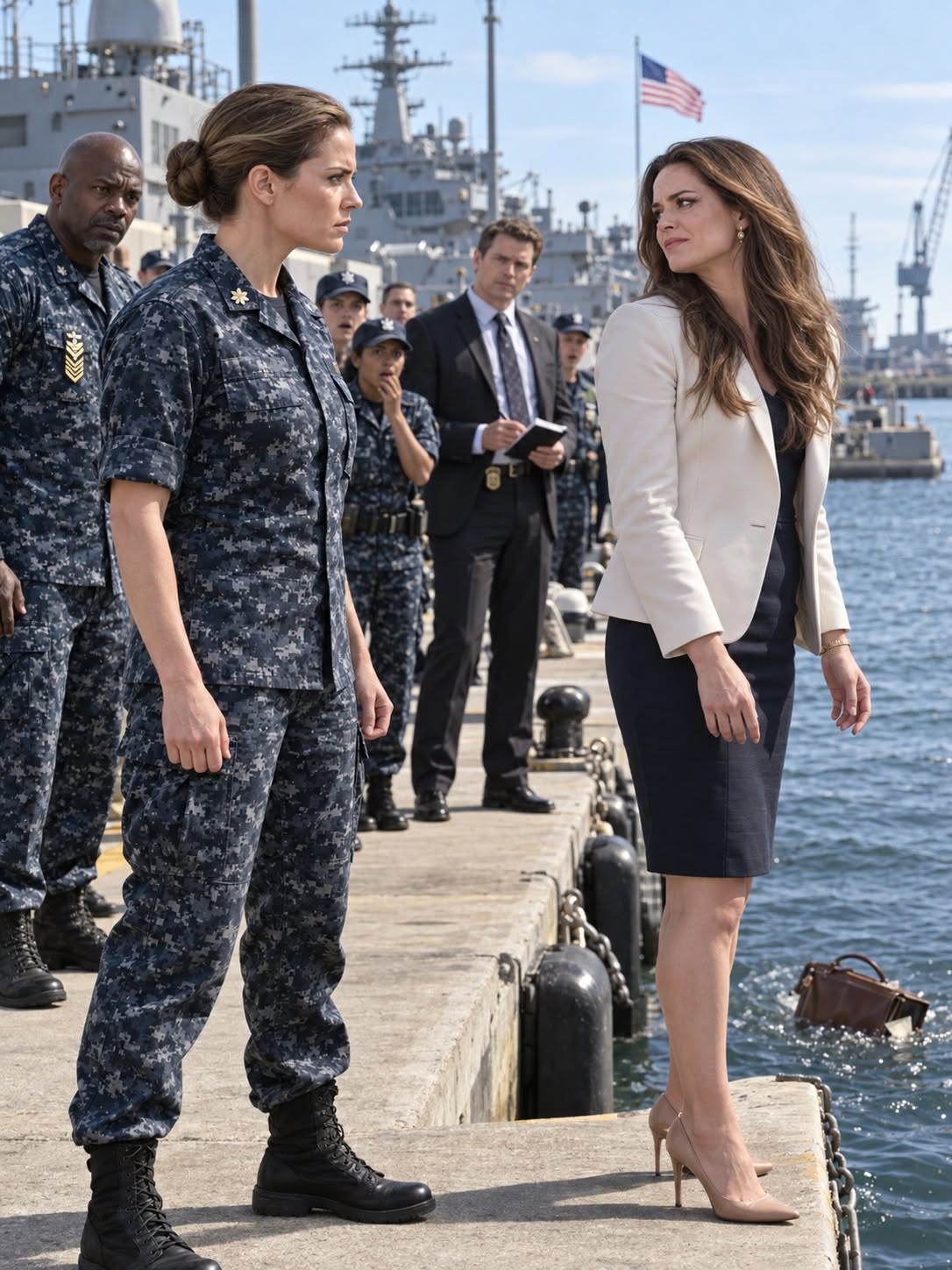
I turned around because Master Chief Kettleman’s eyes had gone wide and his hand had drifted toward his radio. Delphine was walking toward me with the specific expression she used to wear when we were children and she had decided I had taken something of hers.
Her hair was blown back from the humidity, and her mouth was already open before she reached me.
“You have got to be kidding me,” she started, loud enough that two contractors on the pier turned to look. “You actually showed up here. You actually did it.”
I set my clipboard down on a nearby equipment crate very carefully. In 19 years of service, I had learned that the first thing you do in an unexpected situation is remove anything breakable from your hands.
“Delphine,” I answered, keeping my voice level. “This is a secured work area. You need to step back.”
“Don’t you Delphine me.”
She was close now. Close enough that I could smell her perfume, the same jasmine one she had been wearing since high school.
“Bram told me you would try something like this. He said you couldn’t stand that I was working the Kellerman retirement event today. He said you would find a way to insert yourself.”
I had no idea who Kellerman was. I had never heard the name in my life, but I could see very clearly that Delphine had constructed an entire narrative in her head during the drive over, and she had arrived at Pier 12 fully prepared to perform it.
“I’m working,” I told her quietly. “I need you to leave the pier now.”
“Working?”
She laughed, and it was that same bright, brittle laugh she used at family dinners when she wanted everyone to know she was about to say something cruel.
“Working in your little costume with your little clipboard in front of my clients. You couldn’t just let me have one day, could you, Marlo? You couldn’t just stay in your lane.”
Master Chief Kettleman had stepped forward slightly, and I gave him the smallest headshake.
Not yet.
She was my sister. I would handle it.
“Delphine, I’m giving you one more chance to walk back to your vehicle.”
That was when she grabbed my bag.
It happened faster than I expected. My leather work bag was sitting on top of the equipment crate next to my clipboard, and she snatched the strap with the practiced quickness of an older sister who had spent our entire childhood taking my things.
She held it up like a trophy, spun on her heel, and marched to the edge of the pier.
“Delphine, do not—”
“Do not what, Marlo? Do not embarrass you? Isn’t that what you came here to do to me?”
“That bag contains federal property. Put it down.”
She looked at me over her shoulder, and I watched the smile spread across her face. I knew before her arm moved what she was about to do.
The bag arced through the air. It hit the water flat, made a sound like a slap, and began to sink almost immediately because of the weight of the tablet inside.
Somewhere behind me, a young sailor whispered, “Oh my God.”
The NCIS agent, whose name I would later learn was Special Agent Corbin Ashford, quietly pulled a small notebook out of his jacket pocket.
Delphine turned back to face me, chin up, waiting for my reaction. She wanted tears. She wanted shouting. She wanted the version of me she had spent 37 years constructing in her head, the little sister who could be made to feel small.
I did not give her that.
I looked at Master Chief Kettleman and said calmly, “Master Chief, please contact the harbor patrol and request dive recovery for a lost item containing sensitive material. Also, contact the base security office and request an escort.”
“Aye, Commander.”
Delphine’s face changed when she heard the word commander.
Just a flicker. Just a small crack in the performance.
I saw her eyes drop to the silver oak leaf on my collar, then to the name tape over my right pocket, then back up to my face.
She had never actually looked at my uniform before. Not once. Not at any promotion, not at any ceremony, not at Mom’s funeral. She had refused to look because looking would have meant acknowledging.
“What did he just call you?” she asked, and her voice had gone thinner.
“He called me by my rank.”
“Your rank?”
“Commander, United States Navy. I am the officer in charge of this inspection. Every person on this pier, every contractor, every sailor, every civilian is here because I authorized them to be here. And you just committed a federal offense in front of all of them.”
The color drained out of her face in stages. First her lips, then her cheeks, then her forehead.
Behind me, Special Agent Ashford took a step forward and cleared his throat gently.
“Commander Prescott,” he offered. “With your permission, I’d like to have a conversation with this individual.”
“She’s my sister.”
“Understood. My question stands.”
I looked at Delphine. She was staring at me like she had never seen me before, and in a very real sense, she never had. She had constructed a version of me in her mind when we were children, and she had refused to update it for three decades.
The woman she had thrown a bag at did not exist. The woman standing in front of her did, and that woman was about to become the worst problem of her entire life.
“Permission granted,” I answered.
And that was how the morning of June 3rd, 2025, began.
Special Agent Ashford was very polite when he asked Delphine to step over to the pier office with him. And Delphine was very much not polite when she refused.
She told him she did not have to speak to anyone, that she had rights, that her sister was overreacting, and that if he touched her, she would sue the entire United States government.
Ashford listened with the patient, blank expression of a man who had heard every version of this speech a thousand times, and when she finished, he simply repeated his request.
This time, two uniformed masters-at-arms had appeared behind him, and Delphine’s protests dropped in volume by about 50%.
I did not watch her go.
I had an inspection to run and a piece of equipment to recover, and letting Delphine occupy any more of my attention than she already had would have been a professional failure on my part.
I picked up my clipboard, walked back over to Master Chief Kettleman and Rosalind Vega, and asked Rosalind if she could pull up the digital backup of the corrosion assessment on her tablet so we could continue without the physical binder.
Rosalind, who was a former enlisted Marine and did not fluster easily, nodded once and pulled her tablet out of her own bag.
“I have everything from the pre-inspection brief backed up to the secure cloud, ma’am. We can keep moving.”
“Thank you.”
Master Chief Kettleman, who had been in the Navy for 26 years and had seen a great many things, was doing his best to keep his face professional. I could see the corner of his mouth twitching.
“Master Chief.”
“Ma’am?”
“Something amusing?”
“No, ma’am. Absolutely not, ma’am.”
“Good. Let’s continue with the mooring assessment.”
We continued.
The dive recovery team arrived within 40 minutes, which was actually impressive response time, and by 10:30, they had located my bag in about 18 ft of water and brought it up in a mesh recovery net.
The leather was ruined. The tablet was almost certainly ruined, though the security team would need to physically destroy it regardless of whether it powered on. The paper documents were pulped.
I signed the recovery form, initialed the chain-of-custody log, and made a mental note that I would be spending most of my evening writing an incident report.
Around 11:15, my phone rang. It was Captain Odel Bramwell, my direct commanding officer, and I already knew what she was calling about because news of a woman throwing a naval commander’s bag off a pier in front of 11 sailors travels through Naval Station Norfolk at approximately the speed of light.
“Marlo.”
“Ma’am.”
“Tell me what happened on Pier 12 this morning.”
I told her concisely, factually, without emotion. I did not mention that Delphine was my sister until the very end.
And when I did, there was a pause on the other end of the line that lasted about 4 seconds.
“Your sister?”
“Yes, ma’am.”
“Your biological sister?”
“Yes, ma’am.”
Another pause.
“Marlo, I need you to come to my office at 1400. Bring the incident report and any communications you’ve had with this individual over the past year. NCIS is going to want a formal statement, and legal is going to want to walk you through your options.”
“Yes, ma’am.”
“And Marlo.”
“Ma’am?”
“I’m sorry. I know this is complicated.”
“Thank you, ma’am.”
I hung up. Rosalind pretended she had not heard, and Master Chief Kettleman pretended he had not heard, and we finished the morning inspection at exactly 11:52, which was 6 minutes ahead of schedule despite everything.
I ate lunch alone in my office at Building C200: a tuna sandwich from the base commissary, a bottle of water, and the beginning of a headache pressing behind my right eye.
I opened my laptop and began writing the incident report while the details were still fresh. About halfway through the second paragraph, my phone buzzed with a text message from my brother, Corwin.
Corwin was 2 years younger than me and four years younger than Delphine, and he was the only person in our family who had ever made an effort to stay in real contact with me.
He lived in Richmond with his husband, who worked as a public defender, and he had the kind of temperament that made him extremely good at both his job and at being the peacekeeper between his warring sisters.
His text read, “Delphine just called me hysterical. Says you had her arrested. Please tell me what actually happened.”
I stared at the message for a long time. Then I typed back, “She threw my work bag off Pier 12 into the Elizabeth River. It contained federal equipment. She was detained by NCIS, not arrested by me. I’ll call you tonight.”
The three dots appeared, disappeared, appeared again.
Then: “Marlo. Oh my God. Is she in serious trouble?”
I typed, “Yes.”
The three dots appeared for a very long time and then disappeared without a message.
I put the phone face down on my desk and went back to the incident report.
At 1400, I was in Captain Bramwell’s office. She was a small woman with silver hair cut very short and the kind of eyes that missed absolutely nothing, and she had a manila folder open on her desk that I recognized as my personnel file.
Sitting in the chair beside her desk was a Navy JAG officer I had not met before, a lieutenant commander named Ojan Per. Standing behind her was Special Agent Ashford.
“Commander Prescott, please sit down.”
I sat.
“Lieutenant Commander Per is here to advise you on the legal aspects of this situation. Special Agent Ashford is here to take your formal statement. I am here because you work for me and because I want to make sure that whatever happens next, it happens the right way.”
“Yes, ma’am.”
Per leaned forward. He was a young officer, probably early 30s, and he had the bright, alert expression of a lawyer who is actually interested in his case.
“Commander, I want to walk you through what your sister is currently facing so you understand the landscape. Miss Prescott, is it, or is she married?”
“Delphine Ashwell. Her married name is Ashwell.”
“Ms. Ashwell is currently being questioned regarding several potential federal offenses. The most serious is destruction of federal property, which carries a maximum penalty of 10 years and a substantial fine. However, because the bag contained a secure tablet with classified material, there is also a potential charge related to mishandling of classified information. Though that one is complicated because she did not know what was in the bag.”
“She didn’t know.”
“Correct. Intent matters for that charge. It does not matter for destruction of federal property. She threw it. She knew it was yours. She knew you were in uniform. The prosecution has a very straightforward case if they choose to bring one.”
“If they choose to bring one.”
Per nodded slowly.
“Commander, in cases like this, the victim’s preferences carry significant weight. Not because they should legally, but because prosecutors are practical. If you tell NCIS and the U.S. Attorney that you want to pursue this to the fullest extent, they will. If you tell them you want to handle it privately, they may consider that. This is your decision to make, but I want you to make it with clear information.”
I looked at Captain Bramwell. Her face was completely neutral.
Then I looked at Special Agent Ashford.
“Agent Ashford.”
“Ma’am.”
“Setting aside my preference, what does your investigation actually require?”
“Ma’am, we require your formal statement regardless of your preference. Your sister has made several statements during questioning that we will need to verify against your account. Beyond that, the decision to refer for prosecution is not solely yours. She committed the act in front of federal law enforcement. However, your input will be considered.”
I nodded slowly.
“What has she been saying?”
Ashford glanced at Captain Bramwell, who gave a small nod.
“Ma’am, your sister is currently telling us that you have been harassing her for years, that you deliberately scheduled this inspection to interfere with her catering event, that you have a history of using your rank to intimidate her, and that she was acting in what she perceived to be self-defense against a pattern of behavior.”
I sat very still.
“None of that is true.”
“We are aware, ma’am. However, she is stating it emphatically, and she has stated that she intends to contact media outlets to share her version of events.”
Per cleared his throat.
“Commander, this is where the situation becomes strategic. If your sister goes to the media with a fabricated narrative before the facts are established, it becomes significantly harder to control the story. Your name, your rank, your record—all of that becomes public property. My professional recommendation is that we get ahead of it.”
“How?”
“By fully documenting the truth immediately and having NCIS complete their investigation quickly so that, when and if she speaks to media, the facts are already on the record and easily verified.”
I thought about my mother. I thought about Corwin. I thought about the version of me that Delphine had been constructing for people my entire life.
And I thought about how tired I was of letting her write that story.
“Then let’s document the truth,” I answered.
The formal statement took 2 hours.
Special Agent Ashford asked careful questions in a small, windowless room in the NCIS building, and I answered every one of them in the same measured tone I used for after-action reports.
I described the morning chronologically, from my arrival at Pier 12 through Delphine’s approach, her exact words as best I could remember them, the moment she grabbed the bag, and the moment it hit the water.
I named every witness I could identify. I described my prior relationship with Delphine in factual terms without editorializing, going back to our childhood in Rowan Oak and forward through our mother’s funeral in 2023.
Ashford asked about the harassment claim she had made.
I told him the truth, which was that I had not spoken to Delphine in 20 months, that I had not sent her any messages, that I had not contacted any member of her family, and that I could produce phone records to prove all of it.
He nodded and made a note.
He asked about the claim that I had deliberately scheduled the inspection to interfere with her catering event.
I told him that waterfront readiness inspections were scheduled 6 weeks in advance through a coordinated process involving multiple commands, that the schedule was documented, that I had no knowledge of any catering event on any pier that day, and that I could produce every email in the scheduling chain going back to April.
He asked about the claim that I had a history of using my rank to intimidate her.
I sat with that one for a moment.
“Agent Ashford, I have never used my rank in her presence in any context. She has never seen me in uniform except at our mother’s funeral, and I wore dress blues then because my mother had specifically requested it in her final wishes. Delphine did not know I was a commander until this morning. She has consistently referred to me as being in the Navy in the same tone she would use to describe someone working at a gas station.”
Ashford’s mouth twitched slightly. He made another note.
When we finished, he thanked me, told me the investigation would move quickly, and mentioned that Delphine had been released pending charges and had been escorted off the base by security.
She would not be permitted to return without prior authorization from base command.
I drove home to my apartment in Virginia Beach in the late-afternoon traffic. And for the entire 30-minute drive, I thought about how strange it felt to have finally said all of that out loud to someone with the authority to do something about it.
My apartment was small and quiet. Two bedrooms, one for me and one that functioned as an office and library, on the third floor of a building overlooking a small courtyard with a fountain.
I had lived there for 4 years. It contained no photographs of my family other than one of Corwin and Teodoro on their wedding day and one of my mother from before I had joined the Navy.
Delphine had never been inside.
I called Corwin as soon as I put my keys down. He picked up on the second ring.
“Marlo.”
“Hi.”
“Are you okay?”
“I’m fine. I’m home.”
He exhaled. I heard him close a door on his end. Probably the door to his home office.
“Tell me everything.”
I told him everything.
Corwin listened without interrupting, which was one of the many reasons I loved him. And when I finished, he was quiet for a long time.
“She’s telling everyone you attacked her,” he finally offered.
“I know.”
“Aunt Maragold called me an hour ago screaming that you had used your military connections to have Delphine thrown in prison. She said Delphine is traumatized. She said the family is going to organize.”
“Organize what?”
“I don’t know. A statement, I think. Aunt Maragold used the word intervention.”
I laughed. I could not help it.
“An intervention for me.”
“Marlo, she is telling them that you have been stalking Delphine and that today you finally snapped. She’s saying you had her cuffed in front of her clients and that the catering company fired her on the spot.”
“Was she fired?”
“Yes. Bram called me right before you did. They’re apparently now blaming you for that, too.”
I sat down on my couch and rubbed my forehead. The headache from earlier had gotten worse.
“Corwin, I need you to hear me clearly. I am not going to be quiet about this. Not this time. She threw federal property into the water in front of 11 witnesses and a federal agent. There is video. There is a formal investigation. There is a JAG officer involved. If the family wants to have an intervention for me, they are welcome to try. But I am not going to pretend this did not happen so that Delphine can continue to build her version of reality.”
“I know you do, Marlo. I have been watching her do this to you our entire lives. I have watched Mom and Aunt Maragold and everyone else accept whatever she says about you because it’s easier than actually looking at the evidence. I love our family, but I am not going to stand next to them on this one. I want you to know that.”
I closed my eyes.
“Thank you.”
“What do you need from me?”
“I need you to not defend me publicly yet. Let her build her narrative. Let her make the calls and send the messages. Every single one of them is going to be documented, and it is going to make the eventual truth that much clearer. Don’t argue with her. Don’t argue with Aunt Maragold. Just listen and remember what they say.”
“Understood. Teodoro is making dinner. He said to tell you he loves you, and if you need to come stay with us this weekend, the guest room is ready.”
“Tell him thank you. I might.”
We hung up.
I sat on my couch for a while and watched the last of the afternoon light move across the wall. Then I got up, changed into sweatpants and a navy T-shirt, and started to make myself dinner.
Pasta with butter and pepper because it was what I always made when I did not want to think about food.
While the water boiled, my phone started buzzing.
Text messages.
Aunt Maragold first, a wall of text in all capital letters accusing me of destroying the family. Then my cousin Pru, who I had not spoken to in 8 years, informing me that I had always been jealous of Delphine, and this proved it.
Then my uncle Tavish, who wrote only three words: “Call me now.”
I did not call him.
I did not respond to any of them.
I ate my pasta standing at the kitchen counter, drank a glass of water, and then sat down at my desk to begin the incident report addendum I owed Captain Bramwell in the morning.
At 8:47 that evening, Delphine called me. I let it go to voicemail. She called again at 8:49, and again at 8:52, and again at 8:56.
On the fifth call, she left a message.
I listened to it exactly one time, sitting at my desk, and I recorded it playing on speaker with a second phone because I already knew that having a copy was going to matter.
“Marlo, pick up your phone. Pick up your phone right now. Do you have any idea what you have done to me? Do you have any idea? I lost my job today because of you. I was fingerprinted like a criminal. Bram is furious. The kids are asking questions. Aunt Maragold is threatening to disown me if I don’t fix this. Which means I need you to call whoever you called and undo it.
“I don’t care what you have to do. I don’t care what strings you have to pull. You started this and you are going to end it. Because if you don’t, I swear to God, Marlo, I will tell every single person we know exactly what kind of person you really are. I will call the newspapers. I will call your commanders. I will make sure everyone knows what you did to Mom and what you did to me and what you did to this family.
“Call me back tonight. Tonight, Marlo.”
The message ended.
I sat at my desk for a long time.
Then I opened my laptop, transcribed the message word for word, saved the audio file to two separate locations, and sent a copy to Lieutenant Commander Per with a short note explaining what it was.
I did not call her back.
I got into bed at 10:30, lay in the dark for about 20 minutes, and then fell asleep more easily than I expected to.
The last thought I had before I dropped off was that, for the first time in 37 years, I was not going to be the one who made this go away.
The next morning at 0600, I was in my office reviewing the surveillance footage from Pier 12.
The base had four cameras with a view of the location where Delphine had thrown the bag, and Special Agent Ashford had sent me copies of the relevant clips with a note that read, “For your awareness, do not distribute.”
I watched them once through all four angles, and then I watched the clearest angle three more times.
The footage was unambiguous.
You could see me standing with Master Chief Kettleman and Rosalind Vega, my clipboard in my hand, my back partially turned. You could see Delphine approaching from the visitor lot with rapid, purposeful steps.
You could see me set the clipboard down, turn to face her, and lift both hands in the universal gesture of please stop. You could hear faintly my voice telling her that this was a secured area.
You could see her mouth moving as she spoke to me, animated and aggressive.
And you could see me remain still.
You could see her grab the bag. You could see me speak again, this time more sharply. You could see her walk to the edge of the pier.
You could see the bag arc through the air.
And you could see her face when she turned back to look at me afterward.
The smile. The chin up. The waiting.
Anyone who watched that video would understand exactly what had happened. There was no ambiguity, no room for interpretation, no possible alternative version of events.
Delphine had walked onto a secured pier, verbally attacked a uniformed naval officer conducting a federal inspection, and destroyed federal property in the presence of federal witnesses.
I closed the video files, locked my computer, and went to get coffee.
At 08:30, I met with Captain Bramwell and Lieutenant Commander Per in a small conference room. Per had a legal pad in front of him, and Captain Bramwell had a printout of an article that had been published overnight on a local Virginia Beach community news website.
“Marlo, you should see this before we talk about anything else.”
She slid the printout across the table.
The headline read, “Local woman detained by military police after alleged confrontation with sister at Norfolk Naval Base.”
The article was short and mostly speculative, but it contained direct quotes from Delphine.
She was described as a mother of two and small-business employee who had been “traumatized” by an unexpected encounter with her estranged sister, who serves in a leadership role on the base.
She was quoted as saying that she had gone to the pier to try to reconcile after years of family conflict and that her sister had reacted with hostility and had used her military rank to have Delphine detained.
She was quoted as saying that she feared retaliation and was seeking legal counsel.
There was no mention of the bag.
There was no mention of any federal property.
There was no mention of the fact that she had been on a secured pier during a federal inspection.
I read it twice.
“She got it published in less than 14 hours.”
Per nodded.
“She or someone helping her. My guess is a family member with a media contact, or she called the outlet directly. This is not a major publication, but it will get picked up by aggregators, and once it’s in the aggregator ecosystem, it becomes background noise that shapes how larger outlets will approach the story if they pick it up.”
Captain Bramwell folded her hands on the table.
“Marlo, we need to make a decision about how public affairs handles this. If we say nothing, her version becomes the default. If we respond too aggressively, we look like we’re crushing a civilian. My recommendation is that we release a very short factual statement through the base public affairs office confirming the facts of what happened without naming her, and let NCIS confirm through their own channels that an investigation is underway.”
“And me? What do I do?”
“You do nothing. You continue your duties. You do not respond to any media inquiries. You do not respond to your sister. You do not respond to family members. Everything runs through public affairs and legal.”
I nodded slowly.
I could do that. I had spent 19 years learning how to be quiet in front of situations that were much more chaotic than this one.
“There’s one more thing,” Per added. “Your sister’s attorney contacted our office at 07:15 this morning. His name is Roland Vestri. He has requested a meeting to discuss what he called a mutually acceptable resolution.”
“Meaning?”
“Meaning he wants to know what it will take to make this go away. He is going to propose that his client apologize privately, pay for the equipment, and that we all move on.”
“And what did you tell him?”
“I told him that the decision to pursue federal charges is not yours to make and that his client’s actions occurred in the presence of federal law enforcement, and that any resolution will need to involve the United States Attorney’s Office. I also told him that any private apology would need to be received through the appropriate legal channels and would not affect the investigation.”
“How did he respond?”
“He became less friendly. He implied that his client had significant information about you that could complicate matters if the investigation continued. I told him that if his client had information relevant to a federal investigation, she was welcome to share it with NCIS.”
I looked at Captain Bramwell.
She was watching me carefully.
“Marlo, is there anything in your background that could be leveraged against you? Anything at all? I need to know now, not later.”
I thought about it honestly.
I had lived a very careful life. I had made mistakes, of course. Everyone did. But nothing that could be weaponized.
My service record was clean. My personal life was quiet.
I had been married briefly in my late 20s to another naval officer named Beexley Orand, and we had divorced amicably in 2015 with no children and no drama. I had dated occasionally since then, but had not been in a serious relationship in about 4 years.
I did not drink to excess. I did not gamble. I did not have significant debt. And I had never been the subject of any complaint or investigation.
“There is nothing,” I answered. “The worst thing anyone could dig up about me is that I keep to myself and I do not call my family enough.”
“Good.”
Per made a note.
“Then when the attorney threatens to reveal information, we treat it as noise. If he actually produces anything, we respond to what is produced. We do not chase phantoms.”
“Understood.”
I went back to my office.
The rest of the morning was routine. I finished the incident report addendum, forwarded a copy to Captain Bramwell, and then spent 2 hours on the actual work I was paid to do, which was analyzing the corrosion data from the Pier 12 inspection and preparing recommendations for the maintenance schedule.
At 11:45, my phone rang.
It was Corwin.
“Marlo.”
“Hi.”
“You need to know that Aunt Maragold has organized what she is calling a family meeting for this Saturday at her house in Rowan Oak. She has invited every member of the family she can reach. She wants you to be there. She wants me to be there. She has instructed me to instruct you to be there.”
“She used the word instructed?”
“She used the word instructed.”
“Corwin, I am not driving to Rowan Oak this weekend.”
“I know. I told her that. She then instructed me to inform you that if you do not attend, the family will make decisions about you in your absence.”
I laughed. It was becoming a pattern.
“What decisions could they possibly make about me?”
“She used the phrase formal cutoff.”
“Oh no. Not the formal cutoff.”
Corwin laughed too. It was a tired laugh.
“Marlo, I am telling you this because you should know, not because I think you should go. Teodoro and I are not going either. I told Aunt Maragold that I refused to participate in a meeting whose purpose is to attack my sister for being the victim of a crime.”
“Thank you.”
“There’s something else. Delphine has been calling everyone. Cousins, aunts, people I haven’t spoken to in years. She’s telling them a story that keeps changing. Yesterday she said you had her arrested. Today she is saying you set her up. Tomorrow it will be something else. Pru told me she has stopped believing Delphine, which is significant because Pru has been Delphine’s number one supporter since we were kids.”
“Interesting.”
“Marlo, I think the story is starting to unravel on her own end. She is talking too much and she is contradicting herself. People are starting to notice.”
I looked out my office window at the parking lot and the small strip of grass beyond it and the flagpole with the ensign moving slightly in the wind.
“Corwin, let it unravel. Do not help it. Do not slow it down. Just let it happen. She’s going to do this to herself.”
“Yes.”
We hung up.
I sat at my desk for a moment, looking at nothing in particular. And I realized that, for the first time in my adult life, I was watching my sister lose control of a narrative she had spent decades building.
Saturday came, and I did not drive to Rowan Oak.
I drove to Richmond instead, to Corwin and Teodoro’s small brick house on a tree-lined street in the Fan District, and I spent the weekend in their guest room with a stack of books, a cat named Perl who had decided I was acceptable, and no phone service by choice.
I had turned off notifications for everyone except Captain Bramwell and Lieutenant Commander Per.
Teodoro made shrimp and grits on Saturday night, and the three of us sat at their small kitchen table with a bottle of wine and did not talk about Delphine for the first two hours.
We talked about a book Corwin was reading, about a case he was consulting on, about a trip they were planning to Portugal in the fall.
It was the most peaceful evening I had experienced in weeks.
Around 10:00, Corwin’s phone started buzzing. He looked at it, sighed, and put it face down on the table.
“The meeting is over,” he informed us.
“How was it?”
“According to Pru, who texted me the whole time, it was a disaster. Aunt Maragold opened by asking everyone to sign a letter formally cutting you off from the family. Uncle Tavish refused. Two of our cousins refused. Pru refused. Delphine got hysterical when she realized people were not automatically taking her side, and she started screaming at Aunt Maragold that no one loved her. Aunt Maragold told her to sit down and stop making a scene. Delphine left. Bram left after her. Aunt Maragold spent the rest of the meeting complaining about you both.”
Teodoro raised his eyebrows.
“Both of you?”
“Apparently, we are both selfish, both disrespectful, and both responsible for the family’s decline.”
“It’s not a good weekend to be a Prescott.”
I sipped my wine.
“It is not the first weekend. It has not been a good weekend to be a Prescott.”
Corwin laughed. Teodoro laughed.
Perl the cat purred in my lap, and I let myself feel something close to contentment for a moment.
The following Monday, June 9th, I was back in my office at 0700.
There was an envelope on my desk from base legal. I opened it.
Inside was a copy of a formal cease-and-desist letter that had been sent to a local news outlet on Friday afternoon by Roland Vestri, Delphine’s attorney, demanding that they retract the article about her detention.
Attached was a note from Per explaining that the outlet had refused, that they had in fact reached out to Base Public Affairs for comment, and that the base had provided the short factual statement we had discussed.
The updated article, which had been published Sunday evening, now included the fact that Delphine was under federal investigation for destruction of federal property and that a formal charge was being considered.
Per had also included a printout of the reader comments.
I skimmed them.
The tone had shifted significantly.
The initial article had generated sympathetic comments toward Delphine. The updated article had generated a very different response.
People were angry. People were asking why a woman would throw a naval officer’s bag off a pier and then claim to be the victim. People were pointing out that if there was surveillance footage, it should be released.
I did not want the surveillance footage released.
It would be Delphine’s ultimate humiliation. And however much she had earned it, I was not the kind of person who took pleasure in that particular flavor of destruction.
I sent Per a short email asking him to confirm that the footage would not be publicly distributed unless legally required, and he responded within 10 minutes to confirm.
At 0900, I had a scheduled meeting with Rosalind Vega about the corrosion report.
She arrived on time with her tablet and two coffees, one of which she placed on my desk without comment.
“Rosalind.”
“Commander.”
“I did not order coffee.”
“I know. I brought you one anyway. You have had a week.”
I looked at her. She looked back at me with the flat, unreadable expression of a former Marine gunnery sergeant, which was what she had been before she retired and became a defense contractor.
“Thank you.”
“You’re welcome. Now, let’s talk about the mooring cleats on Pier 12, north side.”
We worked for 2 hours.
Rosalind was one of the best in her field, and working with her was always focused and productive.
When we finished, she closed her tablet and looked at me for a moment.
“Commander, permission to speak freely.”
“Granted.”
“Everybody on this base knows what happened. I mean everybody. And I want you to know that not a single person I have talked to thinks anything about you except that you handled it the exact right way. If your sister was hoping to damage your reputation, she failed. The only reputation she damaged is her own.”
I nodded slowly.
“Thank you, Rosalind.”
“There is one more thing. Master Chief Kettleman told me to tell you that the whole Master Chief’s mess is offering to buy you a new bag. Something nice. Italian leather. They took up a collection.”
I laughed. Actually laughed, for the first time in a week.
“Tell Master Chief Kettleman that is very kind, and I will accept a bag, but only if it costs less than $100 and comes from the exchange. I do not want to be the commander who let the enlisted mess buy her expensive gifts.”
“Understood, ma’am.”
She left.
I sat at my desk with my second coffee, warm now, and I thought about how strange it was that, in the middle of the worst family situation of my life, I was surrounded by people who actually saw me.
Really saw me.
Not the version of me Delphine had constructed. Not the version my aunt had refused to look at, but the actual person I had built myself into over 19 years of work.
At 11:15, Per came to my office in person. He was carrying a file folder, and his expression was serious.
“Commander, I wanted to update you directly. The U.S. Attorney’s Office has decided to move forward with charges.”
I set my coffee down.
“What charges?”
“Destruction of federal property, one count. Trespassing on a military installation during a secured operation, one count. They have declined to pursue the classified-material mishandling charge because they cannot prove she knew what was in the bag. But the other two are moving forward. She will be formally charged this week.”
“What is she facing?”
“Realistically, if she pleads out, probation and restitution. If she goes to trial and loses, potentially some jail time, though for a first offense with no prior record, I would be surprised if she got more than a few months. The financial penalty will be significant regardless. The tablet alone was worth about $14,000, and the destroyed documents will be assessed separately.”
“$14,000?”
“Yes, ma’am. And the government will pursue full restitution.”
I sat back in my chair.
Delphine did not have $14,000.
Bram made a decent living as a middle manager at an insurance company, but they were not wealthy people. They had a mortgage, two kids, car payments.
$14,000 in restitution plus legal fees was going to hurt them badly.
“Ma’am?”
“Is there any version of this where the restitution is reduced or waived?”
He looked at me for a long moment.
“Commander, I want to be careful how I answer that. Are you asking as her sister, or are you asking as the victim of a federal offense?”
“I am asking as a person who does not want her sister’s children to lose their house.”
Per nodded slowly.
“The restitution amount is set by the government based on actual loss. It is not something you can waive. However, if you were to submit a victim impact statement that included your perspective on appropriate consequences, the court would take that into account when determining her overall sentence. Restitution would still be owed, but the additional penalties, probation length, fines might be adjusted.”
“I see.”
“Commander, may I speak candidly?”
“Please.”
“Your sister needs consequences. Not because you want to punish her, but because she has spent her whole life not experiencing them. If you soften this too much, she will interpret it as another rescue, and she will continue to behave the way she has behaved. If you let it run its natural course, this will be the first time in her life that someone has held her fully accountable. That might be the best thing that ever happens to her.”
I looked at him for a long time.
“Lieutenant Commander Per, you are very insightful for a man your age.”
“I had three older sisters, ma’am.”
I laughed.
He smiled.
He left the folder on my desk and walked out.
I sat with what he had said for a long time.
Delphine was formally charged on Wednesday, June 11th.
The charging documents were filed in the Eastern District of Virginia Federal Court, and by that evening, the updated news article had spread beyond the small local outlet into the regional news ecosystem.
A Richmond television station picked it up first, then a Norfolk one, then a wire service.
By Thursday morning, the story had been picked up by three national outlets, though it remained a small item in most of them, buried in the section reserved for the strange but true.
The framing had shifted completely.
The original narrative Delphine had tried to construct, in which she was the victim of a rank-abusing sister, had collapsed the moment the base public affairs office confirmed the actual facts.
Now the story was about a woman who had thrown a naval commander’s bag into the Elizabeth River in a fit of family jealousy and was facing federal charges.
The comment sections were unkind.
Some of them were very unkind.
I did not read them.
Corwin read them, and he called me on Thursday evening to report that the tide had turned so completely that even Aunt Maragold had stopped defending Delphine publicly.
Aunt Maragold had, however, doubled down privately and was now telling everyone in the family that I had orchestrated the whole thing to humiliate Delphine.
“Marlo, she is saying that you called the news outlets yourself.”
“I have not spoken to a single reporter.”
“I know. I told her that. She said, ‘You probably had a spokesperson do it,’ which she said was even worse because it meant you were being cowardly.”
“Aunt Maragold has an interesting definition of cowardly.”
“Aunt Maragold has an interesting definition of many things.”
Corwin also reported that Delphine had gone silent.
She was no longer calling family members, no longer sending group texts, no longer trying to organize support.
Her attorney had presumably instructed her to stop communicating publicly.
And for the first time in her adult life, Delphine was actually following advice she had been given.
On Friday morning, June 13th, I received a formal letter through Per’s office.
It was from Roland Vestri, and it contained a written apology from Delphine that had clearly been drafted by her attorney with her under significant duress.
The apology was not really an apology.
It was a statement of regret about the events of June 3rd, an acknowledgment that her actions had been inappropriate, and a request that I consider withdrawing my cooperation with the prosecution.
I read it twice.
Then I wrote a short response through Per, formally acknowledging receipt of the letter and formally declining to withdraw my cooperation.
I did not personalize the response. I did not add anything about our history.
I treated it as a legal matter, which was what it now was.
That weekend, I drove down to the Outer Banks of North Carolina and rented a small cottage for two nights.
I brought a book I had been meaning to read for two years, a pair of running shoes, and no work.
I ran on the beach at sunrise both mornings, ate seafood at a small restaurant where nobody knew my name, and slept better than I had slept in a decade.
On Sunday afternoon, before I drove home, I sat on the porch of the cottage and watched the ocean, and I realized I had not thought about Delphine in almost 18 hours.
Something was shifting in me.
I did not know what to call it yet.
When I got back to Norfolk on Sunday night, there was a message on my apartment door.
Not on my phone. On my actual door.
Taped to the wood with painter’s tape was a folded piece of paper with my name written on it in handwriting I recognized instantly.
Bram.
My brother-in-law.
I had not spoken to Bram in probably seven years.
He was a quiet man, not particularly warm, but not unkind either. He had married Delphine when she was 27 and he was 32, and I had always thought he was a slightly better person than she was, though not by a large margin.
He worked long hours. He coached their son’s Little League team, and he mostly stayed out of Delphine’s family drama.
I took the note inside, made a cup of tea, and sat down at my kitchen table to read it.
The note was short, three paragraphs written on lined notebook paper in blue ink.
Marlo, it began.
I know you are not expecting to hear from me. I know I have not been a good brother-in-law to you. I want to start by apologizing for that. I have spent 17 years listening to Delphine describe you in ways that I now realize were not accurate, and I did not do the work of forming my own opinion. I am sorry.
I am writing to you because I need to tell you some things that I think you should know. Delphine has been struggling for a long time, longer than I understood. About 2 years ago, she started seeing a therapist briefly, and the therapist told her that her relationship with you was something she needed to examine seriously. Delphine quit therapy after four sessions. She would not tell me what the therapist said, but she was angry for weeks afterward. And I now think the therapist told her something she did not want to hear about herself.
What she did to you on the pier was not a moment of anger. It was the culmination of a pattern that I have watched for our entire marriage. I am not writing to defend her. I am writing to tell you that I understand now and that if there is anything I can do to help make this right, I want to know. I will not ask you to withdraw the charges. I will not ask you to speak to her. I will not ask you for anything. I am only offering, and I am telling you that I am sorry it took this for me to see clearly.
Bram.
I read the note three times.
Then I set it down on the table and looked out the window at the dark courtyard below.
I did not know what to do with it.
I did not know if I believed him or if this was another maneuver designed to soften my position. I did not know if his offer was genuine or if it was a strategic apology from a man who had watched his wife’s life fall apart and had decided the safest position was to distance himself.
I decided not to decide.
I put the note in a folder in my desk, made another cup of tea, and went to bed.
On Monday morning, I called Corwin from my office and read him the note.
He was quiet for a long time.
“Marlo, I think it’s real.”
“You do?”
“I have known Bram for a long time. He is not a manipulator. He is not clever enough to be a manipulator. If he is writing to you and apologizing, he means it.”
“What do I do with it?”
“You don’t have to do anything with it right now. He said he is not asking anything of you. Take him at his word.”
“Corwin, do you think Delphine is going to prison?”
He exhaled.
“I think she is going to get probation and a large fine. And I think it is going to bankrupt them. And I think Bram knows that, and I think that is part of why he wrote to you.”
“He said in the note he was not asking for anything.”
“He is not asking. But he is hoping.”
I sat with that for a long time after we hung up.
At noon, Per called me.
There was a preliminary hearing scheduled for July 8th. The prosecution was preparing its case, and there was a possibility that Delphine’s attorney would try to negotiate a plea agreement before the hearing.
Per wanted to know if I was open to being consulted on the terms of any plea agreement.
I told him I was.
“Commander, one more thing. The prosecutor has asked whether you would be willing to meet with your sister in a mediated setting before the hearing. This would not be a substitute for the legal process. It would be a facilitated conversation with a professional mediator present at a neutral location for the purpose of allowing both parties to say what they need to say. Your sister has requested it. You are under no obligation to agree.”
I thought about it for a long moment.
“Per, let me get back to you on that.”
“Take your time, ma’am.”
I sat at my desk.
Outside my window, a group of sailors was walking past in PT gear, laughing about something. I watched them until they turned the corner and disappeared.
I had spent 37 years avoiding a real conversation with my sister.
I had told myself that avoidance was the mature choice, that engaging with her would only give her more ammunition, that silence was strength.
And maybe it had been strength for a while.
But I was starting to wonder if silence had also been a kind of hiding. If I had been avoiding not just her cruelty, but the harder work of actually telling her out loud what I thought about her and what she had done.
I did not know if I wanted to meet with her, but I was no longer sure that not meeting with her was the right answer.
I gave myself a week to decide about the mediation.
During that week, I did four things.
First, I called a therapist.
I had not been in therapy since a mandatory session after my second deployment in 2012, and I had never sought it out on my own, and I recognized this was probably overdue.
I found a woman named Dr. Kalista Mendel, who specialized in family estrangement and who had a cancellation available on Thursday afternoon.
I took the appointment.
Second, I sat down with all the letters and emails and text messages I had saved from Delphine over the years.
Not just the recent ones. All of them.
I had a folder on my computer labeled family correspondence that I had maintained since 2009. Not because I was building a case, but because I had a professional habit of documenting everything.
I read through the folder in chronological order over two evenings, and I saw a pattern I had never fully articulated to myself.
Every message from Delphine going back 16 years followed the same structure.
She would need something. She would frame the request as if I owed it to her. If I said no, she would attack. If I said yes, she would move to the next request.
If I said nothing, she would eventually send a message accusing me of abandoning the family.
There was almost no message in which she asked how I was, expressed interest in my life, or acknowledged anything I had done.
There was one from 2017 in which she had asked if I was okay after a story about a Navy ship collision had been in the news.
That was the only one.
Third, I wrote a list.
It was a list of the things I would say to Delphine if I ever had the chance to say them, and I did not censor myself while I wrote it.
The list was four pages long by the time I finished.
When I read it back, I saw that most of it was not accusation.
Most of it was grief.
Fourth, on Thursday afternoon, I met with Dr. Mendel.
Her office was in a converted house in Ghent, one of the older neighborhoods in Norfolk, with tall windows and hardwood floors and a small courtyard visible from her waiting room.
She was probably in her early 50s, small, with gray-streaked hair pulled back in a low knot, and a very calm way of speaking that made you feel like there was no rush about anything.
I told her in about 20 minutes the entire story.
Not just the pier, but the years before it.
My childhood in Rowan Oak. My mother, who had loved us both but had always been overwhelmed by Delphine and had leaned on me to make things easier.
My father, who had died of a heart attack when I was 14 and Delphine was 16, and who had been the only person Delphine ever really listened to.
My decision to join the Navy at 18 was interpreted by my sister Delphine as abandonment.
Ever since, she had played the good daughter while I was cast as the ungrateful one.
My therapist, Dr. Mendel, helped me realize I needed to confront Delphine to finally process my pain.
I agreed to a mediation before her court hearing.
At the mediation center, Delphine initially refused to listen to me. I told the mediator I would end the session if she would not hear me out.
Delphine agreed to my terms.
I spoke for 17 minutes.
I detailed a lifetime of her cruelty.
She had cut up my favorite dress, stolen $20 and blamed me, spread rumors about my health, lied to our extended family about my Naval Academy acceptance, blamed me for our father’s death, and lied about my support during our mother’s final days.
I explained that I stayed away to survive her constant abuse.
I told her I would not lie for her in court, but I would not hate her either.
Delphine cried and admitted to everything.
She confessed her jealousy and apologized, revealing our mother had actually been proudest of me.
I told her I heard her, but I was not ready to say more.
Afterward, I felt a heavy weight lift from my chest.
Delphine accepted a plea deal.
She would pay $14,600 in restitution, serve probation, and complete community service.
She also voluntarily requested mandatory therapy as part of her sentence.
I called Corwin that evening.
“She asked for therapy.”
“Bram told me. He said she has been going to sessions on her own since the mediation, twice a week.”
“How is he?”
“He’s okay. He’s tired. He said the kids are struggling and Delphine is struggling, but they are talking more than they have in years. He said something about the mediation broke something loose in her.”
“That is what mediation is designed to do.”
“Marlo, are you okay?”
I thought about it.
“I am, actually. I am strange, but okay.”
“Strange how?”
“I don’t know. I have spent my whole life carrying something, and I did not realize until I put it down how heavy it was. Now I am walking around without it, and I do not quite know what to do with my hands.”
Corwin laughed softly.
“You are being very poetic, Commander Prescott.”
“I have been in therapy.”
“It shows.”
We talked for a while longer.
He told me that Aunt Maragold had gone completely silent since the news of the plea agreement, that Pru had reached out to him wanting to reconnect, and that Uncle Tavish had left a voicemail on his phone asking after me in a tone that was almost warm.
The family was reorganizing itself slowly.
On July 20th, 2 days before the sentencing hearing, I received a letter through Per.
It was from Delphine, handwritten, three pages.
Vestri had sent it through Per to make sure it was reviewed before it reached me, and Per had read it and told me it was a personal letter with no legal content, and I could read it or not as I chose.
I chose to read it.
It was a letter of specific apologies, not general ones.
Delphine had gone through her memory and had written down every specific thing she could remember doing to me, and she had apologized for each one individually.
Some of them I had forgotten.
Some of them I had not.
She did not ask me to forgive her. She said she understood that forgiveness was not owed.
She said she was writing the letter because Dr. Whitmore had suggested that specific accountability was more meaningful than general apology, and because her therapist had reinforced the same suggestion, and because she wanted me to know that she was hearing what I had said in the mediation and continuing to sit with it.
The last paragraph read:
“Marlo, I do not expect anything from you, but if you ever decide you want to have a different kind of relationship, one built on truth instead of the story I made up about us when we were kids, I will be here. I will do the work. I have already started. I love you and I have loved you our entire lives, even when I was too broken to show it. I am sorry it took throwing your bag into the river to make me see it.”
I read the letter twice, folded it carefully, and put it in the same folder where I had put Bram’s note.
I did not respond immediately.
I did not know if I would respond at all.
But I did not throw it away either.
The sentencing hearing was on July 22nd at 10:00 in the morning at the federal courthouse in Norfolk.
Per and I sat in the second row. Delphine was at the defense table with Vestri.
Bram sat behind her alone.
I had not seen him arrive.
The judge was a woman in her 60s named Judge Corona Vale, who had a reputation for being firm but fair.
She reviewed the plea agreement, asked Delphine several formal questions to confirm she understood what she was pleading to, and then invited victim impact statements.
I had submitted mine in writing.
I had chosen not to read it aloud.
Per had suggested that a written statement carried more weight in cases where the victim did not want to appear vindictive, and I had agreed.
My statement was short.
It described the events of June 3rd factually, described the impact on my professional life, and closed with a single sentence:
“I do not seek additional punishment from Miss Ashwell beyond the agreed sentence. I ask only that the court require her to complete the therapy she has voluntarily requested so that this may be the last incident of its kind.”
Judge Vale read my statement in silence, then looked up.
“Ms. Ashwell, do you have anything you would like to say to the court before I impose sentence?”
Delphine stood.
Her voice was steady, though quiet.
“Your Honor, I want to say that I understand what I did. I want to say that I understand it was not just an incident on a pier, but the last in a very long series of decisions I have made to hurt my sister. I want to say that I am doing the work now in therapy to understand why I have done what I have done and to become someone who does not do it anymore.
“I accept the sentence the court is imposing. I accept the responsibility for the restitution, and I want to publicly apologize to my sister, Commander Marlo Prescott, in this courtroom in front of the court for what I did to her on June 3rd and for what I have done to her for our entire lives.
“I am sorry, Marlo.”
She sat down.
Judge Vale looked at me for a moment.
Then she looked at Delphine.
“Ms. Ashwell, I accept the plea agreement as submitted. The court adds one modification for the victim’s request. You are hereby ordered to attend weekly therapy for the duration of your 2-year probation with a licensed therapist approved by your probation officer, with monthly compliance reports submitted to the court. Failure to comply will result in a probation violation. Do you understand?”
“Yes, Your Honor.”
“So ordered. This matter is closed.”
The gavel came down.
It was 10:42 in the morning.
I stood up.
Per stood up.
As we filed out of the courtroom, Delphine turned in her seat.
Our eyes met across the aisle.
I did not smile, but I nodded just once.
She nodded back.
That was all.
Outside on the courthouse steps, Per shook my hand and told me I had handled the whole thing with more grace than most of the officers he had ever worked with.
Then he went back to his car.
I stood for a minute in the July heat, looking down at the traffic on Granby Street, and I thought about how quiet the world was.
My phone buzzed.
Corwin: “Are you okay?”
I typed back, “I am okay.”
Then I got in my car and drove back to the base.
The following months were unremarkable in the best possible way.
I did my job.
I continued therapy with Dr. Mendel.
I saw Corwin and Teodoro every few weeks.
I traveled to Guam in September for a joint readiness exercise and came home with a sunburn and a good report from my superiors.
I was told informally that I was on the short list for a promotion to captain in the next selection board.
I did not let myself think about that too much because thinking about promotions tends to make them harder to receive.
I did not speak to Delphine.
I did, however, write her back.
It took me 3 months to do it.
I wrote her a short letter in early October on plain white paper in my careful, even handwriting.
Delphine,
I received your letter. I have read it several times. I am not ready to have a relationship with you, and I do not know if I ever will be, but I want you to know that I heard your apology and I believe you meant it.
I hope the therapy is going well. I hope you and Bram and the kids are okay. If you continue to do the work and if enough time passes, we might be able to see each other again someday.
I am not making a promise. I am just leaving a door slightly open.
Marlo.
I put it in the mail on a Tuesday morning.
I did not expect a response, and I did not receive one.
That was its own kind of answer, and it was the right one.
Delphine understood, finally, that she did not have to fill every silence.
Bram sent me a Christmas card in December.
It was a photograph of the kids in front of a small Christmas tree, and inside he had written simply, Thank you.
He did not sign Delphine’s name to it, and I understood that too.
She was still doing the work.
He was letting her do it on her own terms.
Corwin and Teodoro invited me to Christmas dinner at their house.
I went.
Bram and Delphine and the kids were not there. Aunt Maragold and Uncle Tavish were also not there.
It was just the three of us and a small standing rib roast and a bottle of good wine and Perl the cat sitting under the table waiting for scraps.
In January of 2025, I attended a captain selection ceremony in Washington and learned that I had been selected.
My promotion to captain would be effective in the spring.
Captain Bramwell, who had known before I did, met me for coffee the following week and told me she had never been prouder of one of her officers.
Rosalind Vega sent me a bottle of very good bourbon with a note that read, “From one hard-headed woman to another.”
Master Chief Kettleman shook my hand and told me that if I ever needed a good leather bag, the Master Chief’s mess still had a fund available.
I told him I would keep it in mind.
In February, I received a text message from Delphine for the first time in 8 months.
It was a photograph of her son, my nephew Nolan, standing next to a school science project.
The message read, “He wanted you to see this. He got second place. He picked the project because he wanted to be like his aunt in the Navy.”
I looked at the photograph for a long time.
Nolan was 10 years old.
He had my father’s eyes.
He was holding a small ribbon and grinning at the camera, and the science project was about ocean currents.
I typed back, “Tell him I am very proud of him. Tell him second place is a great result and that he can visit a real ship one day if his mom wants to bring him.”
The three dots appeared.
Then: “Really?”
I answered, “Really.”
That was our first conversation in almost 8 months.
It lasted four messages.
Delphine did not push for more, and I did not offer more.
And that was correct.
We were both learning to move at a pace that would not break what we were slowly, tentatively trying to build.
In April, I pinned on my fourth stripe.
Corwin and Teodoro drove down for the ceremony.
Delphine did not come, but she sent flowers, a small arrangement of white roses with a card that read, “From your sister.”
It was on the table in my office when I got back from the ceremony.
I put it in a vase and left it there for the week.
In May, I brought Nolan and his little sister, Piper, on a base tour.
Bram drove them down for the day.
Delphine did not come.
She had asked through Bram whether it would be all right if the kids came without her, and I had agreed.
I met them at the visitor center at 10:00 in the morning.
Nolan was solemn and polite and asked excellent questions.
Piper, who was six, told me my uniform was pretty and asked if she could try on my hat.
I let her.
She wore it for most of the tour.
At the end of the day, when Bram was buckling them into his car, Piper hugged me around the waist and told me she loved me.
I hugged her back and told her I loved her too.
And I meant it.
And I realized as I said it that I had never said those words to anyone in my family since my mother had died.
Bram watched the exchange and then looked at me over the top of the car.
“Thank you, Marlo. This meant everything to her, to Nolan, and to all of us.”
“You are welcome.”
“She wanted me to tell you that she is doing well. 14 months in and she has not missed a therapy session. She has a new job. She is different. She wanted me to tell you that she does not expect anything, but she wanted you to know.”
I nodded slowly.
“Tell her I know.”
“I will.”
I watched them drive away, and I stood in the parking lot for a while after their car had disappeared.
And I thought about how strange it was that the worst day of my professional life had turned out to be the beginning of something none of us had expected.
I want to tell you what I have learned from all of this because I think it is the reason I have shared this story with you at all.
I spent 37 years believing that the strongest thing I could do was be quiet.
I told myself that silence was the mature response to my sister’s behavior, that engaging with her would only make things worse, that walking away was a form of strength.
And it was, for a while.
Walking away kept me safe.
It let me build a life.
It let me become the person I wanted to be.
But at some point, silence stopped being strength and started being avoidance.
At some point, my refusal to say anything to my sister was not protecting me anymore.
It was protecting her.
It was letting her continue to be the person she had always been without ever having to see the cost of it.
And when she finally did something so public that I could not walk away from it, I discovered that speaking—actually speaking, with all the truth I had been holding for three decades—was harder and better and more freeing than any silence I had ever chosen.
You do not have to explode to be heard.
You do not have to be cruel to be honest.
You do not have to burn down a relationship to set a boundary.
But you do, at some point, have to speak because the people who have been unkind to you are counting on your silence.
They have built their whole understanding of you around your willingness to not say anything.
And the moment you speak, even once, even calmly, even with love, the story they have been telling starts to fall apart.
My sister threw my bag off a pier because she thought I would react the way I had always reacted.
Small. Contained. Contained by her.
Instead, I let the truth of what she had done stand on its own.
And I let the consequences follow.
And I said out loud, for the first time in my life, what she had actually been.
And the thing that surprised me most was that she was capable of hearing it.
Not immediately.
Not easily.
But eventually.
I do not know what our relationship will look like in 5 years or 10.
I do not know if we will ever be close.
I know that we are talking now, carefully, in small doses, and that both of us are different people than we were on June 3rd, 2025.
That is enough for me right now.
If you have someone in your life who has spent years telling a false story about who you are, I want you to know that you do not have to keep letting them tell it.
You do not have to shout.
You do not have to fight.
You do not have to prove anything.
You just have to be willing to speak the truth when the moment comes.
And the moment will come.
It always does.
Thank you for listening to my story. If it meant something to you, please give it a like, subscribe to the channel so you can hear more stories like this one, and share it with someone who might need to hear it.
If you have your own story about family, about boundaries, about the moment you finally spoke up, I would love to hear it in the comments.
Your voice matters.
Your story matters.