The sauce on the stove was a thick, dark red, bubbling in the center of the copper pot.
Daniel stirred it with a long wooden spoon, his movements heavy and deliberate.
Noah stood by the sink,
dried a blue ceramic plate with a yellow dish towel,
and kept his shoulder turned away from his stepfather.
“We need three plates, Noah,†I said, reaching into the cupboard for the glasses.
My hand brushed against my left wrist,
a habit I had not broken since selling my mother’s gold watch to pay the oil bill in August.
“Just two,†Daniel said, without turning around from the stove.
I stopped with my hand on the cupboard door.
“You are not eating with us?†I asked.
Daniel tapped his right thumb against his temple twice, his eyes fixed on the bubbling red sauce.
“I am just not hungry tonight after tasting the sauce all afternoon,†he said.
Noah did not look up, but his fingers began to roll the bottom hem of his grey t-shirt into a tight, wet spiral.
The old corded telephone on the pantry wall gave a brief, dry click, the way it always did when the line was damp.
Daniel turned the burner to low and wiped his hands on a kitchen towel.
“Clara, go out to the garage and find my three-foot level,†he said.
“The wooden one or the yellow metal one?†I asked.
“The metal one,†he said, reaching into his pocket and pulling out his black cell phone. “And give me your phone. I want us to have a dinner without any screens tonight.â€
I took my phone from the counter and handed it to him.
He took both phones and walked toward the back door that led to the covered breezeway.
I followed him into the cold air of the October evening.
The smell of damp oak leaves was strong near the garage floor.
Daniel did not stop at the tool pegboard where he usually kept his levels.
He walked straight to the heavy steel toolbox that sat on the corner of his oak workbench.
It was a green chest with iron handles, something his father had left him.
He opened the lid, dropped both cell phones inside, and let the heavy latch fall shut.
He drew a small brass padlock from his pocket, slipped it through the steel hasp, and snapped it closed with a sharp click.
“Why are you locking them in there?†I asked.
He did not look at me as he slid the key into his pocket.
“So we can focus on each other,†he said.
“The level is not on the bench,†I said, looking at the empty space above the pegboard.
“It must be in the truck,†he said, turning back toward the house.
I stood in the cold garage for a moment, my hand resting on the cool green metal of the locked box.
There was no reason to lock two phones in a toolbox.
When I returned to the kitchen, Noah had already set the two blue plates on the oak table.
Daniel stood by the counter, pouring two glasses of tap water.
He carried them to the table and set one beside my plate and one beside Noah’s.
He did not pour a glass for himself.
“Sit down,†Daniel said, nodding toward the head of the table where he usually sat.
Instead of sitting, he remained standing near the refrigerator, his arms folded across his chest.
I ladled the thick red sauce over the pasta on Noah’s plate, then on my own.
The steam carried a heavy, sweet smell of oregano, but there was something else underneath it, something metallic and sharp.
“Is there something different in the sauce?†I asked.
“Just garlic,†Daniel said.
Noah took a small bite, his eyes fixed on his plate.
“It tastes a little bitter,†Noah said, looking at me.
“Eat your dinner, Noah,†Daniel said from the shadows near the pantry.
I took a forkful of the pasta and chewed slowly.
The bitterness was dry, coating the back of my tongue like aspirin.
“You really should have some, Daniel,†I said, putting my fork down.
“I told you, I am not hungry,†he said.
He tapped his thumb against his temple again, his eyes tracking every movement of my fork.
I swallowed another small bite, wishing to show Noah there was nothing to fear.
The refrigerator hummed, a low, steady vibration that seemed to grow louder in my ears.
Noah dropped his fork, the metal clattering loudly against the blue ceramic.
“Mom,†he whispered, his voice sounding thick and distant.
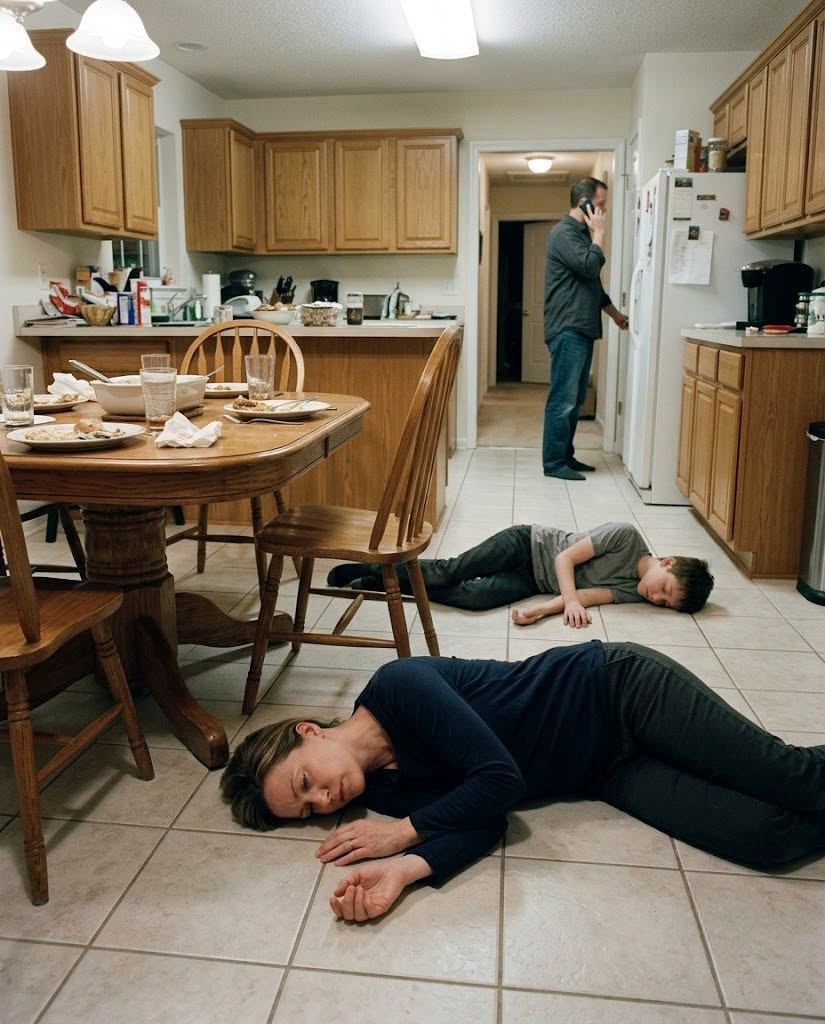
He tried to stand, but his knees buckled, and his shoulder hit the edge of the table as he slid to the linoleum floor.
“Noah,†I tried to scream, but my throat felt dry and heavy, as if it were lined with sand.
I tried to reach for him, but my arms would not move.
The kitchen began to tilt, the yellow walls spinning in a slow, greasy circle.
I fell forward, my chin striking the edge of the wooden table.
Through the haze, I saw Daniel step forward from the pantry door.
He did not look afraid.
He stood over us, his boots inches from Noah’s hand on the floor.
He did not reach down to help his stepson.
My hand reached weakly toward the blue plate before everything goes dark.
The hospital ceiling was a grid of plastic tiles with one dark corner where a bulb had burned out. My tongue tasted of charcoal, and a plastic tube pinched the inside of my nose.
Dr. Vance stood by the gurney, holding a metal clipboard against his white coat. He had a gray smudge of fatigue under each eye that made him look older than thirty-five.
“The blood work shows an elevated level of a prescription sleep aid, Clara,†he said.
I reached for my left wrist, but my watch was gone, replaced by a white plastic band with my name printed in faint thermal ink. My skin felt cold and bare where the silver band usually rested.
“We had pasta,†I said, my voice dry and thick from the charcoal. “Daniel made the sauce from the tomatoes in our backyard garden.â€
“This was not spoiled tomatoes,†Dr. Vance said, tapping his thumb against his clipboard. “The lab found twelve milligrams of zolpidem in your system, and slightly more than that in your son’s.â€
“Noah,†I said, trying to sit up against the stiffness in my lower back. “Where is Noah?â€
“He is down the hall in pediatric recovery,†the doctor said. “He is awake, but his blood pressure is still quite low.â€
I looked at the black digital clock on the wall, which read ten minutes past three in the morning. I wondered why Daniel was not standing in the doorway with his truck keys in his hand, asking if he could sign the insurance forms.
“My husband must be at home cleaning up the kitchen,†I said, though my own words felt heavy and slow.
Dr. Vance did not look up from his clipboard. “The police went to your house an hour ago, Clara, but nobody answered the front door.â€
The morning light in the pediatric hallway was thin and gray, smelling of bleach and old coffee. Noah sat on a blue vinyl bench with his knees pulled up to his chest, his fingers rolling the hem of his gray t-shirt into a tight cord.
I sat beside him, the hospital gown stiff against my legs under my trench coat. His face was pale, with dark circles under his eyes that made him look much younger than sixteen.
“Did your stepfather say anything to you before we fell asleep, Noah?†I asked.
Noah did not look at me. He kept his eyes on his sneakers, his thumb moving over the fabric of his shirt.
“He came into the living room while you were on the floor,†Noah murmured. “I tried to reach for the corded phone by the pantry, but I couldn’t get up.â€
“Did he call for an ambulance?†I asked.
“No,†Noah said. “He stood over me for a long time.â€
A nurse pushed a cart of small plastic cups past us, the tiny wheels squeaking against the linoleum.
“He touched my neck and said it would be easier this way,†Noah said, his voice dropping so low I had to lean closer to hear him.
My fingers tightened on my bare wrist. I wanted to tell him he was mistaken, that Daniel was simply checking his pulse in a moment of panic, but Noah’s eyes were steady and cold.
“He stayed in the dark for three minutes,†Noah said. “I counted by the light on the microwave.â€
Officer Gable was sitting in his cruiser in our driveway when the taxi let us out at two o’clock. The autumn wind was blowing dry oak leaves across the concrete, where they gathered in the corners of the closed garage door.
The young officer stepped out of his car, his leather duty belt creaking as he walked toward the front porch. He was holding a roll of yellow plastic tape in his left hand.
“The detective said nobody goes inside yet, Mrs. Miller,†he said.
“I only need to get Noah some dry clothes and my purse from the kitchen counter,†I said, my hand hovering near the brass doorknob.
“I can go in and grab a bag for you, but that is all,†Gable said. He pulled a small pocket knife from his belt to cut a length of the yellow tape.
Through the glass pane of the back door, the kitchen looked exactly as we had left it, except for the two blue plates still sitting on the wooden table.
On the laminate counter beside the sink, the silver-plated pocket watch my father had given me sat face up, its glass scratched. It was supposed to be in the drawer by the pantry.
“Who put my father’s watch on the counter?†I asked.
Officer Gable did not answer. He pressed the sticky yellow tape across the doorframe, sealing the lock under a bright warning.
My sister Leah’s dining table was covered in bank statements and yellow legal pads. She adjusted her wire-rimmed glasses twice before she sat down, her fingers twitching near her collar.
“Daniel’s business account is overdrawn by twenty-two thousand dollars, Clara,†she said, her voice rising in a quick, anxious rhythm. “The suppliers put a lien on his flatbed truck last Tuesday.â€
“He told me the kitchen remodel was fully paid,†I said, sitting on the edge of the wooden chair.
“He lied to you,†Leah said. She reached into a manila folder and pulled out a photocopy of a three-page document from the county credit union. “And he did not just stop with the business accounts.â€
Noah was sitting on the stairs in the hall, his head resting against the wooden banister, watching us through the spindles.
“What is that paper?†I asked.
“It is a new home equity line of credit for eighty-five thousand dollars,†Leah said, pointing a finger at the signature line on the third page.
I leaned forward to look at my own name, written in the precise, slanting script I had used since college.
“I never signed that document,†I said.
Leah looked down at the table and adjusted her glasses again. “The notary stamp says it was signed in your kitchen three weeks ago, on the day you had that migraine.â€
“I was in bed all day,†I said.
We both looked at the black ink of the signature, which looked exactly like mine but had been witnessed by a name I had never heard of.
“Whose handwriting is this, Clara?†Leah asked.
I stood up from the table without answering, my hand going to my bare wrist where the skin was still cold.
The drive back to our street took less than ten minutes in Leah’s station wagon, the heater blowing stale air against my face.
I walked up the porch steps alone, my shoes crunching on the dry leaves.
The bright yellow police seal was stretched tight across the door handle, the bold black letters warning that entering was a violation of state law.
The tape did not look like police tape from a television show, but rather a thick band of blue paper that held the door frame shut. I did not touch it, nor did I try to insert my brass key into the lock.
Instead, I sat in the hard plastic chair of the second-floor interview room at the county sheriff department the following morning. The table between us was gray laminate, showing circular ring marks from old coffee cups.
Detective Elena Rivera, a woman with a very quiet manner, did not look at me while she turned a page in her black notebook. Her silver pen clicked once, a sharp sound in the small room.
“Your husband has an active prescription for a compound called zolpidem, Clara,†Detective Rivera said.
I rubbed my left wrist where my father’s silver-plated pocket watch usually kept me anchored, though my wrist was bare now. I kept my voice as even as I could manage.
“Daniel has never mentioned trouble with sleeping,†I said.
“The local pharmacy filled the order on the twelfth of September,†she said, sliding a white sheet of paper toward me. “Ninety tablets. The toxicology report from the hospital showed a high concentration of the same compound in your blood.â€
The paper was a printout of a state database, listing Daniel’s name, his date of birth, and the name of the prescribing physician in Mansfield. I read the name of the doctor twice, trying to place it among our acquaintances, but it was entirely unfamiliar.
“This is the exact medication your husband was prescribed last month,†Detective Rivera said.
“He does his bookkeeping on Thursday nights,†I said. “He usually works until midnight. I assumed he was simply tired.â€
“We found no bottle in the house during our initial walk-through,†she said, writing a brief line in her notebook. “Not in the medicine cabinet, and not in the kitchen. We did find the locked metal toolbox in the garage, however.â€
“Daniel keeps his socket wrenches in that box,†I said.
Detective Rivera did not look up from her page. “The deputies are waiting for a warrant to open it.â€
By one o’clock, I was sitting at my sister Leah’s kitchen table with a roll of clear plastic wrapping and a black marking pen. Noah sat on the low stool by the pantry, rolling the hem of his gray t-shirt between his thumb and forefinger.
“We cannot eat what is left in the refrigerator,†Leah said.
She adjusted her glasses with one finger, her eyes wide behind the lenses as she paced the length of her linoleum floor.
“The police took the plates, Leah,†I said. “They did not take the leftovers from the yellow ceramic bowl.â€
I reached into the paper grocery bag I had brought from our kitchen before the seal was placed. I pulled out a small, airtight plastic freezer bag containing three ounces of the cold marinara sauce I had scooped from the saucepan on Friday night.
“You should not have that,†Leah said, stopping her pacing. “If the detective finds out you took evidence from the house, she will think you are trying to hide something.â€
“I am not hiding anything,†I said, sealing the double track of the plastic bag with a firm pinch of my fingers. “I am preserving it in case they lose the samples they took from our stomachs.â€
Noah looked at the plastic bag, his fingers still working the hem of his shirt. “He tasted it, Mom. He told us he wasn’t hungry because he tasted it.â€
“Yes,†I said. “He did say that.â€
“We have to go to the bank,†Leah said, her voice rising slightly. “The three o’clock appointment with the branch manager is still on the calendar.â€
The branch where Leah worked was five miles away, a red brick building with three drive-up lanes that smelled of damp oak leaves and floor wax. We did not sit in Leah’s usual teller cubicle, but in the small office at the back where the commercial accounts were handled.
Mr. Henderson, a man I had known since we both served on the school library committee, laid three sheets of paper on his desk.
“Clara, I am only showing you this because Leah is on our staff,†he said, keeping his eyes on his blotter. “Normally, we would require a formal subpoena for these records.â€
“I understand,†I said. “What did Daniel do with the business account?â€
He tapped a line on the second page with the eraser of his pencil. “On the Tuesday before your dinner, there was a wire transfer of twelve thousand dollars out of the construction escrow fund.â€
“Where did the money go?†I asked.
“To a private account at a savings and loan in Columbus,†Mr. Henderson said. “The name on the receiving account is Lydia Mercer.â€
Leah sat very still, her hands clasped tightly in her lap. She did not adjust her glasses this time, but her chin dropped toward her collar.
“Lydia is his bookkeeper,†I said. “She has worked for his company for six years.â€
“Twelve thousand dollars is a large sum for a single month of bookkeeping services,†Mr. Henderson said.
“Did I sign the authorization for that transfer?†I asked.
“No,†he said, turning the page over. “Only Daniel’s signature was required for the escrow release, but the collateral for the underlying loan was your home.â€
By five o’clock, the autumn air had turned cold enough to make my breath visible in the gravel parking lot behind the police station. Detective Rivera was leaning against the fender of her unmarked sedan, holding a small manila envelope in her gloved hand.
“The warrant for the toolbox was signed thirty minutes ago,†she said as I approached.
“Did you find the medicine bottle?†I asked.
“We found the bottles,†she said. “We also found two mobile phones. One is your personal cell phone, Clara. The other is a prepaid unit bought at a convenience store in Sandusky.â€
“I have never seen a prepaid phone in our house,†I said.
“We ran the toll logs for the prepaid unit,†Detective Rivera said, pulling a slip of paper from her pocket. “It was activated three weeks ago. It has only called one number.â€
She paused, looking toward the street where the yellow school buses were making their late afternoon runs.
“Three minutes after you and Noah collapsed on the kitchen floor,†she said, “someone used that prepaid phone to make a seventy-eight-second call.â€
I looked down at my bare wrist, the skin pale where my father’s pocket watch had sat for twenty years. “Who did he call?â€
“We are verifying the registration of the receiving number now,†she said, holding out a white sheet of paper with a signature line at the bottom. “I need your written consent to search the digital logs of your own phone, Clara. It will show us if the prepaid number was ever used to contact you.â€
I took the silver pen she offered me. My fingers felt cold and stiff, but I held the pen firmly against the paper on the hood of her car.
I signed the police consent form with a trembling hand.
Mr. Vance sat behind a wide mahogany desk that had no paper on it except for a single manila folder. He was a small man with very clean fingernails and a gray suit that looked too large for his narrow shoulders. He adjusted his gold-trimmed spectacles as I sat down in the leather chair opposite him, the leather sighing softly beneath my weight.
“The county prosecutor is looking at this through a very narrow lens, Mrs. Carlisle,†Mr. Vance said, slide-ruling a silver pen to the exact center of his desk.
I kept my left hand flat on my lap, my thumb pressing into the bare skin of my wrist where my watch used to sit. “My son and I spent three days in the county hospital, Mr. Vance. That is not a narrow lens.â€
“A terrible, tragic accident,†he said, opening the folder with one finger. “Daniel is devastated by the mistake. He was trying to keep his medication out of reach, as he always did, and he stored it in the kitchen cabinet where he thought it was secure.â€
“He cooked the dinner,†I said, keeping my voice low and even. “He did not eat a single bite of it.â€
“He tasted the sauce throughout the afternoon, as he told the officers on scene,†Mr. Vance replied, his voice remaining level and dry. “And he has a signed agreement from you, dated three months ago, acknowledging that his prescription medications would be kept in the kitchen pantry lockbox for safety reasons.â€
He turned a single sheet of paper toward me across the dark, polished wood.
My name was written at the bottom of the page in blue ink, the cursive letters slanting slightly to the right, exactly the way I had written my signature since I was nineteen years old.
“I have never seen this paper before in my life,†I said.
Mr. Vance did not look surprised. He adjusted his glasses again, his hands remaining perfectly still on the folder. “It was filed with his medical provider to comply with their safety protocols for high-dose sedatives. It has your signature, Clara.â€
A cold wave of confusion made the room feel very quiet.
“We also have to consider the context of Daniel’s business, Mrs. Carlisle,†Vance said, turning his pen clockwise. “He owes substantial amounts to several subcontractors. The state is trying to paint a picture of financial desperation, suggesting he had a motive to cause harm. But this medication document completely refutes that narrative.â€
“We will have our own examiner look at this, of course,†Mr. Vance said, closing the folder with a soft click of his fingernails. “But as it stands, this document shows you were fully aware of the presence of the medication in the food preparation area.â€
I stood up before he could offer his hand, my winter coat heavy against my shoulders.
The walk to the county jail took twelve minutes, the autumn air smelling of wet asphalt and rotting maple leaves.
The visiting room smelled of floor wax, old wool, and industrial bleach. Daniel sat behind the thick glass partition, wearing a bright orange scrub shirt that made his pale skin look yellow under the harsh fluorescent tubes.
He did not look like a man who had spent three nights in a cell. He tapped his right thumb against his temple, his eyes scanning my face through the scratched plexiglass.
“You shouldn’t have come here, Clara,†he said, his voice coming thin and crackled through the small metal grate. “The lawyer is handling everything.â€
“Mr. Vance showed me a document,†I said, leaning toward the glass so the deputy by the door would not hear. “He showed me my signature on a medication safety form.â€
Daniel did not blink. “We talked about that back in July. You agreed we needed to keep the pills safe from Noah.â€
“We never had that conversation, Daniel.â€
“You have always been forgetful about the papers you sign, Clara,†he said, his voice flat and steady.
My fingers tightened against the strap of my purse. “Detective Rivera found a prepaid phone in your truck. She told me you called a number three minutes after Noah and I fell.â€
Daniel rested his palms against the silver counter on his side of the glass. “I panicked. I tried to call a helpline.â€
“The number you called belongs to Lydia Mercer,†I said.
He did not tap his temple this time. His hand went completely still against the metal.
“Lydia is our bookkeeper,†he said, his voice dropping a register. “She handles the business accounts.â€
“Why would you call your bookkeeper’s personal cell phone from a secret prepaid mobile while your wife and stepson were dying on the floor?â€
Daniel looked past my shoulder at the deputy. “The business has been under a lot of strain, Clara. I needed to know if we had enough left for the emergency room.â€
The lie was so thin I could almost see through it, but his calm face did not crack.
“I am going to find out what you did with Lydia,†I said.
“Go home, Clara,†he said, turning back to the door behind him. “You are only making this harder for yourself.â€
The basement of the county administration building was fluorescent and smelled of old starch. Susan, a woman I had known from the library board for six years, did not look at my eyes when she handed me the heavy paper file.
“I hate to be the one to show you this, Clara,†she said, her finger tracing a bright red stamp on the top sheet.
“What is it, Susan?â€
“The bank filed the formal notice this morning,†she said. “The foreclosure auction is scheduled for December twenty-first.â€
I looked at the number printed in bold type near the middle of the page: eighty-five thousand dollars.
“This is a home equity loan,†I said. “We don’t have a home equity loan. We paid off the original mortgage four years ago.â€
Susan adjusted her collar. “The paperwork was processed in August. It lists you and Daniel as co-signers.â€
“I never signed any loan papers in August.â€
“The notary stamp is from Lydia Mercer’s office,†Susan said, her voice dropping to a whisper. “The bank has already sent the certified letters to your home address.â€
The home where my mother had grown up, the house with the cedar siding and the small garden in the back, was no longer ours.
“Is there a way to halt the sale?†I asked.
“Not without paying the arrears,†Susan said. “The bank wants eleven thousand four hundred dollars by the end of the month just to pause the action.â€
I took a photocopy of the foreclosure notice and folded it twice before putting it into my pocket.
The walk back to Leah’s house felt longer than it was, my shoes clicking against the concrete sidewalks of Oakhaven.
Noah was sitting in the corner of Leah’s dining room, rolling the hem of his gray t-shirt between his fingers. He did not look at me when I came through the door.
Leah had set two bowls of vegetable soup on the oak dining table, but neither of us had touched our spoons. She adjusted her glasses twice before she sat down.
“The bank wouldn’t just invent a loan, Clara,†she said, her voice rising in a rapid burst. “There has to be a paper trail.â€
“Daniel forged my name,†I said, laying the photocopy of the medication form next to the foreclosure notice. “Look at these.â€
Leah leaned over the table, her hand touching her collar. “They look exactly like your handwriting. The loop on the ‘C’ is perfect.â€
“I was at the library every Tuesday evening in August,†I said. “The loan was signed on a Tuesday at three in the afternoon.â€
“But Clara,†Leah said, looking up at me with wide eyes. “What if you did sign it? You were taking those sleeping pills for your back pain last summer. You told me you were walking in your sleep.â€
The soup sat between us, the steam rising and disappearing into the cold air of the room.
“Are you saying you believe him?†I asked.
Leah adjusted her glasses again, her fingers shaking slightly. “I’m just saying the police are going to look at these signatures and see your name. If the bookkeeper notarized them, it’s legal.â€
I looked down at the paper, my name written in neat, rhythmic strokes that looked exactly like my own hand, yet felt like a stranger’s work.
Why would Lydia Mercer notarize a signature she knew was not mine, unless she stood to gain from the eighty-five thousand dollars?
I picked up the copy of the medication form again, staring at the bottom of the page.
The blue ink on the original had been bright, but on this black-and-white copy, the signature looked like a dark, deep crack in the paper.
It looked exactly like my own hand, but it was a lie that was about to take everything we had left.
I set the copy of the loan agreement back on the metal table, my fingers leaving a faint smudge on the plastic sleeve.
Detective Elena Rivera did not look up from her small black notebook immediately. She capped her silver pen with a dry, metallic click before pointing to a gray storage box on the floor between our chairs.
“We found those in the crawlspace of his truck garage,†Detective Rivera said, her voice dropping into that slow, deliberate rhythm she used when she wanted to make sure I heard every syllable. “The bank didn’t send these. These came from the hard drive we seized from his office computer.â€
She pulled out a printout of an email thread dated August fourteenth, three months before the Friday dinner that nearly took my life. My name was at the top of the message, but the address listed was one I had never seen before, a string of random letters and numbers ending in a public domain.
“He created this account in your name,†she said, tapping her finger against the page. “The IP address matches the router in your kitchen. He was corresponding with the loan officer from this account for five weeks.â€
My left hand went to my wrist, my thumb rubbing the bare skin where my father’s silver-plated pocket watch used to sit. The watch was currently sitting in a velvet-lined drawer at the pawn shop on Third Street, but the habit of checking the time remained.
“The loan officer thought she was talking to me,†I said, my voice barely above a whisper.
“She thought she was,†Detective Rivera said. “But we ran a forensic comparison on the digital signatures. The stroke pattern on the electronic pad doesn’t match your handwriting at all. It matches the signature card Daniel filled out for his commercial account in 2011.â€
The truth sat between us like a physical weight. The eighty-five thousand dollar home equity loan had been drawn entirely by Daniel, using a digital trace of my name that he had practiced until it looked like mine.
“Does his lawyer know you have this?†I asked.
“Not yet,†Detective Rivera said. “We are still waiting for the hard drive from his bookkeeper’s office to be fully decrypted. Lydia Mercer has three separate backups, and she isn’t cooperating.â€
The mention of Lydia Mercer made the back of my neck go cold. I had seen her twice at the school library, always checking her phone, her fingers moving across the screen with a defensive speed.
“Did Lydia help him with the digital files?†I asked.
“We think she did more than that,†Detective Rivera said, closing her notebook. “We think she cleared the ledger entries on the business account so the bank wouldn’t see the incoming wire transfers from the home equity line.â€
“And the bank just accepted the online authorization?†I asked.
“They did,†she said. “The system is built on convenience, Clara. If the password is correct and the security questions are answered, they don’t look at the person behind the screen.â€
“He knew all my security answers,†I said. “My mother’s maiden name, the model of my first car. He helped me set up the accounts when we got married.â€
“The digital files show a series of small, testing transfers,†Detective Rivera added, turning a page. “Before the eighty-five thousand was drawn, there were three separate deposits of exactly two hundred dollars. He was checking to see if you received alerts.â€
“I never did,†I said. “My phone was always in my purse.â€
“That is because the alerts were redirected to a number we are still tracing,†she said.
I stood up, the chair scraping against the linoleum. “I need to go. My mother-in-law is waiting for me at Leah’s.â€
Detective Rivera stood with me, her eyes steady and unblinking. “Martha called the station this morning, Clara. She wanted to know if we were going to search her house next.â€
“Did you tell her?â€
“I told her to speak to you,†Detective Rivera said.
I drove to my sister Leah’s house, the midday light reflecting off the dry oak leaves that cluttered the gutters. Martha’s old blue sedan was already parked in the driveway, the engine turned off but the radio hum still vibrating against the glass.
Martha sat on the top step of the porch, her small hands tucked into the sleeves of her wool cardigan. She had a yellow ledger folder resting on her knees, its cardboard edges frayed and darkened by dust.
“You look thin, Clara,†she said as I walked up the gravel path.
“I am eating,†I said, though it was only half true.
Martha did not stand. She looked out at the empty street, her chin trembling slightly before she pulled the yellow ledger folder from her lap and held it out to me.
“I found these in his old desk, and I cannot keep them anymore,†she said.
The cardboard was cool to the touch. I opened the cover and saw a stack of official documents from the state insurance registry, dated only three weeks before the dinner.
“Daniel told me he was restructuring the business,†Martha said, her voice cracking as she reached into her pocket for a tissue. “He said he needed to store some old tax files in my basement because his office was getting painted. But I looked at them this morning after the police called.â€
I turned the page. The life insurance policy on my life had been increased by three hundred thousand dollars, with Daniel listed as the sole beneficiary. There was a secondary policy for Noah, also increased.
“He asked me to sign these,†I murmured, staring at the signature line where my name was written in that same practiced cursive.
“He did it himself,†Martha whispered, her face collapsing as she finally broke down, the tears spilling over her wrinkled cheeks. “I know my son’s handwriting, Clara. He used to sign his father’s name on his report cards. It is the same loop on the letter C.â€
She covered her face with her hands, her shoulders shaking. The cost of this discovery was written in the lines of her grief; she was giving up her only son to save the woman he had tried to destroy.
“He told me he was just keeping them safe,†Martha said, her voice trembling. “But he looked so thin when he came over, Clara. He wouldn’t look me in the eye. He just kept tapping his thumb against his temple, calculating something.â€
“He was calculating how much time he had left,†I said.
“Did Lydia Mercer help him draft these?†I asked, looking down at the notary stamp on the bottom of the page.
Martha shook her head, her voice muffled by the tissue. “I don’t know. But she was at the house the night he brought the boxes over.â€
I held the yellow folder against my chest, the paper smelling of cellar damp and old adhesive. “Thank you, Martha.â€
“Don’t tell him I gave them to you,†she said, looking up with wet, frightened eyes. “Please.â€
I left her on the porch and drove toward the county courthouse, the yellow ledger folder sitting on the passenger seat like a ticking clock.
The basement of the county courthouse smelled of vinegar and old floor wax. Glenn, the archivist, led me past rows of tall metal shelving until we reached the section marked 1998 to 2005.
“We still keep the paper deeds for the properties in Oakhaven,†Glenn said, his boots clicking on the concrete floor. “Most people prefer the digital scans, but the original inks tell a better story.â€
He pulled a heavy, leather-bound ledger from the third shelf and laid it on a sloping wooden table. The pages were yellowed, the edges of the paper thick and fibrous.
“Here is the deed from when you and your first husband bought the lot,†Glenn said, pointing to the entry from twelve years ago.
I looked at my signature from that time. It was rounded, loose, and completely different from the sharp, controlled script on the home equity line. Then I turned the page to the modification agreement Daniel had filed five years later, right after we were married.
“The notary signature on this modification,†I said, my finger tracing the faded blue ink. “It is Lydia Mercer.â€
“She was registered with the county back then,†Glenn said, leaning closer. “Though she let her license lapse three years ago.â€
I looked at the date of the lapse. It was the exact month Daniel had started his new construction project on the lake road, the one that had drained our savings.
“Did she sign this as a witness too?†I asked.
“She did,†Glenn said. “She signed for both of us.â€
“If the signature is forged here too,†I said, “it means the bank should have flag-vetted the modification.â€
“They have a duty to verify identity for any line over fifty thousand,†Glenn said. “But with her stamp, it looked official.â€
“Can I get a certified copy of this page?†I asked.
“It will take ten minutes,†Glenn said, closing the heavy book with a soft thud that sent a puff of dust into the light. “I’ll have to stamp it upstairs.â€
By five o’clock, the wind had picked up, rattling the loose pane in Leah’s dining room window. The smell of boiling white rice filled the kitchen, a clean, simple scent that did not carry the rich weight of garlic or heavy spices.
Noah stood by the stove, his fingers rolling the hem of his gray t-shirt as he watched the small glass lid of the pot rattle with steam. He had refused to let either Leah or me touch the ingredients.
“It is just rice and some boiled chicken,†Noah said, his voice a quiet murmur. “I bought the bag myself from the corner store.â€
Leah sat at the wooden table, adjusting her glasses as she looked at the notepad where we had been listing the weekly expenses. “The bank teller supervisor called me today, Clara. She said they are reviewing the loan files again.â€
“We have the original deed now,†I said, setting the yellow ledger folder on the sideboard. “They can’t ignore the difference in the signatures.â€
Noah carried his bowl to the table, using a clean wooden spoon he had washed three times under the hot tap. He sat down opposite me, his eyes fixed on the white grains.
“Go ahead, honey,†I said softly.
He took a small spoonful, his hand steadying as the rice reached his mouth. He chewed slowly, his eyes closed for a second before he looked up at me.
Noah smiled slightly as he finishes his bowl of self-prepared rice.
The visitor booth at the county jail smelled of floor wax and cold tea. Daniel sat behind the scratched plexiglass panel, his orange jumpsuit looking twice as large as his regular work shirts. He tapped his thumb against his temple, his eyes tracing the beige cinderblock wall behind me before they finally settled on my face.
“The equipment is worth forty thousand if you sell it quick,†he said, his voice flat through the black plastic grate. “I can sign the power of attorney today. It will cover the interest on the mortgage.â€
I rubbed my bare left wrist, feeling the smooth skin where my father’s silver-plated pocket watch used to rest before I had to store things away.
“The bank wants nineteen hundred dollars by the first of the month, Daniel,†I said. “Forty thousand from used trucks won’t stop the foreclosure auction on December twenty-first.â€
“Take the business, Clara,†he said, leaning closer until his forehead almost touched the glass. “I will sign everything over. It will save the house. It will save you and Noah.â€
“You expect me to run a contracting company?â€
“Lydia knows the accounts,†he whispered, his thumb tapping faster. “She can help you close the active jobs. There is still ten thousand dollars in the escrow account from the county road project.â€
He stopped tapping and looked at my collarbone, avoiding my eyes.
“It was a terrible mess, Clara,†he said. “I panicked about the debts. But I can fix this part.â€
I did not answer him. I took the blue pen the guard had laid on the table, but I did not touch the paper he had pushed under the slot.
“Why didn’t you tell me about the eighty-five thousand dollar loan?†I asked.
Daniel looked toward the heavy steel door at the end of the room.
“It wouldn’t have helped you to know,†he said.
“You forged my name, Daniel.â€
“I was trying to keep the roof over our heads,†he said, his voice dropping to a clipped murmur. “The concrete supplier was threatening to sue us. I did what I had to do.â€
He pushed the paper closer to the glass.
“Just sign the authorization,†he said. “We only have twelve days before the bank takes the deed.â€
I stood up from the metal chair, leaving the blue pen on the table.
The lobby of the Oakhaven Bank was quiet when I arrived at three o’clock. Leah stood behind her teller window, her fingers hovering over her keyboard as she adjusted her glasses. She looked up and swallowed hard when she saw me approach.
“The transfer from Daniel’s partner just went through,†Leah said, her voice coming in a rapid, anxious burst. “Ten thousand dollars is in your checking account now. It was cleared by the concrete supplier he works with.â€
“Did Frank say why he sent it?†I asked.
Leah adjusted her glasses again, looking toward the glass doors of the lobby.
“He said it was for the outstanding materials on the high school stadium job,†she said. “But Clara, ten thousand dollars won’t stop the bank from foreclosure on the twenty-first. It is only a drop in the bucket.â€
“It buys us a little time,†I said.
“Daniel’s partner called me twice this morning,†Leah whispered, leaning over the counter. “He wanted to know if the police had asked to see the commercial ledger.â€
“What did you tell him?â€
“I told him I only handle personal accounts,†she said.
She looked down at her screen, her fingers moving rapidly over the keys.
“There is another transfer pending,†she said, her voice dropping lower. “An electronic deposit of fifteen hundred dollars from an account registered in Columbus.â€
“Who is the sender?†I asked.
“The system doesn’t show the name yet,†she said, looking up with a frown. “It only shows a routing number from a private credit union.â€
I thanked her and walked out into the chilly afternoon air.
The autumn air in the backyard was thick with the smell of damp oak leaves. I was gathering the last of the fallen twigs near the cedar fence when Betty, my next-door neighbor, stepped through the gate holding a warm, foil-covered ceramic dish.
“I brought some chicken casserole, Clara,†Betty said, her voice soft and steady. “Noah needs a hot meal, and I know you haven’t had time to stand over a stove.â€
I took the heavy dish, the warmth of the ceramic soaking into my palms.
“Thank you, Betty,†I said. “We appreciate it.â€
“You don’t have to carry this whole house by yourself,†she said, looking at the shuttered kitchen window where the police tape had finally been removed. “People in town know who you are. We don’t believe what they are saying about the accident.â€
“The police are still investigating,†I said.
“We know Daniel was under a lot of pressure,†Betty said, touching my arm. “But he has always been a good neighbor. He helped my husband fix the gutters last spring without asking for a dime.â€
I looked down at the foil, wondering how much the neighborhood really knew.
“Noah is inside studying,†I said.
“Tell him we are praying for him,†Betty said. “And if you need to use our kitchen while yours is still sealed, the key is under the blue flowerpot.â€
She turned and walked back through the gate, leaving me alone in the dimming light.
The Oak Street Diner was nearly empty when I met Lydia Mercer at half past six. She sat in the corner booth, her fingers scrolling rapidly on her phone screen before she slid it into her leather bag. She adjusted her wire-rimmed glasses as I sat down.
“I shouldn’t even be meeting you without a lawyer present,†Lydia said, her voice tight with defensive jargon. “But the prosecutor is looking at the corporate filings, and I need you to know I was just the outside bookkeeper. I had no fiduciary authority over Daniel’s decisions.â€
She pushed a manila folder across the table. On top of the papers sat a printed cash register receipt from this diner, dated for the Friday of the dinner, showing a charge for two black coffees at seven in the evening.
“I brought the internal ledger copies,†she said. “They show he was trying to refinance the truck loans. He lied to both of us, Clara, but he never wanted to hurt you.â€
I opened the folder, my eyes skimming the rows of numbers.
“He poisoned our dinner, Lydia,†I said. “Noah almost died.â€
“He was under extreme duress,†she whispered, her eyes darting to her phone as it lit up with a silent call on the table. “He told me he only wanted you to sleep so he could think. He crushed the tablets and mixed them into the individual dinner portions so you wouldn’t notice any bitterness in the sauce.â€
“How did he know the dosage?†I asked.
“He didn’t,†she said, her voice shaking. “It was an accident, Clara. The dosage was a complete mistake. He only wanted to buy himself one night of peace to sort out the accounts.â€
I stared at the columns of numbers, my mind trying to find a pattern.
“If he only wanted me to sleep, why did you text me that afternoon?†I asked. “You asked if Noah would be home for dinner.â€
Lydia adjusted her glasses, her eyes shifting away from mine to the dark window.
“I was just checking on the family,†she said, her voice dropping. “I wanted to make sure things were quiet for you.â€
“You never text me to check on the family, Lydia,†I said.
“It was a difficult week,†she said, her fingers tightening around her purse strap. “We were all worried about the business.â€
She reached across the vinyl tabletop and took my hand.
“We can get through this without a public trial, Clara,†she said. “Daniel’s partner transferred the ten thousand, and we can find a way to stall the bank.â€
I looked at our joined hands, feeling a sudden chill from the bookkeeper’s cold gold rings.
Lydia pulled her hand back, her gold rings clinking against her water glass, and stood up before I could ask about the second account. She left her wool coat on the back of the booth and walked out of the diner into the gray October wind.
By eleven the next morning, I was sitting in the county sheriff’s department, the pale green walls of Detective Rivera’s office reflecting the fluorescent glare above. The small space smelled of wet winter coats, stale diner coffee, and the salt tracked in from the highway.
Detective Rivera did not look up from her small black notebook immediately. She finished writing a line with her silver pen, capped it with a slow click, and set it beside a stack of printed computer pages that were still warm from the copier down the hall.
“We found the prepaid mobile phone,†Detective Rivera said, her voice slow and deliberate. “It was taped behind the glove box of Daniel’s work truck, wrapped inside a blue shop towel next to his wiring tools.â€
I rubbed my left wrist where my leather watch strap used to sit, the bare skin still feeling empty and cold. “Did he use it to call Lydia Mercer?â€
“He did,†Rivera said. “Dozens of times over the last three months, mostly in the early mornings before he left for his construction sites. Lydia was scheduled for an interview with us at nine this morning. Her car is gone from her driveway, and she has not answered her home phone since yesterday afternoon.â€
I sat very still in the hard plastic chair, my hands folded tightly in my lap. “Her sister lives across the state line in Indiana. Do you think she went there?â€
“We are checking the highway toll cameras near the state line now,†Rivera said, opening a yellow folder on her desk. “But before she turned her phone off, the state forensic unit managed to download the deleted text history from the prepaid line.â€
The hum of the building’s ventilation system was the only sound in the small office. I looked at the gray metal filing cabinets behind her chair, wondering how many other families had their private ruins stored in three-ring binders.
“Lydia was not just doing the bookkeeping for Daniel’s contracting business,†Rivera said, sliding a thin manila envelope toward my side of the desk. “She was coordinating with him on a daily basis. She knew your entire schedule, Clara.â€
“My schedule?†I asked, my voice flat.
“She texted him every time you took Noah to his high school band practices on Tuesday evenings,†Rivera said, referencing the paper in front of her. “She knew when Leah was working the late shift at the bank, and she knew when you would be home alone in the kitchen.â€
I touched the edge of the smooth paper envelope but did not open it.
“She did not just know about the money, Clara; she knew about the plates,†Rivera said.
The silver pen lay still on the desk between us, its polished barrel catching the green reflection of the walls.
“The prosecutor’s office is preparing the formal conspiracy charges now,†Rivera continued, her voice deliberate. “And the bank’s legal department called our office this morning to confirm they are proceeding with the foreclosure. The auction for your home is scheduled for December twenty-first.â€
“That is ten days from now,†I said.
“Ten days,†Rivera confirmed. “I am sending these recovered transcripts to the prosecutor and to Daniel’s defense attorney, Mr. Vance, by noon today.â€
I picked up the manila envelope and stood up, my knees stiff from the cold.
The kitchen at Leah’s house was warm, the smell of toasted bread and cinnamon tea lingering from breakfast. Leah was waiting by the front window, her fingers twitching near the collar of her heavy knit sweater.
She led me into her living room and shut the wooden door behind us, her eyes scanning my face with rapid, anxious movements. “What did they find on the truck phone, Clara? Did they find the accounts?â€
I sat on the edge of her plaid sofa, placing the manila envelope on the wooden coffee table between us. “Lydia Mercer has run. The police are looking for her now.â€
Leah adjusted her glasses, her fingers hovering over her thin gold frame. “Where would she run to? She has lived in Oakhaven her whole life.â€
“We don’t know,†I said. “But the police recovered her deleted text messages to Daniel. She was telling him when I was out of the house. She was helping him plan the dinner.â€
Leah sat down beside me on the sofa, her breath coming in a rapid, anxious burst. “I should have told you about the overdrafts in August, Clara. I saw the business accounts at the bank. I saw the late notices on the home equity line.â€
“You didn’t know what he was planning,†I said.
“But I knew he was borrowing against the house,†Leah whispered, her eyes red. “I saw your signature on the ninety-thousand-dollar draw. I knew you hadn’t been to the bank with him, but I was too afraid of Daniel to say anything to you.â€
The realization that my own sister had carried this secret for months sat heavily in the quiet room.
“We have to tell Noah,†Leah said, wiping her face with the back of her hand. “He is still at the library.â€
“I will go find him,†I said, rising from the sofa.
I walked the three blocks to the park near the high school, where the maple trees had dropped the last of their dark brown leaves. Noah was sitting on a green wooden bench near the empty basketball court, his hands tucked deep into the pockets of his winter coat.
I sat down beside him, the cold wood of the bench chilling me through my wool slacks.
“Mom,†Noah said, his eyes fixed on the gray sky. “Did the police find something else?â€
“They found the texts from Lydia Mercer,†I said. “She was helping Daniel, Noah. She was telling him when we would be home.â€
Noah rolled the hem of his t-shirt between his fingers, his thumb dragging across the worn cotton fabric under his jacket. “I knew she was lying when she came to the house last month. She wouldn’t look at me.â€
“The police are looking for her now,†I said.
“He touched my neck, Mom,†Noah muttered, his voice dropping so low I had to lean closer to hear him. “That night on the kitchen floor, before the ambulance came. He touched my neck and said it would be easier this way.â€
I reached