The handwriting on the back of the appointment card was not my daughter’s.
It belonged to someone at the hospital.
Three short lines.
Patient asked to speak without grandmother present.
Patient reports being punished after medical appointments.
Parent should be contacted directly.
Underneath it was a phone number.
And a name.
Ms. Alvarez — Pediatric Social Work.
For a second, I forgot Grandma was still talking in my ear.
I could hear her voice, sharp and defensive.
“You have no idea how difficult she’s been lately.
She doesn’t listen.
She complains about everything.
She knows you’ll believe anything because you feel guilty about her being sick.”
I stared at the note.
My daughter stared at me.
Her face was pale from treatment. Her shoulders looked too small inside her sweatshirt. She was ten years old and had spent more time in hospitals that year than most adults would in a lifetime.
And somehow, while fighting a brain tumor, she had also been trying to figure out how to ask adults for protection without making Grandma angry.
I interrupted.
“Did you know the hospital tried to contact me?”
Silence.
Not confusion.
Silence.
That was the moment everything changed.
Grandma finally said, “Those hospital people exaggerate everything.”
My stomach dropped.
Because I hadn’t told her what the note said.
I hadn’t mentioned a social worker.
I hadn’t mentioned anyone from the hospital trying to contact me.
Yet she already knew.
I looked at my daughter.
She was watching my face now.
Not Grandma’s.
Mine.
As if she was waiting to see whether I would finally understand.
I lowered my voice.
“How do you know what the hospital said?”
Grandma immediately became angry.
“Don’t start interrogating me.”
“How do you know?”
“I’m the one who takes care of her when you’re working.”
“That’s not what I asked.”
“She needed discipline.”
My daughter’s fingers tightened around mine.
I felt it.
A tiny squeeze.
But it told me everything.
This wasn’t about trash.
It wasn’t about a messy bedroom.
It wasn’t even about one cruel moment.
There was a reason my daughter had waited until Grandma left the room before showing me that card.
There was a reason someone at the hospital had written a private warning on the back.
And there was a reason Grandma was defending herself before I had even accused her of anything.
I ended the call.
Grandma called back immediately.
I declined it.
Again.
I declined it.
Then a text appeared.
You are making a huge mistake.
Another.
She needs structure, not attention.
Then another.
If you take her away every time she lies, she’ll learn she can control you.
My daughter saw the screen.
Her expression changed.
Not dramatically.
That made it worse.
She just looked tired.
Like she had heard those words before.
I put my phone facedown.
Then I asked the question I should have asked weeks earlier.
“What happens here when I’m not around?”
She didn’t answer.
I waited.
Her eyes filled.
Still no answer.
I didn’t push.
I just said, “We are leaving.”
Her head snapped toward me.
“Now?”
“Now.”
She looked toward the bedroom door.
Then toward the hallway.
“She’ll be mad.”
I felt something break inside me.
Not anger yet.
Something deeper.
My daughter had just finished another round of treatment.
She had been nauseated all morning.
Her legs had been trembling when she stood.
And her first concern about leaving a house where she was frightened was whether the adult frightening her would become angry.
I picked up her backpack.
“You don’t need permission.”
That was when she started crying.
Not loudly.
No screaming.
No dramatic collapse.
She covered her mouth with one hand as tears ran down her cheeks.
“I tried to be good.”
I knelt in front of her.
“What?”
“I tried.”
She was crying harder now.
“I ate everything when she told me. I cleaned. I didn’t call you when I threw up. I didn’t complain about the medicine. I tried not to make her mad.”
Every sentence hit harder than the one before it.
“You threw up and didn’t call me?”
She looked terrified that she had said too much.
“I’m sorry.”
“No.”
I reached for her shoulders.
“No. You do not apologize for that.”
She wiped her face.
“She said you were already tired.”
I couldn’t speak.
“She said if I kept calling you, you might lose your job. And then we wouldn’t have money for treatment.”
My hands went cold.
There it was.
The weapon Grandma had chosen.
Not shouting.
Not threats a child could easily recognize.
Fear.
Money.
Treatment.
My daughter’s illness itself.
Grandma had taken the one thing my daughter was most terrified of losing—her chance to get better—and tied it to obedience.
I stood.
“Pack only what matters.”
She looked around the room.
There wasn’t much.
Her hospital blanket.
Her charger.
A book.
A stuffed fox she had taken to every scan since her diagnosis.
And a small zippered pouch.
When she picked up the pouch, Grandma appeared in the doorway.
I hadn’t heard her come back.
She looked from me to the backpack.
Then to my daughter.
“What do you think you’re doing?”
My daughter froze.
Completely.
The change was instant.
Shoulders tight.
Eyes down.
Hands still.
Grandma pointed at her.
“See? Look at her. She knows what she did.”
I stepped between them.
“She’s coming home with me.”
Grandma laughed once.
A dry, disbelieving sound.
“You can’t manage her.”
“She is my daughter.”
“And who has been taking her to appointments when you’re busy?”
“I have.”
“Who cooks?”
“You do sometimes.”
“Who sits with her when she’s sick?”
“You do.”
“Who changed her sheets when she vomited?”
I stared at her.
Grandma’s face hardened.
“I have given up everything for that child.”
Behind me, my daughter whispered something.
So quietly I almost missed it.
“She didn’t change them.”
Grandma’s eyes flicked toward her.
I turned.
My daughter looked terrified.
“What did you say?”
She swallowed.
“She made me sleep on the floor.”
Grandma stepped forward.
“That is not what happened.”
I raised my hand.
“Stop.”
Grandma kept talking.
“She ruined the bedding after I had just washed it. I told her to wait until I could clean everything.”
“How long?”
“What?”
“How long was she on the floor?”
Grandma rolled her eyes.
“Oh, for God’s sake.”
“How long?”
My daughter answered.
“Two nights.”
The room went silent.
Grandma’s face changed.
Only slightly.
But I saw it.
She had realized my daughter was no longer protecting her.
“That is ridiculous,” Grandma said. “She had blankets.”
My daughter pulled up the sleeve of her sweatshirt.
There was a fading bruise near her wrist.
My vision narrowed.
“What happened there?”
My daughter immediately pulled the sleeve back down.
Grandma answered too quickly.
“She bumps into everything after treatment.”
I didn’t look at Grandma.
I looked at my daughter.
“What happened?”
She whispered, “She grabbed me.”
Grandma exploded.
“Because she tried to leave the house alone!”
“I was going to the porch.”
“You were disobeying me.”
“I wanted to call Dad.”
The words landed between us.
Grandma stared at her.
My daughter flinched.
I saw it.
That tiny movement.
A reflex.
And something inside me became very calm.
Not less angry.
More dangerous than angry.
Certain.
I took my phone out and dialed the number on the appointment card.
Grandma saw what I was doing.
“Who are you calling?”
I didn’t answer.
Ms. Alvarez picked up on the third ring.
I told her my daughter’s name.
There was a pause.
Then her voice changed.
“Are you with her right now?”
“Yes.”
“Is she safe?”
I looked at Grandma standing ten feet away.
“We’re leaving.”
Ms. Alvarez didn’t hesitate.
“Take her somewhere she feels safe. Do not leave her alone with anyone she has identified as frightening or unsafe. I need you to bring her back to the hospital today.”
Grandma heard enough.
“This is insane.”
Ms. Alvarez continued.
“We attempted to reach you twice this week.”
My throat tightened.
“I didn’t receive anything.”
“We called the number listed as primary contact.”
I knew the number.
Mine.
“I never got a call.”
Ms. Alvarez paused.
“Did you recently change your contact information?”
“No.”
Another pause.
“Your daughter told us her grandmother sometimes takes her phone.”
I looked at my daughter.
She was staring at the carpet.
Then Ms. Alvarez said something that made my entire body go cold.
“She also said messages are deleted before you see them.”
I slowly turned toward Grandma.
Grandma’s face had gone pale.
That was all the answer I needed.
I told Ms. Alvarez we were on our way.
Grandma moved toward the door.
“You’re not taking her anywhere until we straighten this out.”
I stepped in front of my daughter.
“Move.”
“This is my house.”
“And she is my child.”
“You’re overreacting.”
“Move.”
Grandma’s voice lowered.
“You walk out that door, don’t expect me to help you anymore.”
My daughter began crying again behind me.
Not because she wanted to stay.
Because she had heard the threat.
She thought losing Grandma’s help might mean losing treatment.
I turned to her.
“Look at me.”
She did.
“You are going to the hospital.”
Grandma scoffed.
“She doesn’t need another hospital visit.”
I ignored her.
“You are getting every treatment you need.”
My daughter’s lip trembled.
“Even if Grandma doesn’t help?”
“Even if nobody helps.”
Grandma’s expression changed.
For the first time, she looked uncertain.
Because the fear she had been using wasn’t working anymore.
We left.
She shouted after us from the porch.
She said I would regret humiliating her.
She said my daughter was manipulating me.
She said families handled problems privately.
My daughter kept walking.
One step at a time.
I opened the passenger door.
She climbed inside.
Then she locked it.
That small click nearly destroyed me.
At the hospital, Ms. Alvarez met us before we even reached the pediatric floor.
She didn’t question my daughter in front of me at first.
She asked whether my daughter wanted me there.
My daughter said yes.
Then came questions.
Simple ones.
Calm ones.
Had Grandma ever stopped her from calling me?
Yes.
Had Grandma ever threatened to cancel appointments?
Yes.
Had Grandma ever withheld medication?
My daughter hesitated.
My heart stopped.
Ms. Alvarez leaned forward.
“You’re not in trouble.”
My daughter whispered, “Sometimes.”
I felt the room tilt.
“What do you mean, sometimes?”
My daughter looked at me.
“If I cried.”
I couldn’t process the sentence.
“What?”
“She said the medicine was making me dramatic. So if I cried, sometimes she put it away until I stopped.”
I stood so fast the chair scraped backward.
Ms. Alvarez immediately put a hand up.
“Stay with us.”
I covered my mouth.
My daughter began apologizing.
Again.
“I’m sorry.”
I sat back down.
“No. No, sweetheart.”
She was shaking.
“I didn’t miss the important ones.”
Ms. Alvarez asked, “Which medication did she delay?”
My daughter named it.
It wasn’t chemotherapy.
Thank God.
But it was medication prescribed to control nausea and symptoms after treatment.
Medication she needed.
Medication an adult had turned into a reward for emotional obedience.
Ms. Alvarez wrote something down.
Then she asked whether there was anything else.
My daughter looked at her little zippered pouch.
The one she had packed before we left.
She unzipped it.
Inside were six pieces of folded paper.
Receipts.
Appointment summaries.
A torn envelope.
And three notes written in pencil.
My daughter placed them on the table.
“I kept these because I thought Daddy wouldn’t believe me.”
I looked at her.
“Why would you think that?”
She didn’t answer.
Ms. Alvarez unfolded the first note.
It contained dates.
Times.
Short sentences.
Grandma took phone 7:20.
Grandma said Dad canceled visit.
Grandma said doctor told her I need discipline.
Grandma threw food away because I cried.
Grandma told me not to tell nurse.
My chest hurt.
The second paper had one line written over and over.
I am not trying to be bad.
I had to look away.
The third paper was different.
It was not my daughter’s handwriting.
It was a printed email.
My email address was at the top.
But I had never seen it.
The hospital had sent it four days earlier.
We would like to speak with you regarding concerns raised during your daughter’s visit. Please contact Pediatric Social Work.
I looked at my daughter.
“Where did you get this?”
“Trash.”
My eyes moved to the torn envelope.
Grandma had printed the email.
Then thrown it away.
That meant she had access to my account.
I pulled out my phone.
My hands were shaking now.
I checked my email settings.
At first, nothing looked wrong.
Then I opened the filters.
There it was.
A rule.
Any email containing the hospital’s name was automatically marked as read and moved into an archive folder.
I had never created it.
Then I checked logged-in devices.
Three.
My phone.
My laptop.
And another device.
A tablet.
Grandma’s tablet.
She had borrowed my laptop two months earlier when hers stopped connecting to the printer.
I had entered my password in front of her.
Apparently she had remembered it.
Ms. Alvarez was already calling hospital security and another department.
I didn’t even ask which one.
My daughter was watching me.
“I tried to tell you.”
Those five words hurt more than anything Grandma had done.
Because she had.
Not directly.
Not in one perfect confession.
But children rarely hand you the truth in clean paragraphs.
She had stopped wanting sleepovers.
She had asked whether I could pick her up earlier.
She had complained about her stomach before visits.
She had become unusually quiet when Grandma called.
She had asked me once, completely out of nowhere, whether doctors were allowed to tell parents secrets.
I had answered while checking work emails.
I remembered it.
I had said, “Depends on the secret, honey.”
Then I had changed the subject.
I leaned forward.
“I should have listened better.”
She looked frightened again.
“Are you mad?”
“At you?”
She nodded.
I pulled her into my arms as carefully as I could.
“Never for telling me.”
That afternoon became a blur.
A doctor examined the bruise.
A nurse documented everything.
Someone photographed the mark on her wrist.
Her treatment team reviewed her medications.
A hospital representative helped me change every contact authorization on file.
Grandma’s name was removed.
Completely.
No appointment information.
No access.
No pickup.
No medical decisions.
Nothing.
Then a police officer arrived.
I hadn’t called police.
The hospital had.
Grandma called me seventeen times while we were there.
I didn’t answer.
Then she started texting.
At first, angry.
You are destroying this family.
Then pleading.
I was overwhelmed.
Then defensive.
Nothing I did was abuse.
Then blaming.
She lies when she doesn’t get what she wants.
Then finally:
We need to agree on what we’re telling people before this gets out of control.
I showed the message to the officer.
He read it twice.
“Do not delete this.”
“I won’t.”
He looked at the other messages.
Then he asked whether Grandma had a key to my home.
My stomach dropped.
“Yes.”
“Change the locks.”
I did it that night.
But the story wasn’t finished.
Because when we got home, I discovered Grandma had already been there.
Nothing was stolen.
That would have been easier.
Instead, my daughter’s room had been disturbed.
A drawer was open.
Her medical folder was missing.
So was an old phone I kept in my desk.
I called police.
They came.
I showed them everything.
One officer asked whether the old phone still worked.
“On Wi-Fi.”
“Was it connected to your accounts?”
I suddenly understood.
My email.
Hospital messages.
Appointments.
Grandma hadn’t needed to remember my password forever.
She had access through a device I had forgotten existed.
The officer told me to change every password immediately.
I did.
Email.
Banking.
Hospital portal.
Cloud storage.
Everything.
Then I noticed one more thing.
My daughter’s calendar was missing from the refrigerator.
A little paper calendar where we wrote treatment days in red and good days in green.
I asked my daughter whether she knew where it was.
Her face changed.
“Grandma took pictures of it.”
“When?”
“Last week.”
“Why?”
“She said she needed to know when you’d be at work.”
My blood ran cold.
The officer heard her.
He wrote it down.
The next morning, Grandma showed up anyway.
She stood outside my house pounding on the door.
My daughter was upstairs.
I told her not to come down.
Grandma shouted my name.
Then my daughter’s.
Then she started crying loudly enough for the neighbors to hear.
“I made mistakes!”
I stayed inside.
“I was scared!”
I didn’t answer.
“I thought I was helping!”
Still nothing.
Then her voice changed.
The tears disappeared.
“If you let strangers tear this family apart, that’s on you!”
That sentence told me everything.
She wasn’t there to apologize.
She was there to regain control of the story.
The police arrived ten minutes later.
Grandma tried to become gentle the moment she saw them.
She said this was a family misunderstanding.
She said she had been an exhausted caregiver.
She said my daughter’s medications caused confusion.
Then the officer asked her a question.
“Did you access your son’s email without permission?”
Grandma stopped talking.
“Did you remove hospital messages?”
She looked at me.
“Did you take medical documents from this residence last night?”
Her face changed.
“I came to get my belongings.”
“Those weren’t your belongings.”
Grandma pointed at me.
“He gave me access.”
“To what?”
No answer.
The officer repeated the question.
Grandma finally said, “I was trying to protect everyone.”
That was the phrase she kept using.
Protect.
Protect.
Protect.
But every act of “protection” had required my daughter to be afraid.
The investigation uncovered more over the next two weeks.
Grandma had logged into my hospital portal.
She had changed notification preferences.
She had canceled one call from a nurse by replying through the portal as if she were me.
Nothing life-threatening had been missed.
But only because my daughter’s treatment team was persistent.
Then they found something worse.
A voicemail recording.
Grandma had accidentally saved it while forwarding another message.
Her voice was clear.
“If you tell your father again, I will make sure he knows how difficult you’ve become. He is already exhausted because of you.”
Then my daughter’s tiny voice.
“I just want to go home.”
Grandma answered:
“Then stop giving people reasons not to want you there.”
I couldn’t finish listening.
The officer did.
The social worker did.
The doctor did.
And eventually, so did Grandma’s attorney.
After that recording surfaced, the excuses changed.
She was stressed.
She was tired.
She had caregiver burnout.
She never meant to frighten anyone.
She loved my daughter.
Maybe all of those things were partly true.
But love does not make a child earn medicine.
Love does not tell a sick child that treatment depends on obedience.
Love does not delete messages from doctors.
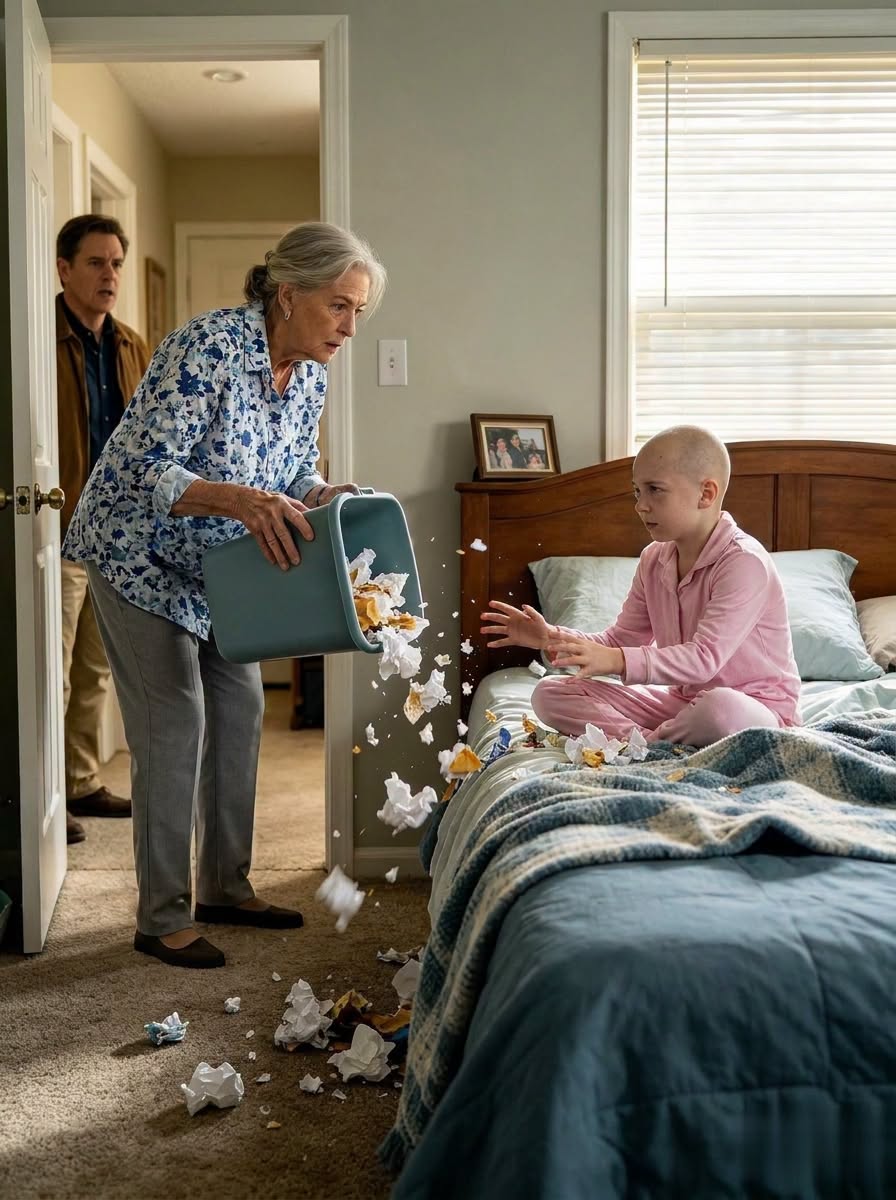
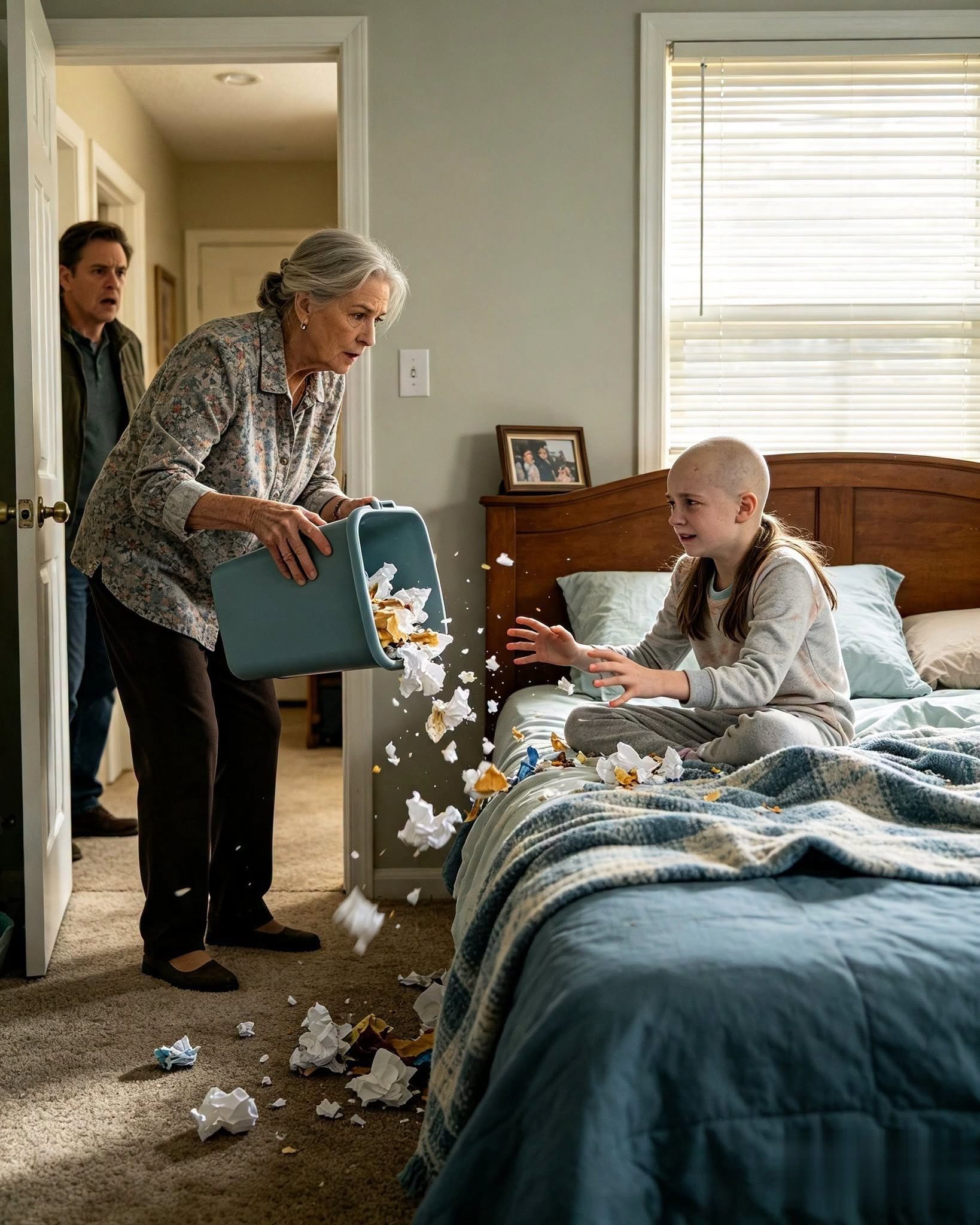
Love does not dump trash over a child’s bed because she asked to go home.
And love does not make a ten-year-old keep evidence in a zippered pouch because she believes nobody will believe her without proof.
My daughter stopped staying with Grandma.
Completely.
There were legal restrictions on contact while the investigation continued.
Grandma was furious.
Then devastated.
Then apologetic.
Then furious again.
I stopped trying to decide which version was the “real” one.
All of them were real.
That was the problem.
Three months later, my daughter had another scan.
I sat beside her in the waiting room.
She had her stuffed fox under one arm.
Her hair was beginning to grow back unevenly.
She looked tired.
But different.
Lighter.
She no longer checked the doorway every time someone raised their voice.
She no longer asked permission to call me.
She no longer apologized every time she felt sick.
The doctor came in holding the scan results.
I stopped breathing.
He smiled.
The tumor had responded.
Not gone.
Not magically fixed.
But smaller.
Treatment was working.
My daughter looked at me.
“Does that mean I’m getting better?”
“It means we keep going.”
She smiled.
Then she asked a question that nearly broke me.
“Can we put today in green?”
I knew exactly what she meant.
Her calendar.
The one Grandma had taken.
I had bought a new one.
It was hanging on our refrigerator.
Treatment days were still red.
Hospital days were blue.
Good days were green.
And now there was another color.
Yellow.
Yellow meant brave days.
The first yellow square was the day she showed me the hospital card.
The second was the day she spoke to Ms. Alvarez.
The third was the day she told the police officer the truth without apologizing.
I smiled.
“Today gets green and yellow.”
When we came home, she ran to the refrigerator.
Then she stopped.
There was an envelope on the kitchen counter.
It had arrived that morning.
No return address.
But I recognized the handwriting.
Grandma.
My daughter saw it too.
Her smile disappeared.
“You don’t have to read it,” I said.
She thought for a moment.
Then she shook her head.
“No.”
Not frightened.
Not hesitant.
Just certain.
“No?”
“She always gets to say what she thinks.”
I waited.
My daughter picked up a green marker.
“Today I don’t want to hear it.”
I stared at her.
Then I put the envelope unopened into a drawer.
Not because Grandma’s words no longer mattered.
Because for once, they didn’t get to decide what happened next.
My daughter colored the square green.
Then yellow around the edges.
She stepped back.
“It looks messy.”
I laughed.
“It does.”
She smiled.
And for the first time in months, messy didn’t mean danger.
Messy didn’t mean punishment.
Messy didn’t mean trash dumped across a bed.
Messy was just a ten-year-old coloring outside the lines.
That night, after she fell asleep, I walked past her room and stopped at the doorway.
Her stuffed fox was beside her.
Her medicine was exactly where the doctor said it should be.
Her phone was charging on the desk.
The door was open.
The room wasn’t perfectly clean.
A book was lying on the floor.
A sweatshirt hung over the chair.
Two candy wrappers were beside the lamp.
I almost laughed when I saw them.
Months earlier, I might have told her to clean up before bed.
Instead, I stood there looking at that ordinary little mess and realized how beautiful it was.
Because no one was going to use it against her.
No one was going to shame her with it.
No one was going to turn it into proof that she was difficult, ungrateful, or bad.
She was allowed to be sick.
She was allowed to be tired.
She was allowed to cry.
She was allowed to make a mess.
She was allowed to tell the truth.
And she was allowed to come home.
I started to close the door.
Then her sleepy voice stopped me.
“Dad?”
“Yeah?”
She opened her eyes.
“Did I get Grandma in trouble?”
There it was.
The last piece.
The guilt adults leave inside children when they make children responsible for adult consequences.
I walked back to her bed.
“No.”
“But if I didn’t tell—”
“No.”
I sat beside her.
“Grandma is responsible for what Grandma did.”
She stared at the ceiling.
“What if she hates me?”
I thought carefully before answering.
“I don’t know what Grandma feels right now.”
My daughter looked at me.
“But I know something more important.”
“What?”
“You told the truth when you were scared.”
She was quiet.
“And?”
“And the truth did not break this family.”
I brushed the hair away from her forehead.
“The things that were happening in secret were breaking it.”
She thought about that.
Then whispered, “Okay.”
Her eyes closed.
A minute later, she was asleep.
I stayed beside her for a long time.
Thinking about that first phone call.
Her quiet voice asking me to come get her.
How close I had come to hearing it as nothing more than homesickness.
How easily adults miss what children are trying to say because children do not always have the language to explain fear.
Sometimes they say:
Can you come get me?
Sometimes they say:
I don’t want to stay tonight.
Sometimes they suddenly hate a place they used to love.
Sometimes they become “difficult.”
Sometimes they become silent.
And sometimes they hide a folded hospital card under a pillow because that is the only evidence they know how to carry.
My daughter had not needed me to become a detective.
She had needed me to believe the change in her.
I wish I had understood sooner.
I cannot change that.
But I can decide what happens next.
So the appointment card is still with me.
I keep it inside the new medical folder.
Not because I want to remember Grandma.
Not because I want to remember the trash.
I keep it because of what was written on the back.
Patient asked to speak without grandmother present.
A ten-year-old girl found the courage to ask an adult for help.
Then another adult listened.
Then finally, so did I.
And that small folded card became the first thing that brought my daughter back home.
Not just into my house.
Back to the place where she understood something she should never have had to question.
She did not have to earn care.
She did not have to stay quiet to deserve treatment.
She did not have to protect adults from the consequences of their own choices.
And she never had to be “good enough” to be loved.
A few weeks later, I found a note taped beside the calendar.
My daughter had written it herself.
Only one sentence.
No explanation.
No name.
Just seven words.
If I’m scared, I’m allowed to tell.
I left it there.
And every morning before school, before treatment, before another uncertain day, she walked past those words.
Green squares.
Yellow squares.
Red squares.
Good days.
Brave days.
Hard days.
All of them hers.
All of them honest.
And for the first time since her diagnosis, our home was no longer a place where everyone pretended everything was fine.
It was simply the place where she could tell the truth.
And still be loved.