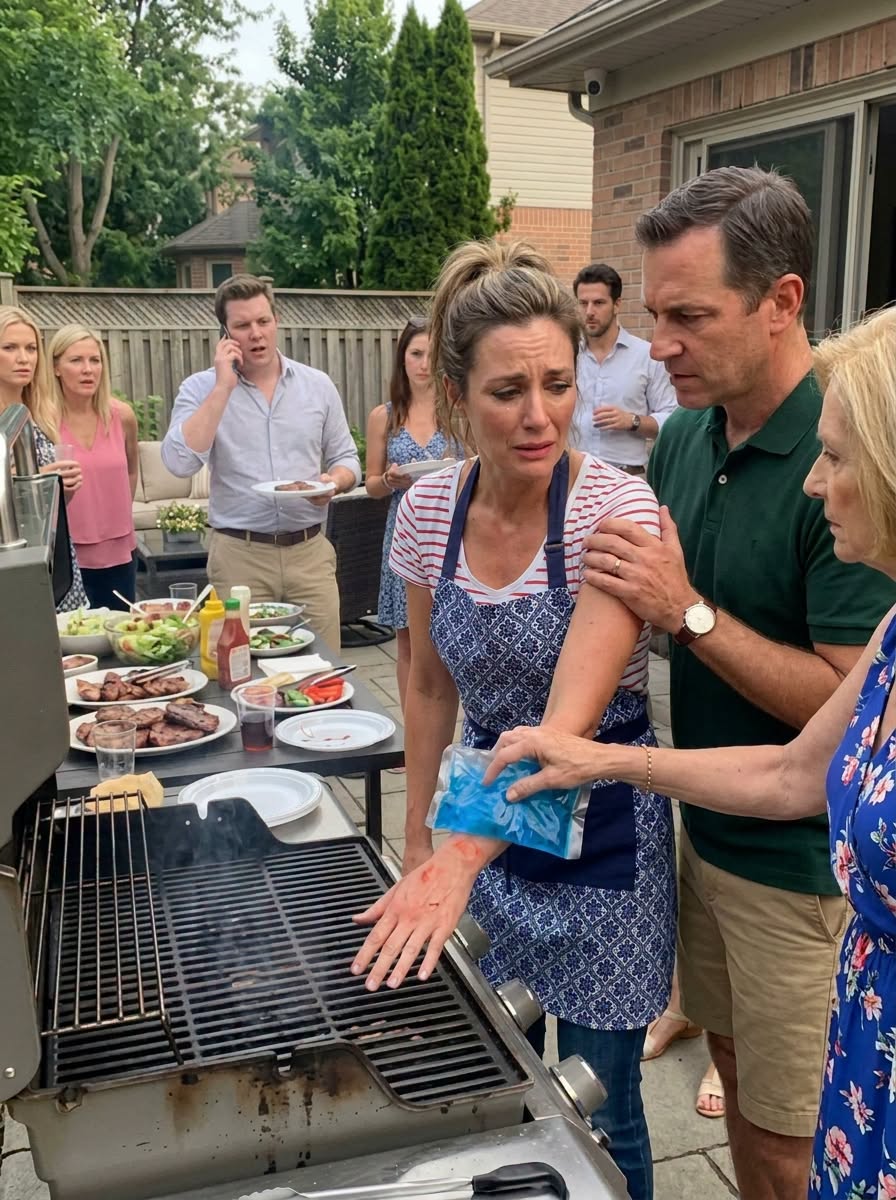
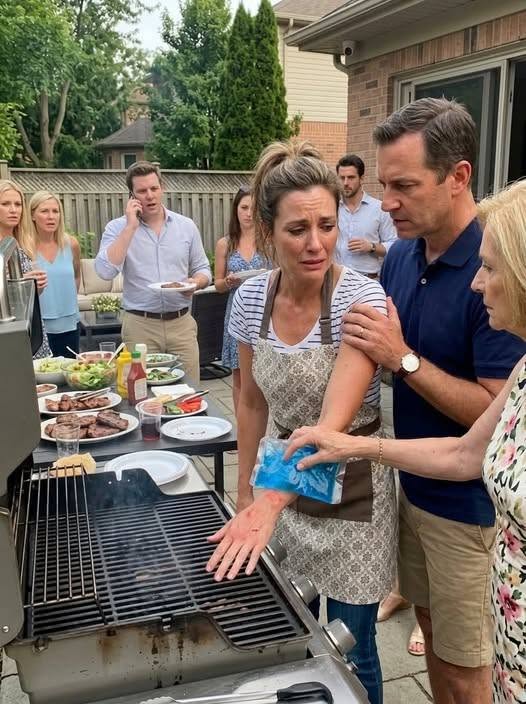
At our backyard barbecue, everyone laughed while I sweated over the grill, serving guests like a maid.
“Do your duty as a wife,” my mother-in-law sneered.
My husband tasted the meat and roared, “You call this edible?”
Then he slammed my palm onto the hot grate.
I screamed.
But instead of begging, I overturned the table, smashed the grill, and smiled.
They thought I had finally broken.
They had no idea what I would destroy next.
The second my palm hit the grill, the laughter stopped.
Pain tore through my hand so fast that my knees nearly buckled.
The ninety-degree heat had already been exhausting me for hours, but the pain that shot through my palm was different.
It was immediate.
Sharp.
Impossible to ignore.
The smell of burning meat disappeared beneath my scream.
For one bright, terrible instant, I saw my husband’s face reflected in the polished steel of the grill.
Ivan looked pleased.
That was the part I remembered most clearly.
Not shock.
Not fear.
Not regret.
Pleasure.
He expected me to pull my hand away, cry somewhere inside the house, cover the burn, and return with another tray before anyone finished their drinks.
That was what I had always done.
I cleaned up whatever he broke.
I swallowed whatever he said.
I protected him from consequences.
For ten years, I had become very good at making his life easier.
The barbecue had been Ivan’s idea.
He called it a “family celebration.”
The backyard was full of people from his world.
Executives from Vanguard Development stood near the patio with drinks in their hands.
Wealthy neighbors admired the garden.
Golf partners laughed beneath the patio umbrella.
Women who barely knew me complimented the flowers while handing me their empty plates.
I had been outside since noon.
The sun pressed down on the yard.
The grill radiated heat against my face.
My apron clung to my back with sweat.
I turned steaks.
I refilled drinks.
I carried trays.
I checked the chicken.
I kept moving.
Nobody asked whether I needed a break.
They noticed when Ivan’s glass was empty.
That was when I had to move faster.
For years, I had told myself this was simply what marriage required.
That successful men were demanding.
That wealthy families had expectations.
That keeping peace was more important than winning an argument.
Somewhere along the way, those excuses had become invisible chains.
I had spent ten years making myself smaller so Ivan could look important.
He had begun treating my silence as proof that I had no voice.
His mother, Cynthia, made sure I remembered my place.
She watched me wipe the sweat from my neck with the edge of my apron.
“Do your duty as a wife,” she announced.
“A successful man needs a woman who understands service.”
Several guests chuckled.
I looked at Ivan.
“The chicken needs five more minutes.”
He tore off a piece.
He chewed once.
Then he spat it onto the patio beside my shoe.
“You call this edible?”
“It isn’t finished.”
His eyes hardened.
He had been drinking.
But alcohol had not created his cruelty.
It had only stripped away the manners he normally used in public.
“Always an excuse,” he said.
Then he caught my wrist.
I knew immediately that something had changed.
His grip was different.
There was no playful pretense.
No audience-friendly gesture.
His fingers closed around me with force.
I tried to step backward.
He pulled me toward the open grate.
Then he forced my palm down.
Pain exploded through my hand.
I screamed.
The sound cut through the backyard.
The serving table went sideways.
A glass hit the patio and shattered.
A bowl of barbecue sauce flipped through the air and burst across Cynthia’s white dress.
Guests stumbled away from the grill.
Someone shouted Ivan’s name.
Someone else dropped a plate.
For a moment, nobody seemed to know what to do.
Then I ripped myself free.
My injured hand throbbed against my chest.
I looked at the grill.
I looked at Ivan.
And something inside me went quiet.
I grabbed the metal spatula with my uninjured hand.
I struck the grill’s control panel until the flames died.
Then I shoved the entire cart over.
The grill crashed onto the patio.
Plates cracked beneath it.
Steaks slid through spilled ice and sauce.
Smoke curled around Ivan’s expensive shoes.
The man who had expected me to cry stared at the wreckage.
I stood in the middle of it.
My palm burned.
My heart pounded.
My entire body wanted to shake.
But I didn’t give him that satisfaction.
I smiled.
“You think this is funny?” Ivan whispered.
“No,” I said.
“I think it’s finally useful.”
He didn’t understand.
Of course he didn’t.
Ivan had spent years learning how to predict me.
He knew which comments would make me go silent.
He knew which insults I would swallow.
He knew I hated embarrassing people in front of guests.
He knew I would rather leave a room than cause a scene.
He knew I valued the company.
He knew I wanted our marriage to survive.
What he didn’t know was that I had stopped confusing peace with safety.
For eighteen months, I had documented everything.
Every insult.
Every threat.
Every forged signature.
Every unexplained transfer from the company account.
I didn’t collect those records because I enjoyed being suspicious.
I collected them because the story Ivan told about himself no longer matched the evidence.
There were dates.
There were amounts.
There were messages.
There were copies.
There were transactions that made no sense.
One document alone could be explained away.
One angry message could be called a misunderstanding.
One transfer could be blamed on an accounting error.
But a pattern was different.
A pattern becomes evidence when you stop pretending it isn’t happening.
Ivan believed Vanguard Development belonged to him because his name was on the building.
He loved saying that.
He liked walking through offices as though every wall carried his name.
He liked introducing himself as the person who had built everything.
He liked introducing me as “the wife.”
The executives heard it so often that some of them stopped looking at me when business decisions were discussed.
That was exactly what Ivan wanted.
He took credit for everything I built.
And I let him.
At least, I let him believe he had.
Because Ivan had forgotten something important.
He had forgotten who funded the first property.
He had forgotten who wrote the original operating agreement.
And he had never bothered to read the trust that still controlled fifty-eight percent of the voting shares.
Me.
I had fifty-eight percent.
He had the title people could see.
I had the control he had never bothered to understand.
For years, I had watched him mistake visibility for ownership.
I watched him speak with confidence at meetings.
I watched him make promises.
I watched him dismiss my contributions.
Then I went home and kept records.
I didn’t confront him every night.
I didn’t threaten him.
I didn’t announce what I knew.
I simply documented.
That was the difference.
Silence is not surrender.
Sometimes silence is the place where evidence grows.
Back in the backyard, the evidence was beginning to become visible.
Phones began to rise.
One of Ivan’s executives lowered his drink.
His eyes moved to my hand.
The angry red marks were spreading across my palm.
Another guest stepped between Ivan and the overturned grill.
It was subtle.
Almost casual.
But I noticed.
He wasn’t protecting Ivan.
He was preventing Ivan from getting close enough to grab me again.
The people who had laughed only minutes earlier were no longer laughing.
The atmosphere had changed.
Cynthia stood frozen in her sauce-covered dress.
A guest stared at the shattered glass.
Someone else looked toward the security camera.
Ivan looked around the patio.
“They’re watching,” I said quietly.
His jaw tightened.
“You embarrassed yourself.”
The words almost made me laugh.
He still thought the humiliation belonged to me.
That was the problem with people who spend years controlling a story.
They begin to believe everyone else is trapped inside it too.
I didn’t answer.
Instead, I lifted my eyes toward the security camera above the back door.
Ivan followed my gaze.
His expression shifted.
The camera covered the grill.
It covered the patio.
It covered the chairs.
It covered the people who had been sitting there.
It had captured the moment his hand closed around my wrist.
It had captured my palm against the grate.
It had captured my scream.
And it had captured his face.
That satisfied expression.
The expression he could not explain away by saying the barbecue had gotten out of control.
Ivan knew what a camera meant.
He knew what a recording meant.
He knew exactly how different a private denial sounded when there was footage.
“Turn it off,” he ordered.
The command was familiar.
So was the expectation behind it.
He still believed I would obey.
Cynthia looked from him to me.
The executives waited.
The neighbors waited.
The golf partners waited.
Everyone seemed to be waiting for the same thing.
Would I do what I had always done?
Would I lower my eyes?
Would I apologize?
Would I make his embarrassment disappear?
Would I protect him one more time?
I looked at the camera.
Then I looked at Ivan.
“No.”
The word wasn’t loud.
It didn’t need to be.
Ivan stared at me.
“What did you say?”
I kept my injured hand close to my body.
“No.”
For the first time, his anger looked less powerful than his confusion.
He had built his version of our marriage around predictable reactions.
If he pushed, I retreated.
If he insulted me, I stayed quiet.
If his mother humiliated me, I endured it.
If something went wrong at Vanguard Development, I helped clean it up.
If he crossed a line, I moved the line.
Then he crossed another.
I moved it again.
Ten years of that had taught Ivan the wrong lesson.
He thought there was no line.
He never realized there was a point where moving the line would stop.
Around us, nobody moved.
The silence was heavier than the laughter had been.
Cynthia seemed to understand before Ivan did.
Her eyes went from my face to the camera.
Then to her son.
Ivan’s gaze followed hers.
His shoulders stiffened.
“Don’t make this worse,” he said.
I looked at him.
“You already did.”
That was when his expression changed again.
Not because I had yelled.
Not because I had overturned the grill.
Because I wasn’t afraid of the consequences anymore.
For eighteen months, I had been preparing for a moment I never wanted to happen.
I had hoped I would never need the records.
I had hoped the threats would stop.
I had hoped the unexplained transfers would have an innocent explanation.
I had hoped the marriage I remembered was still somewhere underneath the one I was living.
But hope is not evidence.
And a marriage cannot be saved by one person protecting the other from the truth.
Ivan glanced toward the executives.
They were watching him now.
Not me.
Him.
That mattered.
Because those people had spent years listening to him speak as though he controlled everything.
They had watched him dismiss me.
They had heard him call me “the wife.”
Now they were looking at the woman he had treated like an employee.
One executive finally lowered his phone.
Another didn’t.
Cynthia opened her mouth.
Nothing came out.
The sauce on her dress was bright against the white fabric.
The overturned grill smoked quietly nearby.
The backyard looked nothing like the polished celebration Ivan had planned.
That felt appropriate.
The image he had built of himself had finally begun to look like the truth underneath it.
Damaged.
Exposed.
And impossible to clean up with another smile.
Ivan took a step toward me.
The guest between us shifted his position.
Ivan stopped.
His eyes narrowed.
“You think you can threaten me?”
“I haven’t threatened you.”
“Then what are you doing?”
I looked down at my apron.
Then I reached into its pocket.
My fingers closed around the one thing Ivan never expected me to carry at his celebration.
His eyes immediately dropped toward my hand.
The backyard went quiet again.
The camera was still running.
The executives were still watching.
Cynthia was still frozen beside the wrecked table.
Ivan stared at me.
“Put it down.”
I didn’t.
His voice became sharper.
“I said put it down.”
For ten years, that tone had been enough.
Not anymore.
I closed my fingers around the object.
Then I looked directly at the man who had just burned my hand in front of his family, his friends, his business partners, and his neighbors.
He thought the barbecue had been the disaster.
He was wrong.
The barbecue was only the moment I stopped cleaning up his mess.
And whatever I had been carrying in my pocket was about to make him understand exactly how much of his life I had been quietly documenting…