My Mother Left Me Alone for a Month With Twenty Dollars.
When She Came Home, the Paper on the Kitchen Counter Destroyed the Lie She Had Built My Whole Life Around.
My childhood ended on a Thursday afternoon with a crumpled twenty-dollar bill pressed into my palm.
I was eleven years old.
My mother was leaving for Europe for a month.
And somehow, in her mind, those three facts belonged in the same story.
“See?” she said brightly,
dragging a huge black Samsonite suitcase across the foyer.
“You’re independent now.”
The wheels rattled over the hardwood floor.
I stared at the money.
Twenty dollars.
Not twenty dollars a day.
Not twenty dollars for emergencies.
Twenty dollars for thirty days.
My mother, Vanessa Whitmore, was dressed for the airport in cream trousers, sunglasses resting on top of her perfectly styled blond hair, and a silk scarf around her neck.
She looked like a woman from a travel advertisement.
I looked like what I was.
An eleven-year-old girl wearing a faded school T-shirt and socks covered in little yellow stars.
“Mom?”
She checked her phone.
“Yes?”
“What am I supposed to eat?”
She gave a small laugh.
“Whatever you want.”
“But there isn’t really anything—”
“Order something.”
“With this?”
I held up the twenty.
For the first time, irritation cracked through her cheerful expression.
“Sydney, please don’t make this dramatic.”
My stomach tightened.
“I’m not.”
“You always do this when I have somewhere important to be.”
She leaned down and took hold of my shoulders.
For one hopeful second, I thought she was finally going to realize how ridiculous this was.
Instead, she smiled.
That bright, brittle smile.
“You’re not a baby anymore. Plenty of kids your age are independent.”
“For a month?”
Her fingers tightened slightly.
“I’ll be back before you know it.”
“Can I stay with Aunt Claire?”
The smile vanished.
“No.”
“Why?”
“Because I said no.”
“What about Mrs. Dawson next door?”
“No.”
“Does she know I’m here?”
My mother looked away.
That told me everything.
No emergency numbers had been placed on the refrigerator.
No relative had been asked to check on me.
No neighbor had been told.
The pantry hadn’t been stocked.
My mother had not prepared for me to live without her.
She had simply prepared to leave.
A horn sounded outside.
Her ride.
She released my shoulders.
“I have to go.”
“Mom…”
I followed her toward the door.
I remember every ordinary detail.
Her perfume.
The afternoon sun through the glass panels.
The silver zipper on her suitcase.
The pencil mark on the wall where I had measured my height six months earlier.
Normal things.
Safe things.
Things that belonged in a house where children were supposed to be protected.
She opened the door.
“Behave yourself.”
Then she walked away.
No hug.
No kiss.
No “I love you.”
Her heels clicked down the driveway.
The suitcase rolled behind her.
She climbed into a dark car.
And disappeared.
I stood in the doorway until the car turned the corner.
“I’ll be fine,” I whispered.
The empty house gave no answer.
Even at eleven, I knew I was lying.
I locked the door and hurried into the kitchen.
Maybe I had misunderstood.
Maybe she had stocked another cabinet.
Maybe there was frozen food downstairs.
Maybe twenty dollars was only pocket money.
I opened the refrigerator.
A carton of sour milk.
Half a jar of pickles.
Mustard.
Three slices of cheese hardened around the edges.
A lemon.
The freezer contained ice cubes and a nearly empty bag of peas.
The pantry held one dented can of tuna, creamed corn, flour, salt, half a jar of peanut butter, and three crackers.
That was it.
I slowly sat on the kitchen floor.
For several minutes, I felt nothing.
Then my hands began to shake.
She had actually done it.
I spent $4.17 that first evening.
Bread.
Bananas.
The cheapest noodles I could find.
I walked six blocks to the little market because nobody was there to drive me.
The cashier, Mr. Kim, knew me.
“Where’s your mom?”
“Trip.”
“Business?”
“Vacation.”
“You staying with family?”
I froze.
Something inside me understood that if I answered honestly, everything would change.
Adults would be called.
Questions would be asked.
My mother would be furious.
At eleven, that possibility frightened me more than hunger.
So I smiled.
“My aunt’s around.”
That was the first lie I told to protect the woman who had abandoned me.
It would not be the last.
During the first week, money became oxygen.
I kept a little purple notebook.
$20.00
Then:
$15.83
$13.12
$9.47
I ate toast.
Bananas.
Tuna stretched across two meals.
At night, the house became enormous.
During the day, I could pretend it was an adventure.
After sunset, every sound became a threat.
Branches against windows.
Pipes knocking.
Cars slowing outside.
Once, after midnight, somebody rang the doorbell.
Then again.
Then came a knock.
“Sydney?”
Mrs. Dawson.
I almost ran to the door.
Then I remembered one of my mother’s favorite rules.
Do not involve the neighbors in our business.
Privacy, she called it.
Our family.
Our problems.
So I stayed silent.
Eventually, Mrs. Dawson left.
The next morning, a plastic container sat on our porch.
Spaghetti.
A note was taped to it.
Made too much. Thought you and your mom might enjoy it.
I carried it inside.
I ate half.
Then cried over the kitchen sink because I finally understood how hungry I had been.
By the ninth day, my twenty dollars was gone.
I had twenty-three cents left.
I called Mom.
Voicemail.
“Hi, Mom. It’s me.”
I tried to sound casual.
“Just wondering when you’re going to call.”
My voice cracked.
“I’m okay.”
Another lie.
“I just… don’t have much food left.”
My eyes burned.
“Can you call me?”
I waited.
“Please?”
She never called back.
I tried again the next day.
And the next.
Nothing.
Then, around the twelfth day, I realized something.
The electricity remained on.
So did the water.
The internet worked.
My mother hadn’t forgotten the bills.
She had made sure the house functioned.
She simply hadn’t made sure I did.
That realization hurt more than the hunger.
She had booked flights.
Paid utilities.
Packed outfits.
Arranged transportation.
Leaving me with twenty dollars had not been an accident.
It had been another deliberate choice.
By day fourteen, I stopped waiting for her to rescue me.
That was the day childhood truly ended.
I searched drawers and found $8.60 in coins.
I returned empty bottles.
I learned how cheap rice, beans, oatmeal, and eggs could be.
I learned to cook from instructions online.
The first rice burned.
The second was watery.
The third was almost right.
I washed clothes.
Took out trash.
Checked the locks before bed.
I created rules.
Never open the door at night.
Never tell strangers I was alone.
Keep the phone charged.
Keep shoes beside the bed.
Eat enough to think clearly.
And:
Write everything down.
That last rule changed everything.
Because when I started writing, I started remembering.
Mom leaves me alone a lot.
Sometimes evenings.
Sometimes overnight.
Sometimes longer.
Mom says Dad left before I was born.
Mom becomes angry when I ask about him.
Why can’t Aunt Claire visit?
Claire was my mother’s older sister.
I barely remembered her.
Curly brown hair.
Peppermint.
A playground.
A birthday card with a butterfly.
Then nothing.
Mom always said Claire had “made choices.”
That phrase ended every conversation.
On day seventeen, I went searching for another blanket.
Under the guest-room bed was a flat storage box.
Inside were old photographs.
One stopped me.
My mother stood beside Aunt Claire.
Both younger.
Claire was holding a newborn baby.
Me.
Written on the back:
Sydney, three weeks old. You were worth every fight. — C
Every fight.
I kept searching.
Beneath the photographs was an old letter addressed to my mother.
Vanessa,
You can keep pretending this is about me interfering, but someday Sydney will ask why every person who tried to help her disappeared from her life.
I did what the attorney advised. I documented everything.
I am asking one last time: let me see her.
Claire.
Attorney.
Documented.
Everything.
At the bottom of the box was a business card.
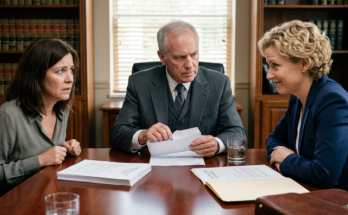
Claire Morrison — Family Law Attorney.
A phone number.
I carried it downstairs.
For ten minutes, I stared at the phone.
Calling Claire felt like betrayal.
But betrayal of whom?
I dialed.
A receptionist answered.
“Morrison and Blake.”
“Can I talk to Claire Morrison?”
“May I ask who’s calling?”
I almost hung up.
Then:
“Sydney.”
“Last name?”
“Whitmore.”
Silence.
“One moment.”
Twenty seconds later, someone answered.
No professional greeting.
Just a trembling voice.
“Sydney?”
I couldn’t answer.
“Sydney, sweetheart, is that you?”
“Yes.”
Claire inhaled sharply.
“Oh my God.”
Then:
“Where is your mother?”
“In Europe.”
“For how long?”
“A month.”
“What adult is staying with you?”
My eyes filled.
“No one.”
Silence.
“Sydney, listen carefully. Are you safe?”
“I think so.”
“Is the door locked?”
“Yes.”
“Are you hurt?”
“No.”
“Do you have food?”
“A little.”
“How long have you been alone?”
“Seventeen days.”
Claire made a broken sound.
Then whispered:
“…she did it again.”
I gripped the phone.
“What?”
“Nothing.”
“What do you mean again?”
“Sydney, I’m coming to you.”
Fear shot through me.
“No!”
She went quiet.
“If Mom finds out—”
“Sydney, your mother left an eleven-year-old alone for more than two weeks.”
I started crying.
“I’m independent.”
Claire’s voice broke.
“Oh, sweetheart.”
That sentence destroyed me because, for the first time, an adult heard the word my mother had taught me and reacted as if it was horrifying.
Claire asked whether Mom had left me overnight before.
Yes.
More than five times?
Yes.
More than ten?
I hesitated.
“Yes.”
Had she left me without enough food?
“Yes.”
“I’m coming,” Claire said.
This time, I didn’t stop her.
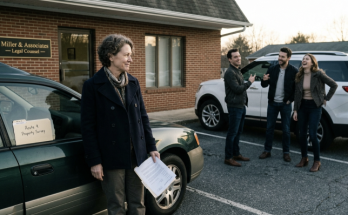
Forty-two minutes later, three knocks came at the door.
Pause.
Three knocks.
Claire had told me that would be her.
She stood outside.
Older than I remembered.
Same curly hair.
Long coat.
Tears already in her eyes.
Beside her were a woman in a navy jacket and a police officer.
I almost backed away.
Then Claire raised her hand to the glass.
A playground flashed through my mind.
Peppermint.
Her hand holding mine.
I opened the door.
She didn’t grab me.
She asked:
“Can I hug you?”
I nodded.
The second her arms wrapped around me, I stopped being strong.
I sobbed.
Fear.
Hunger.
Anger.
Embarrassment.
“I tried.”
“I know.”
“I tried to make the money last.”
“I know.”
“I didn’t break anything.”
“I know, Sydney.”
“I kept everything clean.”
Claire pulled back and held my face.
“You should never have had to prove any of that.”
The woman in navy was from child protective services.
Rebecca.
She asked questions gently.
The officer photographed the pantry, refrigerator, notebook, and phone records.
Then Rebecca said I could not remain there alone.
I expected Claire to look relieved.
Instead, she looked frightened.
Not of the authorities.
Of my mother.
That night, I stayed at Claire’s house.
Her husband, Michael, made grilled cheese.
Their thirteen-year-old daughter, Emma, gave me pajamas without making it awkward.
There was a night-light in the hallway.
I pretended I didn’t need it.
Claire turned it on anyway.
After dinner, I asked:
“What did you mean when you said Mom did it again?”
Claire and Michael exchanged a look.
“Your mother and I had a younger brother,” Claire finally said.
Had.
“His name was Daniel.”
I had never heard the name.
“When Vanessa was eighteen, our parents went away for ten days. Vanessa was supposed to stay with him.”
“What happened?”
Claire’s eyes filled.
“She didn’t. She left Daniel alone for almost three days while she went away with friends.”
“Was he okay?”
“He became very sick.”
She quickly added:
“He survived.”
“Where is he now?”
“I don’t know.”
“What?”
“He left when he turned eighteen and cut contact with nearly everyone.”
Claire stared toward the window.
“That was the beginning of the split in our family.”
The next morning, Claire told me there had been an emergency hearing.
She was granted temporary guardianship.
Mom still had not called.
Then Claire showed me flight records.
The Europe trip had been booked for four people.
Vanessa Whitmore.
Gregory Voss.
Two others.
“Who’s Gregory?”
“Your mother’s boyfriend.”
“I didn’t know she had one.”
“I know.”
There were hotel reservations.
Restaurants.
Luxury shops.
And money missing from an education account my grandparents had created for me.
Nearly forty thousand dollars.
I stared at the number.
“But she gave me twenty.”
Claire said nothing.
That silence hurt more than an answer.
Neighbors were interviewed.
Teachers.
Mr. Kim.
Mrs. Dawson.
Mrs. Dawson admitted she had suspected I was alone but couldn’t believe Mom would leave me longer than a night.
Her security camera provided what nobody could explain away.
It showed my mother leaving.
Then no adult entering our home for seventeen straight days.
We knew Mom would return on the thirtieth day.
Authorities wanted to meet her at the airport.
Claire disagreed.
“She’ll turn it into theater.”
Rebecca asked what Claire suggested.
Claire looked at me.
“You should not be there.”
But I wanted to be.
For nearly a month, adults had decided things around me.
My mother decided I was independent.
The court decided where I slept.
Rebecca decided which questions I answered.
Everyone except my mother meant well.
But they were still deciding.
“I want her to see me.”
That evening, Claire helped me prepare one page.
At the top:
CONSENT TO TEMPORARY GUARDIANSHIP AND VOLUNTARY TRANSFER OF CUSTODIAL AUTHORITY
At the bottom:
Vanessa Whitmore
Signature line.
Beside it:
A pen.
That was what we placed on the kitchen counter.
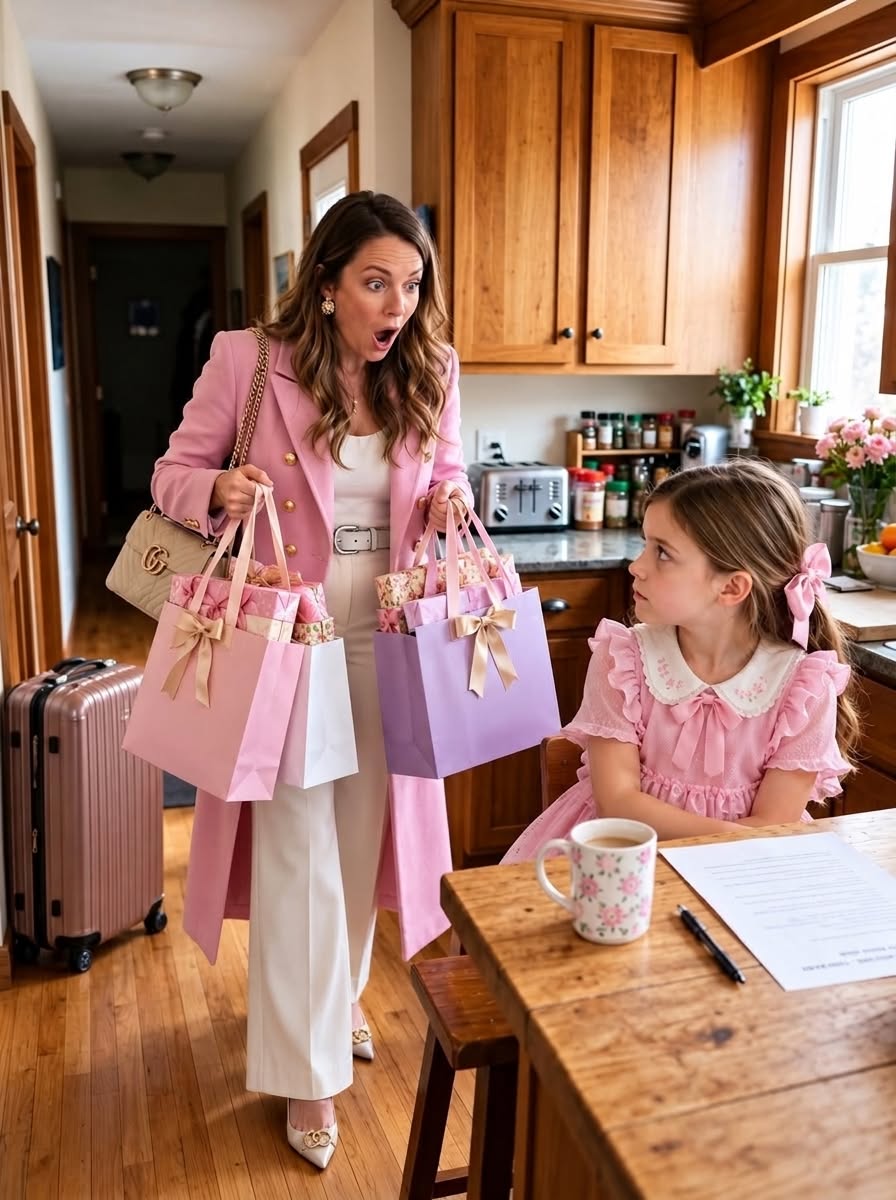
At 4:17 p.m., the front door opened.
Mom walked in laughing at something on her phone.
She looked tan.
Relaxed.
Souvenir bags hung from both wrists.
Designer handbag over one shoulder.
“Sydney?”
Casual.
Almost cheerful.
“You alive?”
Those words still make something inside me go cold.
I didn’t answer.
She entered the kitchen.
“I brought you something from Paris. You are going to love—”
She stopped.
The bags slipped from her hands.
A tiny Eiffel Tower keychain rolled across the floor.
Her eyes fixed on the counter.
The document.
The pen.
“No,” she whispered.
She stepped closer.
“No. No. This can’t be happening.”
I stood across from her.
Finally, she looked at me.
“Where did you get this?”
“Aunt Claire.”
Her face drained.
“What?”
“She knows.”
My mother stared toward the hallway.
“Claire?”
My aunt stepped into view.
“What are you doing in my house?”
Claire answered calmly.
“Protecting Sydney.”
Vanessa gave a sharp laugh.
“From what?”
I answered.
“You.”
My mother turned toward me.
“What did you tell them?”
“The truth.”
“You have no idea what you’ve done.”
For half a second, every old fear returned.
Small.
Guilty.
Responsible for her feelings.
Then Rebecca entered.
“Ms. Whitmore.”
Mom stared at her identification.
“You called social services?”
Claire answered.
“Sydney called me.”
Mom looked at me with betrayal.
“You called Claire?”
“I was hungry.”
“That doesn’t mean you call someone who hates me!”
“I didn’t even know her.”
Mom’s mouth opened.
Nothing came out.
Rebecca began explaining the court order.
Mom interrupted.
“She’s eleven, not four. She knows how to use a microwave. She has a phone.”
Rebecca said:
“You left her alone for thirty days.”
“She was fine.”
“No,” I said.
Mom turned.
“I wasn’t.”
Silence.
“I was scared every night. I ate rice because there wasn’t enough food. I called you.”
“I was traveling.”
“For seventeen days?”
“I had bad reception.”
“You posted pictures every day.”
That stopped her.
“You posted from restaurants. Hotels. Boats. You had reception.”
Her jaw tightened.
“Sydney, adults have complicated lives.”
“And kids get hungry.”
She looked toward Claire.
“You’re being manipulated.”
Claire started to speak.
I stopped her.
“You told me I was independent.”
Mom folded her arms.
“You are.”
“No.”
I pointed at the document.
“Independent means I can do things for myself.”
Then I looked straight at her.
“It doesn’t mean you get to stop being my mother.”
Her face went blank.
I pushed the pen toward her.
“Sign it.”
“No.”
“Then we go to court.”
“You think Claire wants you?”
Claire inhaled sharply.
Mom saw the wound and pressed harder.
“You think she’s doing this because she loves you? You don’t understand this family.”
“What don’t I understand?”
For one second, Mom looked afraid.
Claire noticed.
“So tell her, Vanessa.”
“Stay out of this.”
“Tell her.”
Mom grabbed the document.
“You want the truth?”
She looked at me.
“Claire tried to take you away from me when you were a baby.”
My heart stopped.