The telephone rang at 5:07 on Thanksgiving morning, and before Eleanor Hale answered it,
she already knew something was wrong.
People who loved you did not call at that hour unless somebody was sick, stranded, arrested, or dead.
She sat upright in bed,
listening to the second ring vibrate through the dark house,
and reached for her glasses.
Marcus’s name glowed on the screen.
That surprised her enough to make her hesitate.
Her son-in-law rarely called her without Chloe arranging it first.
Marcus preferred messages—short ones, usually about arrival times or gifts for the grandchildren of other relatives.
Even at family dinners,
he spoke to Eleanor with the strained courtesy of a man acknowledging someone he considered harmless but inconvenient.
She answered. “Marcus?”
“Finally.” His voice was sharp and fully awake. No greeting. No apology. “I need you to go get Chloe.”
Eleanor swung her feet onto the cold floor. “From where?”
“The bus terminal.”
For several seconds, she said nothing. The heating system clicked on somewhere beneath the floorboards. Outside, November wind dragged dry leaves along the driveway.
“What bus terminal?”
“The downtown one. Bay area, whatever they call it.” Marcus exhaled as if Eleanor were already making this difficult. “She should still be there.”
Eleanor looked at the clock again. “Why is my daughter at a bus terminal at five in the morning?”
Another voice sounded faintly behind him. Sylvia, Marcus’s mother. Eleanor could not make out the words, but she recognized the impatient rhythm immediately.
Marcus lowered his voice. “She had an episode.”
Eleanor stood.
She had spent most of her adult life learning that the first description of an incident was rarely the whole incident. Sometimes it was an honest mistake. Sometimes fear distorted memory. Sometimes the person speaking first understood perfectly well that whoever defined the event first gained an advantage.
“What kind of episode?”
“You know Chloe.”
“Yes,” Eleanor said. “I do.”
That answer seemed to irritate him.
Chloe was thirty-six, an engineer who labeled electrical cords before moving houses and once produced a color-coded spreadsheet to organize a three-day family reunion. When her father had died, Chloe had been the one who remembered which relatives needed rides from the airport while Eleanor could barely remember whether she had eaten breakfast.
Chloe could become upset. Anyone could.
But Chloe did not simply disappear into a bus terminal before dawn without her coat.
Marcus continued talking. “She got emotional. Things escalated. Mom tried to calm her down, which obviously didn’t work. We have people coming today, and I can’t spend Thanksgiving dealing with this.”
Eleanor went very still.
“You have people coming?”
“Eleven for dinner.”
“And Chloe?”
“I just told you. Go pick her up.”
Eleanor crossed the bedroom and switched on the lamp. Her late husband’s photograph stood on the dresser, smiling from a summer twenty years earlier. Beside it lay yesterday’s grocery receipt and a small stack of coupons she had clipped while watching the evening news.
To Marcus, those things constituted Eleanor Hale.
Widow. Retiree. Coupons. Old SUV. Birthday cards containing twenty-dollar bills.
He had never asked what came before.
“What happened to Chloe?” Eleanor asked.
“Nothing happened to her.”
The answer came too quickly.
Eleanor opened her closet.
Behind Marcus, Sylvia said something louder this time.
“What did your mother say?” Eleanor asked.
“Nothing relevant.”
“I heard her.”
There was muffled movement, and then Sylvia’s voice arrived directly through the telephone.
“Tell Eleanor to collect her daughter before somebody complains about her hanging around the station.”
Eleanor recognized the tone. Sylvia used it with waiters, cashiers, housecleaners, and anyone else she believed occupied a lower rung of an invisible ladder.
Then Sylvia added, “And tell her Chloe ruined the rug.”
Eleanor stopped with one arm inside her cardigan.
“What rug?”
Marcus muttered something away from the phone.
Sylvia apparently ignored him. “The Persian one in the sitting room. Do you have any idea what professional cleaning costs?”
Eleanor took her arm out of the cardigan.
“Why does it need cleaning?”
Silence.
Not complete silence. She heard dishes touching a countertop. A cupboard shutting. Somewhere in Marcus’s house, Thanksgiving preparations were already underway.
Marcus came back onto the line. “Mom is exaggerating.”
“You said nothing happened.”
“Because nothing serious happened.”
Eleanor’s pulse remained slow. Years earlier, junior attorneys had occasionally mistaken that calmness for uncertainty. Opposing counsel had made the same mistake.
“What happened that wasn’t serious?”
“Eleanor, I don’t have time for an interrogation.”
“No,” she said. “You apparently have a turkey to cook.”
He missed the warning in her voice.
“Exactly. Guests start arriving before noon. Just bring Chloe to your house, let her sleep, and maybe after the holiday she’ll be reasonable.”
Eleanor closed her eyes.
“Where is her car?”
“At the house.”
“Her purse?”
“I don’t know.”
“Her telephone?”
Another pause.
“Probably with her.”
“Probably?”
“I didn’t inventory her possessions.”
Eleanor reached for jeans and pulled them on. “How did she get to the terminal?”
“I assume a ride.”
“From whom?”
“I don’t know.”
“Did you see her leave?”
Marcus’s patience snapped. “She left, Eleanor. Why does every detail matter?”
Because details were where lies developed fractures.
Eleanor did not say that.
Instead she asked, “When did you last see my daughter?”
The line became quiet enough that Eleanor heard Marcus breathing.
“Maybe an hour ago.”
“And you waited until now to call me?”
“I thought she’d cool off.”
“At a bus station.”
“She chose to go there.”
“Without her car.”
“She was being dramatic.”
Sylvia’s voice intruded again. “Marcus, stop explaining yourself to her.”
Then came another sentence, farther from the receiver but unmistakable.
“Lauren will be here by ten. We still need to reset Chloe’s place.”
Eleanor’s fingers tightened around the phone.
“Who is Lauren?”
Marcus said nothing.
“Marcus.”
“Mom shouldn’t have said that.”
“Who is Lauren?”
“This isn’t the time.”
Eleanor stared at herself in the mirror. Gray threaded through the dark hair at her temples. Her face looked exactly as it had a minute earlier, yet something inside it seemed to have changed.
“Is Lauren coming to Thanksgiving dinner?”
“That has nothing to do with picking up Chloe.”
“Is she sitting in Chloe’s place?”
“Eleanor—”
“Answer me.”
Marcus gave a humorless laugh. “You’re making this much bigger than it is.”
Eleanor had heard variations of that sentence in interview rooms, depositions, corridors outside courtrooms, and conference rooms where powerful people discovered that consequences were not theoretical.
She had also heard it from frightened witnesses who had been trained by years of mistreatment to distrust their own judgment.
It was rarely an innocent sentence.
She pulled on wool socks.
“Where exactly is Chloe?”
“I told you. Downtown terminal.”
“It has more than one entrance.”
“Bay Six, I think.”
“You think?”
“That’s where she texted from.”
“Send me the message.”
“No.”
The refusal was immediate.
Eleanor felt something cold move through her that had nothing to do with the November morning.
“Why not?”
“Because it’s private.”
“You just telephoned me before sunrise and ordered me to retrieve my daughter from a terminal. Privacy is an unusual concern to discover now.”
“Just go get her.”
Eleanor did not answer.
Marcus mistook the silence for surrender.
“And please don’t bring her back here. Not today. Everyone’s already been through enough.”
Everyone.
Eleanor thought of Chloe’s empty chair being reset for a woman named Lauren.
“What happened to the rug?” she asked once more.
Marcus hung up.
Eleanor remained beside the bed with the dead telephone pressed to her ear.
She did not swear. She did not call him back. She did not telephone Sylvia. Anger was useful only if it remained subordinate to judgment, and Eleanor had spent thirty-two years learning how expensive uncontrolled anger could become.
She dressed quickly and went downstairs.
Her house smelled faintly of cinnamon because she had baked two pies the previous evening. One was intended for Marcus and Chloe’s Thanksgiving table. Chloe had insisted Eleanor bring only dessert because Sylvia wanted complete control of the meal.
Eleanor looked at the pies on the counter.
Then she walked past them.
In the hallway closet, behind a stack of winter blankets, stood a narrow steel lockbox. Eleanor had not opened it in nearly four years.
She carried it to the kitchen table.
The key remained where it had always been, tucked inside an old ceramic jar containing spare batteries. Eleanor unlocked the box and lifted the lid.
Inside were remnants of another life: identification, photographs, several commendation letters she had never bothered framing, and an old leather credential holder.
She opened it.
The badge had dulled slightly with age.
Eleanor ran her thumb across its edge.
She had once been an assistant United States attorney and later a federal prosecutor whose cases had involved fraud, corruption, organized schemes, intimidation, and people wealthy enough to believe rules were inconveniences designed for someone else.
She had retired without ceremony beyond a modest office gathering.
After her husband became ill, she had wanted quiet.
After he died, she had wanted even more of it.
Chloe knew what her mother had done, of course, but Eleanor rarely discussed cases at home. Marcus knew she had “worked for the government,” yet had never shown enough curiosity to ask exactly how. Sylvia once assumed Eleanor had been a clerk and spent twenty minutes explaining the legal system to her at Christmas.
Eleanor had let her.
There had been no reason not to.
Until now.
She did not put the badge in her purse as a threat or talisman. It had no current authority, and Eleanor understood that better than anyone. She slipped the old credential holder into the inner pocket because touching it had reminded her of something she had nearly forgotten during years of gardening, grocery shopping, and quiet Sunday breakfasts.
Listen first.
Preserve facts.
Separate what you know from what you suspect.
Do not warn someone before you understand what they may be trying to hide.
She closed the lockbox.
Then she picked up her car keys.
At 5:31, Eleanor backed her twelve-year-old SUV out of the driveway.
The windshield heater struggled against the cold. Streets usually clogged with commuters were nearly empty, their traffic lights changing obediently for nobody. Holiday decorations hung from lampposts downtown, red ribbons twisting in the wind.
At one intersection, Eleanor called Chloe.
The call went directly to voicemail.
She tried again.
Voicemail.
She called Marcus.
He declined the call.
Eleanor continued driving.
Ten minutes later, the bus terminal appeared ahead, a low concrete building washed in fluorescent light. Two buses idled near the loading bays, exhaust spreading pale clouds across the pavement.
Eleanor pulled into the nearest space and got out.
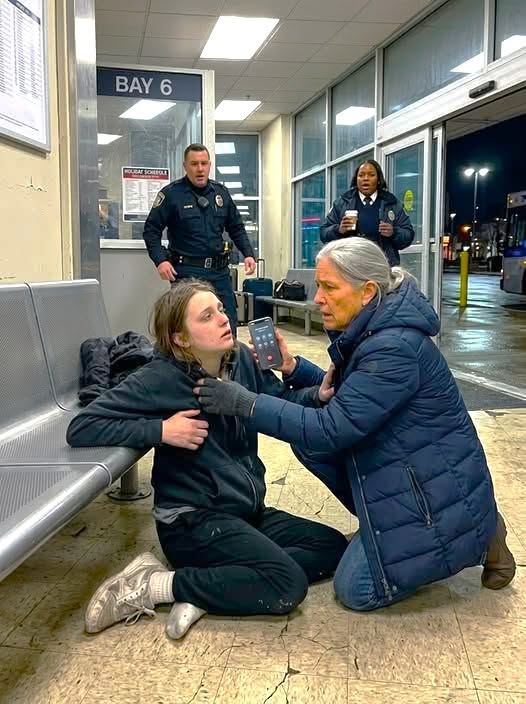
She saw Bay Six.
For one terrible second, she saw nobody.
Then she noticed a figure sitting beyond the shelter, partly hidden by a concrete pillar.
A woman.
No coat.
One shoe.
Eleanor began to run.
And before she reached her daughter, before Chloe raised her bruised face and recognized her, Eleanor understood that Marcus had lied about far more than a Thanksgiving argument.
PART 2 – Chloe Had One Shoe, No Coat, and a Story Marcus Had Expected Shame to Keep Buried
“Mom?”
Chloe said the word so softly Eleanor almost did not hear it over the idling bus.
She was sitting on a metal bench with her arms folded hard across her chest. Her blouse was wrinkled and torn near one shoulder. One stockinged foot rested on the pavement; the other still wore a black flat. Her hair, normally pinned or neatly tied, hung across her face in tangled strands.
Eleanor dropped to her knees in front of her.
“Look at me.”
Chloe tried.
That was when Eleanor saw the discoloration along her cheek.
Every instinct in her body demanded action at once—Marcus’s address, his front door, Sylvia standing behind it—but Eleanor forced those impulses down.
Her daughter came first.
“Can you breathe normally?”
Chloe nodded.
“Did you hit your head?”
“I don’t know.”
“Are you bleeding anywhere?”
“I don’t think so.”
“Do you know where you are?”
A tiny, broken laugh escaped Chloe. “You’re doing the checklist.”
“Yes.”
“Downtown terminal. Bay Six. Thanksgiving morning.” Chloe swallowed. “And I’m thirty-six years old and my mother had to come get me.”
Eleanor took off her coat and wrapped it around her.
“That last part is not part of the checklist.”
Chloe looked down.
Eleanor touched her wrist carefully. Her skin was frighteningly cold.
“How long have you been outside?”
“I don’t know. Maybe forty minutes.”
“Why didn’t you go inside?”
“I did. Then I thought Marcus might come.”
“Was he threatening to?”
“No.”
“Did anyone else come with you?”
Chloe shook her head.
Eleanor wanted to ask a hundred questions. Instead she took her telephone from her pocket.
“I’m calling emergency services.”
Chloe caught her wrist.
“No police.”
Eleanor met her eyes.
“Why?”
“I can’t.”
“That isn’t an answer.”
“Please, Mom.”
Chloe’s fingers were trembling.
Eleanor softened her voice. “I won’t force you to tell me everything this second. But you’re hurt, you’ve been exposed to the cold, and you may have a head injury. We need medical help.”
“I don’t want Marcus arrested.”
Eleanor studied her.
“I didn’t say anything about Marcus being arrested.”
Chloe’s grip loosened.
There it was.
Not proof. Not yet.
But an answer.
Eleanor sat beside her and pulled the coat tighter around Chloe’s shoulders.
“Tell me enough to help you safely.”
Chloe stared across the terminal. A maintenance worker pushed a wheeled trash bin through the automatic doors. Somewhere nearby, an announcement crackled over a speaker.
“I found messages.”
Eleanor waited.
“Marcus left his tablet charging in the kitchen yesterday. A message came through while I was cooking. It said she couldn’t wait to finally spend Thanksgiving with him.”
“Lauren?”
Chloe looked sharply at her.
“How do you know her name?”
“Sylvia mentioned her while Marcus was on the telephone.”
Chloe closed her eyes.
“So they’re already setting the table.”
Eleanor heard the devastation beneath the ordinary sentence.
“Who is Lauren?”
“She works with Marcus. Or used to. I don’t even know anymore.”
“How long?”
“He says six months.”
“And you believe him?”
“No.”
Chloe rubbed both hands over her face, then winced when her fingers touched her cheek.
“I scrolled backward. I shouldn’t have, but I did. There were photographs. Hotel reservations. Messages about weekends he told me were conferences. She knew about me, Mom. She knew everything.”
Eleanor said nothing.
“She asked when he was finally going to leave me. He told her after the holidays.”
“Then why is she coming today?”
Chloe gave another small laugh without humor. “Because Sylvia accelerated the schedule.”
Eleanor turned toward her.
“What does that mean?”
“I confronted Marcus last night. He denied it until I showed him the messages. Then he said our marriage had been dead for years and I was too obsessed with work to notice.”
“Was Sylvia there?”
“She came over.”
“At what time?”
“Maybe eleven-thirty.”
“Why?”
“Marcus called her.”
Of course he had.
Chloe continued. “She didn’t ask what happened. She already knew about Lauren.”
Eleanor’s jaw tightened.
“She knew?”
“She said everyone knew Marcus wasn’t happy.”
“Everyone?”
“That’s what she said.”
Eleanor remembered dinners where Sylvia had smiled across the table at Chloe, accepting gifts, complimenting her desserts, asking about her promotion.
“What happened next?”
Chloe’s eyes moved toward the pavement.
“I wanted to leave.”
Eleanor waited.
“Marcus took my keys.”
“Why?”
“He said I was too upset to drive.”
“Your phone?”
“He took that too.”
Eleanor felt the shape of the incident changing.
“Did you ask for them back?”
“Of course.”
“What did he say?”
“That we needed to finish the conversation.”
“And Sylvia?”
“She stood between me and the front door.”
Eleanor kept her voice level.
“Did she touch you?”
Chloe did not answer.
“Chloe.”
“She grabbed my arm.”
“Show me.”
Chloe hesitated, then pushed Eleanor’s coat from one shoulder and rolled up her sleeve.
Finger-shaped bruises were already forming above her elbow.
Eleanor inhaled through her nose.
“Who did that?”
“Sylvia.”
“And your face?”
Chloe stared at the ground.
Eleanor did not repeat the question.
After several seconds, Chloe whispered, “Marcus.”
The terminal seemed to become very quiet.
Eleanor had prosecuted men who could discuss violence in the language of inconvenience. She knew how tempting it was to imagine them as visibly monstrous. Usually they were not. They wore pressed shirts. They remembered birthdays. They volunteered. They complained about property taxes.
Sometimes they hosted Thanksgiving.
“What happened?”
“I tried to get around Sylvia. Marcus pulled me back. I shoved him away.”
Chloe’s breathing changed.
“Take your time.”
“He said I was embarrassing myself. I told him I was leaving and filing for divorce. Sylvia started saying I wasn’t going anywhere until I calmed down because I’d make a scene and ruin Thanksgiving.”
“Then?”
“I tried to get my phone from Marcus.”
Chloe touched her cheek.
“He hit me.”
Eleanor’s hands remained folded in her lap because she did not trust them to move.
“Open hand or closed?”
“Open.”
“Once?”
“Yes.”
“Did you fall?”
“Into the side table.”
“The rug.”
Chloe looked at her.
“My wineglass fell. Red wine went everywhere.”
For one second neither woman spoke.
Then Eleanor understood the grotesque detail that had bothered her since Marcus’s call.
Sylvia had complained about the rug.
Not Chloe’s face.
The rug.
“What happened after that?”
“They started cleaning.”
Eleanor stared at her daughter.
“Immediately?”
“Sylvia did. She got towels. Marcus kept telling me to stop crying because the neighbors might hear.”
Chloe’s voice cracked.
“I remember standing there watching his mother scrub wine out of the carpet while my lip was bleeding. She kept saying, ‘Look what you’ve done.’ Not what Marcus had done. What I had done.”
Eleanor placed one hand over Chloe’s.
“How did you get out?”
“Marcus eventually gave me my phone. He said if I wanted to leave so badly, leave.”
“Your keys?”
“No.”
“Your coat?”
“No.”
“Your purse?”
“No.”
“How did you reach the terminal?”
“I ordered a rideshare from my phone. He canceled it twice because our accounts are linked. I changed the password in the bathroom and ordered another.”
Despite everything, Eleanor felt a flash of pride.
“What time did you leave?”
“About four-fifteen.”
“Did the driver see you?”
“Yes.”
“Name?”
“I don’t remember.”
“The app will.”
Chloe nodded.
“Why the bus station?”
“I thought I could get a bus to you.”
“You could have called me.”
“I know.”
“Why didn’t you?”
That question finally broke something.
Chloe bent forward, covering her face.
“Because I was ashamed.”
Eleanor moved closer.
“I knew you didn’t like how Marcus spoke to me sometimes. I defended him. I told you he was stressed. I told everybody we were fine. I spent years making excuses, and then suddenly I was outside without a shoe because my husband wanted his girlfriend sitting at my Thanksgiving table.”
Eleanor wrapped both arms around her.
Chloe resisted for perhaps half a second.
Then she collapsed against her mother.
Eleanor held her while buses arrived and departed and strangers rolled suitcases past them. She did not tell Chloe everything would be fine. Eleanor had never trusted promises that required knowledge of the future.
Instead she said, “You don’t have to make this smaller for me.”
Chloe cried silently.
“You don’t have to protect Marcus.”
Her shoulders shook.
“You don’t have to protect Sylvia.”
Another breath.
“And you do not have to protect me from knowing what happened.”
Chloe lifted her head.
“I don’t know what to do.”
“We start with what is in front of us.”
Eleanor took out her phone.
“Medical care.”
Chloe looked frightened again.
“Then what?”
“Then you decide what you want.”
“What would you do?”
Eleanor considered the question.
“Professionally?”
Chloe nodded.
“I would document everything before anyone has time to rewrite it.”
Eleanor called emergency services.
She gave the dispatcher her name, their location, Chloe’s condition, and the essential allegation without embellishment. She reported possible assault, exposure to cold, and potential head injury.
Then she added Marcus’s address.
The dispatcher asked why.
“Because my daughter reports that the incident occurred there, that personal property remains there, and that people were cleaning the room immediately afterward.”
Chloe stared at her.
Eleanor continued, “Please make sure that information is included in the call record.”
When she ended the call, Chloe asked, “Why did you say it like that?”
“Because Marcus called me before sunrise and gave me a version in which you were unstable and inconvenient.”
“He’ll tell everyone that.”
“I know.”
“He’s good at talking.”
“I know.”
“His family will believe him.”
“Some of them may.”
Chloe stared at her mother. “How are you so calm?”
Eleanor looked toward the terminal entrance, where the first distant flicker of emergency lights reflected against the glass.
“I spent a long time dealing with people who believed controlling the first story meant controlling the outcome.”
Chloe frowned.
“I know you were a prosecutor.”
“You know the simplified version.”
“What version does Marcus know?”
Eleanor almost smiled.
“Apparently, an even simpler one.”
Paramedics arrived moments later. Eleanor moved aside only when necessary, answering what Chloe could not and refusing to answer what Chloe could.
One paramedic examined Chloe’s face. Another wrapped a thermal blanket around her. They recommended hospital evaluation.
This time Chloe agreed.
As they prepared to move her, Chloe caught Eleanor’s hand.
“Mom.”
“I’m here.”
“There’s something else.”
Eleanor leaned closer.
Chloe’s eyes filled with a new kind of fear.
“Before I left, Sylvia said they had already decided what they were going to tell everyone about me.”
“What were they going to say?”
“That I attacked Marcus.”
Eleanor’s expression did not change.
Chloe swallowed.
“And Marcus told her not to worry because by the time anyone heard my version, the house would look exactly the way he needed it to look.”
For the first time that morning, Eleanor stopped thinking of what Marcus had done as merely a family betrayal.
Someone who cleaned before witnesses arrived, withheld property, constructed a counter-accusation, and telephoned the injured woman’s mother to establish a narrative was doing more than losing his temper.
Marcus was preparing evidence.
So Eleanor made a decision.
She would not go to his house.
She would not warn him.
She would stay beside Chloe—and let Marcus continue believing nobody on the other side understood exactly what he was doing.
PART 3 – While Marcus Prepared a Perfect Holiday Table, Eleanor Quietly Began Preserving the Evidence He Thought He Had Erased
The emergency department was almost empty when Eleanor followed Chloe through the sliding doors. Thanksgiving decorations had been taped to the reception desk: paper turkeys, orange leaves, a cardboard sign thanking hospital staff for working the holiday. The cheerfulness made Chloe’s condition look even more stark.
A nurse brought Eleanor a plastic chair while Chloe was examined. Eleanor sat with her handbag in her lap and watched the second hand move around a wall clock.
She wanted Marcus to call.
She also hoped he would not.
At 6:19, he did.
Eleanor let it ring.
A message arrived immediately afterward.
Did you get her?
Nothing about Chloe’s condition.
Nothing about whether she was safe.
Eleanor took a screenshot.
A second message appeared.
Please keep her there today. She needs space.
Screenshot.
Then:
Mom says Chloe’s behavior last night was completely unacceptable. I’m not discussing this until she calms down.
Screenshot.
Eleanor placed the phone face down.
Old habits returned with unsettling ease.
Never assume digital material would remain available.
Preserve dates and times.
Keep original messages.
Do not provoke unnecessary statements.
Most importantly, do not contaminate another person’s recollection by supplying details they had not independently remembered.
When Chloe returned from imaging, Eleanor did not ask leading questions. She gave her water and sat beside the bed.
A physician explained that Chloe had no skull fracture or major internal injury. The bruising was concerning, and she needed monitoring, warmth, rest, and follow-up. The medical record would reflect what Chloe had reported about the assault.
Chloe nodded through the explanation.
After the physician left, she stared at the hospital bracelet.
“I keep thinking I should have known.”
“Known what?”
“That Marcus could do this.”
Eleanor adjusted the blanket over her daughter’s feet.
“People are very talented at reviewing the past after something terrible happens and turning every ambiguous moment into a warning they supposedly missed.”
“There were warnings.”
“Probably.”
“I defended him.”
“That does not change what happened last night.”
Chloe looked toward the window. Morning was beginning to dilute the darkness.
“He’d never hit me before.”
Eleanor waited.
“But?”
Chloe rubbed her thumb along the edge of the blanket.
“He punched a hole in the pantry door last year.”
Eleanor remembered.
Marcus had told everyone a contractor damaged it while moving a refrigerator.
“What happened before he punched it?”
“I told him I wouldn’t cancel a work trip.”
“Anything else?”
“He threw my laptop once. Not at me.”
“When?”
“March.”
“Did it break?”
“The screen did.”
“What explanation did he give?”
“That I dropped it.”
Eleanor felt a familiar grief—the grief of seeing a pattern only after someone finally stopped concealing its pieces.
“Did Sylvia know?”
“She bought me the replacement.”
Eleanor looked at Chloe.
“She said it was an early birthday present.”
There were no dramatic revelations in the room after that. Only small ones.
A Christmas when Marcus had driven away for three hours after an argument and returned as if nothing happened.
A dinner where he mocked Chloe’s salary because her promotion had temporarily put her earnings above his.
A weekend when he hid her car keys to stop her leaving a party early, later describing it as a joke.
Sylvia repeatedly appearing afterward with explanations, gifts, or criticism.
Each incident alone could be minimized.
Together, they formed a structure.
Eleanor knew structures mattered.
At 7:02, a police officer arrived to speak with Chloe.
Eleanor stood.
“I can leave.”
Chloe grabbed her hand. “Stay.”
“If the officer permits it.”
The officer did, after confirming Chloe wanted her mother present.
Eleanor then did something Chloe apparently did not expect.
She said almost nothing.
The officer asked the questions. Chloe answered.
When Chloe struggled with times, Eleanor did not correct her. When Chloe forgot the name Lauren at first, Eleanor did not supply it. When she described Marcus striking her, Eleanor watched her daughter’s face rather than the officer’s notebook.
Only after the interview did the officer turn to Eleanor.
“You spoke with the husband this morning?”
“Yes.”
“What time?”
“Approximately 5:07.”
“What did he say?”
Eleanor gave a concise account.
She did not characterize Marcus as a liar.
She simply identified statements that differed from Chloe’s account.
Marcus said Chloe had an emotional episode.
Marcus said nothing serious had happened.
Marcus told Eleanor to collect Chloe from the terminal.
Sylvia complained about a damaged rug.
A woman named Lauren was expected for Thanksgiving.
Marcus refused to send Eleanor Chloe’s message.
The officer wrote steadily.
“Do you have the messages he sent afterward?”
“Yes.”
Eleanor handed over her phone when asked.
The officer looked through the screenshots.
Then he asked, “What kind of work did you do before retirement?”
Chloe glanced toward her mother.
Eleanor answered simply.
“Federal prosecution.”
The officer looked up.
“For how long?”
“More than three decades in one form or another.”
“Criminal?”
“Primarily.”
Something in his posture shifted—not deference exactly, but recognition.
“You understand the process.”
“I understand enough to know this is Chloe’s report, not mine.”
“Exactly.”
“I also understand that my former occupation gives me no authority here.”
The officer nodded.
Chloe stared at Eleanor as though she had never heard her mother speak that way.
Eleanor continued. “I do have one concern.”
“What is it?”
“My daughter reports that Marcus and his mother began cleaning immediately after the incident. She also reports Marcus made a statement suggesting he wanted the house to support his version before other people saw it.”
The officer stopped writing.
“Exact words?”
“I did not hear them. Chloe did.”
He turned back to Chloe.
She repeated what she remembered.
The officer asked several follow-up questions.
Then he stepped into the corridor and made a call.
Eleanor did not ask whom he was calling.
She already knew enough.
At Marcus’s house, the holiday morning would be developing according to an entirely different rhythm.
Turkey in the oven.
Wine breathing.
Place settings arranged.
Perhaps Lauren checking the time before leaving home.
Perhaps Sylvia spraying cleaner over the last faint discoloration in the rug.
Marcus would be waiting for confirmation that Eleanor had obediently removed Chloe from the problem.
His plan depended on everyone behaving according to the roles he had assigned them.
Chloe: unstable wife.
Sylvia: respectable witness.
Lauren: future partner.
Eleanor: elderly mother collecting the embarrassment.
He had not accounted for Chloe speaking before he could finish arranging the stage.
At 7:28, Marcus called again.
Eleanor declined it.
He called a second time.
Then a third.
The messages became less polished.
Where are you?
Why aren’t you answering?
Eleanor, do NOT make this into something it isn’t.
She preserved each one.
Chloe watched from the bed.
“He’s getting scared.”
“Possibly.”
“You can tell?”
“I can tell his communication pattern changed.”
Chloe almost smiled. “That is the most prosecutor answer you could possibly give.”
“It’s also accurate.”
Her smile vanished.
“What happens now?”
“I don’t know.”
“You must have some idea.”
“An investigation is not a vending machine. You don’t insert facts and receive a guaranteed result.”
“So he could get away with it.”
“Yes.”
Chloe flinched.
Eleanor reached for her hand.
“I will not lie to you because you’re hurt. Evidence can be disputed. Memories can differ. People can deny things. Families can choose convenience over truth.”
“Then why document everything?”
“Because uncertainty is not a reason to surrender facts.”
Chloe considered that.
A nurse entered with Chloe’s belongings, including the single shoe she had worn into the ambulance.
Seeing it seemed to affect Chloe more than the medical explanations had.
She picked it up and turned it over in her hands.
“My other one is under the table.”
“At Marcus’s house?”
“Yes. It came off when I fell.”
Eleanor looked toward the door.
One shoe on Chloe.
One shoe at the scene.
A minor detail.
The sort of detail careless people overlooked because it did not sound important until two competing stories needed to explain it.
“Tell the officer.”
Chloe did.
The officer’s expression changed slightly.
“Where exactly?”
“Near the side table in the sitting room.”
“Anything else of yours there?”
“My purse, coat, car, keys. Work laptop. Medication.”
“Does Marcus have access to the laptop?”
“He knows my old password.”
“Is there confidential work material on it?”
“Protected by company security, but yes.”
The officer made another note.
Chloe’s phone suddenly buzzed.
Not Marcus.
A rideshare receipt.
The app had sent an automated email summarizing the trip.
Pickup: Marcus and Chloe’s home.
Drop-off: downtown terminal.
Time: 4:21 a.m.
Driver name and vehicle information were listed.
Eleanor watched Chloe stare at the screen.
“There’s your ride,” she said.
Chloe nodded slowly.
“Would the driver remember me?”
“You were a woman without a coat being picked up before dawn on Thanksgiving. Maybe.”
The officer requested the information.
Another independent point.
Another person outside the family.
Another timestamp Marcus did not control.
At 8:11, Eleanor’s telephone rang from an unfamiliar number.
She answered.
“Mrs. Hale?”
“Yes.”
The caller identified himself as another officer.
He was at Marcus’s address.
Eleanor stood and moved several feet from Chloe’s bed.
“What do you need from me?”
“Nothing at the moment. I’m confirming your daughter is receiving medical care.”
“She is.”
There was a pause.
“Her husband says she attacked him last night.”
Eleanor looked at Chloe.
There it was.
Exactly as Sylvia had promised.
“What injury does he report?”
“I can’t discuss details of an active matter.”
“Understood.”
“He also says your daughter left voluntarily after becoming intoxicated.”
Eleanor glanced at the hospital chart, then toward Chloe’s discarded clothes.
“Understood.”
Another pause.
The officer asked, “Did your daughter have both shoes when she left?”
Eleanor felt every instinct sharpen.
“I did not witness her departure.”
“When you found her?”
“One.”
“Thank you.”
“Officer?”
“Yes?”
“Has something happened?”
“I can’t give you investigative details.”
Eleanor waited.
Then the officer added carefully, “We found a shoe.”
After the call ended, Chloe watched her mother.
“What?”
“They found the other shoe.”
Chloe’s face changed.
For the first time since the terminal, she looked less ashamed than angry.
“Under the table?”
“I wasn’t told where.”
“But they found it.”
“Yes.”
Chloe stared at the wall.
Marcus had expected the house to tell his story.
Instead, before Thanksgiving breakfast was even over, it had begun contradicting him.
Then Eleanor’s phone vibrated once more.
This time the message came from Sylvia.
You have no idea who you are dealing with.
Eleanor read it twice.
For thirty-two years, people in federal courtrooms had occasionally told her some version of the same thing.
She took a screenshot.
Then she placed the phone beside Chloe’s bed.
“No,” Eleanor said quietly. “I think that may be the problem.”
PART 4 – Sylvia Tried to Intimidate the Quiet Widow, Until Marcus Discovered the Woman He Had Never Bothered to Know
By nine o’clock, Thanksgiving morning had acquired two separate realities.
In one, families were waking to coffee, parade broadcasts, crowded kitchens, and arguments over oven temperatures.
In the other, Chloe sat beneath hospital lights while a nurse photographed bruises on her arm and face.
Eleanor stayed beside her.
That choice mattered more than anything happening at Marcus’s house.
Years of prosecution had taught Eleanor how easily justice could become personal theater. Someone was hurt, and suddenly everyone around them wanted to become the hero, investigator, avenger, or strategist.
Eleanor refused to make Chloe a supporting character in her own crisis.
“Do you want me here?” she asked.
Chloe looked offended. “Yes.”
“Then here is where I am.”
“What about Marcus?”
“He can wait.”
“What about Sylvia?”
“She can wait longer.”
Chloe smiled faintly.
Her phone had been filling with messages from relatives.
Marcus had evidently begun calling people.
One cousin asked whether Chloe was all right after her “breakdown.”
An aunt wrote that marriage was difficult and encouraged her not to make permanent decisions while emotional.
Marcus’s sister sent only four words.
What did you do?
Chloe turned the phone facedown.
“He’s already won.”
Eleanor looked at her.
“Won what?”
“The family.”
“Were they a prize?”
Chloe gave her a tired stare.
“You know what I mean.”
“I do. I’m asking whether people who condemn you before speaking to you are something you need to win.”
“That sounds good in theory.”
“It feels terrible in practice.”
“Yes.”
“Both can be true.”
Chloe stared at the ceiling.
“I spent ten years with these people.”
“I know.”
“They were my family.”
“I know.”
“And now they think I’m crazy.”
“Some may.”
“How can you sit there saying that so calmly?”
“Because telling you everybody will eventually recognize the truth would be comforting and dishonest.”
Chloe turned toward her.
Eleanor continued. “Some people will choose Marcus because they love him. Some will choose Sylvia because she frightens them. Some will choose whichever explanation allows Thanksgiving dinner to continue without discomfort.”
“And the truth?”
“The truth is not an election.”
Chloe was silent.
A few minutes later, she picked up the phone again.
“What should I tell them?”
“Whatever you want.”
“What would you tell them?”
“Nothing today.”
“Why?”
“Because you’re exhausted, injured, and answering accusations one by one will turn your morning into Marcus’s defense strategy.”
Chloe deleted the reply she had begun typing.
At 9:23, Sylvia called Eleanor.
Unlike Marcus, she did not try repeatedly. One call. Deliberate.
Eleanor answered.
“Hello, Sylvia.”
“You’ve caused enough trouble.”
No greeting.
Apparently manners were another casualty of the holiday.
“I’ve been at the hospital with my daughter.”
“You called the police.”
“I called emergency services for an injured woman.”
“You knew exactly what would happen.”
“I knew someone would receive medical attention.”
Sylvia lowered her voice.
“Do not play games with me.”
Eleanor stood and walked into the corridor so Chloe would not have to listen.
“I’m not playing anything.”
“Marcus has officers walking through his home on Thanksgiving morning because of you.”
“Then Marcus should cooperate with them.”
“My son has done nothing wrong.”
“That is a conclusion investigators can reach after considering the evidence.”
“You sound ridiculous.”
Eleanor leaned against the wall.
“Do I?”
“You were a government office worker, Eleanor. Stop talking as if you’re some television lawyer.”
There it was.
After all these years, Sylvia still had no idea.
Eleanor could have corrected her.
She did not.
Instead she asked, “Why did the rug need cleaning?”
Silence.
“Excuse me?”
“You complained about it at five this morning.”
“Chloe spilled wine.”
“Before or after Marcus struck her?”
“Marcus did not strike anyone.”
“Then why is Chloe injured?”
“She was hysterical.”
“That does not answer the question.”
“You weren’t there.”
“Neither were the eleven people you’re expecting for dinner, yet apparently they’re already being given a version.”
Sylvia’s breathing sharpened.
“You need to tell Chloe to stop this.”
“Stop what?”
“Making accusations.”
“I won’t instruct an adult woman to alter a truthful account.”
“You don’t know whether it’s truthful.”
“Neither do you?”
“I was there.”
The words came quickly.
Eleanor straightened.
That was important.
Sylvia realized it a second too late.
Eleanor did not pounce.
“Then you should tell the police what you witnessed.”
“I already did.”
“Good.”
“You think you’re clever.”
“No.”
“You always sit there quietly judging everyone.”
“I generally find listening more informative.”
Sylvia laughed. “You’re a lonely old woman who doesn’t understand how real families work.”
The sentence should have hurt.
Perhaps another morning it would have.
Eleanor thought of her husband’s empty chair at home, of four years learning how silence changed after a person died, of Chloe asleep as a child with one hand curled beneath her cheek.
Lonely was not the same as weak.
“Are you finished?” Eleanor asked.
Sylvia’s tone became colder.
“You should be careful.”
“About what?”
“Marcus knows people.”
Eleanor almost sighed.
There were phrases so predictable they seemed to survive across generations.
“Then I hope some of them are good attorneys.”
Sylvia hung up.
Eleanor saved the call information and returned to Chloe.
“Was that her?”
“Yes.”
“What did she say?”
“That Marcus knows people.”
Despite everything, Chloe laughed.
It was the first real laugh Eleanor had heard from her all morning.
“Did she seriously say that to you?”
“She did.”
“Oh, Mom.”
“What?”
Chloe shook her head.
“Nothing. She really has no idea what you used to do.”
“Apparently not.”
“Marcus doesn’t either.”
“That was his choice.”
Chloe studied her mother.
“Why did you never tell him?”
“I didn’t hide it.”
“You never exactly advertised it.”
“I was retired before you married him. I wasn’t interested in spending the rest of my life introducing myself by an old job title.”
“But you prosecuted federal cases.”
“Yes.”
“Big ones.”
“Some.”
“You put a state senator in prison.”
“The jury convicted him.”
“You always say that.”
“Because it’s true.”
“And the financial case? The one Dad used to joke about because reporters camped outside the house?”
“That was twenty years ago.”
Chloe shook her head, almost bewildered.
“Marcus thinks you processed paperwork.”
“Marcus never asked.”
That sentence settled between them.
It was not merely that Marcus underestimated Eleanor.
He had never been curious enough to discover who she was.
The same might be said of Chloe.
He had lived beside an accomplished engineer and reduced her competence to inconvenience whenever it challenged him.
People often revealed their character less through whom they hated than through whom they failed to see.
At 10:04, Chloe was discharged with instructions, documentation, and a follow-up plan.
The officer who had interviewed her returned before they left.
“There are a few developments,” he said.
Eleanor remained silent.
The officer addressed Chloe.
“Your husband maintains that you initiated the physical confrontation.”
Chloe’s face tightened.
“He’s lying.”
“I understand that’s your position. We’re documenting both accounts.”
“What about my shoe?”
“It was recovered.”
“Where?”
“Near the side table.”
Chloe closed her eyes.
The officer continued. “We also located what appears to be a small amount of blood on the edge of that table.”
Eleanor’s attention sharpened.
“Is it mine?” Chloe asked.
“That hasn’t been established.”
“But—”
“It’s being documented.”
Eleanor placed a hand on Chloe’s shoulder.
The officer continued. “Your mother-in-law says the room was cleaned because wine spilled.”
“It was.”
“Do you remember whether you were bleeding before or after you hit the table?”
Chloe thought carefully.
“After Marcus slapped me, my mouth was bleeding. I fell sideways. I remember touching my lip before I stood up.”
The officer nodded.
“There may also be exterior camera footage relevant to your departure.”
Chloe looked up.
“Whose camera?”
“A neighboring property.”
Eleanor felt the case acquire another independent witness—this one mechanical.
“What does it show?” Chloe asked.
“I’m not going to characterize footage that still needs review.”
The answer was proper.
Eleanor appreciated it.
“Your rideshare driver has also been identified,” the officer said. “Someone will speak with him.”
Chloe’s shoulders lowered slightly.
For the first time, Marcus’s account was no longer competing only against hers.
There was the shoe.
The medical documentation.
The rideshare timestamp.
Possibly blood.
Possibly video.
Possibly a driver who had seen her condition minutes after she left.
Facts were beginning to accumulate around the event.
The officer hesitated.
“There is one other issue.”
“What?” Chloe asked.
“Your husband says your belongings are marital property and he doesn’t want anyone entering the residence to retrieve them without arrangements.”
“My medication is there.”
“We can discuss options for a civil standby or retrieval process. Don’t go there alone.”
“I wasn’t planning to.”
“Good.”
The officer looked at Eleanor.
“Mrs. Hale, may I ask you something unrelated?”
“If it’s relevant.”
He almost smiled.
“One of the officers at the residence recognized your name.”
Chloe looked from him to her mother.
Eleanor’s expression remained neutral.
The officer continued. “He asked whether you were Eleanor Hale from the Calderon corruption prosecution.”
“Yes.”
Chloe groaned softly. “Here we go.”
The officer nodded once. “I thought so.”
“I’ve been retired for years.”
“I understand.”
“And I don’t want my former position affecting how my daughter’s report is handled.”
“It won’t.”
“Good.”
“I only mention it because your son-in-law apparently overheard the question.”
Eleanor stared at him.
“And?”
The officer’s mouth tightened as though suppressing an expression.
“He asked who Eleanor Hale was.”
Chloe covered her eyes.
Eleanor said nothing.
“The officer answered him.”
There was a moment of absolute stillness.
“What exactly did he say?” Eleanor asked.
“That you were a retired federal prosecutor.”
Chloe slowly lowered her hands.
“And Marcus?”
The officer looked at her.
“He stopped talking.”
That, Eleanor thought, was probably the wisest thing Marcus had done all morning.
They left the hospital shortly afterward.
Outside, the sky was clear and painfully bright. Thanksgiving traffic had begun filling the roads. Somewhere in the city, Marcus’s guests would already be traveling toward a dinner that no longer resembled the one he had planned.
Eleanor helped Chloe into the passenger seat of the SUV.
Before closing the door, Chloe looked at her.
“Mom?”
“Yes?”
“Did you bring it?”
Eleanor knew immediately what she meant.
“The badge?”
Chloe nodded.
“It’s in my purse.”
“Why?”
“Not because it gives me authority.”
“I know.”
“I opened the old box this morning because I needed to remember how to think.”
Chloe looked down at Eleanor’s battered handbag.
“You never missed it?”
“The job?”
“Yes.”
Eleanor considered the courthouse corridors, late-night files, frightened witnesses, arrogant defendants, good agents, bad coffee, acquittals that hurt, convictions that brought no joy, and years measured in trial calendars.
“Sometimes.”
“Do you miss being feared?”
Eleanor gave her a long look.
“I was never interested in being feared.”
“What did you want?”
“For facts to survive the people trying to bury them.”
Chloe nodded slowly.
Eleanor closed the passenger door.
Before she could walk around the SUV, her phone rang.
Marcus.
She looked through the windshield at Chloe.
Chloe saw the name.
“Answer it.”
“You sure?”
“Yes.”
Eleanor accepted the call and activated the speaker only after Chloe nodded.
Marcus did not speak immediately.
The arrogance from five that morning was gone.
“Eleanor.”
“Yes?”
“I think there’s been a misunderstanding.”
Chloe shut her eyes.
Eleanor leaned against the driver’s door.
“What misunderstanding?”
“Things got out of hand.”
“That is not what you told me this morning.”
“I was stressed.”
“You said nothing serious happened.”
“I didn’t have all the facts.”
“You were there.”
Marcus breathed into the telephone.
Then he tried another direction.
“I didn’t know about your career.”
Eleanor looked across the roof of the SUV toward the hospital entrance.
“No,” she said. “You didn’t.”
“You could have told me.”
“You could have asked.”
“That’s not fair.”
“Which part?”
“Look, I’m trying to handle this privately.”
Chloe’s eyes opened.
Marcus continued. “There’s no reason to destroy everyone’s lives over one bad night.”
Eleanor watched Chloe’s expression change.
Not fear this time.
Recognition.
The old argument in a new costume.
Make it smaller.
Protect the family.
Preserve the dinner.
Protect Marcus.
Eleanor said, “What exactly are you asking me to do?”
“I’m asking you to talk sense into Chloe.”
“Meaning?”
“Tell her not to press this.”
Chloe stared at the phone.
Eleanor’s voice remained even.
“Marcus, I will never advise my daughter to give a false statement, conceal evidence, or abandon a truthful report for your convenience.”
“That’s not what I said.”
“It is the practical effect of what you said.”
“You’re twisting my words.”
“No. I’m making them precise.”
He fell silent.
Then Marcus said something that finally removed the last uncertainty about what Eleanor needed to do next.
“If Chloe keeps this going, I’ll make sure everyone knows what she’s really like.”
Eleanor looked directly at her daughter.
Chloe heard it too.
The threat was not dramatic.
That was what made it useful.
Eleanor replied, “You should discuss your next steps with counsel.”
“Is that a threat?”
“No.”
“Then what is it?”
“Advice.”
She ended the call.
Chloe stared at her.
“He threatened me.”
“Yes.”
“While knowing you were listening.”
“Yes.”
“Is he stupid?”
Eleanor put the phone into her handbag.
“Intelligence and judgment are different things.”
Chloe leaned back against the seat.
“What now?”
Eleanor walked around the SUV and got behind the wheel.
For the first time that morning, she allowed herself to think beyond the next hour.
There would be lawyers.
Property to recover.
A marriage to untangle.
Statements to give.
People who would choose sides.
Evidence that might strengthen Chloe’s account and evidence that might complicate it.
There would be no miraculous badge, no single courtroom speech, no effortless punishment delivered before dessert.
Real consequences did not work that way.
But something fundamental had changed.
At 5:07, Marcus had called Eleanor because he believed she was the easiest person in the family to control.
Five hours later, his own words had become part of the record, Chloe had spoken, independent evidence had begun emerging, and the quiet widow he dismissed had remembered exactly why patience had once made dangerous people nervous.
Eleanor started the engine.
“We go home,” she said.
“And Thanksgiving?”
“We eat when you’re hungry.”
“My things?”
“We retrieve them properly.”
“Marcus?”
“We let him decide whether he wants to keep talking.”
Chloe looked through the windshield.
Then her telephone buzzed.
A new message had arrived.
This one was from Lauren.
Chloe read it once.
Her face went white.
“What does it say?” Eleanor asked.
Chloe handed her the phone.
The message was short.
Lauren said she had just learned what happened.
She said Marcus had lied to her too.
And she had something Chloe needed to see before Marcus had a chance to delete it.
PART 5 – Lauren’s Evidence Did Not Just Expose the Affair—It Revealed How Long Marcus Had Been Preparing to Replace Chloe
Lauren’s message remained on Chloe’s screen while Eleanor sat behind the steering wheel, one hand resting on the key and the other gripping the telephone.
For several seconds neither woman spoke.
Traffic moved past the hospital entrance in slow Thanksgiving clusters. Families in sweaters and winter coats crossed the parking lot carrying foil-covered dishes. Somewhere nearby, a car radio played a cheerful song about coming home.
Chloe finally said, “Ask her what she has.”
Eleanor handed the phone back.
“No.”
Chloe stared at her. “No?”
“You should ask her.”
“Why does that matter?”
“Because she contacted you.”
Chloe understood after a moment. Whatever Lauren wanted to provide belonged to Chloe’s story, not Eleanor’s investigation.
She typed carefully.
What do you have?
Lauren’s answer came less than a minute later.
Messages. Emails. Screenshots. Some financial things. Marcus told me you already knew we were together. I believed him until this morning. I am sorry.
Chloe read it aloud, then gave a hollow laugh.
“He told her I knew.”
“That would solve several problems for him,” Eleanor said.
“He told me she was just a colleague.”
“And apparently told her you were a consenting obstacle.”
Chloe looked at the phone again.
Another message appeared.
Please don’t delete anything I send. I’m worried he’ll get into my accounts.
Eleanor’s attention sharpened.
“Ask her whether Marcus knows her passwords.”
Chloe did.
Lauren replied that he had once helped set up several accounts on a new laptop and probably knew old passwords. She had changed the most important ones that morning.
“Good,” Eleanor said. “Tell her to enable two-factor authentication and preserve the originals.”
Chloe gave her mother a sideways look.
“You’re doing it again.”
“Doing what?”
“Sounding like the person Marcus should have researched before threatening.”
Eleanor started the engine.
“Where does Lauren want to meet?”
A moment later, Chloe had an answer.
Not in person.
She wants to send everything electronically.
“That’s better,” Eleanor said. “For now.”
They drove toward Eleanor’s house.
Chloe remained silent for several miles, reading as the first images began arriving.
The first screenshot showed Marcus telling Lauren in June that he and Chloe had been “functionally separated” for nearly a year.
They had not been.
In June, Marcus and Chloe had taken a weeklong anniversary trip to Maine.
The second showed him telling Lauren that Chloe spent most nights in the guest bedroom.
Also false.
The third was worse.
It was a conversation from September.
Lauren had asked whether Marcus was certain Chloe would move out of the house after the divorce.
Marcus wrote that the property was effectively his because his family had contributed the original down payment.
Chloe stared at the sentence.
“That isn’t true.”
“How was the house purchased?”
“My money covered most of the down payment.”
“Documented?”
“Yes. I transferred it from an investment account I had before we married.”
“Keep reading.”
Chloe scrolled.
Marcus had written:
She won’t fight. She hates conflict and her mother is old-school. Her mom will tell her to keep things civil.
Chloe’s face went utterly still.
Eleanor looked ahead at the road.
The sentence bothered her more than Marcus’s insult.
It revealed planning.
He had not merely underestimated Eleanor.
He had built part of his strategy around her predicted cooperation.
Chloe kept scrolling.
“There’s more.”
“What?”
“He told Lauren I’d probably leave my job.”
“Why?”
“Says I’m unstable under pressure.”
Eleanor’s fingers tightened around the wheel.
The insult itself was ordinary.
The context was not.
“Does Lauren have anything showing why he thought that mattered?”
Chloe read further.
Then she whispered, “Oh.”
“What?”
“He wanted me to quit before the divorce.”
Eleanor glanced at her.
“Why?”
“Marcus told Lauren that if I left work, he could argue I’d become financially dependent during the marriage.”
“Does that make sense legally?”
“Not really.”
“No. But the fact that he believed it might help him is still informative.”
Chloe swallowed.
“He kept pushing me to take a sabbatical.”
“When?”
“Since August.”
“What reason did he give?”
“That I was exhausted.”
Eleanor remembered Chloe mentioning it twice.
Marcus had presented himself as concerned.
He said Chloe needed rest.
He said success was not worth destroying herself.
At the time Eleanor had considered those statements unusually thoughtful.
Now she understood they may have served another purpose.
The next set of screenshots involved Sylvia.
Lauren had apparently communicated with her directly.
That stopped Chloe cold.
“My God.”
“What?”
“My mother-in-law was texting Marcus’s girlfriend.”
Eleanor pulled into her driveway but did not immediately get out.
Chloe read.
Sylvia had welcomed Lauren into what she called “the inevitable future.”
She described Chloe as cold, career-obsessed, and incapable of making Marcus happy.
In another message, Sylvia advised Lauren not to feel guilty because “some marriages end years before the paperwork catches up.”
Chloe’s mouth tightened.
“They were discussing Christmas.”
“Whose Christmas?”
“Theirs.”
She turned the screen toward Eleanor.
There was a message from Sylvia inviting Lauren to a family holiday gathering in December.
Dated October 3.
Almost two months before Chloe discovered the affair.
Below it was Marcus’s response.
Thanksgiving first. If everything goes right, after that nobody has to pretend anymore.
Eleanor read the line twice.
“What did he expect to happen by Thanksgiving?” Chloe asked.
“I don’t know.”
“You have an idea.”
“I have several. None are useful until we know more.”
They went inside.
Eleanor’s kitchen still contained the two untouched pies from the previous evening.
Chloe looked at them and suddenly began crying.
Not dramatically.
Her face simply folded as she stood beside the counter.
“I made the cranberry sauce.”
Eleanor moved closer.
“For their dinner.”
“I know.”
“I bought the stupid wine Sylvia likes.”
“I know.”
“I was worried the pie crusts wouldn’t come out.”
Her voice cracked.
“And they were planning where to seat her.”
Eleanor drew her daughter into her arms.
There was nothing intelligent to say to that.
Betrayal often looked absurd from the outside because ordinary details survived alongside it.
A grocery list.
A pie.
A bottle of wine chilling in a refrigerator.
Human beings could be planning cruelty while arguing about whether they had enough butter.
When Chloe’s breathing steadied, Eleanor made tea.
They sat at the kitchen table and continued reviewing Lauren’s material.
Lauren had exported entire message threads.
She had screenshots from several platforms.
She had photographs Marcus sent while claiming to be traveling for work.
She had hotel confirmations.
She had emails showing he had used a private account Chloe did not know existed.
And she had one document that changed the nature of the morning again.
It was a draft budget.
The file name was NEW LIFE.
Marcus had apparently sent it to Lauren three weeks earlier.
Columns listed expected monthly expenses after separation.
Mortgage.
Utilities.
Dining.
Travel.
Legal fees.
A line labeled CHLOE PAYOUT.
Chloe stared.
“What does that mean?”
Eleanor leaned closer.
A figure appeared beside it.
$75,000.
“That’s not remotely close to my share of the house.”
“No.”
“Not even close.”
“What is the estimated equity?”
“At least six hundred thousand.”
“And retirement?”
“We both have accounts.”
“Any joint brokerage accounts?”
“Yes.”
Chloe scrolled farther.
Marcus had projected retaining the house.
One vehicle.
Most household furnishings.
And an investment account Eleanor knew Chloe had largely funded.
There was also a note.
Push mediation. Avoid discovery.
Eleanor felt the old professional sensation return—the moment an apparently emotional dispute revealed an underlying economic objective.
“Does Marcus control your finances?” she asked.
“Some accounts.”
“Which?”
“Our household checking. Joint savings. One investment account.”
“Can he transfer money without you?”
“Yes.”
Chloe’s face changed.
She opened her banking app.
The joint checking balance looked normal.
So did savings.
Then she opened the brokerage account.
Her mouth went dry.
“Mom.”
Eleanor moved beside her.
“What?”
“There was almost two hundred thousand dollars here.”
“What is there now?”
“Thirty-four thousand.”
Eleanor felt a coldness settle through her.
“When did you last check it?”
“Maybe six weeks ago.”
“Transaction history.”
Chloe opened it.
Several transfers had been made.
Not one large withdrawal.
A sequence.
Twenty-five thousand.
Thirty thousand.
Forty.
Fifteen.
Amounts designed not necessarily to evade reporting requirements, but perhaps to avoid catching Chloe’s attention.
The recipients were not obvious.
Some were transfers to another institution.
One bore the name of an LLC Chloe did not recognize.
“Do you know that company?”
“No.”
“Screenshot everything.”
Chloe did.
“Should we call the bank?”
“Yes, but first we need to understand what access he has and what can be frozen without harming you.”
“I don’t care about harming him.”
“I said you.”
Chloe looked at her.
Eleanor continued, “You still need access to funds. Rash account closures can create problems. We make deliberate moves.”
Chloe nodded.
Her phone buzzed again.
Lauren.
There’s one more thing. I think it matters.
An attachment followed.
It was a photograph of a printed document on Marcus’s desk.
At the top appeared Chloe’s company name.
Below it, a heading.
EMPLOYEE ASSISTANCE / MEDICAL LEAVE RECOMMENDATION.
Chloe stood so abruptly her chair scraped the floor.
“That isn’t real.”
Eleanor looked at her.
“What is it supposed to be?”
“A recommendation from HR that I take medical leave.”
“Did HR ever make such a recommendation?”
“No.”
“Could Marcus have accessed your company documents?”
“He shouldn’t.”
“What about your laptop?”
Chloe went still.
The laptop still sat in Marcus’s house.
“He knew my old password,” she said.
Eleanor looked at the photograph again.
The wording was crude enough that Eleanor doubted a competent HR department had produced it. But to a relative or mediator unfamiliar with the company, it could look official.
At the bottom was Chloe’s name.
And beneath it, what appeared to be a physician’s signature.
Chloe whispered, “That doctor has never treated me.”
Now Eleanor understood why Marcus had repeatedly described Chloe as unstable.
Perhaps not merely because it excused his behavior.
Perhaps because he had been laying groundwork.
“You need an attorney,” Eleanor said.
“For the assault?”
“For everything.”
“I thought you said not to rush.”
“I said not to make rash decisions. Hiring competent counsel is not rash.”
Chloe stared at the fake document.
“What was he going to do with this?”
“I don’t know.”
“Use it in a divorce?”
“Possibly.”
“Against my job?”
“Possibly.”
“Could he?”
“If he intended to circulate false medical or employment material, that creates its own problems.”
Chloe rubbed her forehead.
“This is insane.”
“No.”
Chloe looked at her.
Eleanor spoke quietly.
“Calling it insane makes it sound disorganized. What I’m seeing is organized.”
That frightened Chloe more.
Her phone rang.
This time it was Lauren.
Chloe hesitated, then answered.
“Hello?”
Lauren’s voice came through thin and nervous.
“I’m sorry for calling. I know this is awful.”
Chloe said nothing.
“I need you to know something before Marcus reaches me.”
“What?”
“I was supposed to come to Thanksgiving.”
“I know.”
Lauren started crying.
“I thought you had moved out.”
Chloe closed her eyes.
“He told me you were staying with your mother.”
“I was at home yesterday.”
“I know that now.”
Lauren took an unsteady breath.
“Marcus called me about twenty minutes ago.”
“What did he say?”
“He said you attacked him and that the police are overreacting because your mother has connections.”
Eleanor listened without expression.
“He told me not to speak to anyone.”
Chloe looked at her mother.
Lauren continued.
“He also told me to delete our messages.”
The kitchen became completely still.
“Did he say why?” Chloe asked.
“He said they were private and could be taken out of context.”
“Did you delete anything?”
“No.”
“Good.”
“He asked whether I still had the documents he sent.”
Eleanor leaned toward the phone.
Chloe saw the movement and nodded permission.
Eleanor said, “Lauren, this is Eleanor Hale.”
There was a pause.
“I know who you are now.”
“That isn’t important. Do not delete anything. Do not edit it. Do not forward material unnecessarily beyond preserving it for your attorney or law enforcement if requested. Keep the original devices.”
Lauren sounded frightened.
“Am I in trouble?”
“I can’t tell you that.”
“Marcus said—”
“Marcus is not your lawyer.”
Silence.
Then Lauren said, “There’s something else I haven’t sent.”
“What is it?” Chloe asked.
“I have an audio recording.”
Eleanor’s gaze sharpened.
“Of whom?”
“Marcus and his mother.”
“When?”
“Last Sunday.”
“Were you part of the conversation?” Eleanor asked.
“Yes. It was a video call. I recorded it because Marcus kept changing what he told me and I wanted proof.”
“What did they discuss?”
Lauren began crying again.
“At first Thanksgiving.”
“And then?”
“How to get Chloe out of the house.”
Chloe’s face drained.
Lauren struggled through the next sentence.
“Sylvia said if Chloe refused to leave voluntarily, they needed something that would make everyone believe she was unstable enough that Marcus had no choice.”
No one spoke.
Lauren whispered, “I thought they meant divorce.”
Eleanor stared at the fake medical document glowing on the table.
“What exactly did Marcus say?”
Lauren inhaled.
“He said, ‘By Thanksgiving night, she’ll either be gone or everybody will understand why she has to be.’”
Chloe closed her eyes.
Eleanor reached for a notepad.
“Lauren, preserve that recording exactly as it is.”
“I will.”
“Do not contact Marcus again.”
“What if he contacts me?”
“You are free to make your own decisions, but you should consider getting legal advice before responding.”
Lauren agreed.
After the call ended, Chloe remained motionless.
“That wasn’t just an affair.”
“No.”
“He planned something.”
“Yes.”
“To make me look unstable.”
“That appears possible.”
“And yesterday I confronted him before whatever he planned happened.”
Eleanor looked at the fake HR document.
Then at the transferred money.
Then at Marcus’s messages.
Perhaps Chloe’s discovery had not created the Thanksgiving crisis.
Perhaps it had interrupted one already scheduled.
Chloe seemed to reach the same conclusion.
“If I hadn’t seen that message on the tablet…”
She stopped.
Eleanor waited.
“What was supposed to happen tonight?”
“I don’t know.”
“But Lauren might.”
“Maybe.”
Chloe picked up her phone.
Eleanor put one hand over it.
“No.”
“I need to ask her.”
“You need to breathe first.”
“Mom—”
“Think.”
Chloe stared at her.
“If Marcus and Sylvia had a plan, they may already be destroying evidence because the plan failed. Lauren has preserved what she has. You have medical documentation. Police are involved. This is the moment to become more careful, not less.”
Chloe’s breathing slowed.
“What do we do?”
“We contact counsel.”
“And the police?”
“We tell them about the recording and the documents.”
Eleanor pulled her own telephone from her purse.
Before she could make the call, another message appeared from Marcus.
It contained only six words.
You are making a terrible mistake.
Chloe read it.
Then another arrived.
Think about what happens to your career when this becomes public.
Eleanor watched her daughter’s expression change.
Marcus was no longer asking for privacy.
He was applying pressure exactly where he believed Chloe was vulnerable.
Chloe took a screenshot.
Her hands no longer shook.
“Mom.”
“Yes?”
“I want to report all of it.”
Eleanor held her gaze.
“The money?”
“Yes.”
“The false document?”
“Yes.”
“Lauren’s recording?”
“Yes.”
“And Marcus’s messages?”
“All of it.”
Eleanor nodded once.
That was the decision she had been waiting for—not because it was the decision Eleanor would have made, but because Chloe had made it herself.
Chloe looked at the two untouched pies on the counter.
“Do you know what’s strange?”
“What?”
“I woke up yesterday worried I’d disappoint Sylvia if my crust was too dry.”
Eleanor followed her gaze.
“And now?”
Chloe picked up the pie box and placed it in the refrigerator.
“Now I want my life back.”
Eleanor reached for the phone.
Before noon on Thanksgiving, Chloe stopped trying to save the family Marcus had already dismantled.
She began protecting herself instead.
PART 6 – A Recording from Sunday Revealed the Thanksgiving Trap, but the Most Dangerous Part Was What Marcus Had Already Set in Motion
The attorney Eleanor called was named Daniel Mercer.
He had once been a young federal prosecutor assigned to a fraud case Eleanor supervised. Twenty-three years later, he ran a respected litigation practice and had enough gray hair to make Eleanor feel the passage of time more sharply than any birthday.
She did not ask for special treatment.
“I need a referral,” she told him.
“For you?”
“For my daughter.”
Daniel heard something in her voice.
“What kind?”
“Family law with experience in financial misconduct. Also possibly civil litigation intersecting with criminal allegations.”
“That is an unpleasant combination.”
“Yes.”
“Is she safe?”
“At the moment.”
Daniel stopped asking casual questions.
Within twenty minutes, Chloe had the name of a lawyer named Priya Shah.
Priya called despite the holiday.
She did not begin with strategy.
She began by asking Chloe whether Marcus knew where she was.
“Yes.”
“Does he have keys to your mother’s house?”
“No.”
“Access to location-sharing?”
Chloe looked at her phone.
“I don’t know.”
“Check.”
Marcus still had access through a family-sharing application Chloe had forgotten they used.
She disabled it.
Priya continued.
“Bank logins?”
“Yes.”
“Email recovery account?”
“Possibly.”
“Cloud storage?”
“Yes.”
The list grew.
Eleanor watched Chloe realize how many parts of a modern marriage existed inside passwords.
Priya instructed her to change credentials from a device Marcus had never controlled, preserve records before making changes, and document every financial irregularity she could identify.
“Do not log into his private accounts,” Priya warned. “Even if you know passwords. We preserve what is lawfully accessible to you.”
Chloe nodded automatically, then remembered Priya could not see her.
“Understood.”
“Do not go to the house alone.”
“I won’t.”
“Do not negotiate property over text.”
“Okay.”
“And do not respond emotionally to provocation.”
Chloe glanced at Eleanor.
“My mother already told me that.”
Priya laughed softly.
“Your mother used to terrify half the federal defense bar. Listen to her on that one.”
Eleanor closed her eyes.
“Priya.”
“What?”
“You said you wouldn’t encourage the mythology.”
“I said no such thing.”
For the first time all day, Chloe smiled.
The levity lasted less than a minute.
Priya asked for the broad facts.
Chloe explained the affair, assault, property left behind, transferred funds, and documents Lauren had provided.
Then she mentioned the recording.
Priya’s tone changed.
“Has anyone listened to the entire file?”
“No.”
“Then do not rely on Lauren’s summary. Preserve the original and listen carefully, preferably without jumping around.”
Lauren sent the recording through a secure link she created after speaking with an attorney of her own.
The file ran twenty-eight minutes.
Eleanor and Chloe sat at the kitchen table.
Priya remained on speakerphone.
Lauren’s voice opened the recording.
She sounded uncertain but cheerful.
“So are we seriously doing Thanksgiving?”
Marcus laughed.
“We are.”
Sylvia’s voice followed.
“It’s time.”
Chloe flinched.
Eleanor did not touch the playback.
The three of them discussed food first.
Lauren asked whether attending would be cruel.
Marcus assured her Chloe would not be there.
Lauren asked where Chloe was going.
Marcus replied, “That depends on how cooperative she is.”
A silence followed on the recording.
Lauren said, “What does that mean?”
Sylvia answered.
“It means some people require a push before they accept reality.”
Marcus told his mother to stop being dramatic.
They laughed.
Eleanor watched Chloe’s jaw tighten.
Several minutes later, the conversation shifted to Chloe’s job.
Sylvia said Chloe had always treated her career as more important than her marriage.
Marcus agreed.
Then came the part Lauren had described.
Sylvia said, “If she refuses to leave, you need people to understand she isn’t well.”
Lauren asked whether Chloe had a mental health condition.
Marcus said, “Not officially.”
Not officially.
Eleanor wrote the words down.
Lauren responded, “Then what are you talking about?”
Marcus explained that Chloe had been under “extreme stress.”
He said she had been sleeping badly.
He said she was obsessed with work.
He said she sometimes cried after long days.
None of those statements, Eleanor knew, established mental illness.
Yet assembled selectively, repeated confidently, and attached to the fake HR document, they could become a narrative.
Then Sylvia said, “You have the doctor letter.”
Chloe paused the recording.
“What doctor letter?”
Eleanor looked at the fake document.
“Keep listening.”
Chloe pressed play.
Marcus answered, “That’s for later.”
Lauren sounded uncomfortable.
“You told me HR recommended leave.”
“They did.”
“They actually wrote that?”
Marcus hesitated.
Then said, “The documentation supports it.”
Not the same answer.
Sylvia changed the subject.
Ten minutes later, they discussed Thanksgiving night.
Marcus said Chloe would probably drink wine because Sylvia always served the burgundy Chloe liked.
Lauren asked again whether Chloe knew about her.
“No,” Marcus said.
Lauren became upset.
“You told me she did.”
Marcus laughed.
“I told you she understood the marriage was over.”
“No, you told me she knew about me.”
“Lauren, don’t start.”
The recording captured several seconds of silence.
It was the precise moment, Eleanor realized, when Lauren first understood she might be inside a lie larger than an affair.
Then Sylvia spoke.
“What matters is that tomorrow everything changes.”
The recording date was Sunday.
“Tomorrow?” Chloe whispered.
Priya interrupted through the speaker.
“Wait.”
They listened.
Lauren said, “Thanksgiving is Thursday.”
Sylvia responded, “I’m speaking generally.”
Marcus quickly changed the subject again.
Eleanor wrote that down too.
A later section proved more troubling.
Marcus described wanting Chloe to “lose control” in front of people.
Lauren asked why guests were needed.
Marcus said, “Because if she makes a scene, I’m not being the only person who says it happened.”
Lauren objected.
“You’re talking like you expect her to make one.”
“She always does when she’s cornered.”
Chloe stopped the recording.
“That is a lie.”
Priya said, “I understand.”
“I don’t make scenes.”
“You don’t need to defend your personality to me.”
“But that’s what he was setting up.”
Eleanor spoke carefully.
“It sounds like he expected a confrontation.”
Chloe looked at her.
“Expected? He planned it.”
“Possibly. We still distinguish inference from fact.”
Chloe exhaled through her nose.
“You’re impossible.”
“I know.”
They resumed.
Near the end, Lauren asked whether she should arrive before dinner.
Marcus said ten in the morning.
Lauren reacted with surprise.
“What if Chloe is still there?”
“She won’t be.”
“How do you know?”
Marcus answered in a lighter tone.
“Because Mom and I are going to have a long talk with her Wednesday night.”
The recording ended six minutes later.
Nobody spoke.
Priya finally broke the silence.
“Save at least three copies.”
“We will,” Eleanor said.
“Original metadata if possible.”
“Yes.”
“Lauren needs to retain her original device.”
“She knows.”
Priya paused.
“Chloe, I want to say something carefully. The recording does not necessarily prove they planned an assault.”
“I know.”
“But it may support that they anticipated engineering a confrontation and creating a narrative about your stability.”
“That’s what I heard.”
“Yes.”
“What was supposed to happen?”
“We don’t know yet.”
That answer frustrated Chloe.
Eleanor understood why.
A plan that remained partly invisible was more frightening than one fully revealed.
After the call, they reviewed Chloe’s finances.
The transfer pattern had begun in July.
The receiving account appeared to belong to an LLC called Westvale Holdings.
Chloe searched the name online through a corporate database.
The company had been created eight months earlier.
Registered agent: a commercial service.
Manager information was not immediately listed.
But an address appeared.
Chloe stared at it.
“What?”
“I know that building.”
“Whose?”
“Marcus’s accountant.”
Eleanor sat back.
“Do you share the accountant?”
“No. Marcus uses him for consulting income.”
“Name?”
“Peter Lang.”
“Do you have communications with him?”
“Only tax documents copied to me.”
“Save those.”
Chloe opened her email and searched.
Several messages appeared.
One from March contained a joint tax estimate.
Another from May discussed Marcus’s side-business income.
Then Chloe found one from August with an attached spreadsheet.
She frowned.
“I never opened this.”
“What is it?”
“Asset restructuring.”
The email was addressed primarily to Marcus.
Chloe had been copied.
The body was vague.
Marcus, attached is the preliminary structure you requested. As discussed, ownership treatment should be reviewed with counsel before execution.
Chloe opened the attachment.
Westvale Holdings appeared twice.
Beneath it were proposed transfers involving brokerage funds and something labeled PROPERTY CONTRIBUTION.
“Was anything actually contributed?” Eleanor asked.
“I don’t know.”
“The house?”
“I don’t know.”
Priya had instructed Chloe not to contact anyone until they spoke again.
So they preserved the document.
At noon, Eleanor heated soup.
Chloe managed half a bowl.
Her face was swelling more noticeably.
The bruise on her arm had darkened to purple.
The contrast between the physical injury and financial material created a strange duality.
One part of the crisis had happened in seconds.
The other appeared to have unfolded over months.
At 12:36, the doorbell rang.
Both women froze.
Eleanor looked through the side window before approaching.
A uniformed officer stood outside.
Not Marcus.
She opened the door.
The officer introduced himself as Officer Bell.
“I’m here because Mr. Vance reported property missing.”
Chloe came into the hallway.
“What property?”
“A tablet.”
Chloe stared.
“The one I found the messages on?”
Eleanor glanced at her.
Officer Bell said, “He claims you took it when you left.”
“I didn’t.”
“Do you have it here?”
“No.”
“Would you consent to me looking?”
Priya’s earlier advice surfaced immediately in Eleanor’s mind.
She said nothing.
This was Chloe’s house only temporarily.
Eleanor’s property.
Chloe looked at her mother.
Eleanor said, “Officer, is there a warrant?”
“No, ma’am. I’m asking voluntarily.”
“Then respectfully, no.”
He nodded without argument.
“I expected that.”
Chloe said, “I left without my purse. Why would I take his tablet?”
“I’m not making a judgment.”
“Did he tell you he kept my laptop?”
“He says the laptop is marital property.”
“It belongs to my employer.”
That got the officer’s attention.
“Company-owned?”
“Yes.”
“Did you tell the other officers?”
“I said it had confidential work information. I don’t know whether I made clear the company owns it.”
Officer Bell made a note.
“What company?”
Chloe told him.
“Do they have a security department?”
“Yes.”
“Contact them.”
Chloe hesitated.
Marcus had just threatened her career.
Now she would have to inform her employer that a company laptop remained in the house of an estranged husband who knew an old password.
The thought visibly humiliated her.
Eleanor stepped closer.
“Chloe.”
“I know.”
“No. Look at me.”
Chloe did.
“Security departments exist because things happen.”
Chloe breathed out.
“Right.”
She called.
The response from her employer was immediate.
Her manager did not accuse her.
IT did not panic.
Security remotely disabled the laptop, revoked access tokens, and began reviewing login history.
Twenty-three minutes later, they called back.
There had been access.
Chloe gripped the phone.
“When?”
The security specialist gave a date.
Three weeks earlier.
At 2:14 a.m.
From Chloe’s home network.
Chloe had been asleep then.
Marcus often stayed awake late.
“What was opened?” she asked.
Several folders.
One contained human-resources correspondence.
Another contained a document about employee leave policies.
The specialist said there was no evidence of a major data breach, but they were investigating.
“Was anything downloaded?”
“We’re checking.”
Chloe looked at Eleanor.
The fake HR document no longer seemed mysterious.
Someone had accessed real employment material.
Perhaps to make a false one look convincing.
The specialist continued.
“There’s another access event.”
“When?”
“Last night.”
“What time?”
“Eleven fifty-six.”
Chloe’s face changed.
That was after Sylvia arrived.
After Chloe confronted Marcus.
After Marcus took her phone and keys.
“What was accessed?”
There was typing on the other end.
“Your archived email.”
“Which messages?”
“Searching now.”
A pause.
Then:
“Correspondence with your physician’s office.”
Eleanor felt the room contract around them.
Not medical records necessarily.
But enough, perhaps, to harvest a doctor’s name.
Chloe whispered, “That’s the signature on the fake letter.”
Nobody spoke for several seconds.
The security specialist asked, “What fake letter?”
Priya called back before Chloe finished explaining everything.
When she heard about the unauthorized laptop access, her voice sharpened.
“Do not retrieve that laptop yourselves.”
“We weren’t going to,” Eleanor said.
“Good. Chloe, authorize your company to handle its device through proper channels.”
“I will.”
“Second, we need to notify the officer handling the assault report about the possible fabricated document.”
“Already planning to.”
“Third, I want a forensic accountant involved as soon as possible.”
Chloe leaned against the counter.
“How bad is this?”
“I don’t know yet. But money moved, a company device was accessed, and there is evidence someone may have been constructing documents about your employment or health.”
Priya paused.
“That crosses far beyond an ugly divorce.”
At 1:47, Thanksgiving afternoon, a detective called Chloe.
Her name was Detective Rosa Alvarez.
She had reviewed the initial report and wanted to speak further.
Chloe told her about Lauren.
The recording.
The false HR document.
The financial transfers.
The laptop access.
Alvarez listened without interrupting.
Then she asked one question.
“Does your husband know you have the recording?”
Chloe looked at Eleanor.
“No.”
“Keep it that way.”
“Why?”
“Because I want him talking naturally.”
There was something in the detective’s tone Eleanor recognized immediately.
Not certainty.
Interest.
Real investigative interest.
Alvarez continued.
“I also need to tell you something. We reviewed preliminary footage from your neighbor.”
Chloe held her breath.
“What does it show?”
“You leaving the house at approximately 4:16 a.m.”
“Okay.”
“You are not wearing a coat.”
“Yes.”
“You appear to stumble when you come down the front steps.”
Chloe closed her eyes.
“And your husband follows you outside.”
Eleanor leaned closer to the phone.
“What happens then?” Chloe asked.
Detective Alvarez paused.
“He takes something from you.”
Chloe whispered, “My shoe?”
“No.”
“What?”
“We’re enhancing the footage.”
Another pause.
“But from what we can see, it appears to be your phone.”
Chloe stared at the device in her hand.
“That can’t be. I used it for the rideshare.”
“You may have gotten it back afterward.”
“What does Marcus say?”
“He says he never took your phone.”
Eleanor looked at Chloe.
One contradiction.
Then another.
Then another.
Alvarez continued.
“There’s more footage from approximately four minutes earlier.”
“Inside?”
“No. Through a neighbor’s camera angle toward your front window.”
Chloe frowned.
“What can it see?”
“Not much.”
“Then why does it matter?”
The detective’s answer was careful.
“Because someone appears to close your curtains from inside at 4:12.”
Chloe went pale.
“Our sitting-room curtains?”
“Yes.”
“I never close those.”
“Who does?”
Chloe looked at her mother.
“Sylvia.”
Detective Alvarez said nothing.
Chloe’s voice dropped.
“She said the neighbors were nosy.”
A beat passed.
Then Alvarez said, “Chloe, I need you to understand something. Do not contact Marcus. Do not go near the house. And if he or Sylvia appears at your mother’s home, call immediately.”
The warning changed the atmosphere.
“Are you expecting them to?” Eleanor asked.
“No.”
“Then why say it?”
“Because Marcus has been informed that police may retain certain items from the residence pending further review.”
“What items?”
“I can’t discuss everything yet.”
Eleanor knew not to press.
But Alvarez volunteered one detail.
“The company laptop is one.”
Chloe looked relieved.
Then the detective added:
“And we found printed material in a desk drawer that appears related to you.”
“What kind of material?”
“Medical and employment documents.”
“The fake letter?”
“Possibly.”
“Anything else?”
Another pause.
“Yes.”
Chloe’s hand tightened around the phone.
“What?”
“A draft petition requesting emergency temporary control of the residence.”
Chloe stared at Eleanor.
“On what basis?”
Detective Alvarez answered slowly.
“Your alleged instability.”
The kitchen became silent.
Marcus had not merely intended to tell people Chloe was unstable.
He had already prepared paperwork designed to turn that narrative into leverage.
Thanksgiving was not simply when he planned to replace her at the table.
It was when he intended to remove her from her own home.
PART 7 – The Petition Explained Why Marcus Needed Witnesses, and Sylvia’s Version Began Collapsing Under the Weight of Her Own Details
By midafternoon, the untouched Thanksgiving pies had become absurd.
Eleanor finally cut one.
She placed a narrow slice in front of Chloe and another beside her own coffee.
Neither woman ate more than two bites.
Detective Alvarez had not sent the petition. She had only described its existence and warned Chloe not to draw conclusions until it could be authenticated.
But Chloe could not stop imagining it.
A legal document.
Her name.
Her house.
Her alleged instability.
Prepared before she knew her husband intended to leave her.
“He was going to make me leave.”
Eleanor stirred her coffee.
“That appears to have been the goal.”
“Not ask.”
“No.”
“Not negotiate.”
“No.”
“Make me.”
Eleanor held her daughter’s eyes.
“Yes.”
Chloe pushed the pie away.
“Why didn’t you tell me marriages could become this ugly?”
“I did.”
“No, you told me to keep my own bank account.”
“That was one version.”
Despite herself, Chloe smiled faintly.
Then the smile disappeared.
“Did Dad ever—”
“No.”
Eleanor answered before the question fully formed.
“Your father never hit me. Never took my keys. Never fabricated documents. Never emptied accounts.”
Chloe nodded.
“I knew that.”
“You needed to hear it.”
“Yes.”
Eleanor understood another question lived underneath.
Could someone love a person for years and still fail to know what they might become?
There was no comfortable answer.
At 3:11, Priya arrived in person.
She carried a laptop bag, a legal pad, and a paper cup of coffee.
“I was supposed to spend Thanksgiving with thirty relatives,” she said as Eleanor opened the door. “You may have saved me.”
“Don’t let your mother hear you say that.”
“My mother is the reason I became a litigator.”
Priya hugged Eleanor briefly, then introduced herself to Chloe.
She was in her late forties, composed, quick-eyed, and uninterested in dramatizing what did not require drama.
That immediately reassured Chloe.
They sat in the dining room.
Priya reviewed the broad timeline.
When Chloe finished, Priya drew a line down a page.
“Two tracks,” she said.
She wrote PERSONAL SAFETY on one side.
FINANCIAL / LEGAL on the other.
“The assault investigation belongs primarily to law enforcement. We cooperate, preserve evidence, and avoid interfering.”
She tapped the other column.
“This is where I work.”
“The house?” Chloe asked.
“The house, accounts, property, divorce, preservation demands, potential dissipation of marital assets, and ensuring Marcus does not use fabricated material in court.”
“What about the emergency petition?”
“We need a copy.”
“Can we get one?”
“If filed, yes. If only drafted, eventually through proper discovery or police evidence depending on what happens.”
Chloe rubbed her palms together.
“What would he have needed to get me removed?”
“Depends on what relief he sought and what he alleged. Judges do not generally evict spouses from homes merely because one says the other is stressed.”
“So why prepare it?”
“To try.”
Priya leaned back.
“Or to frighten you into agreeing.”
Eleanor nodded.
That possibility fit Marcus.
A document did not need to succeed legally to succeed psychologically.
It needed only to look official enough to frighten someone into surrender.
“Could the fake HR letter support it?” Chloe asked.
“If submitted knowingly as false evidence, that creates a serious problem for whoever did it.”
“Criminal?”
“Potentially. I’m not making that conclusion from a photograph.”
Chloe glanced toward Eleanor.
“You two talk exactly alike.”
“Occupational hazard,” Priya said.
They moved to finances.
Priya examined the brokerage transfers.
“Westvale Holdings is our first priority.”
“Could Marcus own it?”
“Possibly.”
“Can we find out?”
“Yes.”
“Today?”
“Not everything happens at Thanksgiving speed.”
Chloe sighed.
Priya looked at her.
“You are allowed to hate that.”
“I do.”
“Good. Hate it without doing something reckless.”
Priya reviewed the house records Chloe could access online.
The deed remained in both names.
There was no obvious transfer.
The mortgage was current.
Then Priya asked about recent refinancing.
Chloe frowned.
“Marcus mentioned rates a few months ago.”
“Did you sign anything?”
“No.”
“Home-equity line?”
“I don’t think so.”
“We verify.”
Eleanor watched Chloe’s face tighten with each new category.
A marriage created thousands of mundane permissions.
Signatures.
Passwords.
Shared addresses.
Assumptions.
Marcus may have spent months exploiting Chloe’s assumption that their shared life remained shared.
At 3:46, Priya received a call from an investigator in her office.
She listened, asked several questions, then ended the call.
“Westvale Holdings is connected to Marcus.”
Chloe’s shoulders stiffened.
“How?”
“A formation record identifies him as an authorized manager in a supplemental filing.”
“So he moved our money into his company.”
“Potentially marital money into an entity he controls.”
“Can he do that?”
“He can physically transfer money if he has account access. Whether he can lawfully keep it as separate property is another question.”
“How much has moved?”
“From the statements we have, at least a hundred and sixty thousand dollars.”
Chloe stared at the table.
Priya continued gently.
“I’m going to seek immediate restraints against further transfers.”
“Today?”
“We prepare today. Filing availability depends on the court.”
“What if he empties everything before then?”
“We contact the institutions regarding disputed activity and preservation. But I don’t want you personally making accusations to Marcus.”
“I won’t.”
A knock sounded at the front door.
Everyone froze.
Eleanor stood.
Priya said, “Do you have cameras?”
“Yes.”
Eleanor opened the doorbell application.
Sylvia stood on the porch.
No coat.
No casserole.
No holiday smile.
Just Sylvia.
Chloe whispered, “What is she doing here?”
Eleanor pressed the intercom.
“Sylvia, you need to leave.”
Sylvia looked directly at the camera.
“I need to talk to Chloe.”
“No.”
“She is my daughter-in-law.”
“Not an access credential.”
“Eleanor, stop behaving like a lawyer.”
Priya glanced at Eleanor.
Eleanor ignored her.
“Sylvia, leave.”
“I know she’s inside.”
Chloe’s breathing quickened.
Priya spoke quietly.
“Do not engage further. Call the police.”
Eleanor did.
Sylvia remained on the porch.
Then she did something strange.
She began talking to the camera.
“Chloe, Marcus is willing to forgive what happened.”
Chloe stared at the screen.
“For hitting me?”
Eleanor raised a hand.
Do not answer.
Sylvia continued.
“If you stop involving strangers, this can remain a private family matter.”
Then:
“You know you weren’t yourself last night.”
Eleanor watched closely.
There it was again.
The narrative.
Not an apology.
Not concern.
A performance.
Sylvia stepped closer to the camera.
“You had been drinking.”
Chloe whispered, “One glass.”
“You became aggressive.”
Chloe’s hands clenched.
“You frightened Marcus.”
Priya began taking notes.
Sylvia continued.
“He was trying to stop you from hurting yourself.”
Eleanor looked at Priya.
The attorney’s eyebrows rose slightly.
That was new.
Marcus’s earlier account had apparently been that Chloe attacked him.
Now Sylvia’s version suggested restraint for Chloe’s own safety.
Two defenses beginning to diverge.
Sirens became audible in the distance.
Sylvia heard them.
Her expression changed.
“Eleanor, did you call the police on me?”
“Yes.”
“You unbelievable woman.”
“You were told to leave.”
“I came to help.”
“You threatened me this morning.”
“I did no such thing.”
The doorbell camera captured everything.
“You told me to be careful because Marcus knows people.”
“That was advice.”
Priya almost smiled.
Sylvia stepped away from the door.
Before she reached the sidewalk, a patrol car pulled up.
Eleanor did not go outside.
She watched through the camera as an officer spoke with Sylvia.
The conversation lasted seven minutes.
Sylvia gestured repeatedly toward the house.
Finally she returned to her vehicle and drove away.
The officer knocked afterward.
Eleanor opened the door with Priya beside her.
“Everything okay?” he asked.
“Yes.”
“She says she came to discuss family arrangements.”
“She was told to leave.”
“She understands she is not to return without permission.”
“Thank you.”
The officer glanced toward Priya.
“Attorney?”
“Yes.”
“Good.”
Then he added something that caught Eleanor’s attention.
“Detective Alvarez may call you. There’s been another development.”
“What development?” Chloe called from the dining room.
The officer hesitated.
“I don’t have enough information to speak accurately.”
Eleanor respected him immediately for saying so.
He left.
Detective Alvarez called sixteen minutes later.
“I need clarification from Chloe.”
Priya remained present with permission.
Alvarez asked, “How much wine did you drink last night?”
“One glass. Maybe three-quarters of it.”
“Anything else?”
“No.”
“Medication?”
“Normal allergy medicine in the morning.”
“Recreational drugs?”
“No.”
“Prescription sedatives?”
“No.”
“Anything Marcus gave you?”
Chloe frowned.
“No.”
“Think carefully.”
Chloe looked toward the kitchen.
Then her face changed.
“He made me tea.”
Eleanor sat upright.
“When?” Alvarez asked.
“After I found the messages.”
“Before Sylvia arrived?”
“Yes.”
“Did you drink it?”
“Some.”
“What kind?”
“Chamomile.”
“Did it taste normal?”
Chloe thought.
“I don’t know.”
“Did you feel different?”
“I was upset.”
“Physically.”
Chloe closed her eyes.
“I got tired.”
Eleanor’s pulse changed.
“How tired?” Alvarez asked.
“I remember sitting down because my legs felt heavy.”
“When?”
“Maybe ten-thirty.”
“Did you tell anyone?”
“I told Marcus I felt strange.”
“What did he say?”
“That I was having a panic attack.”
Eleanor felt cold.
Chloe continued.
“I thought he was right.”
“Did you lose consciousness?”
“No.”
“Confusion?”
“Some. Everything felt slow.”
Priya wrote rapidly.
Detective Alvarez asked, “Was the cup still at the house when you left?”
“I don’t know.”
“Where did you leave it?”
“Coffee table.”
Silence.
Then the detective said, “We recovered a mug from the kitchen trash.”
Chloe stopped breathing for a moment.
“Why was it in the trash?”
“We don’t know.”
“Was it mine?”
“We don’t know yet.”
“What did Sylvia say?”
Another pause.
“That you took prescription medication voluntarily.”
Chloe’s face hardened.
“That is a lie.”
“She named a medication.”
“What?”
Alvarez said it.
Chloe stared at Eleanor.
“I don’t take that.”
“Have you ever?”
“No.”
“Does anyone in the household?”
“Marcus takes sleeping medication occasionally, but not that one.”
Priya leaned toward the phone.
“Detective, are you saying Sylvia alleged Chloe ingested a specific prescription drug?”
“Yes.”
“Did she explain how she knew?”
“Not adequately.”
Eleanor understood immediately.
A detail too precise could become more damaging than a vague lie.
If Sylvia claimed Chloe took a specific drug Chloe had never used, investigators would naturally ask where Sylvia got that information.
Alvarez continued.
“We’re testing what we can.”
Chloe whispered, “My hospital bloodwork?”
“Some samples may still be usable for additional testing depending on what was collected and timing. The hospital has been contacted.”
Eleanor’s jaw tightened.
“What exactly prompted this line of inquiry?”
There was a long pause.
Then Alvarez said, “The trash.”
“The mug?”
“Not only the mug.”
“What else?”
“A medication blister pack.”
Chloe went pale.
“Which medication?”
The detective named the same drug Sylvia had just claimed Chloe took voluntarily.
Priya closed her notebook.
“That is not a small development,” she said.
“No,” Alvarez replied. “It isn’t.”
“Where was the blister pack?”
“Kitchen trash.”
“Fingerprints?”
“I’m not discussing forensic results.”
“Understood.”
Alvarez turned back to Chloe.
“Did you ever see that medication in your home?”
“No.”
“Did Marcus?”
“I don’t know.”
“Did Sylvia?”
“I don’t know.”
Then Eleanor remembered something.
“Sylvia’s husband.”
Chloe looked at her.
“What?”
“He used medication for sleep after his surgery.”
“That was years ago.”
“Do you remember the name?”
Chloe shook her head.
Eleanor did.
She had driven Sylvia to the pharmacy once during his recovery.
The name was the same.
Detective Alvarez became silent.
“How certain are you?” she asked.
“Very.”
“Could Sylvia still have access to it?”
“I have no idea.”
After the call ended, Chloe stood and walked to the window.
For several minutes she said nothing.
Priya did not interrupt.
Eleanor eventually joined her.
Outside, neighborhood houses glowed warmly against the early winter dusk.
“You think they drugged me.”
Chloe’s voice was barely audible.
“I think investigators have a reason to consider it.”
“Mom.”
Eleanor waited.
“Say what you think.”
Eleanor looked at her daughter.
“I think Marcus expected you to behave in a way that would support his story.”
Chloe swallowed.
“And if I didn’t?”
“The recording suggests he intended to provoke something.”
“The tea.”
“Maybe.”
“The wine.”
“Maybe.”
“The guests.”
“Yes.”
Chloe turned.
“They were going to make me look unstable in front of witnesses.”
“That is one plausible interpretation.”
“And when I found the affair early, I ruined the timing.”
Eleanor said nothing.
Chloe continued, thinking aloud.
“I confronted him Wednesday night instead of Thanksgiving.”
“Yes.”
“Lauren wasn’t there.”
“No.”
“The guests weren’t there.”
“No.”
“So Marcus called Sylvia because the plan had started too early.”
Eleanor felt the pieces settle.
The false documents.
The anticipated confrontation.
The drug Sylvia claimed Chloe had taken.
The witnesses expected the following day.
The emergency petition.
And Marcus’s certainty that by Thanksgiving morning Chloe would be gone.
Chloe stared at her mother.
“This wasn’t supposed to happen last night.”
Eleanor understood.
The assault may have been spontaneous.
The larger setup was not.
What failed Wednesday night might have been intended for Thursday in front of an audience.
Chloe’s phone buzzed.
A text from an unknown number.
She opened it.
A photograph appeared.
Marcus standing in front of Eleanor’s house.
The photo had been taken from across the street only moments earlier.
Beneath it, a message.
You should tell your daughter to stop before this gets worse.
Eleanor looked toward the front window.
A dark sedan was parked halfway down the block.
Someone inside had just photographed Marcus coming to the house.
Except Marcus was not outside.
Which meant the photograph had not been taken moments ago.
It had been taken earlier.
Or someone wanted them to believe Marcus had been there.
Priya looked at the screen.
“Do not respond.”
Eleanor enlarged the image.
Then she noticed the timestamp embedded in the photograph.
4:03 p.m.
Twenty minutes earlier.
While Sylvia had been standing on Eleanor’s porch.
And reflected faintly in the sedan window behind Marcus was another figure.
Sylvia.
The visit had not been spontaneous.
They had come together.
Only Sylvia had approached the door.
Marcus had stayed out of sight.
PART 8 – Marcus Finally Lost Control of the Story When the Camera, the Bank Records, and Lauren All Pointed in the Same Direction
Eleanor did not open the curtains again that evening.
Officer Bell returned with another patrol officer and reviewed the anonymous message.
The dark sedan was gone.
The photograph showed enough of Marcus’s face for identification but not enough of the vehicle to read a plate.
“What matters,” Priya said after the officers left, “is not whether the message frightens you.”
Chloe stared at the phone.
“It did.”
“Of course it did. What matters legally is preservation.”
The message was saved.
Screenshots were taken.
The number was recorded.
Carrier information could be sought if investigators believed it relevant.
No reply was sent.
For the first time since dawn, Eleanor locked the deadbolt.
It had always been a habit before bed.
Now it felt like a statement.
At six-thirty, Priya left after arranging an emergency filing for the next available court session.
She instructed Chloe not to access joint funds beyond ordinary living expenses unless necessary.
“Marcus may accuse you of exactly what he appears to have done.”
“Hide money?”
“Yes.”
“I wouldn’t.”
“I know. Which is why we leave a clean record.”
At the door, Priya looked at Eleanor.
“You’re not sleeping tonight.”
“I might.”
“No, you won’t.”
Eleanor almost smiled.
“Neither will you.”
“That’s why I charge more.”
After she left, Chloe stood in the kitchen staring at the refrigerator.
“I’m hungry.”
“Good.”
“What do normal people eat on Thanksgiving after discovering an affair, financial fraud, forged documents, and possibly being drugged?”
“Leftover soup.”
“That feels insulting.”
“There’s pie.”
“Better.”
They ate at the kitchen table.
No turkey.
No china.
No centerpiece.
Chloe wore Eleanor’s old college sweatshirt because her clothes remained at Marcus’s house.
It was, Eleanor thought, the least impressive Thanksgiving dinner she had ever served.
It might also have been the most important.
Chloe finished half a slice of pie.
Then she asked, “Why didn’t you tell me more about your cases when I was younger?”
“Because they were work.”
“That’s all?”
“Some were ugly.”
“I knew that.”
“You knew abstractly.”
Chloe waited.
Eleanor looked at her coffee.
“There were people whose lives had been reduced to exhibits and transcripts before I ever met them. I didn’t want to bring those people home as dinner stories.”
“Did you ever get scared?”
“Yes.”
Chloe seemed surprised.
“You never looked scared.”
“That isn’t the same thing.”
“Were you scared today?”
Eleanor considered lying.
“No.”
Chloe narrowed her eyes.
“Mom.”
“Yes.”
“When?”
“At the bus station.”
Chloe looked down.
“When I saw you without your coat, I thought for approximately three seconds that I might lose the ability to think.”
“What stopped you?”
“You looked at me.”
Chloe’s eyes filled.
Eleanor continued.
“You needed someone who could think.”
They sat quietly.
At 7:18, Detective Alvarez called again.
Her tone was controlled but urgent.
“We have the preliminary toxicology result.”
Chloe gripped the edge of the table.
“And?”
“A sedative was detected.”
Silence.
“The same drug?” Eleanor asked.
“Yes.”
Chloe stared at the wall.
“How much?”
“Enough to be consistent with recent ingestion, but dosage and timing require expert interpretation.”
“I didn’t take it.”
“I understand your statement.”
“I didn’t.”
“I believe you understand that I cannot make final findings over the phone.”
“Yes.”
Alvarez continued.
“We’re treating the possibility of nonconsensual administration seriously.”
Chloe covered her mouth.
Eleanor felt anger rise with a clarity that frightened her.
She pressed both palms against the table.
“What happens now?” Chloe asked.
“Evidence is being processed. We’re interviewing additional people.”
“Marcus?”
“Yes.”
“Sylvia?”
“Yes.”
“Lauren?”
“We have spoken with her.”
Chloe looked up.
“Did she give you the recording?”
“She did.”
Something in Alvarez’s voice suggested the recording had mattered.
“What did Marcus say about the drug?”
“I can’t detail his interview.”
“What did Sylvia say?”
“I can tell you her account has changed.”
Eleanor exchanged a look with Chloe.
“How?” Chloe asked.
“At first she stated you voluntarily took medication because you were distressed.”
“Yes.”
“She later said she did not personally see you take it.”
Chloe’s mouth tightened.
“Then how did she know?”
“That is one of our questions.”
“And Marcus?”
Alvarez paused.
“He initially denied knowing the medication was in the house.”
“Initially?”
“I’m not going farther than that.”
Eleanor heard enough.
The word initially carried weight.
Detective Alvarez continued.
“There is another matter. Your employer’s forensic team provided information regarding the laptop.”
Chloe straightened.
“What?”
“They identified an external storage device connected during one of the unauthorized access events.”
“Like a USB drive?”
“Yes.”
“Do they know what was copied?”
“Several files, including correspondence related to medical leave policies and a document containing your physician’s contact information.”
Chloe shut her eyes.
“That’s how they made the letter.”
“Possibly.”
“Was the drive found?”
Another pause.
“Yes.”
“Where?”
“In a locked desk drawer in the residence.”
“Marcus’s desk?”
“Yes.”
Eleanor looked toward the darkened window.
The story Marcus had constructed was collapsing because he had preserved too much of his own work.
People imagined deception required sophistication.
Often it failed because liars wanted the convenience of keeping the tools they used.
Alvarez said, “There’s one more item on that drive.”
“What?”
“A document that appears to be a timeline.”
Chloe frowned.
“What timeline?”
“It lists dates beginning in August.”
“Can you tell me what they say?”
“Not in full. But several entries refer to your emotional state.”
Chloe laughed without humor.
“My emotional state?”
“Things like ‘work stress,’ ‘crying,’ ‘argument,’ ‘couldn’t sleep.’”
Eleanor understood immediately.
A private chronology.
Not necessarily false in every detail.
That was what made it effective.
Take ordinary human moments.
Arrange them selectively.
Strip away context.
Call the result a pattern.
“What’s the last date?” Eleanor asked.
Detective Alvarez hesitated.
“Today.”
Chloe stared at the phone.
“What does today say?”
Alvarez was quiet long enough that Eleanor expected refusal.
Then she answered.
“Thanksgiving: incident witnessed.”
The room went completely still.
Chloe whispered, “He wrote it before it happened.”
“Yes.”
“What time was the file last edited?”
“We’re verifying metadata.”
“But the line was already there?”
“It appears so.”
The central architecture suddenly became visible.
The guests had not merely been dinner guests.
They were intended witnesses.
The sedative was not necessarily meant to incapacitate Chloe completely.
Perhaps only to make her appear disoriented, emotional, or unsteady.
The forged documents would provide history.
The staged confrontation would provide the incident.
The petition would provide the next step.
And Marcus would provide the interpretation.
Eleanor closed her eyes.
He had been preparing not merely to end his marriage.
He had been preparing to control the evidence of why it ended.
Chloe whispered, “What was he going to do to me in front of everyone?”
“We don’t know,” Eleanor said.
“Yes, we do.”
“No.”
“Mom.”
“We know he anticipated an incident. We know he expected witnesses. We know someone put a sedative in your system. We do not yet know the precise planned event.”
Chloe stared at her.
“I hate when you do that.”
“I know.”
“But you’re right.”
“Yes.”
At 8:02, Lauren called Chloe.
Her voice was shaken.
“The detective told me not to discuss details of my interview, but I needed to tell you one thing personally.”
Chloe put her on speaker.
“What?”
“I am sorry.”
“You already said that.”
“No. I mean for believing him.”
Lauren’s voice trembled.
“He made you sound like someone who didn’t care whether he existed. He said you humiliated him, ignored him, controlled money, and treated him like a tenant.”
Chloe looked exhausted rather than angry.
“That isn’t true.”
“I know now.”
Lauren took a breath.
“There were things I ignored because I wanted the story he told me to be true.”
Chloe looked toward Eleanor.
“That happens.”
The gentleness in her answer surprised them all.
Lauren began crying.
“He told me Thanksgiving would be the first day we could stop hiding.”
Chloe’s expression hardened slightly.
“What did you think would happen to me?”
“I thought you were leaving Wednesday.”
Chloe froze.
“Why Wednesday?”
“That’s what he said.”
Eleanor leaned closer.
“When did he tell you that?”
“Last week.”
“What exactly did he say?” Chloe asked.
“That he and Sylvia were going to speak to you Wednesday night, and afterward you’d stay with your mother.”
“So he knew I would be gone before Thanksgiving.”
“Yes.”
“How?”
Lauren was silent.
“I didn’t ask.”
Eleanor looked at Chloe.
That was another indication Marcus expected Wednesday night to produce a predictable result.
Lauren continued.
“I thought you had agreed to separate.”
“No.”
“I know.”
“Did he say why I would leave?”
“He said you were afraid of your mother finding out how unhappy you were.”
Chloe almost laughed.
“That doesn’t even make sense.”
“To me it did then.”
Lauren hesitated.
“There’s something else from the Sunday call that wasn’t on the recording.”
Eleanor frowned.
“What do you mean?”
“After I stopped recording, Marcus called me privately.”
“Why?”
“He was angry I kept questioning the plan.”
“What did he say?”
“He told me not to arrive early on Thanksgiving.”
“But the recording says ten.”
“Yes. Later he changed it to noon.”
“Why?”
Lauren swallowed.
“He said they needed time for the family conversation first.”
“What family conversation?”
“He didn’t explain.”
“And you didn’t ask?”
“I did. He said, ‘By the time you get here, Chloe won’t be able to ruin anything.’”
Chloe’s hand tightened.
That sentence could mean many things.
Given the sedative in her blood, none felt harmless.
“Did he mention medication?” Eleanor asked.
“No.”
“Wine?”
“Yes.”
Chloe looked up.
“What about it?”
“He said not to bring champagne because there would already be enough alcohol in the house.”
Eleanor frowned.
“Anything else?”
Lauren was silent.
Then:
“He joked that Chloe would probably be asleep before dessert anyway.”
No one spoke.
The joke might have been meaningless.
Or it might have been the closest Marcus came to revealing intent.
Later that night, Chloe slept in Eleanor’s guest room.
Eleanor sat in the living room with a blanket over her knees and did exactly what Priya predicted.
She did not sleep.
At 11:42, headlights moved slowly across the front windows.
Eleanor reached for her phone.
A car stopped.
She checked the doorbell camera.
Police vehicle.
Detective Alvarez stepped out.
Eleanor opened the door before she knocked.
“Is Chloe awake?”
“I don’t know.”
“I need to speak to both of you.”
Eleanor felt something change.
“Come in.”
Chloe appeared in the hallway seconds later, hair loose, still wearing the old sweatshirt.
“What happened?”
Alvarez remained standing.
“We executed additional evidence procedures at the residence this evening.”
Chloe’s face tightened.
“Okay.”
“We located the remainder of the medication packaging.”
“Where?”
“In the garage.”
“Whose fingerprints?”
“I’m not discussing forensic conclusions yet.”
“Then why are you here?”
Alvarez looked directly at Chloe.
“Because Marcus was arrested.”
Chloe went completely still.
Eleanor said nothing.
“For assault?”
“Among other allegations under investigation.”
“Sylvia?”
“Not arrested at this time.”
“At this time,” Chloe repeated.
“Yes.”
“What changed?”
Detective Alvarez hesitated.
“The timeline document.”
“The one on the USB drive?”
“Yes.”
“What about it?”
“Forensic review recovered a deleted earlier version.”
Eleanor’s pulse quickened.
Deleted drafts could be more revealing than final ones.
“What did it say?” Chloe asked.
Alvarez’s expression hardened.
“The Thanksgiving entry was different.”
“How?”
The detective looked at Eleanor, then back to Chloe.
“It did not say ‘incident witnessed.’”
“What did it say?”
Alvarez answered.
“Thanksgiving: witnesses see breakdown.”
Chloe stared at her.
“That still doesn’t prove—”
“There was another line underneath.”
Eleanor felt the air leave the room.
“What line?”
Detective Alvarez spoke carefully.
“Medication before dinner.”
Silence followed.
Not dramatic silence.
The heavy, irreversible kind.
Chloe sat down.
Eleanor remained standing because she was not certain her knees would work if she moved.
Alvarez continued.
“We also recovered a draft message on Marcus’s computer that appears intended for family members after the planned Thanksgiving dinner.”
Chloe looked up.
“What did it say?”
“I’m not going to read it verbatim.”
“Tell me.”
“It described you as having suffered a serious emotional episode in front of multiple relatives. It said Marcus was seeking help for you and requested everyone respect his privacy while he took steps to keep both of you safe.”
Chloe began to cry.
Quietly.
“He wrote the aftermath before the event.”
“Yes.”
“He already knew what everybody was supposed to see.”
“Yes.”
“And if I had stayed until Thanksgiving…”
Alvarez did not finish the thought for her.
Neither did Eleanor.
That remained unknown.
The dosage.
The provocation.
The exact intended scene.
But the broad plan no longer required imagination.
Marcus had prepared a diagnosis without a doctor.
A crisis without an event.
A witness narrative before witnesses arrived.
And a legal response before Chloe had done anything requiring one.
Detective Alvarez knelt slightly so Chloe did not have to look upward.
“You finding the messages Wednesday night disrupted the schedule.”
Chloe wiped her face.
“So when I confronted him…”
“He may have lost control of the plan.”
“And hit me.”
“Yes.”
“And then they cleaned.”
“Yes.”
“And threw out the cup.”
“We are investigating that.”
Chloe nodded slowly.
Then she asked the question Eleanor had been afraid to hear.
“If I hadn’t found the affair, would anybody have believed me?”
Alvarez did not offer false comfort.
“I don’t know.”
Chloe looked toward her mother.
Eleanor sat beside her.
“I would have.”
“But Marcus already planned for you.”
“Yes.”
“He thought you’d tell me to keep it quiet.”
“Yes.”
“He thought you were harmless.”
Eleanor looked at the old family photographs lining the bookshelf.
Marcus had assumed age was irrelevance.
Quiet was weakness.
Retirement was disappearance.
And a woman who baked pies on Thanksgiving could not possibly recognize a manufactured narrative.
But the truth was simpler.
Eleanor had never needed Marcus to fear her.
She had only needed Chloe to trust herself long enough to speak.
Detective Alvarez stood to leave.
“At some point tomorrow, we’ll need another formal interview.”
Chloe nodded.
“And Marcus?”
“He will have counsel.”
“Can he come here?”
“Follow Priya’s advice and any protective conditions that may be imposed. If he appears unexpectedly, call immediately.”
Alvarez reached the door, then stopped.
“There’s one other thing.”
Eleanor waited.
“We interviewed several relatives who were supposed to attend dinner.”
“What did they say?”
“Two of them were told in advance that Chloe had been struggling emotionally.”
Chloe closed her eyes.
“By Marcus?”
“One by Marcus. One by Sylvia.”
“When?”
“Earlier this week.”
The witnesses had been prepared before they ever witnessed anything.
Eleanor felt the entire structure reveal itself.
It was not simply evidence fabrication.
It was audience conditioning.
Tell people what they are about to see, then stage something resembling it.
Human perception would do the rest.
After Alvarez left, Eleanor locked the door again.
Chloe stood in the hallway.
“It’s almost midnight.”
“Yes.”
“Thanksgiving is over.”
“Almost.”
Chloe looked toward the kitchen.
“The turkey at Marcus’s house probably never got eaten.”
“Probably not.”
“Lauren never came.”
“No.”
“The relatives didn’t either?”
“I don’t know.”
Chloe considered that.
Then she walked into the kitchen.
Eleanor followed.
Chloe opened the refrigerator and took out the second pie.
“What are you doing?”
“I’m finishing Thanksgiving.”
“At midnight?”
“Yes.”
She put two slices on plates.
Eleanor sat across from her.
For several minutes they ate quietly.
Then Chloe said, “Tomorrow I want to start the divorce.”
Eleanor set down her fork.
“Are you certain?”
“Yes.”
“Not because Marcus was arrested.”
“No.”
“Not because I think you should.”
“No.”
“Why?”
Chloe looked at the bruise reflected faintly in the dark kitchen window.
“Because before yesterday, I thought staying married required me to keep explaining him.”
Eleanor waited.
“I don’t want to explain him anymore.”
That answer was enough.
They finished the pie in silence.
Outside, the neighborhood settled after Thanksgiving.
Inside, Chloe’s old life had not yet ended neatly. There would be hearings, evidence, financial tracing, family fractures, and questions no single arrest could answer.
But Marcus’s most important advantage was gone.
He no longer controlled the first story.
And for the first time since he began preparing Chloe’s downfall months earlier, he had no idea what she would choose next.
PART 9 – By Friday Morning Marcus Had a Lawyer, but Chloe Finally Had Something More Important Than His Version of Their Marriage
Chloe woke at 6:18 Friday morning because, for several seconds, she did not know where she was.
The guest room ceiling was lower than the one in her bedroom at home. Pale winter light pressed around the curtains. Her mother’s old quilt covered her legs, and somewhere downstairs a kettle clicked off.
Then Chloe moved her jaw.
Pain returned.
So did everything else.
Marcus’s hand.
The terminal.
Lauren.
The false documents.
The sedative.
Detective Alvarez standing in Eleanor’s living room near midnight and saying Marcus had been arrested.
Chloe lay still until her breathing settled.
Her telephone rested on the nightstand. During the night it had accumulated thirty-seven notifications.
She did not open them.
Instead she went downstairs.
Eleanor stood at the kitchen counter in a robe, slicing bread. Her hair was uncombed. Reading glasses rested low on her nose.
“You slept,” Chloe said.
“Approximately ninety minutes.”
“That doesn’t count.”
“It counts mathematically.”
Chloe sat.
Eleanor placed coffee in front of her.
“You don’t have to be funny.”
“I’m not trying.”
That made Chloe smile despite herself.
On the kitchen table lay a yellow legal pad covered in Eleanor’s handwriting.
Chloe pointed at it.
“You’ve been working.”
“I’ve been remembering.”
“What?”
“Questions.”
“For the detective?”
“For you, Priya, the accountant, your employer, myself. Not all questions belong to the same person.”
Chloe wrapped both hands around the mug.
“Did Marcus get out?”
“I don’t know.”
“You didn’t check?”
“I am not entitled to information merely because I’m curious.”
“Mom.”
“Yes?”
“Sometimes being ethical must be exhausting.”
“It’s mostly repetitive.”
At 6:41, Priya called.
Marcus had counsel.
The attorney was Leonard Briggs, a criminal-defense lawyer with substantial trial experience. Priya knew him professionally and described him as competent, cautious, and unlikely to let Marcus continue sending messages.
“So Marcus will finally stop talking?” Chloe asked.
“If Briggs has anything to say about it.”
“That’s disappointing.”
Priya ignored the joke.
She had filed for emergency financial restraints at the first available opportunity and was preparing the divorce petition.
“Before I file,” she said, “I need you to decide whether divorce is truly what you want.”
“I told you last night.”
“You told me after midnight, following the most destabilizing day of your adult life.”
“I want the divorce.”
“Say why.”
Chloe looked at Eleanor.
Her mother quietly stood and carried her coffee into the living room.
The gesture mattered.
Chloe answered alone.
“Because I don’t trust him.”
Priya waited.
“Because he had an affair.”
Another pause.
“Because he hit me.”
Still Priya said nothing.
“Because he took money and tried to build a story about me that wasn’t true.”
Chloe swallowed.
“And because even if every criminal allegation disappeared tomorrow, I would never feel safe sleeping beside him again.”
Priya’s voice softened.
“That is clear enough for me.”
“File it.”
“I will.”
When Eleanor returned, Chloe was staring at the dark screen of her phone.
“It’s done?”
“It’s beginning.”
“That’s different.”
“I know.”
At 7:26, Detective Alvarez called.
Marcus had been released subject to conditions Chloe’s attorney would receive formally. He was not to contact Chloe directly.
Chloe absorbed the information quietly.
“Is Sylvia allowed to contact me?”
“Her status is separate. But document anything she sends and follow your attorney’s advice.”
“Is she a suspect?”
“I’m not labeling people for you.”
“Did she drug me?”
“We’re investigating.”
Chloe closed her eyes.
Alvarez continued.
“We need another interview today.”
“When?”
“Ten.”
“I’ll be there.”
“Bring counsel if you want.”
“I will.”
Before ending the call, Chloe asked, “Did Marcus admit writing the timeline?”
A pause.
“I can’t discuss his interview.”
“You keep saying that.”
“Because it remains true.”
Chloe almost laughed.
Afterward, she finally opened her notifications.
The family group chat had become a battlefield conducted largely without her.
Marcus’s sister, Rebecca, had written that nobody should “rush to judgment.”
An uncle urged everyone to pray.
A cousin asked people to stop discussing an active police matter.
Then Sylvia posted a long message at 1:13 a.m.
Chloe read it once.
Her face tightened.
“What does it say?” Eleanor asked.
Chloe handed her the phone.
Sylvia described Thanksgiving as having been “destroyed by private marital difficulties that should never have become public.”
She said Marcus loved Chloe.
She said the family was concerned for “both of them.”
She suggested outside influences had escalated a painful misunderstanding.
Eleanor reached that phrase and stopped.
Outside influences.
Chloe laughed bitterly.
“That’s you.”
“Probably.”
“She still thinks this is about you.”
“That may be useful to her.”
“How?”
“If your decisions are mine, she never has to accept that you made them.”
Chloe took the phone back.
At the bottom, Sylvia had written:
We hope Chloe gets the help she needs and remembers that family protects family.
Chloe’s thumb hovered over the keyboard.
Then she deleted the reply she had begun.
“What were you going to say?” Eleanor asked.
“That family apparently protects rugs first.”
Eleanor looked away.
“Are you laughing?”
“No.”
“You are.”
“Only internally.”
Chloe put the phone facedown.
At ten, Priya accompanied her to the police station.
Eleanor did not.
Chloe had expected her mother to insist on coming.
Instead Eleanor said, “Call when you’re finished.”
“You don’t want to know what happens?”
“Of course I do.”
“Then why stay?”
“Because you have counsel, the detective needs your memory, and I was not present during the incident.”
Chloe understood.
Her mother was deliberately refusing to occupy every room.
That, too, was protection.
The interview lasted almost two hours.
Detective Alvarez reconstructed Wednesday night slowly.
What time Chloe discovered the tablet message.
Where Marcus stood when she confronted him.
When he made tea.
Which mug.
How much Chloe drank.
When Sylvia arrived.
What Sylvia carried.
That question stopped Chloe.
“Her purse.”
“Anything else?”
“I don’t remember.”
“Think about the doorway.”
Chloe closed her eyes.
Marcus opening it.
Cold air.
Sylvia entering.
Her camel-colored coat.
Leather handbag.
And something white in her hand.
“A pharmacy bag.”
Alvarez did not react.
“Certain?”
“No.”
“Good answer.”
Chloe opened her eyes.
“I remember white paper with blue printing. It could have been something else.”
“Did she put it anywhere?”
“Kitchen counter, maybe.”
“Did you see medication?”
“No.”
They moved forward.
The argument.
Keys taken.
Phone taken.
Sylvia blocking the door.
Marcus striking Chloe.
The wineglass falling.
The rug.
The cleaning.
The eventual rideshare.
At the end, Alvarez asked about the tea again.
“Who prepared it?”
“Marcus.”
“Did he leave the kitchen while preparing it?”
“I wasn’t watching.”
“Did Sylvia have access to it?”
“She hadn’t arrived yet.”
That mattered.
Chloe realized it as she said it.
If the sedative had been in the tea, Sylvia could not have placed it there unless she had supplied it beforehand.
If it had entered Chloe’s system later, the wine became another possibility.
There was still uncertainty.
The detective did not pretend otherwise.
After the interview, Priya drove Chloe to Eleanor’s house.
“You did well,” she said.
“How can you tell?”
“You said ‘I don’t know’ when you didn’t know.”
“That’s doing well?”
“In litigation, it can be excellent.”
At home, another problem was waiting.
Chloe’s employer had completed more of its forensic review.
The fake HR recommendation contained phrases copied directly from legitimate internal documents.
Not merely similar language.
Exact structural fragments.
The false document had apparently been assembled using real company material accessed from Chloe’s laptop.
Her physician’s name had come from archived correspondence.
The signature, however, was not genuine.
The doctor confirmed it.
Chloe listened to the security officer explain this and felt strangely calm.
Marcus had attempted to make a lie credible by attaching pieces of truth to it.
That pattern now seemed to define him.
The affair had contained real business trips.
The instability story contained real stressful days.
The fake HR document contained real corporate language.
His story about the marriage contained real arguments.
He never invented an entire world.
He rearranged pieces of the existing one.
At 1:32, Priya called with the first financial tracing result.
Westvale Holdings had received the missing brokerage funds.
From there, money had moved again.
“Where?” Chloe asked.
“One portion went into a bank account controlled by Westvale. Another appears connected to a real-estate escrow.”
“What real estate?”
“We’re identifying it.”
“Marcus bought property?”
“Possibly attempted to.”
“With our money?”
“Potentially.”
“Lauren knew?”
“No evidence of that.”
Eleanor, listening with Chloe’s permission, asked, “When was the escrow transfer?”
Priya gave the date.
October 18.
Chloe went still.
Marcus had been away that weekend.
He told her he was attending a leadership retreat.
“Where is the property?” Chloe asked.
Priya named a suburb forty minutes away.
Chloe had never been there.
The purchase had not closed.
The escrow remained active.
Priya was moving to preserve the funds.
“Whose name is on the proposed purchase?” Chloe asked.
“Westvale Holdings.”
“Not Lauren?”
“No.”
“Marcus?”
“Indirectly through the entity.”
Chloe leaned back.
“So he was buying himself a house while telling me we should renovate our kitchen.”
“That appears possible.”
Eleanor said nothing.
There were betrayals too ordinary for legal language to capture.
Choosing cabinet handles with someone while secretly planning another address was one of them.
At 2:10, the doorbell rang.
Eleanor checked the camera.
A courier stood outside.
He delivered a thick envelope addressed to Chloe.
Divorce-related correspondence from Marcus’s attorney.
Priya told Chloe not to panic and asked her to photograph the pages.
The letter proposed an immediate negotiated separation.
Marcus would temporarily vacate the marital home.
Chloe could retrieve personal belongings.
Both parties would refrain from public statements.
Financial issues would be handled through mediation.
Then came the paragraph that made Chloe laugh.
Marcus denied wrongdoing but wished to “avoid unnecessary escalation.”
“He drugged me and prepared fake documents, but now he dislikes escalation.”
Eleanor looked at her.
“Allegedly.”
“Seriously?”
“Yes.”
“I’m his wife.”
“And you’re still allowed to distinguish what is proven from what you believe.”
Chloe dropped the letter onto the table.
“You must have been unbearable at dinner parties.”
“Your father seemed to manage.”
The next page contained something more important.
Marcus offered to preserve existing assets pending negotiation.
Priya called that language meaningless without full disclosure.
“He already moved money,” she said. “We want records, not promises.”
By late afternoon, the emergency financial restraint had been granted in part.
Accounts Priya identified could not be further dissipated without court scrutiny.
The escrow funds were flagged.
Chloe exhaled for what felt like the first time in hours.
“Can I get the money back?”
“We have to establish the ownership and trace it properly.”
“But it’s not disappearing tonight.”
“Correct.”
That was enough for one day.
At 5:04, Lauren sent Chloe a message.
I found something else. I don’t know whether it matters.
Attached was a photograph Marcus had sent Lauren in October.
It showed the front of a modern house.
The same suburb Priya had named.
Beneath the photograph Marcus had written:
Ours if everything works.
Chloe stared at the word.
Ours.
She sent it to Priya and Detective Alvarez.
Then she replied to Lauren.
Did you know he was using money from our joint investments?
Lauren answered immediately.
No. He told me it was his consulting money.
Chloe believed her.
Not because she trusted Lauren completely.
Because Marcus’s method had become recognizable.
Give each person enough truth to make the lie comfortable.
At 6:20, Eleanor reheated Thanksgiving leftovers they had never actually cooked, which meant sandwiches, soup, and the final pieces of pie.
Chloe sat across from her.
“Do you hate Lauren?”
Eleanor considered it.
“No.”
“Why not?”
“I don’t know her well enough.”
“She slept with my husband.”
“Yes.”
“She knew he was married.”
“Yes.”
“But?”
“There is no but. Those things are true. So is the fact that Marcus lied to her.”
Chloe picked at the edge of her sandwich.
“I thought I would hate her more.”
“You may tomorrow.”
“That’s allowed?”
“Yes.”
“Good.”
Her phone buzzed.
This time the message came from Rebecca, Marcus’s sister.
Chloe almost ignored it.
Then she saw the first line.
I need to tell you something Mom asked me to do before Thanksgiving.
Chloe opened the message.
Rebecca wrote that Sylvia had called Monday asking her to pay particular attention to Chloe during dinner.
She said Chloe had been “acting erratically.”
Sylvia specifically asked Rebecca to remember anything Chloe said or did that seemed confused, angry, or inappropriate.
Rebecca had thought the request strange.
Now she was frightened by it.
At the bottom:
Mom told me Marcus might need witnesses later.
Chloe handed the phone to Eleanor.
Her mother read it slowly.
Another prepared witness.
Another person conditioned to interpret Chloe before Chloe entered the room.
“Call Priya,” Eleanor said.
Chloe did.
Then Rebecca sent a second message.
There’s more. Mom asked me to bring my husband’s prescription bottle because she said Marcus had run out of something and pharmacies would be closed Thanksgiving.
Chloe stopped breathing.
“What prescription?” Eleanor asked.
Rebecca sent a photograph.
The label showed the same sedative detected in Chloe’s blood.
The same medication Sylvia claimed Chloe had voluntarily taken.
The same drug whose packaging police recovered from Marcus’s house.
Chloe stared at the screen.
Rebecca’s final message arrived seconds later.
I gave the bottle to Mom Tuesday night.
PART 10 – Sylvia’s Tuesday Errand Closed One Gap in the Timeline, While Marcus’s Hidden House Revealed What the Scheme Was Really Protecting
Detective Alvarez was at Eleanor’s house within forty minutes.
Rebecca arrived separately.
She looked nothing like Sylvia when frightened.
Sylvia became sharper under pressure.
Rebecca seemed to shrink.
She was forty-two, Marcus’s older sister, with the same dark eyes as her brother and none of his composure that evening.
“I didn’t know,” she said before sitting down.
Chloe remained across the room.
“I believe you.”
Rebecca’s eyes filled.
“You shouldn’t.”
“Why?”
“Because Mom told me you were unstable and I believed her.”
“That’s different from knowing she intended to drug me.”
Rebecca covered her mouth.
Detective Alvarez intervened gently.
“Let’s not decide intent before we establish facts.”
Eleanor glanced at her.
The detective caught the look.
“Yes,” Alvarez said. “I know where I learned that sentence.”
For the next hour Rebecca reconstructed Tuesday.
Sylvia called around seven in the evening.
She said Marcus had trouble sleeping.
She knew Rebecca’s husband, Owen, had recently been prescribed a sedative after back surgery.
Could Rebecca spare a few tablets until Marcus contacted his doctor?
Rebecca objected.
Sylvia insisted.
“It was stupid,” Rebecca said. “I know you’re not supposed to share prescriptions.”
“How many tablets?” Alvarez asked.
“I don’t know. Maybe four.”
“You gave her the bottle?”
“Yes.”
“Why?”
“I was rushing. Owen was asleep. I told Mom to bring it back.”
“Did she?”
“No.”
“Did you ask?”
“Thursday morning.”
Chloe looked up.
“What did she say?”
Rebecca swallowed.
“That Marcus didn’t need it anymore.”
The room became quiet.
Alvarez asked, “Exact wording?”
“Something like, ‘It turned out not to be necessary.’”
Eleanor wrote it down.
Not necessary.
A peculiar description for medication supposedly borrowed because Marcus had run out.
“Did Sylvia mention Chloe when she asked for the medication?” Alvarez asked.
“No.”
“Did Marcus contact you?”
“No.”
“Did you know whether he actually used that drug?”
“No.”
“Have you told Owen?”
“Yes.”
“How did he respond?”
“He is furious.”
“Understandably.”
Rebecca began crying.
“I brought it to Mom.”
Chloe crossed the room and handed her tissues.
Rebecca looked at her in disbelief.
“I helped them.”
“You delivered something because your mother lied about why she wanted it.”
“But if I had said no—”
“Then maybe she would have gotten it somewhere else.”
Eleanor watched Chloe say the words and recognized something changing.
Yesterday Chloe had treated every missed warning as proof she should have known better.
Today she refused to impose the same impossible standard on Rebecca.
Perhaps compassion became easier once shame loosened its grip.
Alvarez asked Rebecca about the planned Thanksgiving dinner.
Sylvia had called several relatives.
Rebecca confirmed Chloe’s alleged instability had been discussed before Wednesday.
“She told me Marcus might ask Chloe to take some time away from the house.”
“When?”
“Monday.”
“Did she say Chloe had agreed?”
“She implied it.”
“How?”
“She said, ‘After Thursday, Marcus can finally breathe again.’”
Rebecca frowned.
“I thought they were separating.”
“Did she mention Lauren?”
“No.”
That surprised Chloe.
“Sylvia didn’t tell you about her?”
“No.”
“Why?”
“I don’t know.”
Eleanor did.
At least she suspected.
A mistress would complicate the story Marcus wanted his family to believe.
A devoted husband seeking help for an unstable wife generated sympathy.
A man installing his girlfriend in the house before his wife’s chair cooled generated different questions.
Lauren was supposed to appear only after Chloe had already been discredited.
At the end of the interview, Alvarez asked Rebecca to preserve her messages and provide the medication information formally.
Rebecca agreed.
Before leaving, she faced Chloe.
“I’m sorry.”
Chloe looked at her for several seconds.
“I’m not ready to tell you it’s okay.”
Rebecca nodded.
“It isn’t.”
“But I believe you didn’t know.”
Rebecca began crying again.
“That’s more than I deserve.”
“No,” Chloe said. “It’s exactly what the evidence says.”
Eleanor heard herself in the sentence.
She said nothing.
After Rebecca left, Alvarez remained.
“There’s a development with the medication packaging.”
Chloe braced herself.
“The lot information is consistent with Owen’s prescription.”
“Consistent?” Priya asked over speakerphone.
“Same manufacturer, dosage, and distribution information. We’ll establish more through pharmacy records and evidence handling.”
“What about fingerprints?”
“I’m not giving you laboratory results prematurely.”
Chloe exhaled.
“You really enjoy saying that.”
“No. I enjoy not ruining cases.”
Alvarez turned to Eleanor.
“You remembered Sylvia’s late husband once taking the same medication.”
“Yes.”
“That may explain why she knew its effects.”
“Or it may be coincidence.”
Alvarez smiled faintly.
“You’re worse than I am.”
“I’m retired. I have time.”
The detective’s expression became serious again.
“Marcus’s attorney has indicated he will not make further statements.”
“Smart,” Eleanor said.
“Yes.”
“Has Sylvia retained counsel?”
“Yes.”
That answered several questions.
“What is she saying now?” Chloe asked.
“Through counsel, very little.”
“So the family-protection speech ended quickly.”
Alvarez did not comment.
She left just before nine.
The next morning brought the first genuinely public consequence.
Not criminal.
Financial.
Priya’s forensic accountant confirmed Westvale Holdings had been created using Marcus’s consulting-business address and funded primarily with money traceable to joint marital accounts.
The planned suburban house was not merely an idea.
Marcus had signed a purchase agreement.
The closing had been scheduled for December 8.
Chloe read the contract at Eleanor’s dining table.
“Buyer: Westvale Holdings.”
“Yes,” Priya said.
“Who was supposed to live there?”
“We cannot prove that from the contract.”
“Lauren has the photograph.”
“Yes.”
“He called it ours.”
“That is useful evidence of his intended use.”
Chloe turned another page.
Then stopped.
“There are furniture invoices.”
Priya nodded.
Marcus had ordered a dining table.
A bed.
A sectional sofa.
Kitchen stools.
Delivery scheduled after closing.
Chloe recognized the retailer.
Marcus had taken her there in September.
They had been shopping for a new sofa for their own living room.
He complained everything was overpriced.
Three days later, according to the invoice, he ordered furniture for the hidden house.
Chloe stared at the total.
“Eleven thousand dollars.”
“Charged to Westvale.”
“With our money.”
“Traceable funds, yes.”
The financial betrayal had become strangely intimate.
Money was abstract until it became a bed.
A dining table.
A house chosen for another life.
“Can we stop the purchase?” Chloe asked.
“The restraints should prevent the closing from proceeding normally. We’re communicating with escrow.”
“Good.”
Priya looked at her carefully.
“I need you to prepare for Marcus claiming these transfers were legitimate asset planning.”
“He hid them.”
“Yes.”
“He lied.”
“Yes.”
“He used joint money.”
“Yes.”
“That isn’t enough?”
“It is evidence. I’m telling you the argument he may make.”
Chloe looked toward Eleanor.
“I understand why people hate lawyers.”
Priya smiled.
“Excellent. You’re recovering.”
The divorce petition was filed that afternoon.
Chloe read every page before authorizing it.
She refused language she thought sounded unnecessarily theatrical.
Priya removed two adjectives.
Eleanor approved silently.
The filing sought dissolution of the marriage, preservation and accounting of assets, appropriate possession arrangements for the home, and other relief Priya considered necessary.
There was no paragraph calling Marcus evil.
No declaration that Sylvia was monstrous.
Facts carried enough weight.
At 1:17, Marcus was formally served through counsel.
At 1:43, Sylvia called Eleanor.
Eleanor did not answer.
At 1:44, she called again.
At 1:46, another time.
Then a voicemail appeared.
Eleanor listened once.
Sylvia sounded different.
Not threatening.
Not superior.
Desperate.
“Eleanor, please call me. You have to understand that this has gone too far. Marcus’s life is being destroyed. Chloe can still stop this before the damage becomes permanent.”
Eleanor saved it.
Chloe listened.
“Does she think I control the criminal investigation?”
“Possibly.”
“She really doesn’t understand anything.”
“She understands family pressure.”
Chloe’s expression hardened.
“She used it on me for ten years.”
“Then she is using what she knows.”
Chloe did not call back.
That afternoon, Lauren met with Priya and Chloe in person for the first time.
Eleanor offered to stay elsewhere.
Chloe asked her to remain.
Lauren arrived wearing jeans, a dark sweater, and the expression of someone entering a room where she expected to be hated.
She was thirty-three.
Younger than Chloe, though not by much.
She carried a folder.
“I printed everything.”
Priya immediately said, “Digital originals matter more.”
“I have those too.”
“Good.”
Lauren sat.
Chloe looked at her.
For several seconds neither knew what language belonged to the moment.
Lauren finally said, “I’m sorry.”
“I know.”
“I don’t expect forgiveness.”
“Good.”
Lauren flinched.
Chloe did not apologize for it.
Then she asked, “When did it start?”
“April.”
Chloe nodded.
Marcus had told Lauren six months.
That, at least, had been approximately true.
“When did he tell you our marriage was over?”
“Before anything physical happened.”
“Of course.”
Lauren looked down.
“He said you had agreed to stay together publicly until after the holidays.”
“That was a lie.”
“I know.”
“He said I knew about you?”
“Yes.”
“Why didn’t you ever speak to me?”
“Because he said it would humiliate you.”
Chloe laughed once.
“Convenient.”
“Yes.”
Lauren accepted the judgment.
Priya steered them toward evidence.
The hidden house.
The Thanksgiving plan.
Marcus’s statements about Chloe’s mental state.
Then Lauren remembered something.
“He asked me for a favor in October.”
“What?” Chloe said.
“A reference.”
“For what?”
Lauren opened her folder.
“He wanted me to write down things he had told me about your behavior.”
Eleanor’s attention sharpened.
“You had not witnessed them?”
“No.”
“What did he ask you to write?”
“That he’d called me from work several times because you were having episodes at home.”
Chloe stared.
“Did you?”
“No.”
“Why?”
“It felt weird.”
“Did he explain?”
“He said his lawyer wanted documentation.”
Priya looked up.
“Which lawyer?”
“He didn’t say.”
“Did he have a lawyer then?”
“I assumed so.”
Priya made a note.
That introduced another possibility.
Had Marcus consulted counsel while planning the petition?
If so, what had he truthfully told that attorney?
Privilege would limit what could be learned, but fabricated evidence supplied to counsel could create complications Marcus had apparently never considered.
Lauren continued.
“He also asked me to save some voicemails.”
“What voicemails?”
“Ones he left me after arguments with you.”
Chloe frowned.
“Why?”
“He would call and say things like, ‘She’s screaming again,’ or ‘She won’t let me leave.’”
“I never screamed at him like that.”
“I know.”
“How?”
“Because one time he left the voicemail while I could hear television in the background.”
Chloe waited.
“He said you were yelling.”
“Yes?”
“But there was no yelling.”
Eleanor felt the pattern deepen.
Marcus had not merely been describing a false history after the fact.
He had been manufacturing contemporaneous records.
Voicemails.
Timelines.
Documents.
Prepared witnesses.
Each item alone weak.
Together, superficially persuasive.
“Do you still have them?” Priya asked.
Lauren nodded.
“All of them.”
Chloe looked at her.
“Why?”
Lauren gave a sad smile.
“Because eventually I started wondering whether he was lying to me too.”
That afternoon, the voicemails were preserved and provided appropriately.
One contained Marcus speaking in a strained whisper.
Lauren, she’s completely out of control. I can’t even talk to her.
Behind his voice, a television game show played clearly.
No shouting.
No disturbance.
Another voicemail had been left on a date Chloe was not home.
She checked her calendar.
She had been attending a conference in Denver.
Flight receipts confirmed it.
Marcus claimed in the message that Chloe had locked herself in their bedroom after an argument.
Chloe was fourteen hundred miles away.
Priya stared at the travel record.
“That one is unusually helpful.”
Eleanor nodded.
A provably false detail could undermine an entire manufactured chronology.
At five, Detective Alvarez received the material.
At six, she called back.
“Chloe, I need to ask where you were September fourteenth.”
“Denver.”
“Certain?”
“Yes.”
“Documentation?”
“Flights, hotel, conference badge, expense report.”
“Good.”
“Why?”
“Because the timeline recovered from Marcus’s drive says you had a severe emotional episode at home that evening.”
Chloe closed her eyes.
There it was.
The timeline had failed its first external test.
Alvarez continued.
“And there’s something else.”
“What?”
“The emergency petition includes the same incident.”
Priya leaned toward the phone.
“September fourteenth?”
“Yes.”
“What does it allege?”
“That Marcus feared Chloe might harm herself after an argument in their bedroom.”
Chloe’s face became almost peaceful.
Not because the accusation was small.
Because it was impossible.
“I was giving a presentation in Denver that afternoon.”
“Can anyone verify your whereabouts that evening?”
“About eighty people.”
“And your hotel?”
“Yes.”
“Any photographs?”
Chloe opened her phone.
Her conference group had gone to dinner.
A colleague had taken a photograph at 8:13 p.m.
Chloe sat in the center.
Smiling.
Holding a menu.
Fourteen hundred miles from the bedroom where Marcus claimed she had been having a breakdown.
Eleanor looked at the image.
Marcus’s strategy had depended on volume.
Enough allegations that nobody would test every one.
Enough fragments to create an impression.
But now investigators were testing them.
And one of the foundational incidents in his supposedly careful history had just proved impossible.
The following morning, Priya called with another development.
The emergency petition had not been filed.
It remained a draft.
But metadata showed creation in September.
Long before Thanksgiving.
Long before Marcus claimed the marriage suddenly collapsed.
Long before Chloe discovered Lauren.
Chloe listened quietly.
“What was the first date on his timeline?”
“August.”
“And when did he create Westvale?”
“January.”
That stopped her.
“January?”
“Yes.”
Months before the affair with Lauren began.
Chloe looked at Eleanor.
The hidden company predated the mistress.
So Lauren had not caused Marcus’s plan.
She had been incorporated into something already underway.
“Why would he start hiding assets in January?” Chloe asked.
Priya’s answer was immediate.
“That is exactly what we need to find out.”
The next financial records supplied part of the answer.
Westvale had received an initial deposit in February.
Not from the brokerage account.
From Marcus’s consulting income.
Then, beginning in July, joint marital funds started flowing in.
In March, Marcus obtained an appraisal of the marital home without telling Chloe.
In April, he requested estimates of what the property might sell for.
In May, he downloaded sample separation agreements.
By June, he was telling Lauren the marriage was effectively over.
The affair had not started the exit.
It had simply given Marcus somewhere to imagine landing.
Chloe sat with the chronology spread across Eleanor’s dining table.
January: company.
March: appraisal.
April: Lauren.
May: separation templates.
July: transfers.
August: instability timeline.
September: draft emergency petition.
October: hidden house.
November: prepared witnesses.
Thanksgiving: planned breakdown.
“This was almost a year,” Chloe said.
Eleanor looked at the pages.
“Yes.”
“And I didn’t know.”
“No.”
Chloe’s eyes filled, but she did not cry.
“What kind of person spends a year planning to leave someone while still asking what they want for Christmas?”
Eleanor could have offered a psychological theory.
Instead she said, “The kind of person Marcus chose to be.”
Chloe nodded.
That afternoon, Sylvia finally sent Chloe a direct message despite Priya’s instruction that contact should be documented.
Your mother is turning you against your husband.
Chloe read it.
Then another.
Marcus made mistakes. That does not justify destroying him.
Then:
You will regret choosing strangers over family.
Chloe took screenshots.
Her reply consisted of one sentence.
Do not contact me again.
She sent it after Priya approved.
Three minutes later, Sylvia responded.
You have always been ungrateful.
Chloe did not answer.
At 4:26, Detective Alvarez called.
“Chloe, Sylvia has been asked to come in again.”
“Why?”
“I can’t discuss investigative strategy.”
“Is she being arrested?”
“I didn’t say that.”
“Does it have to do with Rebecca?”
A pause.
“I didn’t say that either.”
Eleanor looked at Chloe.
They both understood.
The medication bottle now had a path.
Owen.
Rebecca.
Sylvia.
Then somehow to Marcus’s house.
One gap remained.
Who put the drug into Chloe?
At 6:03, that gap narrowed.
The neighbor’s camera had captured more than investigators first realized.
A second camera faced the side driveway and kitchen entrance.
At 10:47 Wednesday night, Sylvia entered Marcus and Chloe’s house carrying her handbag and a white pharmacy bag.
At 11:09, she stepped outside briefly.
She no longer had the pharmacy bag.
That alone proved little.
But another detail appeared inside the kitchen through the glass door.
The camera could not clearly show faces.
It could show movement.
At approximately 11:16, after Sylvia arrived, someone stood near the counter where Chloe’s wineglass had been placed.
Chloe frowned.
“But I had the tea before she arrived.”
“Yes,” Alvarez said.
“The sedative could have been in either.”
“Yes.”
“Can you tell which?”
“Not yet.”
“Then what does the footage prove?”
“By itself? Very little.”
Chloe exhaled.
Alvarez continued.
“But we have the mug.”
“The one in the trash.”
“Yes.”
“And?”
“No detectable residue of the sedative.”
Chloe stared at Eleanor.
“So not the tea.”
“Not necessarily. Cleaning, dilution, and other factors matter. But preliminary testing did not detect it.”
“The wineglass?”
“Broken pieces were recovered.”
“From the trash?”
“Yes.”
“And?”
Alvarez paused.
“Preliminary testing detected residue consistent with the drug.”
Chloe’s face drained.
The wine.
The glass Sylvia cleaned after Chloe fell.
The shattered evidence she had treated as a stain on her rug.
“Who poured it?” Alvarez asked.
Chloe closed her eyes.
She saw the evening again.
Marcus opening the bottle.
Sylvia arriving later.
The glass on the coffee table.
Her confrontation continuing.
She remembered setting it down.
She remembered going upstairs briefly to get a charger.
When she returned, Sylvia was in the sitting room.
“I don’t know,” Chloe whispered.
“Who had access?”
“Both of them.”
Alvarez’s voice remained steady.
“That is where the evidence currently stands.”
No accusation.
No leap.
But the scheme had acquired a physical mechanism.
Someone had put the sedative into Chloe’s wine.
And only two people in the house had the opportunity.
PART 11 – The Case Turned on a Small Kitchen Detail Chloe Almost Forgot, and Sylvia Finally Chose Between Protecting Marcus and Protecting Herself
The question followed Chloe into sleep.
Who touched the wine?
She woke Sunday before dawn remembering fragments.
Marcus uncorking the bottle.
Her own hand around the stem.
Sylvia’s camel coat.
The side table.
A charger upstairs.
The argument resuming.
But memory refused to produce the clean answer everyone wanted.
Eleanor found her at the kitchen table at 5:50.
“You’re reconstructing.”
“Yes.”
“Stop.”
Chloe looked up sharply.
“I need to remember.”
“You need not to manufacture a memory by repeatedly forcing one.”
“I’m not manufacturing anything.”
“Not deliberately.”
Chloe leaned back.
Eleanor sat opposite her.
“Memory is not video. Every time you rehearse uncertain details, you risk becoming more confident without becoming more accurate.”
“So what do I do?”
“Write what you actually remember once. Mark uncertainty honestly. Then let independent evidence do its job.”
Chloe hated the advice because she knew it was right.
She wrote:
Marcus opened wine before Sylvia arrived.
I had one glass.
I put it on coffee table.
I went upstairs at some point.
Sylvia was in sitting room when I came back.
I do not remember seeing anyone touch glass.
She stopped.
“That’s all.”
“Then that’s all.”
At 8:22, Detective Alvarez called.
She wanted Chloe to identify several household objects from photographs.
Priya joined remotely.
The images showed the sitting room before police moved items.
Side table.
Broken glass.
Rug.
Coffee table.
A coaster.
Then a small silver object near the sofa.
Chloe frowned.
“What is that?”
“That’s what I’m asking.”
Alvarez enlarged it.
Chloe stared.
“A pill cutter.”
“Yours?”
“No.”
“Marcus’s?”
“I’ve never seen it.”
“Could it belong to Sylvia?”
“I don’t know.”
The cutter had been found partly beneath the sofa.
It contained powder residue.
Testing was underway.
Eleanor felt the significance but said nothing.
The next photograph showed a dish towel.
Another showed the kitchen trash.
Then the white pharmacy bag.
Empty.
“Where was that?” Chloe asked.
“Under other trash.”
“The bottle?”
“Not in the bag.”
Rebecca’s husband’s prescription bottle had been found later in Sylvia’s vehicle during a lawful evidence procedure.
Several tablets were missing.
The count, Alvarez said, remained part of the investigation.
Chloe closed her eyes.
“So she had the bottle.”
“At the time it was recovered, yes.”
“After telling Rebecca Marcus didn’t need it.”
“Yes.”
“After bringing the bag into my house.”
“Video appears consistent with that.”
“After telling police I took that medication voluntarily.”
“Yes.”
The accumulation was becoming difficult to explain innocently.
Still Eleanor resisted certainty.
A path was not proof of administration.
Then Alvarez showed them another image.
A paper napkin.
Chloe almost laughed.
“What am I supposed to recognize?”
“Look at the pattern.”
Blue leaves printed along one edge.
Chloe knew it.
“Sylvia’s.”
“How?”
“She brings those napkins everywhere. She says ours are cheap.”
Eleanor almost smiled.
Alvarez did not.
“The napkin was recovered near the broken wineglass.”
“So?”
“It contained powder residue consistent with the medication.”
Chloe stared at the photograph.
That was stronger.
But still not the final answer.
At 10:15, Priya called about the financial case.
The court had expanded restrictions on transfers.
Marcus was required to preserve records.
Westvale’s accounts were subject to disclosure.
The hidden property transaction was effectively halted.
“Will I lose the house?” Chloe asked.
“Your marital house?”
“Yes.”
“Nothing is decided yet.”
“I don’t want it.”
Priya paused.
“Yesterday you did.”
“Yesterday I wanted him not to take it.”
“That is different.”
“Yes.”
Chloe looked around Eleanor’s dining room.
“I don’t know if I can live there again.”
“You don’t have to decide today.”
“Good.”
The criminal investigation accelerated that afternoon.
Not because of the napkin.
Because of Marcus’s telephone.
A warrant had authorized examination of relevant communications.
Detective Alvarez did not reveal everything recovered.
She disclosed one exchange because investigators needed Chloe’s context.
It occurred Wednesday at 10:39 p.m.
Marcus to Sylvia:
She found the messages. Come now.
Sylvia:
Did she drink it?
Marcus:
Some. Not enough.
Chloe stopped breathing.
Eleanor closed her eyes.
There was the answer they had been approaching.
Not complete.
But devastating.
Priya asked, “Is that exact?”
Alvarez confirmed.
A second message followed at 10:41.
Sylvia:
Do not give her more yet.
Marcus:
Then get here.
Chloe stood abruptly and walked away from the table.
Nobody stopped her.
She reached the sink and gripped its edge.
The tea had already happened.
Marcus had asked whether Chloe had consumed enough of something before Sylvia arrived.
The detective continued only after Chloe returned.
“At 11:04, after Sylvia arrived, Marcus sent another message.”
To Sylvia, despite both being in the same house.
Marcus:
She’s still too clear.
Sylvia replied:
Leave it.
Then, three minutes later:
We can do Thursday.
Chloe sat down.
The larger plan had indeed been intended for Thanksgiving.
Wednesday’s confrontation disrupted it.
Marcus apparently tried to proceed anyway.
Sylvia, at least in that message, told him to wait.
“What happened after that?” Chloe asked.
“We’re still reviewing.”
“Did they text about the wine?”
Alvarez hesitated.
“Yes.”
“What?”
“At 11:14, Marcus wrote: Glass is there.
Chloe’s hands began trembling.
“And Sylvia?”
“She replied with a thumbs-up symbol.”
Nothing in the message explicitly said drug.
But placed beside the earlier exchange, the pharmacy bottle, the residue, the napkin, and toxicology, its meaning became difficult to ignore.
“Who touched the glass?” Chloe whispered.
Alvarez looked at her.
“We have additional evidence.”
The side-driveway camera could not see the coffee table clearly.
But a smart-home camera inside the kitchen had once been connected to Marcus’s security system.
Marcus believed it had been disabled months earlier.
It had not been recording continuously.
It retained short motion-triggered cloud clips.
One clip from 11:15 showed Sylvia entering the kitchen.
She carried Chloe’s wineglass.
The clip lasted nine seconds.
Sylvia set the glass on the counter.
Her body blocked the camera’s view of her hands.
Then she carried the glass back out.
Chloe stared at Alvarez.
“That’s it.”
“It is significant.”
“She drugged me.”
“It is significant evidence.”
“Say it.”
“I will say what I can prove.”
Eleanor understood the restraint even as she hated it.
Alvarez continued.
“Another clip shows Marcus entering the kitchen approximately two minutes later.”
“What does he do?”
“Nothing visible beyond looking toward the sitting room.”
“Did he know?”
“The messages are evidence relevant to that question.”
Chloe laughed bitterly.
“He knew.”
Alvarez did not argue.
That evening, Sylvia was arrested.
The charges were preliminary and subject to prosecutorial review, modification, and the normal process.
Eleanor did not celebrate.
Neither did Chloe.
When Priya told them, Chloe sat quietly for a long time.
“I thought I’d feel better.”
“Arrests rarely repair anything,” Eleanor said.
“I know.”
“Knowing and feeling are separate.”
“Were your victims ever happy after convictions?”
“Sometimes relieved.”
“Happy?”
“Rarely for long.”
Chloe looked down.
“Because the thing still happened.”
“Yes.”
Marcus’s family split almost immediately.
Rebecca supported Chloe publicly in the family group chat.
An uncle accused Rebecca of betraying her mother.
Two cousins left the chat.
Another relative apologized to Chloe privately for believing Marcus’s version.
Chloe read the apology and did not know what to do with it.
Eleanor said, “You don’t owe immediate absolution because someone discovered they were wrong.”
Chloe put the phone away.
The following morning, Priya received Marcus’s formal response in the divorce proceeding.
He denied intentionally dissipating assets.
He claimed Westvale had been created for legitimate consulting investments.
He denied planning to defraud Chloe.
He acknowledged the affair.
He denied intentionally drugging her.
He characterized the slap as occurring during a mutual physical confrontation.
And he claimed Sylvia acted independently regarding any medication.
Chloe read that sentence three times.
“He’s blaming his mother.”
Priya nodded.
“That appears to be part of the position.”
“After she protected him.”
“Yes.”
Eleanor looked out the window.
People who built alliances around avoiding responsibility often discovered how temporary those alliances were.
By Tuesday afternoon, Sylvia’s attorney apparently reached the same conclusion.
Detective Alvarez called.
“Sylvia has requested another interview through counsel.”
Chloe stared at the phone.
“Why tell me?”
“Because some of what she says may require us to verify details with you.”
“What is she saying?”
“I can only share what is necessary.”
Alvarez paused.
“She says Marcus planned the Thanksgiving incident.”
Chloe closed her eyes.
“And her role?”
“She admits bringing the medication.”
Eleanor felt the room become still.
“Does she admit putting it in the wine?” Chloe asked.
“Not yet.”
“Of course.”
“She claims Marcus asked her to obtain it because he wanted Chloe sedated enough to appear impaired but not unconscious.”
Chloe’s face went pale.
“Why?”
“To support the narrative that you were unstable and abusing medication.”
The cruelty of it was almost elegant.
Drug Chloe.
Then claim Chloe took drugs.
Create the symptom.
Use the symptom as evidence.
“What does Sylvia say she believed?” Priya asked.
“That Marcus was trying to force a separation and gain temporary control of the house.”
“Did she know about the false documents?”
“She says she knew some records had been prepared but claims Marcus told her they were legitimate.”
“Lauren?”
“She knew about Lauren.”
“Financial transfers?”
“She denies knowledge.”
Chloe asked, “Why is she talking now?”
Alvarez did not answer directly.
Eleanor did.
“Because Marcus blamed her.”
The detective looked at Eleanor.
“That would be my inference, not a fact I can give you.”
Chloe almost smiled.
Even now.
Especially now.
They remained precise.
Alvarez continued.
“Sylvia claims she told Marcus Wednesday night to abandon the plan until Thursday.”
“The text supports that.”
“Yes.”
“But the drug ended up in my wine anyway.”
“Yes.”
“What does she say about that?”
“That Marcus added it.”
Chloe stared.
“But the camera shows her carrying the glass.”
“Yes.”
“So she’s lying.”
“Or her account is incomplete.”
Eleanor leaned forward.
“Does she claim why she carried the glass?”
Alvarez answered.
“She says Marcus asked her to take it to the kitchen for ice.”
Chloe frowned.
“I don’t drink red wine with ice.”
“Did Sylvia know that?”
“She mocked someone for doing it at a wedding.”
Priya wrote something down.
Alvarez continued.
“We also recovered deleted messages from Sylvia’s phone.”
“What messages?”
“One from Marcus Wednesday afternoon.”
Before Chloe discovered the affair.
Before the confrontation.
Before Sylvia was summoned.
The message read:
Tomorrow after first glass?
Sylvia answered:
Better second. People need to see enough beforehand.
Chloe felt sick.
They had discussed timing.
Not merely medication.
Audience timing.
Let Chloe appear normal first.
Then impair her.
Make the change visible.
A before and after for witnesses.
Marcus followed:
Then push job topic.
Sylvia:
She always gets defensive.
Chloe whispered, “My promotion.”
Eleanor looked at her.
“What?”
“Marcus knew criticizing my work made me angry.”
The planned provocation was becoming clear.
Drug Chloe.
Raise the subject that reliably produced conflict.
Have relatives already primed to expect instability.
Let Chloe become upset, disoriented, perhaps unsteady.
Then frame the behavior as a breakdown.
Priya asked the obvious question.
“What was supposed to happen afterward?”
Alvarez answered from Sylvia’s account.
“Marcus planned to suggest Chloe stay with Eleanor for a few days.”
“And if she refused?”
“Sylvia says Marcus expected to call emergency services.”
Chloe stared.
“On me?”
“He allegedly intended to say he feared you might harm yourself.”
The draft petition would then be ready.
The relatives would become witnesses.
The false HR material would provide background.
The manufactured timeline would provide history.
The sedative would create symptoms.
The confrontation would create the scene.
Emergency responders would create an official record.
And Marcus would use that record to argue Chloe should remain away from the house.
Eleanor felt physically cold.
It was not one clever trick.
It was a chain.
Each link designed to make the next appear reasonable.
Chloe whispered, “He wanted professionals to repeat the lie for him.”
Eleanor nodded.
That was exactly it.
The most effective manufactured evidence was evidence innocent people unknowingly created after being given a false premise.
A relative saw Chloe stumble.
A paramedic heard Marcus say she had taken pills.
A hospital documented his concern.
A lawyer attached those records to a petition.
Soon the original lie disappeared beneath authentic paperwork.
But Wednesday had broken the sequence.
Chloe found Lauren’s message too early.
She confronted Marcus without witnesses.
Marcus panicked.
Sylvia arrived.
The controlled performance became an uncontrolled argument.
Marcus hit Chloe.
She escaped.
And the machinery designed to discredit her began documenting him instead.
Alvarez finished the call with one final disclosure.
“Sylvia says Marcus kept a folder.”
“What folder?”
“Materials for the petition.”
“We know about the documents.”
“She says there was more.”
“What?”
“Notes about each Thanksgiving guest.”
Chloe stared.
“What kind of notes?”
“How each person was likely to interpret you.”
Eleanor’s stomach tightened.
The folder was recovered.
Later that afternoon, Alvarez confirmed its contents.
Rebecca: trusts Mom, notices drinking.
Uncle David: dislikes public scenes.
Cousin Mark: will back Marcus.
Aunt Susan: likely to suggest counseling.
Lauren: arrive after.
Eleanor: call after Chloe leaves.
And beside Eleanor’s name:
Will avoid scandal. Easy.
Chloe read the transcription Priya received through proper disclosure and looked across the kitchen at her mother.
“Easy.”
Eleanor did not react.
Marcus had planned Eleanor’s response the same way he planned everyone else’s.
Not because he knew them.
Because he reduced them to useful assumptions.
Chloe looked at the line again.
Then she laughed.
A quiet laugh.
“What?”
Eleanor asked.
“He really did build the entire plan around one mistake.”
“Which one?”
“He thought nobody would surprise him.”
Eleanor looked at the folder notes.
Marcus had assigned every person a role.
Chloe would break down.
Sylvia would support him.
Relatives would witness.
Lauren would arrive.
Eleanor would remove Chloe quietly.
Even the professionals summoned afterward would unknowingly confirm his narrative.
He had planned everyone’s behavior except his own.
When Chloe discovered the affair early, Marcus was the person who lost control.
And the slap he delivered in anger became the first fact his carefully prepared story could not contain.
PART 12 – Months Later Chloe Returned to the House for the Last Time, Carrying No Shame and Leaving Marcus’s Manufactured Story Behind
The criminal case did not end at Thanksgiving.
It did not end that Christmas.
It did not end when winter loosened and the first crocuses appeared beside Eleanor’s driveway.
Real cases moved through calendars, motions, evidence review, negotiations, expert reports, and the frustrating discipline of due process.
Eleanor knew that.
Chloe had to learn it.
Marcus and Sylvia retained separate attorneys.
That alone changed their relationship.
Statements once coordinated became competing explanations.
Each had reasons to minimize personal responsibility.
Each possessed information potentially damaging to the other.
Neither could rely on family loyalty the way they had before Chloe escaped.
The toxicology evidence was reviewed by experts.
The wineglass residue was analyzed.
Digital records were authenticated.
The smart-home clips were preserved.
The messages between Marcus and Sylvia were recovered and examined in context.
Lauren provided her recording and communications.
Rebecca testified about the medication bottle.
Chloe’s employer documented unauthorized laptop access and confirmed the false HR recommendation had never existed within company systems.
Her physician confirmed the signature was fabricated.
Conference records established Chloe had been in Denver on a date Marcus’s timeline placed her inside their bedroom.
The financial case developed separately.
Westvale Holdings became considerably less mysterious once subpoenas and court orders replaced voluntary explanations.
The missing funds were traced.
The suburban purchase collapsed.
Escrow money was preserved.
Marcus’s attempt to characterize the transfers as ordinary business planning became harder to sustain against records showing they coincided with secret preparations for separation.
Chloe did not receive every dollar immediately.
She learned another unpleasant lesson.
Recovering money could take much longer than moving it.
Priya kept reminding her that litigation was measured in documents and deadlines rather than moral satisfaction.
Chloe began answering, “I know,” before Priya finished the sentence.
By February, the swelling in Chloe’s face had long disappeared.
The emotional consequences had not.
She startled when someone stood between her and a door.
She disliked red wine.
For weeks she woke whenever her telephone rang before dawn.
Eleanor noticed all of this without turning observation into surveillance.
Sometimes Chloe wanted to talk.
Sometimes she wanted silence.
Sometimes she spent an entire evening discussing nothing more serious than whether Eleanor’s dishwasher was making a strange noise.
Those evenings were important too.
Lauren contacted Chloe less frequently.
There was no dramatic friendship.
Chloe did not want one.
Lauren had participated in the affair knowingly even if Marcus deceived her about the marriage’s condition.
Both truths remained.
When Lauren apologized again in January, Chloe finally answered differently.
“I believe you’re sorry.”
Lauren waited.
“I’m not ready to forgive everything.”
“I understand.”
“But I’m glad you saved the evidence.”
Lauren cried.
Chloe did not.
That was enough.
Rebecca’s relationship with Sylvia deteriorated severely.
She testified truthfully about the medication and the pre-Thanksgiving requests.
Several relatives accused her of betraying her mother.
Rebecca responded once.
“I’m not betraying anyone by telling the truth about what I did.”
Then she stopped arguing.
Eleanor approved of that sentence.
Marcus’s family never reunited around a single interpretation.
Some relatives apologized to Chloe.
Some avoided her.
One continued insisting Marcus had been “pushed too far.”
Chloe learned that evidence could establish facts without controlling loyalty.
She stopped trying to persuade everyone.
That freedom arrived slowly.
The divorce moved faster than the criminal proceedings.
Marcus initially fought over the house.
Then financial disclosures weakened his bargaining position.
Priya negotiated from records rather than outrage.
The Westvale transfers were accounted for in the property division.
The hidden-house transaction became impossible to ignore.
Marcus eventually agreed to terms that protected Chloe’s financial interests far more effectively than the seventy-five-thousand-dollar “payout” he had once imagined.
When Priya showed Chloe the final settlement structure, Chloe stared at the number.
“He thought I’d accept seventy-five.”
“Yes.”
“Why?”
“Because he expected you to negotiate from fear.”
Chloe looked at Eleanor.
Her mother said, “He also expected me to help him.”
Priya smiled.
“That may have been his least sophisticated assumption.”
Eleanor gave her a look.
The marital house remained the hardest question.
Chloe could afford to retain it under the settlement.
At first she intended to.
Then one Saturday in March, she visited with Priya’s arrangements in place.
Marcus had already removed most of his personal belongings.
Chloe entered the sitting room.
The rug was gone.
That surprised her.
For months the rug had occupied a disproportionate place in her memory.
Sylvia kneeling over the wine stain.
Her own bleeding lip.
The absurd accusation that Chloe had ruined something expensive while Marcus stood nearby.
Now bare hardwood reflected afternoon sunlight.
Chloe stood where the side table had been.
Nothing happened.
No revelation.
No collapse.
It was only a room.
She walked upstairs.
Her old clothes hung in the closet.
Her books remained on shelves.
The kitchen still contained the blue ceramic bowl she bought in Maine during the anniversary trip Marcus later described to Lauren as part of a dead marriage.
Chloe picked it up.
Then put it back.
Eleanor waited outside in the SUV.
She had offered to come in.
Chloe said no.
That mattered.
An hour later Chloe returned carrying two boxes.
“Done?” Eleanor asked.
“For today.”
“Keeping the house?”
Chloe looked back at it.
“No.”
Eleanor waited.
“I thought selling it meant he took something from me.”
“And now?”
“Now keeping it feels like letting him choose where I live.”
The house was listed.
It sold in spring.
Chloe bought a smaller place fifteen minutes from Eleanor.
She chose it herself.
The first thing she noticed during the viewing was the light in the kitchen.
The second was the front door.
Wide.
Unobstructed.
No narrow hallway.
No furniture blocking the exit.
She did not mention that to the realtor.
Eleanor noticed anyway.
The criminal resolution came months after Thanksgiving.
Marcus ultimately faced consequences arising from the assault, the sedative scheme, fabricated materials, and related conduct supported by the evidence prosecutors determined they could prove.
Sylvia faced consequences for her own participation.
The precise legal resolutions did not resemble the dramatic endings people expected after hearing the story.
There was no single speech.
No courtroom erupted in applause.
No judge announced that every person who had doubted Chloe should be ashamed.
There were negotiated positions, factual findings, sentencing considerations, restrictions, financial consequences, and records that would outlast family gossip.
Eleanor preferred that.
Justice was not entertainment.
What mattered was that the manufactured story failed.
Marcus had intended official records to say Chloe was unstable.
Instead official records documented what had been done to her.
He had intended witnesses to remember her breakdown.
Instead witnesses described how they had been prepared in advance to expect one.
He had intended the medication to become evidence against Chloe.
Instead its path became evidence against the people who obtained and used it.
He had intended the emergency petition to remove her from the house.
Instead the false incidents inside it helped expose how deliberately the narrative had been constructed.
The Denver allegation proved especially damaging.
It was simple.
Concrete.
Impossible to explain away.
A woman could not be having a breakdown in her bedroom while photographed at a professional dinner fourteen hundred miles away.
That single false entry gave investigators reason to test every other entry more aggressively.
Marcus’s greatest mistake had not been insufficient planning.
It had been believing quantity could substitute for truth.
By summer, Chloe returned fully to work.
Her employer had supported her throughout the investigation.
The career Marcus threatened survived.
In fact, the first time Chloe gave a major presentation after everything happened, she stood backstage feeling her hands tremble.
Her colleague Jenna noticed.
“Nervous?”
“Yes.”
“You never get nervous.”
Chloe smiled.
“That was probably never true.”
Then she walked onto the stage.
Nothing miraculous happened.
She did not become fearless.
She simply delivered the presentation while afraid.
Afterward, she called Eleanor.
“How did it go?”
“I forgot one statistic.”
“Catastrophic.”
“I recovered.”
“I assumed.”
“Three hundred people.”
“Did anyone throw anything?”
“No.”
“Then excellent.”
Chloe laughed.
There were still bad days.
One came when the divorce became final.
She expected relief.
Instead she sat in her car outside the courthouse and cried for twenty minutes.
Not because she wanted Marcus back.
Because ten years of her life had become a case caption and signatures.
Eleanor sat beside her without speaking.
Eventually Chloe wiped her face.
“I feel stupid.”
“For crying?”
“For missing things that weren’t real.”
Eleanor looked at her.
“They were real to you.”
“Was any of it real to him?”
“I don’t know.”
“I keep wanting an answer.”
“You may never get one.”
“That’s terrible.”
“Yes.”
Chloe laughed through tears.
“You could occasionally lie.”
“I’m out of practice.”
They drove home.
In October, nearly a year after the affair began and weeks before the anniversary of that Thanksgiving, Chloe hosted dinner at her new house.
Not Thanksgiving.
Just dinner.
Rebecca came with Owen.
Priya came late because she had court.
Daniel Mercer stopped by for dessert.
Lauren was not invited, and nobody treated that decision as cruelty.
Chloe had learned boundaries did not require hatred.
Eleanor arrived carrying two pies.
Chloe opened the door and stared at them.
“Really?”
“What?”
“You had to bring pie?”
“I was assigned dessert.”
“You assigned yourself dessert.”
“Then the system worked.”
They ate around a table Chloe bought with her own money.
There were no place cards.
No strategic seating.
No hidden guest scheduled to arrive after someone else disappeared.
After everyone left, Eleanor helped wash dishes.
Chloe stood beside the sink.
“Do you remember what Marcus said when he called you?”
“Which time?”
“The first morning.”
Eleanor did.
“He told me to collect you.”
“As if I were luggage.”
“Yes.”
“He thought that would be the end.”
“Probably.”
Chloe dried a plate.
“What would you have done if I’d refused to tell police anything?”
Eleanor thought carefully.
“I would have tried to keep you safe.”
“Would you have pushed me?”
“Probably more than you would have liked.”
Chloe smiled.
“But?”
“I could not live your life for you.”
Chloe set the plate into the cupboard.
“That’s what Sylvia never understood.”
“What?”
“She thought protecting family meant deciding for them.”
Eleanor nodded.
“And Marcus thought loving someone meant owning the version of them everyone else saw.”
Another plate.
Another cupboard.
Ordinary movements.
“I spent years helping him do that,” Chloe said.
“How?”
“Explaining him. Covering for him. Laughing when something hurt because other people were watching.”
Eleanor turned off the faucet.
“You stopped.”
“Eventually.”
“Yes.”
Chloe leaned against the counter.
“Do you think Dad would have been angry?”
Eleanor knew exactly what she meant.
“At Marcus?”
“Yes.”
“Furious.”
“What would he have done?”
“Something unhelpful involving a tire iron, probably.”
Chloe burst out laughing.
Eleanor smiled.
“He was not always a model of prosecutorial restraint.”
“I miss him.”
“So do I.”
The anniversary arrived quietly.
Thanksgiving morning, Eleanor woke before five.
For a moment she lay in bed remembering the telephone ringing the year before.
Then she heard nothing.
The house remained still.
At seven, Chloe arrived carrying groceries.
She had insisted on cooking.
Eleanor opened the door.
“You’re early.”
“I know.”
“You have both shoes.”
Chloe looked down.
Then up.
“That was terrible.”
“I considered not saying it.”
“No, you didn’t.”
“No.”
They cooked together.
The menu was deliberately ordinary.
Turkey.
Potatoes.
Green beans.
Cranberry sauce.
Two pies.
Chloe bought different wine but left it unopened.
Not because she feared it.
She simply did not want any.
Rebecca and Owen arrived at noon.
A few friends came later.
There were empty places where a larger family once might have sat.
Nobody pretended not to notice.
Loss did not become less real merely because leaving had been necessary.
At three, Chloe stepped onto the back porch.
Eleanor joined her.
Cold air smelled of wood smoke.
For a while they watched leaves move along the fence.
“I used to think the worst thing that happened was finding Lauren’s message,” Chloe said.
“It wasn’t.”
“No.”
“What do you think was?”
Chloe considered it.
“Believing Marcus when he kept telling me my reactions were the problem.”
Eleanor waited.
“The affair hurt. The money hurt. The plan…” Chloe stopped.
Her jaw tightened.
“The plan still scares me.”
“That makes sense.”
“But the part that lasted longest was wondering whether maybe I really had become difficult enough to deserve being treated like a problem.”
Eleanor turned toward her.
“You did not.”
“I know that now.”
The certainty in Chloe’s voice mattered more than the words.
Inside, someone called that the potatoes were burning.
Chloe laughed.
“Rebecca.”
“Almost certainly.”
They went inside.
Dinner was imperfect.
The potatoes were slightly overdone.
One pie crust cracked.
Owen spilled water on the table and nobody treated the tablecloth as a victim.
Near sunset, Chloe’s phone buzzed.
For an instant her body stiffened.
Then she checked it.
A colleague had sent a photograph of her new puppy wearing a ridiculous turkey costume.
Chloe laughed and passed the phone around.
Eleanor watched her.
A year earlier, Marcus had written a Thanksgiving ending before the day occurred.
He had assigned Chloe a breakdown.
Assigned relatives their interpretations.
Assigned Sylvia the role of corroborating witness.
Assigned Lauren a seat.
Assigned Eleanor the task of quietly removing the inconvenient woman from the scene.
He had mistaken prediction for control.
The truth had survived because people eventually refused their assigned parts.
Lauren saved the messages.
Rebecca told investigators about the medication.
A rideshare driver supplied a timestamp.
A neighbor’s camera preserved movement.
Chloe’s employer preserved access logs.
A conference photograph disproved a fabricated memory.
Detectives asked patient questions.
Lawyers followed records.
And Chloe spoke even while ashamed and frightened.
Eleanor’s hidden past had mattered, but not in the way Marcus feared after learning she had been a federal prosecutor.
She had not used old power to destroy him.
She had no old power to use.
Her badge had expired as authority years before.
What remained was discipline.
Listen.
Preserve.
Do not exaggerate.
Do not confuse suspicion with proof.
Do not let intimidation decide what facts are allowed to exist.
Most of all, do not take control away from the person you claim to protect.
After dinner, Chloe found Eleanor alone in the kitchen wrapping leftovers.
“Mom.”
“Yes?”
“Where’s your old badge?”
Eleanor glanced at her.
“Back in the lockbox.”
“You put it away?”
“Months ago.”
Chloe smiled.
“I thought you might frame it after all this.”
“Absolutely not.”
“Why?”
“It clashes with the kitchen.”
Chloe laughed.
Then she became serious.
“Thank you.”
Eleanor closed the container.
“For what?”
“For coming to the station.”
“There was nowhere else I would have been.”
“For believing me.”
“That was not difficult.”
“For not taking over.”
That answer made Eleanor pause.
Chloe continued.
“You could have.”
“I tried not to.”
“I know.”
Eleanor looked at her daughter.
“You were the one who had to choose what happened next.”
Chloe nodded.
Outside the kitchen window, evening settled over the neighborhood.
No sirens.
No waiting sedan.
No person standing outside constructing a story about what happened inside.
Just darkness, reflected kitchen light, and the faint outlines of people Chloe had chosen to let into her home.
The previous Thanksgiving, she had arrived at a bus terminal missing a shoe and believing shame belonged to her.
This Thanksgiving, she understood something Marcus had spent nearly a year trying to prevent her from understanding.
Her life did not require his explanation.
Her anger did not require his permission.
Her competence did not disappear because he called it instability.
Her memory did not become false because Sylvia preferred another version.
And leaving a family determined to protect its image was not the same as losing a family.
Eleanor switched off the kitchen light.
Chloe picked up the remaining pie.
“Taking that home?”
“Yes.”
“You said my crust was dry.”
“I said it could have used more butter.”
“Thief.”
“Prove it.”
Eleanor laughed.
They walked toward the front door together.
Chloe opened it herself.
Cold November air entered the hallway.
She stepped through carrying the pie, her keys, her phone, her coat, and everything else Marcus had once believed he could take away long enough to decide who she was.
This time, nobody stood between her and the door.