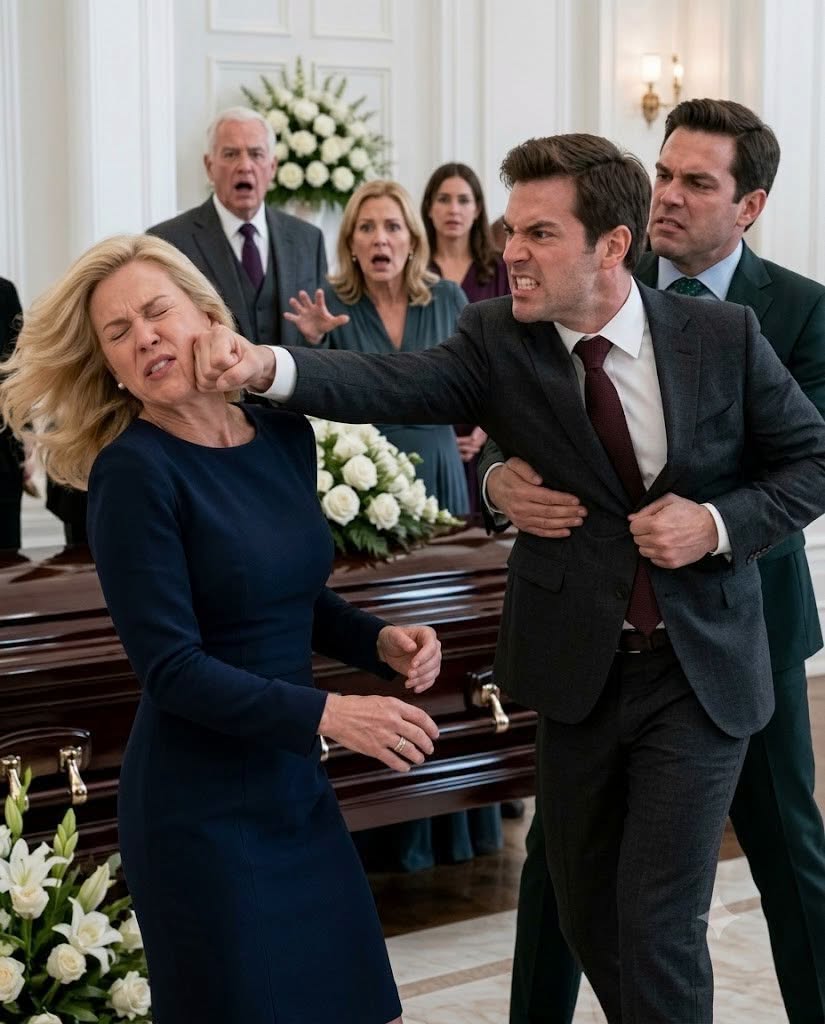
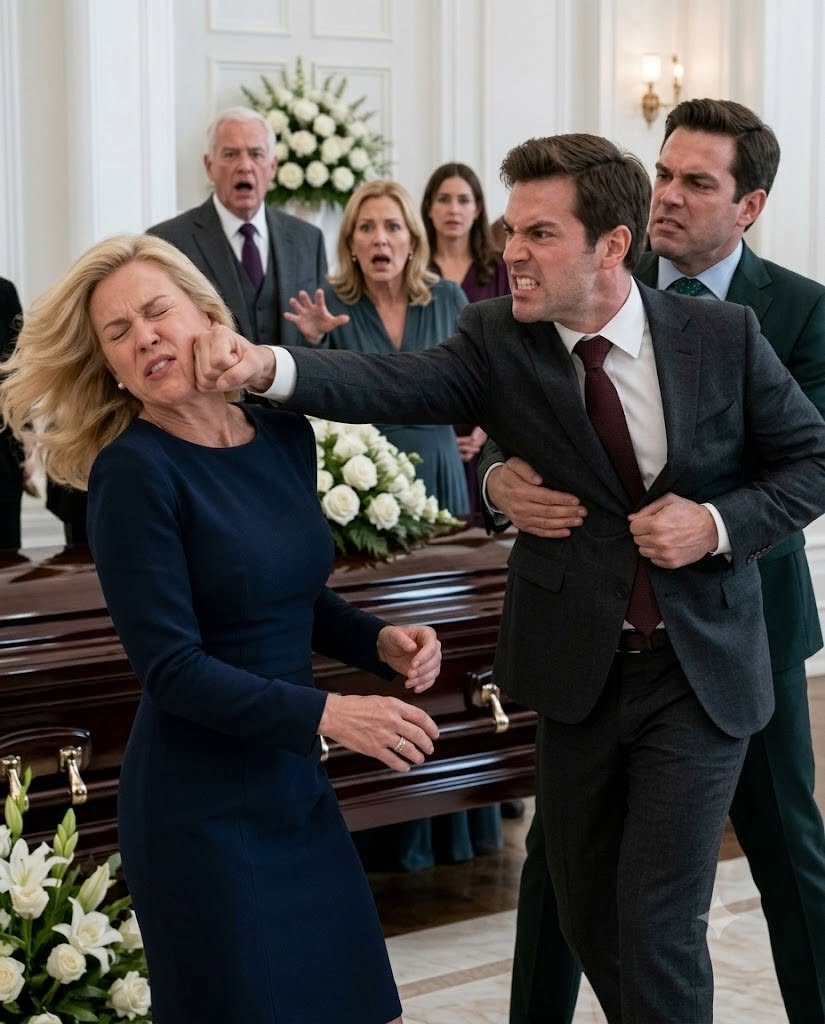
My brother’s fist struck before the final prayer ended.
I tasted blood, heard my aunt scream, and watched crimson drops spread across the black dress I had chosen to bury our father.
“Give me the safe key!” Julian shouted as two cousins dragged him backward between the church pews. “She’s stealing my inheritance!”
The mourners stared at me as if grief had suddenly become entertainment.
Julian had always known how to perform.
He was the charming son, the loud son,
the son who borrowed money and called it ambition.
I was Elena, the quiet daughter who handled Dad’s medications,
paid his bills, and slept in a chair beside his hospital bed during the final week.
I pressed a handkerchief to my split lip. “The safe will be opened at the house,” I said. “In front of everyone.”
Julian laughed. “Listen to her. She thinks she’s the executor.”
“I am.”
That silenced him for three seconds.
Then our uncle Raymond stepped forward. “Your father would never choose you over his son.”
I looked at the polished coffin. “He didn’t choose me over Julian. He chose someone he trusted.”
At the house, relatives crowded into Dad’s study. Julian paced behind me, whispering that I had manipulated a dying man. His wife, Serena, stood near the fireplace wearing diamonds they could
not afford. She smiled when Julian announced that the safe contained at least two million dollars in cash, bearer bonds, and property deeds.
He believed it because Dad had let him believe it.
I knelt before the old steel safe and removed the brass key from the chain beneath my collar. Julian leaned close enough for me to smell whiskey.
“Open it,” he hissed. “Then get out of my house.”
“It isn’t your house.”
“Everything Dad owned is mine.”
I turned the key. The lock clicked.
Inside were no stacks of money, no jewelry, no bonds. Only six sealed folders, a flash drive, and a handwritten note bearing Dad’s unmistakable signature.
Julian’s face changed.
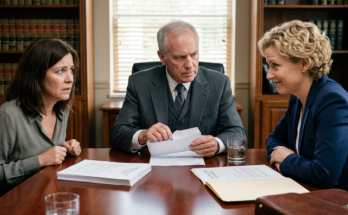
I lifted the note but did not open it yet. “Before anyone touches these documents,” I said, “my father asked that his attorney be present.”
From the hallway, a calm voice answered, “I’m already here.”
Attorney Samuel Price entered with two bank investigators behind him. Julian stopped smiling.
For the first time that day, he looked at me not as the weak sister he could frighten, but as the witness he should have feared.
Dad had warned me that grief would make greedy people careless. He had warned me not to reveal what I knew until Julian trapped himself. Now, surrounded by witnesses, with blood drying on
my chin, I understood why patience had been Dad’s final lesson…
Julian stared at Samuel Price.
Then at the two bank investigators standing behind him.
His face changed so quickly it was almost frightening.
The rage disappeared.
For one second, there was nothing underneath it but fear.
Then the performance returned.
“What are they doing here?”
Samuel closed the study door behind him.
“Your father requested their presence.”
“My father is dead.”
“Yes.”
Samuel’s voice remained perfectly calm.
“But his instructions are not.”
Julian laughed.
It sounded forced.
“This is insane. Elena has been poisoning him against me for months.”
I touched the handkerchief to my mouth.
Fresh blood appeared on the white fabric.
Samuel looked at my lip.
“Before we continue, Elena, do you want medical attention?”
“No.”
“Do you want the police called regarding what happened at the funeral?”
Julian snapped:
“Oh, come on.”
I looked at my brother.
Only twenty minutes earlier, he had punched me beside our father’s coffin because I would not give him a key.
And he still sounded offended that there might be consequences.
“Yes,” I said.
Julian stopped smiling.
Samuel nodded once.
“I already asked someone downstairs to make the call.”
Serena stepped forward.
“You can’t be serious.”
I looked at her.
“Why?”
“It was one punch.”
My aunt gasped.
Serena realized what she had said.
Too late.
I folded the bloody handkerchief in half.
“That is one more than I was willing to accept.”
Julian pointed toward the safe.
“She stole my inheritance.”
Samuel looked at him.
“Then opening the safe should settle that.”
“It will.”
Julian pointed at me again.
“She has had that key for weeks.”
“Correct.”
“She could have emptied it.”
Samuel nodded toward the open steel door.
“That concern is one reason your father documented the contents.”
Julian’s face tightened.
“Documented how?”
Samuel gestured toward the flash drive.
Nobody spoke.
I looked down at the safe.
Six folders.
One flash drive.
One handwritten note.
No money.
No bearer bonds.
No deeds to some secret property empire.
Nothing Julian had spent the morning telling relatives was hidden inside.
I picked up the first folder.
A white label was fixed to the front.
ACCOUNT REVIEW — FIRST NATIONAL BANK.
Julian looked away.
That was all I needed to see.
I handed it to Samuel.
He opened it.
The first bank investigator stepped forward.
Her name was Melissa Grant.
She was in her forties, dressed in a gray suit, with the expression of someone who had already heard every possible version of “I didn’t know.”
She removed a transaction summary.
“Mr. Moreno,” she said to Julian, “do you recognize account ending in 4421?”
He crossed his arms.
“I recognize my father’s bank.”
“It was one of his primary savings accounts.”
“So?”
Melissa looked at the paper.
“Eight months ago, the balance was $683,420.”
A murmur passed through the room.
Julian glanced toward our relatives.
Then back at her.
Melissa continued.
“By the time your father entered the hospital last month, the balance was $31,807.”
My uncle Raymond frowned.
“That can’t be right.”
“It is.”
Julian shrugged.
“Dad had expenses.”
I looked at him.
“What expenses?”
“He was sick.”
I almost laughed.
“I paid the hospital deposits.”
“You handled some bills.”
“All of them.”
“You don’t know everything.”
“No.”
I nodded toward Melissa.
“That is why she is here.”
Melissa turned the page.
“Over a period of seven months, there were nineteen withdrawals or transfers inconsistent with Mr. Moreno’s prior activity.”
Julian’s jaw moved.
She began reading.
“Forty thousand dollars.”
Next line.
“Twenty-seven thousand five hundred.”
Another.
“Sixty thousand.”
Another.
“Eighteen thousand.”
Serena spoke quickly.
“Victor—”
Julian turned on her.
“Don’t.”
The entire room caught it.
Victor.
Not Julian.
Victor was our father’s first name.
Serena had almost said Dad.
Or Victor gave us permission.
Or Victor knew.
Whatever sentence she had been about to use, Julian did not want her finishing it.
Samuel noticed.
“So you were aware of the transactions, Mrs. Moreno?”
Serena stiffened.
“I was aware that Victor helped Julian.”
Julian interrupted.
“Dad gave me money all the time.”
I stared at him.
“No, he didn’t.”
“You wouldn’t know.”
“I managed his accounts for the last four months.”
“Exactly. Last four.”
He smiled.
“Before that, Dad made his own decisions.”
Melissa nodded.
“That is something we examined.”
Julian looked less comfortable.
She continued.
“Your father had historically written checks when he wished to give family members money. He also documented gifts above ten thousand dollars with his accountant.”
“So?”
“These transfers did not follow that pattern.”
She placed another page on the desk.
“They were initiated online.”
Julian shrugged.
“He knew how to use a computer.”
Dad did.
But slowly.
Painfully.
And never for banking.
He hated online banking.
He once drove twelve miles in a snowstorm because he preferred speaking to a teller.
Melissa continued.
“The login device for sixteen of the nineteen transfers was not your father’s computer.”
Julian stopped moving.
“It was a device registered to an internet connection at your home.”
Serena whispered:
“Julian.”
He turned.
“Shut up.”
Samuel’s eyes narrowed.
I looked around the room.
My relatives had stopped watching me.
Now they were watching him.
That was the first thing Dad had predicted correctly.
Greedy people were brave when everyone was looking in the wrong direction.
The moment attention turned toward them, courage became anger.
Julian pointed at Melissa.
“I helped Dad with his banking.”
“Did you?”
“Yes.”
“Did he authorize the transfers?”
“Yes.”
“Excellent.”
She removed another document.
“Then perhaps the second folder will support that.”
I picked it up.
AUTHORIZATION RECORDS.
Julian’s confidence returned a little.
“See?”
I opened it.
Not authorizations.
Rejections.
Dad had contacted First National Bank four months earlier.
Three separate times.
On the first call, he reported that his password appeared to have been changed.
On the second, he disputed two transfers.
On the third, he requested that online access be restricted until he could meet privately with a bank officer.
Raymond looked at Julian.
“You told us he was confused.”
Julian snapped:
“He was.”
I felt something burn behind my ribs.
“No.”
Dad had been dying.
He was tired.
Sometimes medicated.
Sometimes weak enough that holding a cup required two hands.
But he had known exactly what was happening.
Julian had simply needed everyone else to believe otherwise.
Samuel removed a signed statement.
“Your father met with me four months ago.”
Julian glared at him.
“You were supposed to be his estate lawyer.”
“I was.”
“Not his detective.”
Samuel did not react.
“Victor believed money was being taken from him.”
“He gave me access.”
“That is not the same as permission to take whatever you want.”
Julian’s voice rose.
“He was my father!”
Samuel replied:
“Which is not a banking credential.”
One of my cousins looked down to hide a smile.
Julian saw it.
His face reddened.
I lifted the third folder.
MEDICAL CAPACITY.
This time, my stomach tightened.
Dad had hated this part.
I knew because I had been there when he arranged it.
Two independent physicians had evaluated him after Julian began telling relatives that Dad was confused.
Both concluded that although Dad was physically weak, he remained cognitively capable of understanding his finances and estate.
The dates mattered.
Every evaluation occurred before or during the period when Julian claimed Dad had voluntarily given him hundreds of thousands of dollars.
Samuel held up the reports.
“Your father anticipated that someone might challenge his mental capacity.”
Raymond shifted uncomfortably.
“He told me Victor didn’t know what day it was sometimes.”
I looked at my uncle.
“Who told you?”
He glanced at Julian.
There it was again.
Julian.
Always Julian.
Dad forgets things.
Dad is confused.
Dad gave me permission.
Dad wants me to have the house.
Dad has two million in the safe.
Each statement had been planted carefully.
Repeated until repetition sounded like evidence.
Serena suddenly spoke.
“Even if Julian moved money, Victor wanted him to have more.”
I turned toward her.
“How do you know?”
“Because he was the son.”
The room went still.
She realized she had said it out loud.
Raymond did not look at me.
Neither did two of my older aunts.
That belief had lived inside our family for years.
Julian was the son.
I was the daughter.
Therefore his mistakes were investments.
My responsibility was duty.
When Julian needed money, Dad was expected to help.
When Dad needed help, I was expected to provide it.
No invoice.
No applause.
No inheritance calculation.
Just Elena will handle it.
I looked at Serena.
“My father had two children.”
She rolled her eyes.
“You know what I mean.”
“Yes.”
I did.
That was the problem.
I picked up folder four.
PROPERTY RECORDS.
Julian moved toward me.
Samuel immediately stepped between us.
“Do not.”
Julian stopped.
“What’s in there?”
I opened it.
Property tax records.
Title documents.
A home-equity application.
I frowned.
Then I saw Julian’s name.
And mine.
My signature appeared beneath a guarantee.
Except I had never signed it.
My breath caught.
Samuel looked at me.
“This is the first time Elena is seeing that document.”
Julian stared at him.
“You didn’t tell her?”
“No.”
“Why not?”
“Victor asked me not to.”
I looked at Samuel.
That part was new.
“Dad knew?”
“Yes.”
Samuel’s expression softened slightly.
“He wanted to verify the extent before involving you.”
I looked down again.
The application was for a $350,000 line of credit secured against Dad’s house.
Applicant:
VICTOR MORENO.
Co-applicant:
ELENA MORENO.
The signature under my name was close.
But wrong.
Julian had always been bad at copying my E.
My hands went cold.
“You forged my signature too?”
He laughed.
“You’re being dramatic.”
“Did you sign my name?”
“No.”
I held the document higher.
“Then who did?”
“Maybe Dad.”
“Dad would not forge my signature.”
“You don’t know that.”
I stared at him.
That was his mistake.
He had chosen the only defense more insulting than the accusation.
“You’re saying our dying father forged my name?”
Julian’s eyes shifted.
“I’m saying I don’t know.”
Serena grabbed his arm.
“Stop talking.”
Melissa Grant took the document.
“The application did not proceed.”
I looked at her.
“Why?”
“Identity verification failed.”
Relief washed through me.
Then she added:
“But the supporting documents submitted with it are relevant.”
“What supporting documents?”
The second bank investigator, Daniel Cho, opened his tablet.
“Tax returns.”
My stomach dropped.
“Whose?”
“Yours.”
I stared at him.
“I never gave Julian my tax returns.”
Daniel nodded.
“We know.”
“How did he get them?”
Silence.
Then I remembered.
Dad’s house.
Three years earlier.
I had lived there for six months during a renovation of my apartment.
I had used Dad’s old office printer.
Scanned documents.
Maybe left copies.
Julian smiled faintly.
Not because he was innocent.
Because he knew I had figured it out.
I looked at him.
“You went through Dad’s files.”
“No.”
“You found copies of my taxes.”
“You’re making things up.”
Samuel said quietly:
“Victor installed a camera.”
Julian’s smile disappeared.
I turned toward Samuel.
“What?”
“In the study.”
I looked around.
Dad’s study had been renovated five years earlier.
Bookcases.
Old desk.
Landscape paintings.
No visible camera.
Samuel pointed toward the clock above the doorway.
Julian looked at it.
His face went white.
Dad had been watching.
Not constantly.
Not secretly for years.
Samuel explained that after the disputed bank transfers, Dad had installed a motion-activated camera with cloud storage.
The flash drive held copies.
I stared at it.
Julian whispered:
“Turn that off.”
Samuel looked at him.
“It is not on.”
“Destroy it.”
That was when my aunt Linda actually gasped.
Julian realized what he had said.
Again—
too late.
Samuel picked up the flash drive.
“Your father instructed me to play selected files after the safe was opened.”
Julian moved toward the door.
Daniel Cho stepped slightly to one side.
Not blocking him.
Just watching.
Samuel said:
“You are free to leave.”
Julian stopped.
“But if you leave, Elena remains executor and these documents remain evidence.”
Julian turned.
“So?”
Samuel looked at the blood still drying along my chin.
“And police are downstairs.”
Julian stayed.
Not because he wanted the truth.
Because he wanted to hear how much of it we had.
Samuel connected the flash drive to Dad’s old television.
The first video appeared.
Timestamp:
APRIL 12 — 11:48 P.M.
Empty study.
Then Julian entered.
He looked younger than he did that morning.
Calmer.
He went directly to Dad’s desk.
Opened the second drawer.
Removed a folder.
Photographed several pages.
Returned it.
Then sat at the computer.
The room watched in complete silence.
Video two.
APRIL 19.
Julian again.
This time Serena was with him.
She stood by the door.
“Hurry.”
His recorded voice answered:
“I need the verification code.”
“Where does he keep the phone?”
“Bedroom.”
“He’ll wake up.”
“He’s medicated.”
Serena covered her mouth.
On screen, Julian left the study.
Returned two minutes later holding Dad’s phone.
My aunt whispered:
“Oh my God.”
Video three.
Julian entered alone.
He typed.
His own voice:
“Come on, Dad.”
Then a notification sound.
He smiled.
Video four.
Serena sat at Dad’s desk.
She looked directly toward the hidden camera without knowing it was there.
“How much is left?”
Julian answered from outside frame.
“Enough.”
“For what?”
“If I move it slowly, nobody notices.”
Serena laughed.
“Elena will.”
My body went cold.
Julian answered:
“Elena sees whatever Dad tells her.”
Serena:
“She handles the bills.”
Julian:
“Then I make sure the statements disappear.”
The video stopped.
Nobody looked at me.
They looked at Julian.
He stared at the blank television.
His mouth slightly open.
Then he found anger again.
“That proves nothing.”
Melissa said:
“It proves quite a lot.”
“No. You don’t hear Dad giving permission because he did it privately.”
Samuel nodded.
“Victor anticipated that argument.”
I reached for folder five.
PERSONAL STATEMENT.
Inside was a notarized declaration.
Dad’s words.
His signature.
Samuel began reading.
“I, Victor Moreno, being of sound mind, state that I have not authorized my son, Julian Moreno, or his wife, Serena Moreno, to transfer, withdraw, pledge, borrow against, or otherwise use my assets except for the limited payments described in the attached schedule.”
Julian interrupted.
“That’s fake.”
Samuel continued.
“I have discovered unauthorized transactions from my accounts. I have chosen not to confront Julian immediately because my attorney and bank have advised that doing so may cause records to be destroyed or funds to be moved.”
My hand started shaking.
Dad had known.
While I changed his sheets.
While I crushed his pills into applesauce.
While he asked me whether Julian had called.
He had known his own son was taking from him.
And he had carried that knowledge quietly.
Samuel kept reading.
“I do not want Elena blamed for any investigation. She did not discover the full scope before my decision to document it.”
I closed my eyes.
Even dying, Dad had been protecting me from Julian’s next accusation.
Samuel continued.
“If Julian claims I promised him the contents of the safe, that statement is false.”
Julian whispered:
“Dad.”
For the first time, his voice sounded like a child’s.
Samuel read on.
“I told Julian that what remained for him would be in the safe because I wanted him to reveal what he believed he was entitled to.”
A chill moved through me.
Dad had built a trap out of Julian’s certainty.
He had told him just enough.
There is something for you in the safe.
Julian had translated that into:
Millions.
Bonds.
Deeds.
His inheritance.
Dad knew greed would write the rest.
The statement continued.
“The safe contains no cash. It contains a record.”
Julian sat down.
Not gracefully.
His legs seemed to stop supporting him.
Serena whispered:
“You said he promised you two million.”
Julian turned.
“Not now.”
“You told me he said two million.”
“Serena.”
“You said he kept cash because he didn’t trust banks.”
“I said shut up.”
She stepped away from him.
Suddenly the diamonds around her neck looked less like wealth and more like evidence.
I had noticed that necklace.
So had Dad.
Because the fifth folder contained purchase receipts.
Luxury watch.
$18,900.
Serena’s diamond bracelet.
$32,400.
Vacation package.
$21,700.
A car down payment.
$47,000.
All purchased within days of withdrawals from Dad’s accounts.
Serena stared at the pages.
“That doesn’t prove where the money came from.”
Melissa responded:
“Several payments originated directly from the disputed account.”
Julian stood again.
“You’re twisting normal gifts into theft.”
I finally spoke.
“Then why did Dad dispute them?”
“He was sick!”
“Doctors say he was competent.”
“You pressured him.”
“I didn’t even know about most of this.”
“You always wanted the house.”
“No.”
“You wanted control.”
“No.”
“You hated me.”
I stared at him.
“Yes.”
The room went silent.
Julian seemed surprised.
I continued.
“For a while, I did.”
My voice remained calm.
“I hated the calls asking me to fix whatever you had broken.”
His face tightened.
“I hated watching Dad give you another chance.”
Serena scoffed.
I looked at her.
“I hated watching my brother arrive at Christmas in a new car after asking Dad to cover his rent.”
Then back at Julian.
“But hating what you did does not mean I stole from you.”
I pointed toward the documents.
“You stole from Dad.”
Julian looked at our relatives.
“Are you all going to let her do this?”
Nobody answered.
He pointed at Raymond.
“Uncle Ray.”
Raymond’s face crumpled.
“Did you take the money?”
Julian looked stunned.
“What?”
“Just answer.”
“You know me.”
“That isn’t an answer.”
Julian’s voice cracked.
“He gave me things.”
“Did you take the money?”
Julian stared at him.
Then at everyone.
And I saw the exact moment he understood the family story had shifted.
He was no longer the wronged son.
I was no longer the greedy executor.
There were bank records.
Videos.
Medical evaluations.
A notarized declaration.
And twenty witnesses.
The same audience Julian had wanted when he punched me.
Dad had been right.
Grief made greedy people careless.
Julian had created his own courtroom.
Samuel looked at me.
“One folder remains.”
I had almost forgotten.
Folder six.
ESTATE DISTRIBUTION.
Julian stared at it.
For the first time all afternoon, he did not demand that I open it.
I did anyway.
Dad’s will.
Not the old version everyone knew about.
A new one.
Signed five months before his death.
Witnessed.
Notarized.
Reviewed after the medical capacity assessment.
Samuel explained:
“Victor revised his estate plan after discovering the account activity.”
Julian whispered:
“He disinherited me.”
“No.”
Samuel looked directly at him.
“That was discussed.”
Julian swallowed.
“But he chose not to.”
My anger disappeared for a second.
Of course Dad had not.
Even after everything, he could not completely stop being Julian’s father.
Samuel continued.
“The estate is to be divided equally between Elena and Julian.”
Julian stared.
Then laughed.
A strange, relieved laugh.
“See?”
Nobody joined him.
He pointed at me.
“Half.”
“Yes,” Samuel said.
“Half the house.”
“Potentially.”
“Half the investments.”
“Yes.”
“Half everything.”
Samuel closed the will.
“After adjustment.”
Julian stopped smiling.
“What adjustment?”
“The will contains a debt-offset provision.”
His face changed.
Samuel continued.
“Any unauthorized funds conclusively determined to have been taken by a beneficiary are charged against that beneficiary’s share.”
Silence.
I looked down.
Dad had not removed Julian.
He had done something far more precise.
He had counted.
Every dollar.
Julian whispered:
“That isn’t legal.”
Samuel replied:
“It is.”
“You can’t steal someone’s inheritance.”
Melissa actually blinked.
The irony was so obvious no one needed to say it.
Samuel opened an accounting schedule.
“Current estimated gross estate, excluding disputed recoveries, is approximately $2.4 million.”
Julian’s eyes widened.
“Then my half is 1.2.”
“Before expenses, taxes, claims, and adjustments.”
“Fine.”
Samuel looked at Melissa.
She passed him a page.
“The currently documented transfers associated with you total $917,600.”
Serena gasped.
Even I had not known the number.
Julian stared.
“No.”
Melissa continued.
“That figure does not include the failed home-equity application.”
“No.”
“Nor certain transactions still under review.”
“No.”
“Nor possible interest or recovery expenses.”
Julian pushed the papers away.
“No.”
One word.
Again and again.
As if repetition could become a legal argument.
Samuel said:
“If the final accounting establishes that the amount you improperly received exceeds your distributive share, you may receive nothing from the remaining estate.”
Julian lunged toward the desk.
Two cousins grabbed him before he reached me.
Again.
Exactly as they had at the funeral.
But this time nobody blamed grief.
Julian screamed:
“She did this!”
I stood.
My lip hurt.
My head hurt.
My father was dead.
I wanted nothing more than for everyone to leave.
But I looked at my brother and said:
“No.”
He fought against our cousins.
“You poisoned him against me.”
“No.”
“You took my inheritance.”
“No.”
“You always wanted everything.”
I picked up Dad’s handwritten note.
“No.”
Then I finally opened it.
The room went quiet.
Dad’s handwriting had become shaky near the end.
But I knew every letter.
Elena,
If you are reading this, then I am gone, and Julian has probably made a scene.
A broken laugh escaped me.
Even Samuel smiled faintly.
Dad knew us.
I continued reading.
I am sorry that I left you the responsibility of cleaning up another mess after spending so much of your life cleaning up mine.
I had to stop.
The words blurred.
I wiped my eyes.
Not the blood.
The tears.
The note continued.
You were never the child I loved because you were useful.
I am afraid I made you feel that way.
You stayed because you were loyal.
I should have protected that loyalty instead of depending on it.
My throat closed.
For years, I had told myself I did not need Dad to say that.
Apparently I had been lying.
I continued.
Julian is my son.
I love him.
But love cannot mean financing the destruction of the person you love.
Every time I erased one consequence, I taught him that someone else would pay.
Eventually, that someone became me.
Julian stopped struggling.
He was listening now.
I looked at him.
His face was wet.
I had never seen my brother cry without using tears as a weapon.
I did not know whether these were different.
Dad wrote:
If he took what the records suggest he took, do not protect him for my sake.
Do not punish him for my sake either.
Tell the truth.
Let the truth decide what remains.
Then the final paragraph.
And Elena—
the safe key was never an inheritance.
It was a responsibility.
I gave it to you because I knew you would open the door even if what waited inside hurt you.
I am sorry that it did.
Dad.
I lowered the note.
Nobody spoke.
Then the doorbell rang downstairs.
A moment later, footsteps came up the hall.
Two police officers entered the study.
One looked at me.
“Ms. Moreno?”
“Yes.”
“We were told there was an assault at the funeral.”
Julian stared at me.
For one second, I saw the old version of our relationship.
He makes the mess.
Elena makes it disappear.
He loses money.
Elena says nothing.
He screams.
Elena lowers her voice.
He hurts someone.
The family explains why he was upset.
Julian looked at my split lip.
Then at me.
“Elena.”
Just my name.
A request hidden inside it.
I knew exactly what he wanted.
Not money this time.
Protection.
I looked at the officer.
“I want to make a statement.”
Julian closed his eyes.
The investigation that followed was not dramatic.
Real investigations rarely are.
They are slow.
Paperwork.
Interviews.
Subpoenas.
Account records.
Passwords.
Devices.
Arguments between lawyers.
Julian initially insisted Dad authorized everything.
Then his attorney stopped allowing him to speak publicly.
Serena hired a separate lawyer.
That was when their marriage began breaking apart.
Within six weeks, she claimed she had believed all the money came from legitimate gifts.
Julian claimed Serena had pressured him to maintain a lifestyle they could not afford.
They blamed each other with the same energy they had once used to blame me.
The bank recovered some funds.
Not all.
A luxury vehicle was sold.
Jewelry was surrendered during civil recovery negotiations.
One investment account Julian had opened with Dad’s money still held enough to be frozen.
Other money was gone.
Hotels.
Restaurants.
Gambling.
Trips.
Debt payments.
A life built to look richer than it was.
The assault case moved separately.
Julian’s lawyer called it an emotional incident during acute grief.
That was probably true.
It was also still an assault.
Both things could be true at once.
I did not ask for revenge.
I asked for the truth to remain on the record.
Months later, Julian entered a negotiated resolution related to the financial misconduct and the assault.
There were restitution obligations.
Financial restrictions.
Probationary conditions.
Consequences.
Not the dramatic ending some relatives wanted.
Not prison for the rest of his life.
Real consequences rarely satisfy spectators.
They simply exist.
Uncle Raymond apologized to me.
Not immediately.
It took him three months.
He came to Dad’s house while I was sorting books for donation.
“I believed him.”
I kept packing.
“I know.”
“I told people your father would never choose you as executor.”
“Yes.”
“I said some ugly things.”
“Yes.”
He stood there awkwardly.
“You could make this easier.”
I looked at him.
“For you?”
His face fell.
“I suppose I deserve that.”
I closed the box.
“I don’t need you to hate Julian.”
“I know.”
“I don’t need you to choose me.”
He nodded.
“I need you to remember what happened the next time a loud person tells you a quiet person must be lying.”
He looked down.
“I will.”
Maybe he did.
Maybe he did not.
But I stopped needing to control what my relatives believed.
Dad’s house sold nine months later.
I expected that to hurt more than it did.
The study was the hardest room.
On the last afternoon, I stood in front of the empty safe.
The six folders were gone.
Evidence copies lived with lawyers, investigators, accountants.
The original note was with me.
The safe itself was worthless.
Heavy steel bolted into a wall nobody needed protected anymore.
Samuel stood in the doorway.
“You ready?”
“Almost.”
I touched the brass key hanging beneath my collar.
“Dad made such a big deal about this thing.”
Samuel smiled.
“He knew Julian would.”
“Did Dad really tell him there was something for him in the safe?”
“Yes.”
“What exactly?”
Samuel thought for a moment.
Then smiled faintly.
“He told Julian, ‘Everything you need to understand what you’re getting is in there.’”
I laughed.
For the first time, the memory did not hurt.
“That sounds like Dad.”
“It does.”
I removed the key from the chain.
“Do you want it for the estate file?”
“No.”
“What am I supposed to do with it?”
“Whatever you want.”
I looked at the little brass key.
A year earlier, Julian had believed it opened a box containing millions.
At the funeral, he had hit me for it.
Relatives had watched blood run down my dress because he believed a key in my possession meant I had stolen his future.
But the key had never protected money.
It protected evidence.
That was why Dad had given it to me.
Julian and Serena divorced eventually.
I heard through Raymond.
I did not celebrate.
Calamity had stopped entertaining me.
Julian and I did not speak for nearly two years.
Then one afternoon, a letter arrived.
No demand.
No accusation.
No request for money.
Just six handwritten pages.
I almost threw it away.
Then I read it.
He apologized for the funeral.
For the money.
For making Dad’s final months more frightening than they needed to be.
He admitted something I had not expected.
Dad had tried to confront him once.
Three months before he died.
Julian had denied everything.
Then Dad said:
“You keep thinking the worst thing that can happen is losing money.”
Julian wrote that he had laughed.
Dad had answered:
“No. The worst thing is becoming someone who can lose people and only notice the money.”
I read that sentence three times.
Julian ended his letter with:
I became exactly who he was warning me about.
I don’t expect forgiveness.
I just wanted one person in this family to finally hear me tell the truth without being forced.
I folded the letter.
I did not call him.
Not that day.
Forgiveness is not the same as immediate access.
Dad had taught me that too.
Six months later, Julian and I met at a coffee shop.
Public.
Neutral.
He looked older.
No expensive watch.
No tailored jacket.
No Serena.
He sat across from me.
“I’m sorry about your lip.”
I almost laughed.
“Out of everything, that’s where you start?”
“I’ve practiced this conversation about a thousand times.”
“How many versions went better?”
“All of them.”
That made me smile.
Barely.
Then he said:
“I thought Dad loved you more.”
I looked at him.
“Why?”
“Because he trusted you.”
“That isn’t the same thing.”
“I know that now.”
He stared at his coffee.
“I spent my whole life thinking being the son meant I would eventually get everything.”
I said nothing.
“And every time Dad rescued me, I thought it proved I was important.”
His voice became quieter.
“I never realized you were the one paying for half those rescues.”
“Sometimes literally.”
“I know.”
He looked at me.
“I’m not asking you to forget.”
“Good.”
“I’m not asking for the money.”
“There is no money for you to ask me for.”
“I know.”
That mattered.
For once, he understood the estate was not something I personally withheld.
The final accounting had done exactly what Dad intended.
Unauthorized amounts were offset.
After expenses and recoveries, Julian received no additional distribution.
I received my lawful share.
Not because Dad loved me more.
Because I had not already taken mine.
I used part of my inheritance to establish home-care support for elderly patients whose adult children could not afford full-time help.
Not because I was trying to create a monument.
Because during Dad’s final month, I learned how quickly caregiving could consume a person.
I knew what one night of professional help could mean to a daughter sleeping upright beside a hospital bed.
I named nothing after Dad.
He would have hated that.
Instead, the program simply said:
RESPITE CARE FUND.
A year after it began, Samuel sent me a photograph of the first family it had helped.
A woman my age stood beside her father.
Both smiling.
I cried harder over that picture than I did when the estate finally closed.
Three years after Dad’s funeral, I still had the safe key.
It lived in the top drawer of my desk.
Not on a chain.
Not hidden.
Just there.
Sometimes I would see it while looking for a pen.
A little piece of brass attached to one of the worst days of my life.
One evening, Julian visited my apartment.
We were not close the way siblings in sentimental stories suddenly become close.
We were careful.
There were boundaries.
Some conversations stayed short.
Some subjects remained closed.
But he showed up sober.
On time.
Without asking for anything.
That counted.
He noticed the key in my open drawer.
“You kept it.”
“Yes.”
He picked it up.
Turned it between his fingers.
“I really punched you for this.”
“Yes.”
“I thought there were two million dollars behind that door.”
“I know.”
He gave a small, embarrassed laugh.
“What an idiot.”
I looked at him.
“You weren’t angry because there was money in the safe.”
He frowned.
“What?”
“You were angry because I had the key.”
He became quiet.
I continued.
“You thought if I controlled access, I controlled what belonged to you.”
He set the key down.
“I guess I did.”
“But Dad knew something you didn’t.”
“What?”
I closed the drawer.
“The person holding the key does not always own what is behind the door.”
Julian looked at me.
“Sometimes they’re just responsible for opening it.”
He nodded.
Then quietly said:
“And sometimes you wish they hadn’t.”
I smiled sadly.
“Yes.”
We sat there for a moment.
Two children of the same father.
One who had spent years being rescued.
One who had spent years being reliable.
Both damaged by roles Dad had helped create.
He had admitted that before he died.
That mattered.
Dad had not left us a perfect lesson wrapped in a perfect estate plan.
He had left us documents because trust had already failed.
He had left cameras because his words had been twisted.
He had left medical evaluations because he knew weakness would be mistaken for confusion.
And he had left me the key because he knew Julian would eventually demand it.
For years, I thought Dad’s final lesson was patience.
It was not.
Patience was only how he delivered it.
The real lesson was simpler.
Love does not erase accountability.
Being family does not transform theft into inheritance.
Being a son does not create ownership.
Being a daughter does not create an obligation to remain quiet.
And protecting someone from every consequence does not save them.
Sometimes it teaches them that everyone else exists to absorb the damage.
The morning we buried my father, Julian screamed that I was stealing his inheritance.
He was wrong.
By then, most of what should have been his inheritance had already disappeared.
Not because I took it.
Because he had.
He thought opening the safe would expose me.
Instead, it exposed the one person he had spent years refusing to look at.
Himself.
And the brass key he was willing to bloody my face to possess?
It never opened a fortune.
It opened the truth.
In the end, that was the only thing Dad had left inside the safe that neither of us could spend.
THE END.