My mother let out an embarrassed laugh.
“Daniel, please sit down. You’re making this awkward.”
He did not move.
His eyes remained locked on me.
“Ma’am,” he repeated.
My father’s smile disappeared.
“What is this?”
Daniel swallowed.
Then he looked at the insignia on my chest again, as though hoping he had misread it.
He had not.
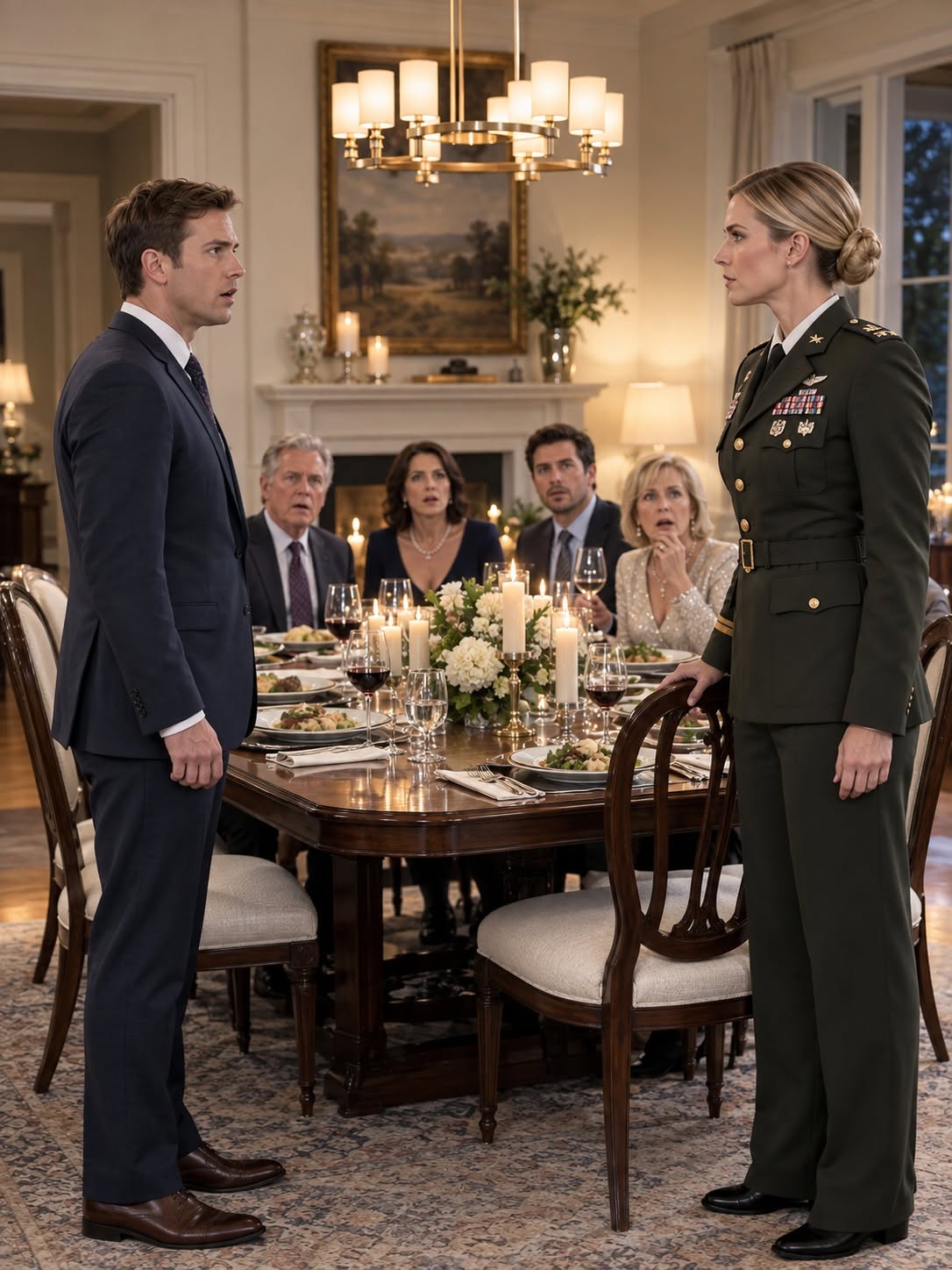
“Lieutenant General Evelyn Hart,” he said.
My sister’s head snapped toward me.
My mother blinked.
Dad laughed.
Actually laughed.
“Lieutenant general?”
Daniel turned toward him.
The expression on his face stopped the room cold.
“Sir, she is the commanding director of Federal Vanguard Command.”
Nobody spoke.
Daniel continued.
“The entire judicial continuity and protection network.”
My father stared.
“I don’t know what that means.”
Daniel looked at me once, almost asking permission.
I gave the smallest nod.
He turned back.
“It means every federal court facility in the Northern Judicial Grid uses her command for protective operations, emergency continuity, secure movement, threat coordination, and crisis response.”
My mother’s mouth opened.
Daniel’s voice lowered.
“When I said she commands us all…”
I almost corrected him.
He did it himself.
“Not our rulings. Not judicial decisions. But every judge in my grid works inside an infrastructure her command keeps operational.”
Silence.
My father looked at my uniform again.
Three stars.
The Vanguard insignia.
The badge he had dismissed as decoration.
His face changed slowly.
“No.”
It was almost a whisper.
I pulled out the empty chair.
“May I sit now?”
Nobody answered.
I sat.
Daniel remained standing.
“At ease, Judge Mercer.”
The absurdity of telling a civilian judge at ease nearly made me smile.
Daniel seemed to understand the joke.
He sat.
His hands were still shaking.
Rachel stared at me.
“You’re a general?”
“Yes.”
“For how long?”
“Three-star? Nine months.”
Her eyes widened.
“Three-star?”
“Yes.”
Mom whispered, “You never told us.”
There it was.
The sentence families use when they discover they never asked.
I picked up my water glass.
“I sent an invitation to the promotion ceremony.”
Mom frowned.
“What invitation?”
“Last February.”
Dad waved one hand.
“You send all kinds of government things.”
I looked at him.
“It said Lieutenant General Evelyn Hart across the top.”
His mouth tightened.
“I thought that was some departmental title.”
Daniel almost choked on his water.
My father glared at him.
Daniel looked down.
Rachel whispered, “Why Hart?”
That question surprised me more.
“You really don’t know?”
Her face changed.
Hart was my grandmother’s maiden name.
My father’s mother.
The one family member who let me sleep in her spare room after Dad threw me out.
I legally changed my surname at twenty-one.
Not because I hated my parents.
Because I wanted to carry the name of the person who had opened a door instead of closing one.
Rachel looked devastated.
“I thought Hart was your married name.”
“I’ve never been married.”
Mom’s face flushed.
“I knew that.”
“Apparently not well enough to explain it to Rachel.”
“Evelyn.”
I set down the glass.
“No. We’re not doing that.”
Dad leaned back.
“Doing what?”
“The part where everybody’s lack of interest becomes my failure to communicate.”
His jaw tightened.
“Watch your tone.”
Twenty years disappeared.
I was eighteen again.
Standing in this same dining room with one duffel bag.
Dad pointing at the door.
My mother crying silently beside the china cabinet but never saying stop.
My father telling me:
If you walk out with that uniform application, don’t come back asking for help.
I had not even worn a uniform yet.
I had applied to the Vanguard Officer Preparatory Program.
That was enough.
My father had planned another life for me.
University.
Law school.
His firm.
Eventually a partnership.
He had already told people at the country club that both daughters would become attorneys.
Rachel did.
I didn’t.
At eighteen, I wanted federal service.
Security policy.
Emergency management.
The strange new Vanguard system had only existed for six years then, built after a series of attacks and courthouse shutdowns exposed how fragmented federal judicial protection had become.
To Dad, it was glorified guard work.
“You want to stand at a metal detector for the rest of your life?”
That was his argument.
I told him I wanted to commission.
He laughed.
I told him there were operational, intelligence, protection, logistics, continuity, and command tracks.
He said:
A guard with a college brochure is still a guard.
I signed anyway.
He told me to leave.
Mom said nothing.
Rachel was fourteen.
She cried upstairs.
I slept that night on Grandma Hart’s couch.
Four days later, she drove me to my intake medical appointment.
She gave me twenty dollars for lunch.
I still have the bill.
Not because twenty dollars saved me.
Because it was the first money anyone had given me without attaching a future to it.
Dad’s voice pulled me back.
“You disappeared.”
I looked at him.
“No.”
“You did.”
“You kicked me out.”
“You chose to leave.”
“No.”
His face hardened.
“I gave you a choice.”
“Yes.”
I nodded.
“Obey or lose your home.”
“That is a choice.”
Daniel closed his eyes.
Rachel whispered, “Dad.”
He ignored her.
“I was trying to stop you from ruining your life.”
I looked at the three stars on my collar.
“How did that go?”
Rachel almost laughed.
She covered it quickly.
Dad’s face darkened.
“This is exactly what I mean. You come in here dressed like this and suddenly think you’ve won something.”
I stared at him.
“I came directly from work.”
“You could have changed.”
“I told Rachel I might be late.”
Rachel nodded immediately.
“She did.”
Mom said, “But this is an engagement dinner.”
“And I came.”
My voice remained calm.
“That was the priority.”
Dad looked toward Daniel.
He was searching for the room again.
Trying to restore the old hierarchy.
“Whatever title Evelyn has, Daniel is one of the youngest judges in the Northern Grid.”
Daniel looked uncomfortable.
Dad continued.
“He makes decisions affecting thousands of people.”
I nodded.
“He does important work.”
Dad blinked.
He had expected competition.
I gave him none.
Daniel said quietly, “So does she.”
Dad looked irritated.
“I didn’t say she doesn’t.”
“You called her a pathetic night guard seven minutes ago.”
The room stopped.
Daniel’s voice was not loud.
That made it stronger.
Dad’s jaw clenched.
“That was family humor.”
I looked at him.
“No.”
His eyes moved to me.
“No what?”
“It wasn’t humor.”
“Evelyn.”
“It was contempt with an audience.”
Mom whispered, “Please.”
I turned toward her.
“Please what?”
“Not tonight.”
Old script.
Protect the occasion.
Protect Rachel.
Protect Dad’s dignity.
My dignity could wait.
I looked at Rachel.
“This is your dinner. Do you want me to stop?”
She stared at me.
For the first time since I arrived, she looked directly at my face.
“No.”
Dad said, “Rachel.”
She turned toward him.
“No, Dad.”
Her voice shook.
“You invited her.”
“Yes.”
“And then you insulted her the second she walked in.”
“I was teasing.”
“You said she was a family disgrace.”
My father’s face changed.
Rachel continued.
“You said she would never succeed.”
Mom whispered, “Your father was upset.”
Rachel laughed.
“About what? Her being late?”
Nobody answered.
Rachel looked at me.
“I’m sorry.”
I frowned.
“For what?”
“For not saying anything.”
“You were fourteen when I left.”
“Not then.”
She shook her head.
“Tonight.”
That mattered.
I nodded.
“Thank you.”
Daniel had finally stopped shaking.
Now he looked embarrassed.
Not by me.
By himself.
He stared at his plate.
I noticed.
“What?”
His eyes lifted.
“Ma’am?”
“Evelyn.”
He hesitated.
“I should have stopped it too.”
My father scoffed.
“You didn’t even know her.”
Daniel turned.
“That should not have mattered.”
Good.
He understood quickly.
He looked at me.
“When Mr. Hart—”
“My father is Mr. Cross.”
Daniel corrected immediately.
“When your father called you a night guard, I assumed he was describing some private security job.”
“And?”
“I thought it was rude.”
“But you said nothing.”
“No.”
“Why?”
His face tightened.
“I was meeting Rachel’s family.”
There it was.
Social cowardice.
Not evil.
Still real.
“I didn’t want to make a scene.”
I nodded.
“Understandable.”
He looked relieved.
Then I continued.
“Not admirable.”
His relief disappeared.
“No.”
He swallowed.
“You’re right.”
Dad stared at him.
“You are taking her side?”
Daniel looked at my father.
“I’m taking the side of not humiliating someone at dinner.”
That ended the argument.
For the moment.
Mom stood abruptly.
“Dessert.”
Nobody stopped her.
She fled to the kitchen.
Rachel followed.
Daniel stayed.
Dad remained at the head of the table.
For several seconds, the two of us sat across from each other with twenty years between us.
Then he said:
“Do you actually command judges?”
“No.”
His shoulders loosened.
“Then Daniel exaggerated.”
“Operationally.”
I leaned back.
“Federal judges retain judicial independence. I have no authority over their rulings, cases, or legal judgment.”
“So what do you command?”
That was the first real question he had asked about my work in twenty years.
I almost missed it because his tone was defensive.
I answered anyway.
“Federal Vanguard Command.”
“What does that mean in practice?”
Another real question.
I explained.
Roughly eighteen thousand uniformed and civilian personnel across several regions.
Protective intelligence.
Courthouse security coordination.
Emergency judicial continuity.
Secure transport.
Critical infrastructure protection.
Threat response.
Communications resilience.
Interagency coordination during large-scale incidents.
Not every guard at every door directly reporting to me.
Not every court under personal control.
A command structure.
A system.
Dad listened.
Actually listened.
Then said:
“Eighteen thousand?”
“Approximately.”
His face changed.
“You’re responsible for that many people?”
“Responsibility is distributed.”
He almost smiled.
“You always do that.”
“What?”
“Qualify things.”
“I prefer accurate things.”
He looked down.
Then:
“You started as security.”
“Yes.”
“What kind?”
“Protective operations.”
“So I wasn’t completely wrong.”
There it was.
The old need to salvage something.
I let him have exactly what was true.
“No.”
He looked up.
“I did night shifts.”
His expression brightened slightly.
“At courthouses?”
“Yes.”
“Checking IDs?”
“Sometimes.”
He almost smiled.
“See?”
I waited.
Then:
“I was nineteen.”
His smile disappeared.
“I did night security while finishing my degree and officer training.”
Silence.
“I was proud of that job.”
He looked confused.
“Why?”
“Because Grandma was sick and I was trying not to take her money.”
His face changed.
He had not known.
“She was helping you?”
“She housed me for three years.”
“I knew that.”
“She paid my first semester tuition shortfall.”
His jaw tightened.
“I didn’t.”
“She asked you once.”
That surprised him.
“What?”
“She called after I left.”
His face went still.
“She asked whether you’d help with books.”
“I don’t remember.”
“I do.”
“What did I say?”
“You said if she made things easy for me, I’d never learn.”
Dad looked away.
There are sentences people forget because they cost them nothing.
The person who receives them may carry them for decades.
I continued.
“So I worked nights.”
His hands tightened.
“You could have come home.”
“No.”
“Yes.”
“You never said that.”
“You knew the address.”
“That is not an invitation.”
He had no answer.
Mom returned carrying pie she had not cut.
Rachel followed with plates.
The dinner somehow continued.
That is the strange thing about family detonations.
Someone still serves dessert.
Daniel asked me about Vanguard restructuring.
Rachel asked how long I had been in Washington.
Mom asked whether three stars meant I could retire soon.
Dad barely spoke.
Then Daniel made a mistake.
Not a terrible one.
An honest one.
He asked:
“Were you involved in the Northgate courthouse incident?”
My fork stopped.
Rachel looked between us.
“What incident?”
Daniel realized too late.
“Evelyn?”
I considered.
Northgate had happened seven years earlier.
A coordinated attack on two federal facilities.
Enough details were public.
Most of my role was not.
“I was in regional command at the time.”
Daniel’s face changed.
“You were the commander who kept Grid Three running.”
“Part of the team.”
He shook his head.
“My first bench assignment was in Grid Three.”
I nodded.
“I know.”
“You know?”
“I read your bio after Rachel told me who you were.”
Rachel stared at me.
“You did?”
“Yes.”
She looked almost hurt.
“You looked him up.”
“Of course.”
“Why?”
“You’re my sister.”
That silenced her.
She looked down.
Daniel continued.
“We were told the grid remained operational because Vanguard rerouted court functions within six hours.”
“Seven.”
He smiled.
“Seven.”
Dad said quietly:
“You never told us.”
I looked at him.
“I wasn’t talking to you.”
He flinched.
That was not said to punish him.
It was simply the truth.
For most of those twenty years, our contact existed through Rachel and Mom.
Birthday cards.
A few Christmas calls.
Dad and I spoke maybe once a year.
Usually about Grandma until she died.
Afterward, almost nothing.
Then Rachel got engaged.
She called me.
Not Mom.
Not Dad.
She said:
I want my sister there.
That was why I came.
Not reconciliation.
Not triumph.
Rachel.
After dessert, Daniel’s parents left first.
They were polite.
His mother hugged me.
His father apologized for laughing earlier.
“I assumed your father was making a family joke.”
“He wasn’t.”
“I understand that now.”
“Good.”
He looked embarrassed.
I appreciated it.
No excuses.
When the front door closed, Rachel asked:
“Can you stay?”
Dad immediately said:
“She has important people to command.”
Sarcasm.
Old reflex.
Rachel turned.
“Dad.”
He stopped.
Good.
I looked at my watch.
“I have forty minutes.”
Rachel took my hand.
We went into the living room.
Mom followed.
Dad stayed in the dining room.
Daniel remained too.
I heard low voices.
Rachel sat beside me on the couch.
Then she started crying.
“I thought you hated me.”
My chest tightened.
“What?”
“All these years.”
“Rachel.”
“You never came home.”
“I wasn’t invited.”
“Mom said you didn’t want to.”
I looked at Mom.
Her face crumpled.
Of course.
“What did you tell her?”
Mom sat opposite us.
“That you needed distance.”
“I did.”
“That you had a new life.”
“I did.”
“That you didn’t want family drama.”
“Accurate.”
Rachel shook her head.
“You told me she refused Thanksgiving.”
Mom closed her eyes.
I stared.
“Which Thanksgiving?”
“All of them.”
Rachel laughed through tears.
“Basically.”
I looked at Mom.
“Did you ever invite me?”
Her lips trembled.
“Not directly.”
There it was.
Not a lie exactly.
Another family specialty.
A story built from omission.
Mom whispered:
“Your father said if you wanted to come home, you knew where we lived.”
I laughed once.
“That sentence should be engraved on this house.”
Rachel grabbed my hand harder.
“I thought you chose not to know me.”
That hurt.
“I didn’t.”
“You missed my college graduation.”
“I sent flowers.”
“I know.”
“I wasn’t invited.”
Her face changed.
“Mom said you were overseas.”
“I was in Maryland.”
Mom covered her face.
Rachel whispered:
“Why?”
Mom began crying.
“I was trying to keep peace.”
There it was.
Again.
Peace.
The most expensive word in our family.
“Between whom?” I asked.
“You and your father.”
“We weren’t in the same room.”
“I know.”
“So you solved possible conflict by keeping us out of the same room forever.”
She cried harder.
“Yes.”
Rachel looked devastated.
“Mom.”
“I thought your father would soften.”
“He didn’t.”
“No.”
“And then…”
Mom looked at me.
“You got more successful.”
That surprised me.
“What does that have to do with anything?”
“He got embarrassed.”
I stared.
“By me?”
“By himself.”
Silence.
“He heard things.”
“What things?”
“Promotions. Commendations. Your Northgate assignment.”
My chest tightened.
“From whom?”
“Grandma.”
Of course.
Grandma had followed everything.
She kept newspaper clippings.
Printed government announcements.
She called me after every promotion and said:
I have no idea what half these words mean, but they look expensive.
Mom continued.
“Your father would say none of it mattered because you still walked away from family.”
I looked toward the dining room.
So he knew.
Not everything.
Enough.
Mom whispered:
“I let that become easier than admitting we were wrong.”
Rachel cried silently beside me.
I felt strangely calm.
“Why didn’t you tell her?”
“I thought you would someday.”
I shook my head.
“No.”
Mom looked up.
“You were the parent.”
That sentence broke something in her.
Not loudly.
She simply folded.
“I know.”
Daniel appeared in the doorway.
Not Dad.
He looked toward Rachel.
“Your father left.”
Mom stood.
“What?”
“He went for a drive.”
Of course.
Dad handled emotion through movement.
At eighteen, he paced.
At thirty-eight, apparently he drove.
I checked my watch.
“I need to go.”
Rachel tightened her grip.
“Please don’t disappear again.”
The word hit me.
I looked at her.
“I won’t.”
“Promise?”
“I promise I’ll answer if you call.”
That was honest.
Not:
We’ll be close now.
Not:
Everything is fixed.
Just answer.
Daniel walked me to the door.
At the porch he said:
“I’m sorry about what I said.”
“Commands us all?”
He winced.
“Yes.”
I smiled.
“It was dramatic.”
“I panicked.”
“I noticed.”
“I just recognized the Vanguard badge and stars.”
“Reasonable.”
“Then I remembered Northgate.”
His face tightened.
“I had colleagues in that system.”
“I know.”
“You really read my bio.”
“Yes.”
He shook his head.
“Rachel was right.”
“About what?”
“You’re impossible.”
I almost laughed.
Then he became serious.
“I’m marrying your sister.”
“I know.”
“I want you there.”
I looked at him.
“That invitation belongs to Rachel.”
“I know.”
“Good.”
He nodded.
Then said:
“I should have stopped your father before I recognized your rank.”
There.
He had kept thinking.
“That matters more than dropping the glass.”
He smiled sadly.
“I know.”
I left.
The next morning, my father called at 5:47.
I was already awake.
Some habits survive every career.
“Evelyn.”
“Dad.”
Silence.
Then:
“I looked you up.”
Of course.
“What did you find?”
“Too much.”
That almost made me laugh.
He had found the public biography.
Thirty years of service.
Protective operations.
Regional commands.
Northgate continuity.
Deputy commander.
Commanding general.
Senate confirmation.
Three stars.
All public.
All searchable.
“I thought you were security.”
“I was.”
“No.”
He sounded frustrated.
“I mean I thought that was all.”
“I know.”
“How?”
The question was almost angry.
“How did you go from standing at a door to this?”
I looked out my hotel window.
Morning traffic beginning below.
“The same way most people build careers.”
“That isn’t an answer.”
“Years.”
He said nothing.
“School.”
Silence.
“Training.”
Silence.
“Bad assignments. Good mentors. Mistakes. Promotions. People trusting me before I thought I was ready.”
My voice softened.
“Work.”
Dad breathed out.
“I told people you checked IDs.”
“Yes.”
“For twenty years.”
“Yes.”
“You knew?”
“Yes.”
“Why didn’t you correct me?”
I almost laughed.
Then stopped.
Because this time he sounded broken.
“Would you have listened?”
He did not answer.
That was enough.
After a while:
“I was angry.”
“I know.”
“You embarrassed me.”
There it was.
Still.
I waited.
“When you rejected law school.”
“I rejected your plan.”
“You made it look like I couldn’t control my own daughter.”
My stomach tightened.
“At eighteen.”
“Yes.”
“So you kicked me out.”
“Yes.”
Silence.
“I thought you’d come back.”
That surprised me.
“What?”
“I thought two weeks.”
I closed my eyes.
“Dad.”
“You’d hate the work. You’d realize Grandma couldn’t support you. You’d apologize.”
“But I didn’t.”
“No.”
His voice cracked.
“You did well.”
There it was.
Not pride.
A confession.
“And every year you did well made what I did harder to defend.”
I leaned against the desk.
“So you defended it harder.”
“Yes.”
That honesty hurt more than denial.
“I called your job pathetic because…”
He stopped.
“Because?”
“Because if it was pathetic, then throwing you out still made sense.”
Silence.
I closed my eyes.
There it was.
The entire twenty years.
Not ignorance.
Self-protection.
Dad continued.
“I knew you became an officer.”
My throat tightened.
“I knew you made colonel equivalent.”
“Brigadier.”
“Yes.”
“You knew?”
“Your grandmother told me.”
“And you never called.”
“No.”
“Why?”
“Pride.”
Simple.
Ugly.
True.
I sat down.
Dad said:
“I’m sorry.”
I did not answer immediately.
Then:
“For what?”
He breathed out.
“For telling you to leave.”
Good.
“For making your career small because admitting it mattered meant admitting I was wrong.”
Better.
“For calling you a disgrace last night.”
His voice broke.
“And for letting twenty years become easier than one apology.”
There.
That was the one.
I looked out the window.
“I don’t know what happens now.”
“I know.”
“I’m not moving back into the family emotionally because you finally read my biography.”
“I understand.”
“I’m here for Rachel.”
“Yes.”
“And maybe…”
I paused.
“Maybe we talk.”
He breathed in sharply.
“Okay.”
“No promises.”
“Okay.”
“Coffee first.”
He almost laughed.
“I can do coffee.”
We had coffee three weeks later.
Neutral diner.
No chandelier.
No family audience.
Dad asked what Vanguard Command actually did.
I explained.
Then I asked about his company.
Not because I wanted to be kind.
Because I realized I knew almost as little about his current life as he knew about mine.
He had sold his firm four years earlier.
I had not known.
That stung.
Families can become mutually ignorant while blaming only one side.
We talked for ninety minutes.
No hug.
No breakthrough.
But when we left, Dad said:
“May I call you next Sunday?”
Not:
I’ll call.
May I.
“Yes.”
He did.
Every Sunday for six months.
Sometimes five minutes.
Sometimes forty.
He asked questions.
Real ones.
Not:
How important is your job?
But:
What part is hardest?
Do your people call you when something goes wrong at night?
Do you miss field work?
Did Grandma ever see your first command?
That last question made me cry.
Rachel and Daniel married eight months later.
I wore a dress.
By choice.
Dark blue.
No uniform.
No insignia.
No stars.
Dad saw me before the ceremony.
For one dangerous second, I thought he might joke about security.
He didn’t.
He said:
“You look beautiful.”
“Thank you.”
Then:
“I’m glad you’re here.”
That mattered.
Rachel asked me to stand beside her during the family photographs.
Not because Daniel recognized my badge.
Because I was her sister.
At the reception, someone asked Dad:
“Which one is your daughter?”
He pointed toward Rachel.
“The bride.”
Then toward me.
“And that’s Evelyn.”
The man squinted.
“Wait. General Hart?”
Dad hesitated.
I watched him.
Then he said:
“Yes.”
But he did not smile proudly at the title.
He looked at me.
“My oldest.”
That was better.
Daniel turned out to be a good husband.
Not perfect.
Good.
He never again said I commanded judges.
I reminded him regularly.
At Christmas once, he handed me the carving knife and said:
“You command us all.”
I threatened to revoke his dessert clearance.
Rachel nearly fell out of her chair laughing.
Humor changed once it stopped reducing me.
Mom took longer.
She carried more guilt than Dad in some ways because she had always considered herself the gentle parent.
Dad slammed doors.
Mom softened the story afterward.
That made her feel innocent.
Eventually, she admitted something harder.
“I let him be cruel so I could be kind afterward.”
We were sitting on my apartment balcony.
I looked at her.
“What does that mean?”
“He would say no.”
She twisted her hands.
“Then I would bring you food.”
“Yes.”
“He would insult you.”
“Yes.”
“I would tell you not to take it personally.”
“Yes.”
“He threw you out.”
My throat tightened.
“And I gave Grandma money secretly.”
I stared.
“You did?”
“She wouldn’t take much.”
I had never known.
Mom began crying.
“I thought helping quietly made me good.”
I looked away.
“It helped.”
“But I never stood beside you where he could see me.”
“No.”
“That was cowardice.”
I did not argue.
She needed the word.
After a while, I said:
“You were scared of him.”
“Yes.”
“That explains some things.”
“It doesn’t excuse them.”
“No.”
Good.
We rebuilt too.
Slowly.
No instant mother-daughter shopping trips.
No rewritten childhood.
She apologized to Rachel for the lies about my absence.
She corrected relatives.
That part mattered.
At one family lunch, Uncle Paul said:
“Well, Evelyn always was stubborn. She chose that security life over family.”
Mom stopped him.
“No.”
Everyone looked up.
“She was eighteen. Richard told her to leave because she enrolled in federal service training. Evelyn did not abandon us. We let her go.”
Silence.
Mom looked at me.
I nodded.
That correction meant more than flowers.
My career continued another four years.
At forty-two, I retired.
Not because three stars were the finish line.
Because I had done thirty years and wanted a life where a midnight phone call usually meant Rachel’s baby had a fever rather than a courthouse threat assessment.
At my retirement ceremony, Dad sat in the front row.
Mom beside him.
Rachel.
Daniel.
Grandma Hart had died years earlier.
I placed an empty chair at the end of the row with her old blue scarf folded across it.
When I spoke, I did not tell the story of being thrown out.
Not directly.
I thanked the people who had opened doors.
Mentors.
Officers.
Civilian employees.
Guards.
Analysts.
Dispatchers.
Judicial staff.
And one grandmother who let an eighteen-year-old girl sleep on her couch without asking whether the plan was respectable enough.
Dad cried.
Afterward he found me beside the empty chair.
“I should have been that person.”
I looked at him.
“Yes.”
No comforting lie.
He nodded.
“I know.”
Then:
“I’m glad she was.”
“So am I.”
He touched the scarf.
“I thanked her once.”
That surprised me.
“When?”
“Before she died.”
“What did she say?”
Dad smiled through tears.
“She said, ‘You’re welcome. Took you long enough.’”
I laughed.
That was Grandma.
People always love the engagement-dinner version of my story.
The daughter kicked out at eighteen.
Twenty years later, she walks back into the family dining room wearing a dark navy uniform.
Dad laughs.
Calls her a pathetic night guard.
A disgrace.
Someone who will never succeed.
Then the powerful young judge engaged to her sister notices the badge.
The silver Vanguard insignia.
Three stars.
His glass drops.
He stands.
Turns pale.
“She commands us all.”
It sounds like justice arriving through rank.
But Daniel’s recognition was not justice.
It was information.
My stars did not make my father wrong.
If I had actually spent twenty years working night security, Dad would still have been wrong to call honest work pathetic.
If I had never become an officer, throwing an eighteen-year-old out for choosing a different career would still have been cruel.
If Daniel had never recognized the badge, I still belonged at my sister’s engagement dinner because she invited me.
That took everyone longer to understand than the insignia.
Including me.
For years, I thought success would eventually settle the argument.
One promotion.
Then another.
A command.
A third star.
Surely at some point Dad would be forced to admit he had been wrong.
Then I learned success cannot retroactively parent you.
A title does not travel backward in time and hug the eighteen-year-old standing beside a duffel bag.
It cannot make Mom speak when she stayed silent.
It cannot give Rachel the sister she thought had chosen to disappear.
All it can do is become another fact.
Repair requires people.
Dad had to say:
I was wrong.
Mom had to say:
I was afraid.
Rachel had to say:
I believed the story.
And I had to admit something too.
I became very good at surviving without them.
So good that eventually independence became armor.
I stopped sending invitations because I expected rejection.
I stopped explaining because I expected dismissal.
I told myself that was strength.
Some of it was.
Some of it was grief with excellent posture.
The most difficult command decision of my life had nothing to do with eighteen thousand people.
It was deciding to answer Dad’s Sunday call.
Not because he deserved unlimited access.
He didn’t.
Because I wanted to find out whether the man apologizing at sixty-two could become different from the father who closed the door at forty-two.
He did.
Not perfectly.
Enough.
Years later, Dad and I returned to Grandma Hart’s old house before it was sold.
The couch was still there.
Ugly brown thing.
I stood beside it.
“This is where I slept.”
Dad looked at the cushions.
“All three years?”
“No. I got an apartment after training.”
He nodded.
Then asked:
“Were you scared that night?”
I looked at him.
“At eighteen?”
“Yes.”
“Terrified.”
His face broke.
“I thought you were angry.”
“I was.”
“You looked so calm.”
“I learned that from you.”
He looked down.
“I’m sorry.”
“I know.”
Then he sat on the old couch.
For a while neither of us spoke.
Finally he said:
“You know what I thought would happen?”
“What?”
“You’d be back by Monday.”
I smiled sadly.
“You gave me one terrible gift.”
His eyes lifted.
“What?”
“I learned not to build a life that depended on someone reopening a door.”
He flinched.
“That doesn’t sound like a gift.”
“It wasn’t.”
I sat beside him.
“But I built a good life anyway.”
He nodded.
“Yes.”
Then I added:
“And I’m glad you eventually knocked.”
That was enough.
The night of Rachel’s engagement, Daniel saw three stars and realized who I was inside the system he served.
My parents saw those same stars and realized how little they knew.
But the most important thing happened much later.
No uniform.
No badge.
No judge dropping a glass.
Just my father sitting beside me on an ugly brown couch and finally asking the question he should have asked twenty years earlier.
Were you scared?
Yes.
I was.
And for the first time, he stayed long enough to hear the answer.
The end.