My mom died when I was ten.
I remember the hospital room more clearly than
I remember her voice some days—the white sheets, the plastic bracelet on her wrist, the way Dad kept saying,
“She’s going to be okay,”
even after the doctor had stopped looking him in the eye.
After she was gone, the house changed.
Dad changed too.
He stopped singing in the kitchen.
He stopped fixing old radios in the garage.
He moved through life like someone had turned the volume down on the world.
When I was fourteen, he married Cheryl. At first, everyone said she was good for him.
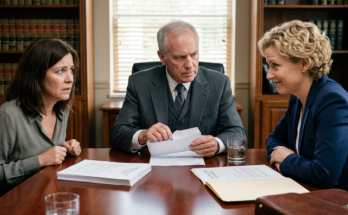
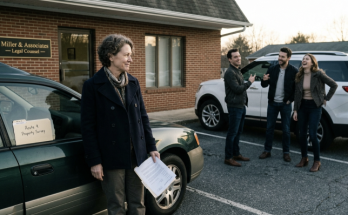
She wore pastel dresses to church, brought casseroles to grieving neighbors, and smiled with both hands folded like she had been born for sympathy. But inside our house, when Dad wasn’t looking, Cheryl’s smile disappeared. “You walk like your mother,” she would snap. “You stare like her too.” She hated my guitar most of all because it had been Mom’s last gift to me. Dad never saw the sharp parts of her. Or maybe he was too tired to notice. Five years later, Dad died suddenly from a heart attack in the garage, right beside the old workbench where he had once taught me how to sand wood smooth. I was nineteen and alone in a way that felt too familiar. Cheryl did not wait for the funeral flowers to wilt. Two days after we buried him, she stood in the living room with her arms crossed and said, “You’re not family anymore. Get out.” I stared at her, thinking grief had made me hear wrong. “This is my home.” She laughed. “No. This is my husband’s house. And now it’s mine.” I left with one duffel bag, my guitar, and the kind of anger that makes your hands stop shaking. I slept in my old car behind a gas station that night. The next morning, I came back to grab the rest of my things before Cheryl could throw them away. But when I turned onto our street, I hit the brakes. Five black SUVs were parked outside the house. Men in dark suits stood near the porch. At first, I thought Cheryl had called security to keep me away. Then the front door opened. Cheryl stepped out, pale as paper, her lipstick trembling at the edges. “Oh!” she said too brightly. “I was just about to call you, sweetheart.” Sweetheart. She had never called me that in her life. I blinked. “What’s going on?” Before Cheryl could answer, an older man in a navy suit walked out behind her holding a leather folder. He looked straight at me and asked, “Are you Lily Carter?” My throat tightened. “Yes.” His expression softened. “I’m Attorney Daniel Whitcomb. I represented your father.” Cheryl’s face twisted. “This is a private matter.” The lawyer ignored her. “Your father left instructions that could only be opened after his funeral.” I looked from him to the SUVs. “Instructions for what?” He opened the folder slowly. “For you.” Cheryl stepped forward fast. “She doesn’t need to hear this.” The lawyer’s voice turned cold. “Mrs. Carter, if you interrupt again, the officers will remove you from the property.” Officers. My eyes moved to the men in suits, and for the first time, I saw the badges clipped at their belts. Cheryl’s knees seemed to weaken. Attorney Whitcomb handed me one sealed envelope. On the front, in my father’s handwriting, were four words that made my chest collapse: For my real family. Type “Next” if you want
I stared at the sealed envelope in Attorney Whitcomb’s hand while Cheryl stood beside the porch looking like the ground had disappeared beneath her. For my real family. Those four words were written in Dad’s uneven handwriting, the same handwriting that used to appear on notes inside my lunchbox when I was little. My fingers trembled as I took the envelope. Cheryl reached for it. “That belongs to me. I was his wife.” One of the officers stepped between us. “Do not touch her.” Cheryl froze. Attorney Whitcomb opened the leather folder and removed several documents. “Your father anticipated that Mrs. Carter might attempt to remove you from the house before the will was read,” he said. “That is why he arranged for federal investigators and private security to be present.” I looked at the badges again. “Federal investigators?” Cheryl’s face went pale. “This is ridiculous.” Whitcomb ignored her. “Your father discovered six months ago that someone had been forging his signature, transferring money from his business accounts, and attempting to change the beneficiary of his life-insurance policy.” I looked toward Cheryl. She shook her head quickly. “He was sick. He became paranoid.” “My father died of a heart attack,” I said. “He was not sick.” Whitcomb’s expression darkened. “That is the second matter we need to discuss.” The air left my lungs. Cheryl backed toward the doorway, but an officer blocked her path. I tore open Dad’s envelope. Inside was a letter and a small silver key. Lily, if you are reading this, Cheryl has already shown you who she really is. I am sorry I did not see it sooner. Your mother left you more than a guitar. She left you half ownership of Carter Instruments, the company her father built. I have protected those shares in trust until your nineteenth birthday. The house, the business, and the investment accounts are yours. Cheryl receives only what is legally hers under the prenuptial agreement. My knees weakened. Carter Instruments was not just a local music shop, as Cheryl had always claimed. It was a national manufacturer of custom guitars, including the instrument Mom gave me before she died. Dad had spent years managing the company quietly while letting me believe he repaired equipment for a living. “Why didn’t he tell me?” I whispered. Whitcomb looked at the guitar case beside my car. “Because your mother asked him to let you choose music before money chose you.” Cheryl laughed sharply. “This is fake. Thomas promised me the company.” “No,” Whitcomb replied. “He promised you a salary while you remained his wife. That ended at his death.” He placed a bank statement on the porch table. “During the final year of his life, you transferred eight hundred thousand dollars into accounts controlled by your brother.” Cheryl’s voice cracked. “Those were gifts.” “Mr. Carter reported them as theft.” Two agents stepped closer. I looked at Dad’s letter again. There was one final paragraph: The key opens the fireproof cabinet behind my garage workbench. Do not allow Cheryl to reach it first. I ran toward the garage with Whitcomb and two officers behind me. Cheryl shouted for us to stop. The workbench remained exactly as Dad had left it, covered with sandpaper, old radio parts, and a coffee mug stained black inside. Behind a wooden panel was a steel cabinet. The silver key fit. Inside were financial records, voice recordings, and a small bottle of heart medication bearing Dad’s name. An investigator picked it up carefully. “This prescription was never filled through his regular pharmacy.” Cheryl appeared in the garage doorway, held back by an officer. “I can explain that.” Whitcomb removed a recorder from the cabinet and pressed play. Dad’s tired voice filled the room. Cheryl has been replacing my heart medicine. I watched her crush different tablets into my coffee. If I die before I can reach Lily, test everything in this cabinet. Cheryl screamed, “He was confused!” But another voice followed—hers. The recording captured her speaking on the phone. Once he is gone, the girl leaves. The house becomes mine, and we sell the company before anyone finds the trust. I looked at Cheryl and felt every cruel comment from the last five years return at once. She had not thrown me out because I was no longer family. She had thrown me out because she knew I owned everything she intended to steal. Federal agents placed her in handcuffs. She fought them, shouting that Dad had loved her and that I had manipulated him. “You let me sleep in my car two days after burying my father,” I said. “Do not use the word love.” Forensic testing later proved that Dad’s heart medication had been replaced with tablets that weakened his heart. Cheryl and her brother were charged with financial fraud, forgery, conspiracy, and murder. Her brother was arrested at the airport with two million dollars in transferred funds and a one-way ticket overseas. The trial lasted four months. I testified with Mom’s guitar beside me, not because I needed courage from an object, but because I wanted both of my parents represented in the room. Cheryl was convicted on every major charge and sentenced to spend the rest of her life in prison. Afterward, I moved back into the house, but I changed almost everything. I removed Cheryl’s furniture, reopened Dad’s garage, and turned the largest room into a free music studio for children who had lost parents. I also took my place on the board of Carter Instruments. I knew nothing about running a national company at first, but I knew what the guitars meant. We created a scholarship in Mom and Dad’s names and gave instruments to young musicians who could not afford them. One year after Dad’s death, Attorney Whitcomb handed me a final package he had been instructed to keep until the criminal case ended. Inside was a video of Dad sitting at the garage workbench. He looked tired, but he smiled. “Lily,” he said, “family is not the person who claims the house after you leave. Family is the person who makes sure you always have a place to return to.” I cried until the screen blurred. Then I picked up Mom’s guitar and played the song Dad used to sing in the kitchen before grief silenced him. The house no longer felt like Cheryl’s victory. It felt like my parents had finally brought me home. Thanks for reading