Three days after my mother forced me out of the hospital to save money,
my parents left me home alone,
seriously ill and nearly broke,
while they enjoyed a luxury vacation.
Then they came back to find someone else standing behind my front door…
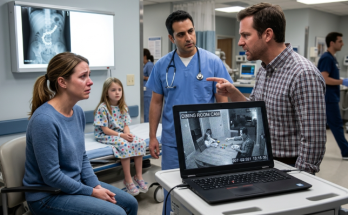
I was still wearing a hospital wristband when my mother signed me out against medical advice.
The plastic band cut into my swollen wrist every time I moved my hand,
and I could still smell the hospital on myself—stale sheets, fever, disinfectant,
and the oxygen mask I had breathed through for most of the night.
Even sitting upright took effort.
Every breath felt shallow and unfinished, like my lungs were stopping before they reached the bottom.
A nurse stood between us and the elevator and tried one more time to explain that my oxygen levels were unstable.
She told my mother that leaving could send me straight back to the ER.
My mother barely acknowledged her.
“She is coming home,” she said.
Her tone made it sound as though the decision had already been made somewhere else and everyone in the hallway was simply wasting time by discussing it.
Two days earlier, I had collapsed at work in Columbus, Ohio, after what I thought was a miserable respiratory infection became something much more dangerous.
I remembered pieces of the ambulance ride more clearly than I wanted to—the siren, the tight feeling in my chest, the paramedic asking me to keep my eyes open.
At the hospital, fluorescent lights streaked above me while people moved quickly around the bed.
Later, when things were calmer, a doctor leaned close enough to make sure I heard every word.
“You are not safe to leave yet.”
There was nothing vague about it.
But my parents and younger brother had booked a Florida beach vacation months earlier.
In our family, changing plans was treated like a personal failure.
My illness became an inconvenience almost immediately.
My mother called it terrible timing.
My father said hospitals always wanted to keep people longer than necessary.
My brother mostly complained about how much the trip had already cost.
By the morning my mother decided I was leaving, their vacation seemed to matter more than anything the medical staff was saying.
At 10:17 a.m., she told me to get dressed.
I had to stop halfway through because standing made the room tilt.
The discharge packet lying on the bed had AGAINST MEDICAL ADVICE printed across it in block letters.
I stared at those words while my father stood near the window checking flight confirmations on his phone.
The nurse came back with papers and instructions.
When my mother turned toward the hallway, the nurse quietly pressed a yellow sticky note into my palm.
A patient-rights number was written across it.
She did not make a speech.
She just closed my fingers over the note and looked at me long enough to make sure I understood that I should keep it.
I slipped it into my pocket.
My father was still looking at his phone when I told my mother that I could barely walk to the bathroom by myself.
“You’ll feel better at home,” she replied.
I reminded her that the doctor had said my breathing was too weak.
She leaned close enough that only I could hear her.
She told me I was embarrassing the family and wasting everyone’s time.
That hurt in a way I did not have enough energy to react to.
I was too sick to argue properly.
I was too tired to make a scene in a hospital hallway.
Mostly, I wanted to lie down again.
They drove me to their house outside the city instead of taking me to my apartment.
Halfway there, I realized I still needed medication and groceries.
I asked my mother for my debit card.
She kept both hands on the steering wheel.
“We used your account to cover the rental car and hotel,” she said. “We’ll pay you back.”
For a second, I thought the fever had made me misunderstand her.
I asked her what she meant.
She repeated it in the same casual voice.
They had used my money for their vacation.
I had less than two hundred dollars left after rent, and they knew I had already missed a week of work.
I opened my banking app with hands that were shaking from weakness.
The transactions were right there.
8:44 a.m.—airline upgrade.
9:03 a.m.—beachfront resort deposit.
9:19 a.m.—restaurant prepayment.
A fraud-alert banner pulsed at the top of the screen.
The timing was almost harder to process than the amounts.
While I had been sitting in a hospital bed struggling to breathe, they had been spending money from my account on a nicer version of their trip.
I looked up at my mother.
She did not apologize.
She talked about paying me back as though she had borrowed twenty dollars for gas.
At the house, they helped me inside with the detached care people use when they are trying to finish an unpleasant chore.
My brother carried my overnight bag with two fingers.
My father unlocked the door without looking at me.
My mother put a glass of water on the table and set down a paper bag containing crackers, canned soup, and cold medicine.
“Just rest,” she said. “We’ll be back in four days.”
I waited for someone to laugh.
Nobody did.
I told them plainly that I could not safely stay alone.
I explained that I got dizzy whenever I stood up.
I told them I might not even be able to reach the front door if my breathing got worse.
My brother shrugged.
“Call 911 if you’re that bad.”
Then he picked up his suitcase and carried it outside.
That was the moment I understood that they were actually going.
Not threatening to go.
Not trying to scare me into cooperating.
Going.
They left before sunrise the next morning.
I woke to the sound of the front door closing.
A few seconds later, tires ground over the gravel outside.
I reached for my phone.
The battery was at nine percent.
My inhaler was nearly empty.
When I opened the refrigerator, I found condiments, beer, and spoiled fruit.
No real food.
No meals prepared for someone who could barely stand.
Nothing that suggested anyone had seriously considered what four days alone would look like for me.
I drank water and tried to eat crackers.
Even chewing made me tired.
By noon, I was lying on the kitchen tile because the floor felt cooler and I had become too dizzy to trust myself in a chair.
From where I was lying, I could see the family calendar hanging nearby.
Across that week, my mother had written one cheerful word in blue marker.
VACATION.
I stared at it for a long time.
The word looked absurd from the floor.
My phone was losing power quickly.
I knew I needed to make one call that mattered.
At 12:38 p.m., I pulled the yellow sticky note from my pocket and dialed the patient-rights number.
My voice sounded rough and thin even to me.
I gave the woman my name.
I told her which hospital I had been in.
I gave her the approximate discharge time.
Then I told her that my mother had removed me against medical advice and that charges had been made on my debit card while I was medically unstable.
The woman asked me a few careful questions.
I answered as best I could.
Then she went quiet.
“Do not hang up,” she said.
Those four words were the first moment since leaving the hospital when I felt like another adult actually understood the seriousness of what had happened.
I stayed on the line.
The situation stopped being a private family argument after that.
People began asking for facts instead of accepting my mother’s version of events.
What time had I left the hospital?
What condition had I been in?
Did I have my discharge paperwork?
Could I document the charges?
Was there food in the house?
Did I have the medication I was supposed to be taking?
For the first time, the details my family had dismissed as overreacting began to matter.
The hospital wristband mattered.
The discharge packet mattered.
The yellow sticky note mattered.
The banking screenshots mattered.
So did the empty refrigerator.
By the third day, there were photographs of what little food had been left in the house.
There were screenshots showing the vacation charges.
There was the discharge packet marked AGAINST MEDICAL ADVICE.
There was also a list of medications I had never been able to fill.
I did not need to exaggerate anything.
The timeline was enough.
A welfare check became a police report.
The police report became a case number.
The change was strange to watch because my parents had spent days acting as though I was the unreasonable one.
They had treated the doctor’s warning like an inconvenience.
They had treated my fear of being left alone like drama.
They had treated my missing money like something that would eventually be smoothed over with a promise to repay me.
But once each piece was written down beside the next one, the story looked different.
I had been hospitalized after collapsing at work.
A doctor had said I was not safe to leave.
My mother had signed me out anyway.
My parents had taken money from my account for vacation expenses while I was sick.
Then they had left me in a house with almost no food, an almost-empty inhaler, no filled prescriptions, and no reliable person staying with me.
None of those facts needed dramatic language.
They were serious enough by themselves.
I spent most of that third day exhausted.
Every small task took longer than it should have.
I kept my phone charging whenever I could and stayed close to the places where I could sit down quickly.
The house felt different now that other people knew what had happened there.
Before, every room had seemed to belong to my parents’ version of reality.
They decided what counted as serious.
They decided what was worth money.
They decided whether I was sick enough to deserve help.
Now there was a case number.
There were records.
There were people outside the family who had heard the timeline and did not dismiss it.
At 6:11 p.m., headlights swept across the living room wall.
I knew immediately who it was.
My parents were home.
I heard car doors closing outside.
Then my mother’s voice floated across the porch.
She was laughing.
It was an ordinary vacation laugh, relaxed and careless, the sound of someone returning from four good days away.
Her keys jingled as she walked toward the door.
I stayed where I was.
I could picture the version of the homecoming she expected.
They would come inside sunburned and tired.
My mother would probably ask whether I had rested.
My father would start unloading bags.
My brother might complain about the trip home.
Then, eventually, someone would tell me not to make such a big deal about the money.
Maybe they would promise again to pay it back.
Maybe my mother would say that everything had turned out fine because I had survived the four days.
That was how problems usually disappeared in our family.
If the worst possible outcome did not happen, then whatever they had done suddenly became acceptable.
The key entered the lock.
The front door opened.
My mother stepped inside first.
She stopped dead.
My father nearly walked into her from behind.
The laughter from the porch vanished because I was not alone anymore.
A police officer was standing behind my front door holding a folder.
Inside that folder was something my mother recognized immediately.
My hospital bracelet had been sealed inside a clear evidence bag.
For three days, that bracelet had felt like a humiliating reminder of how powerless I had been when my mother signed me out.
In the hospital, it had identified me as a patient.
At home, it had looked like proof that I had been too weak to stop them.
Now it meant something else.
It was part of a timeline they could no longer reduce to a family disagreement.
My mother looked from the officer to me and then back to the clear bag.
Her face tightened as she understood that the four days she had spent treating the situation like it was over had been four days in which the details were being preserved.
The charges had not disappeared because she called them borrowing.
The discharge warning had not disappeared because she called the doctors dramatic.
The lack of food had not disappeared because she left crackers and canned soup on the counter.
And my condition had not become safe simply because they had gotten on a plane anyway.
I did not need to shout from across the room.
I did not need to give them the speech I had imagined during the hours when I was alone and frightened.
The officer had the folder.
The case already had a number.
The documents already had dates and times.
For once, my mother was not the person deciding which version of events everyone had to accept.
My parents had come home expecting the same daughter they had left behind—sick, dependent, nearly broke, and too exhausted to challenge them.
What they found instead was a record of the choices they had made.
The blue VACATION note was still on the family calendar.
The yellow sticky note was no longer just something a nurse had slipped into my hand.
And the hospital bracelet that had cut into my swollen wrist on the day I was forced out was now sealed inside a clear evidence bag, held by someone my parents could not order to look the other way.