I stared at my computer screen,
but the numbers on the spreadsheet blurred into meaningless symbols.
It was a Tuesday afternoon in March,
the kind of day that feels like every other day you’ve lived—ordinary, forgettable,
the fabric of a life that had somehow become smaller than the dreams I once had.
I’d been married to Michael for twelve years.
Twelve years of compromises,
of putting his career ambitions first,
of postponing conversations about kids because the timing was never right,
of watching my own goals collect dust on shelves I’d built to make room for his.
My assistant Maria had just brought me my third coffee when my phone buzzed.
Michael never called during work hours. Never. He said it was unprofessional, and Michael cared deeply about appearing professional, about maintaining the image of a man who had everything under control. “Hey,” I answered, already sensing something was different in the silence that followed. “My uncle just died,” he said, his voice strange, lighter somehow, like he was reading lines from a script. “And I inherited eight hundred million dollars.” I remember the exact moment my brain processed the words because time seemed to split into before and after. Before, I was a woman in a modest office overlooking the city, making decent money but never enough to feel truly secure. After, I was the wife of a man who had just inherited nearly a billion dollars. “That’s…” I started, but he cut me off. “Pack your things and be out before I get home.” The line went dead. I sat there for exactly thirty seconds, my coffee cooling beside my hand, wondering if I’d somehow misheard him. Then I called back. Straight to voicemail. I tried twice more. Voicemail both times. It was like watching a magic trick in reverse—the world I thought I knew vanishing, and in its place, something that made no sense at all.
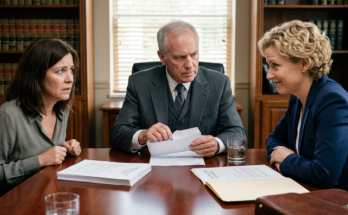
I left work early, something I never did. My hands were steady as I drove home, steadier than they should have been given the chaos spiraling through my mind. Maybe he was joking. Some elaborate prank based on a dark sense of humor I’d forgotten he possessed. Maybe he was having a breakdown. Maybe this was a test of some kind, though I couldn’t fathom what it would test. But when I walked into our apartment—the one we’d bought together, the one I’d spent countless weekends decorating—I knew it wasn’t a joke. The divorce papers were laid out on the kitchen island like place settings at a formal dinner, each page perfectly aligned, my name printed in perfect lawyer’s font, and our twelve years of marriage reduced to bullet points and legal terminology. Fifty copies. I counted them. Fifty printed pages of our dissolution. A note in his handwriting sat on top: “Already signed on my pages. Just need yours.” My hands didn’t shake. My voice didn’t crack. I have replayed that moment a thousand times since, and I still can’t explain the strange calm that settled over me like a weighted blanket. Maybe it was shock. Maybe it was years of swallowed frustration suddenly crystallizing into something harder, colder, more focused than anger. I signed every single page. Every one. I didn’t read them carefully—I’m sure a smarter woman would have. But I signed them all anyway, dated them in black ink, and left them in a neat stack exactly where he’d left them.
When Michael walked through the door an hour later, still wearing his work suit, his face flushed with the excitement of a man who’d just won the lottery of life, I handed him the pen we’d used to sign our marriage certificate twelve years earlier. “Enjoy your fortune,” I said quietly. He laughed. Actually laughed, the kind of laugh that comes from deep in the belly, like he’d just heard the funniest joke of his life. Like he’d gotten away with something. Like he’d won. I walked past him to the bedroom we’d shared, packed one suitcase with the essentials, and left that apartment for the last time without looking back. I drove to my sister’s house and sat in her guest room, staring at the wall, waiting to feel something. Rage. Devastation. Betrayal. But all I felt was the strange clarity of someone who’d just watched a puzzle come together in an unexpected way. The next morning, my phone started ringing. Then it wouldn’t stop. Michael’s mother. His sister. His brother. His lawyers. His accountants. People I barely knew. I didn’t answer any of them. Not immediately. I waited, letting them call, because I’d learned something in that moment of unexpected freedom: sometimes the most powerful thing you can do is wait and see what happens next. And something was definitely about to happen. Something Michael had clearly missed, something that came with that eight-hundred-million-dollar inheritance, something that would prove that you can win the lottery of money and still lose everything that matters.
I waited three days before my sister finally convinced me to open one of the certified letters that had arrived at her house. The envelope was thick, official, bearing the letterhead of a prestigious law firm in Manhattan. My hands were steady when I opened it—they’d remained steady throughout, I’d noticed, as if my body had decided to preserve me from feeling too much too soon.
The letter began with a formal greeting and quickly descended into the kind of legal language designed to make simple truths sound impossibly complex. But the core of it was clear enough: “Per the terms of the estate of Robert Frederick Ashford, the full inheritance of eight hundred million dollars is contingent upon the beneficiary remaining in a lawfully recognized marriage for a minimum of one calendar year following the inheritance date.”
I read it twice. Then three times.
I sat on my sister’s couch in my borrowed life and understood what Michael had done. What he’d destroyed in his rush to be free.
The divorce was finalized within days. He’d paid for the fastest processing available, and I’d signed without contest, without a single counterclaim. I’d handed him the pen and a clean break, and in doing so, I’d handed him poverty dressed up as freedom.
My phone finally rang at ten in the evening on the fourth day. Michael’s voice was different now—the lightness gone, replaced by something that sounded like a man whose entire reality had collapsed in a single moment of comprehension.
“We need to talk,” he said, his words careful, measured, like he was walking through a minefield. “My lawyers found something. There’s a clause. In the will.”
I didn’t respond. I waited. I’d become very good at waiting. “I didn’t know,” he continued, and I could hear something new in his voice. Desperation. “It was in the fine print. The inheritance requires—required—that I maintain marital status. For one year. You have to sign something. We have to get remarried.
Or at least… not finalize the divorce. My lawyer says there might be a way to pause the proceedings. To suspend it for—”
“No,” I said quietly. “You don’t understand. We’re talking about eight hundred million dollars. Half of that could be yours. Four hundred million. We could—”
“No,” I repeated. He called fourteen times that night. Seventeen the next day. I blocked his number on the sixth day when he started showing up at my sister’s house, standing in her driveway at three in the morning, begging me to reconsider, to see reason, to understand that we could work this out because the money made everything workable, didn’t it? Money could fix anything.
The story broke in the financial press two weeks later: “Tech Executive Loses Billion-Dollar Inheritance Due to Premature Divorce.” The articles were merciless in their descriptions of his mistake—a brilliant man undone by his own impatience, his own arrogance, his own certainty that he could bend the world to his will. His family sued him. Then they sued each other, fighting over what remained of the estate now that Michael had disqualified himself. The whole inheritance was subject to dispute, tied up in litigation, divided among cousins and distant relatives and the state of New York.
None of it went to him. None of it ever would. I didn’t take pleasure in it, though I thought I might. I’d imagined that when this moment came—and somehow, I’d always known it would—I would feel vindicated. Triumphant. But what I actually felt was something quieter, something that felt more like clarity than revenge.
Six months after signing those divorce papers, I received a letter from a lawyer representing Michael’s estate liquidation. Inside was a check for $47,000—the value of our joint bank account, split according to the divorce agreement I’d never properly read. It was exactly half of what we’d saved together over twelve years. Exactly what was legally mine. I didn’t deposit it immediately. I looked at that check for days, thinking about what twelve years of compromise, of support, of being the person who held things together while he built his ambitions, was worth in dollar terms. $47,000. It came to roughly ten dollars a day for marriage. I deposited it. And I used it to enroll in a graduate program at a university across the country, studying architectural design—something I’d dreamed about in those early years of marriage before the dreams got smaller to make room for his.
Michael tried to reach out once more, a year later, when the lawsuits had finally settled and he was left with approximately nothing. He wanted to talk. To explain. To perhaps convince me that we’d both made a mistake. I didn’t answer. I didn’t need to. He’d already said everything that mattered when he handed me those divorce papers. But here’s what I learned from the whole thing, what I’d realized that first afternoon when I packed my single suitcase and drove away: There’s a kind of power that doesn’t come from money, from winning, from having the world arranged exactly as you want it. It comes from knowing who you are when everything’s taken away. It comes from not needing someone else’s fortune to feel rich.
Michael had inherited eight hundred million dollars and lost everything that mattered. I’d inherited nothing but clarity, and somehow, in the end, that made me infinitely wealthier.
Two years later, I received a wedding announcement. Michael had remarried—to a woman named Veronica with whom he’d worked on his startup before the inheritance. It was a small ceremony, the announcement said. Private. Intimate. But the inheritance was long gone by then, swallowed by legal fees and family disputes and his own catastrophic decisions.
He was starting over from zero, his new wife starting beside him, and I was building something entirely new across the country, something that was entirely my own. He’d thought he’d won the lottery of life. What he’d actually won was a second chance at learning who he really was without the money to hide behind.
I never wished him ill. I didn’t need to. The universe had already taught him the lesson that I never could have: that sometimes the fortune you think you’ve won is actually the thing you were supposed to lose. And sometimes walking away with nothing is actually getting everything you need.
THANKS FOR READING