{..My mother stood motionless.
“If you walk out that door with her,
don’t come back.”
I picked Clara up.
She weighed so little.
Far too little.
“Then I’m not coming back.”
We went up through the passage to the storage room. T
he morning light was coming through the small window.
Everything looked the same, and yet,
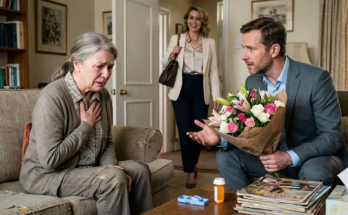
I was no longer the same man who had turned the key the night before. In the living room, the house smelled of cinnamon, cold tea, and lies. On the table sat the cup my mother had given me at midnight. My father picked it up, smelled it, and looked at Beatrice.
“Again.” She turned pale. “Don’t start.” “What was in it?” I asked. My mother lifted her chin. “A sedative. You were agitated.”
I felt nauseous. Not because of the tea. Because of me. Because I didn’t even need to be drugged to become her accomplice. She only had to cry and I obeyed.
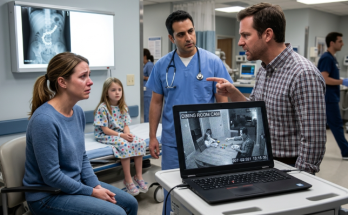
We went to the hospital. I don’t remember the whole drive. I remember the streets of Seattle waking up, the coffee shops opening, the smell of damp pine, a ferry horn sounding in the distance, the traffic near downtown. I remember Clara gripping my shirt when a pain crossed her body. I kept repeating: “Forgive me.” She didn’t respond. My father was in the front, staring ahead, like a man also carrying an old guilt. Every so often he turned toward me and then toward her, not knowing which of the two he had lost more.
In the ER, they took her away. I was left with empty hands. I had blood on my fingers. Very little, but enough for the whole world to accuse me. My father sat beside me. For a while, he said nothing. Neither did I. Then he spoke: “You aren’t guilty of what your mother did to me.” I swallowed hard. “But I am guilty of what I did to Clara.” “Yes.” I was grateful he didn’t comfort me. I needed the truth.
Half an hour later, a doctor came out. “She’s stable. There’s a risk of miscarriage, but the pregnancy is still viable. She needs rest, quiet, and zero stress.” Zero stress. I almost laughed. As if my house wasn’t a fear factory. “Can I see her?” I asked. The doctor looked at me harshly. “She asked to see Mr. Arthur first.”
My father stood up. I didn’t complain. I stayed seated. Learning what it was like not to be chosen.
Twenty minutes passed. Then my father came out. “She wants to talk to you.” I went in. Clara was in a bed, hooked up to an IV. Her hair was matted to her face and her eyes were tired. Seeing her like that, I realized that asking for forgiveness was far too little—almost an insult. Even so, I said it. “Forgive me.”
She looked toward the window. “I don’t know if I can.” I nodded. “I know.” “It wasn’t just last night, Julian. Last night was the door. But you’ve been locking me out of your life for years every time you chose your mom.” I sat far away, so as not to invade her space. “I’m going to report what happened.” She turned her head. “Against your mother?” “Against her and myself. I locked you in.” Her eyes filled with tears. “Are you saying that because you’re afraid of losing me?” “Yes,” I said. “But also because I’ve already lost myself.”
Clara closed her eyes. “I’m not going back to that house.” “I’m not going to ask you to.” “And my child is not going to grow up where a grandmother rules by crying and a father obeys by shouting.” That sentence pierced me. Our child, I wanted to say. But I kept quiet. I didn’t have the right to that word yet. She opened her eyes again. “I need time.” “I’ll give it to you.” “I need distance.” “That too.” “And I need you to understand something, Julian. If I stay alive, if this baby lives, it won’t be thanks to your regret. It will be because I found an exit where you put a key.”
I couldn’t hold her gaze. “Yes.”
That afternoon, I went to the District Attorney’s office. My mother arrived before I finished my statement. She walked in furious, with her black shawl and her martyr’s face. She tried to hug me. I didn’t let her. “Tell them it was a misunderstanding,” she ordered me in a low voice. I looked at her. It was unbelievable. She still believed I was an extension of her will. “No.” Her face changed. “I am your mother.” “Clara is my wife.” “Wives come and go.” “That’s why you ended up alone.”
She slapped me. In front of everyone. A stinging blow, filled with thirty years of control. I didn’t raise my hand. I only said: “That goes in the statement too.”
Beatrice started to cry. But no one rushed to comfort her. That was her first punishment. Not jail. Not shame. The silence of a room where her tears no longer commanded anything.
The following weeks were a collapse. My father recovered the deeds to the house and proved that part of the property was still in his name. My mother had lived for years on a borrowed throne. The neighbors—the ones who always said “Beatrice has suffered so much”—started to lower their voices when she passed.
Clara walked toward the car with Maya in her arms. I carried the diaper bag. Nothing more. Nothing less. And as we moved forward, I understood that that morning I didn’t lose my wife in a locked room. I found her coming out of it. The one who almost stayed locked in was my entire life. And the key, finally, was no longer in my mother’s hand.