“Keep feeding Mason in front of him. By Sunday, Dustin will be begging Clarissa to take him home.”
Then Ellie answered, “Once the boy refuses to come here, Parker can visit without her.
She’ll overreact, we’ll have it recorded, and Parker will finally see that she’s the problem.”
Alana laughed softly.
“And after that, this place can start feeling like a real family house instead of Clarissa’s private property.”
Ellie had not accidentally recorded their plan.
She had been waiting for me to lose control.
I saved the audio to my phone and sent it to Parker without adding a single word.
Ellie screamed that I had no right, while Alana insisted they had only been joking.
Thirty seconds later, Parker called me.
I answered and prepared myself to hear him defend them.
Instead, his voice shook as he said, “I’m on my way. Don’t let them talk to Dustin again—
and when I get there, I’m going to tell my mother what I should have told her years ago.”
Parker arrived forty-three minutes later.
I knew because I watched every minute pass on the clock above the fireplace.
Alana and Ellie had stopped packing.
That told me everything.
They were waiting for Parker to save them.
Ellie sat on the couch with her arms crossed, whispering angrily to her mother. Alana kept rearranging the same stack of clothes inside an open suitcase as though she wanted to look busy without actually leaving.
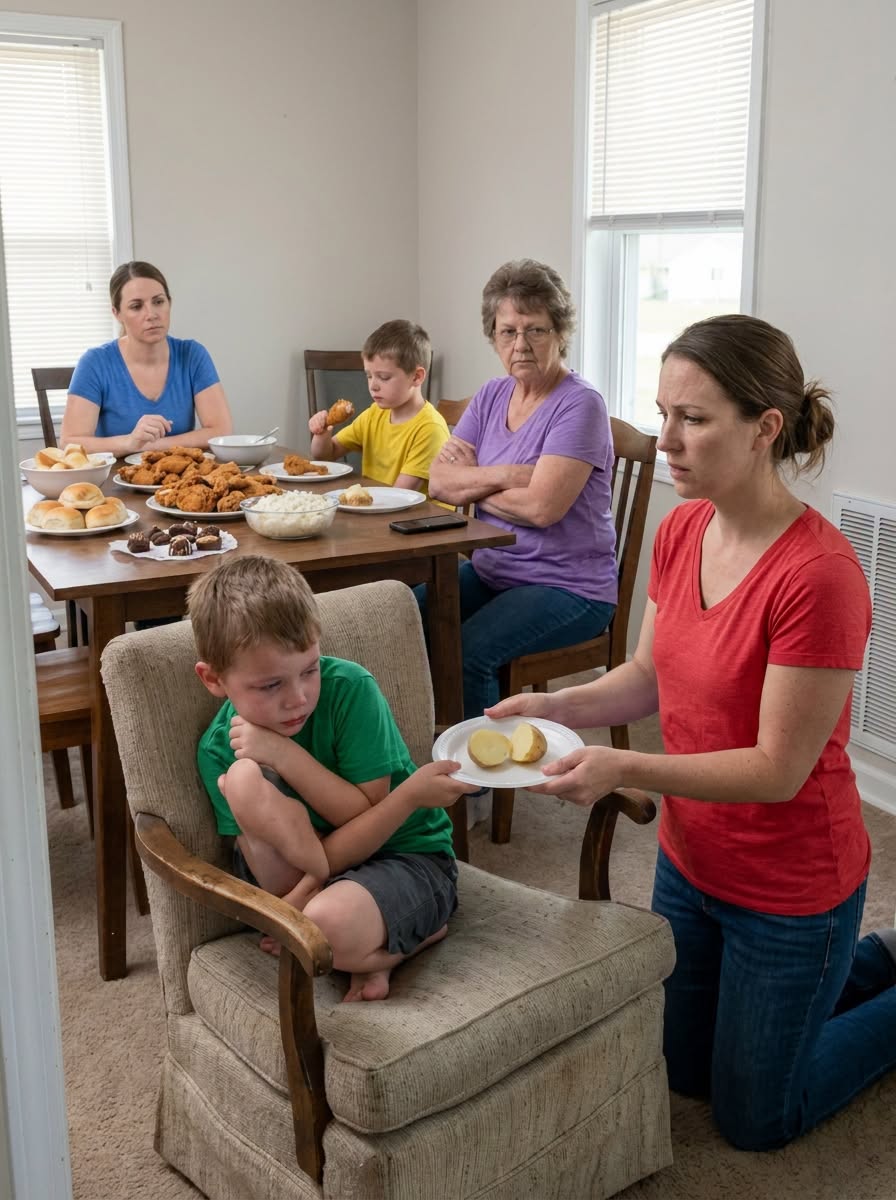
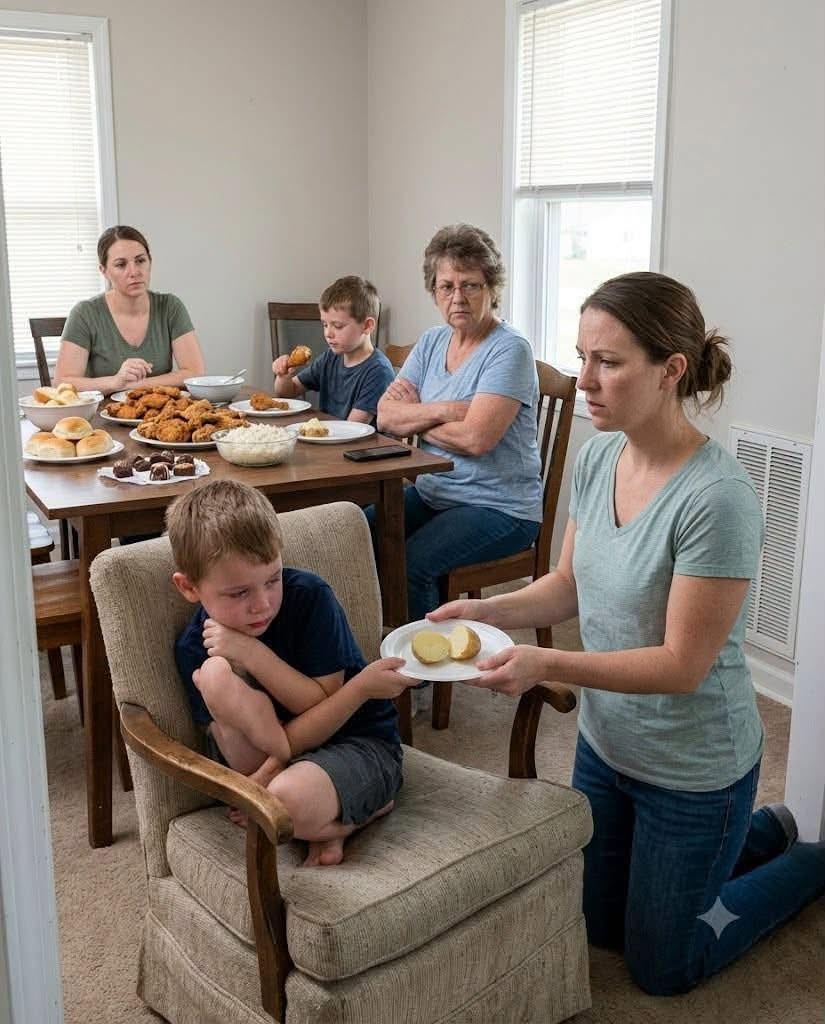
Mason sat at the dining table eating another dinner roll.
Dustin was upstairs.
I had made him scrambled eggs, toast, strawberries, and warm milk. He ate slowly, as if he was waiting for someone to tell him he had taken too much.
When I put another strawberry on his plate, he whispered, “Can I have that?”
I nearly broke.
“They’re yours,” I told him.
“All of them?”
“If you want them.”
He looked at me for several seconds before eating it.
That tiny hesitation made something cold settle inside me.
I had left my son here believing he was safe.
He had learned to ask permission for fruit.
Downstairs, tires crunched over the gravel driveway.
Ellie jumped to her feet.
“Finally.”
Alana straightened her shirt.
I walked to the bottom of the staircase.
Parker came through the front door so quickly he didn’t even close it behind him.
His face was pale.
He looked first at me.
Then at his mother.
Then at his sister.
“Where’s Dustin?”
“Upstairs,” I said.
“Is he okay?”
“Physically?”
Parker flinched.
That was the right reaction.
He started toward the stairs, but Alana blocked him.
“Parker, sweetheart, before she fills your head with—”
“Move.”
Alana froze.
I had been married to Parker for four years.
I had heard him angry.
I had heard him frustrated.
I had never heard that voice.
Low.
Flat.
Final.
His mother stepped aside.
Parker went upstairs.
For several minutes, nobody spoke.
Then I heard Dustin’s bedroom door open.
Silence.
A minute later, I heard Parker say something too softly for me to understand.
Then Dustin began crying.
Not loudly.
That made it worse.
It was the sound of a child who had practiced crying quietly.
Parker stayed upstairs nearly fifteen minutes.
When he came down again, his eyes were red.
He walked directly toward the dining table and picked up the plate Dustin had been using earlier.
The potato was gone, but the knife marks remained on the plastic.
Parker stared at it.
Then he looked at his mother.
“How many times?”
Alana blinked.
“How many times what?”
“How many times did you make my son eat separately?”
“He isn’t your—”
Parker slammed the plate onto the table.
It cracked down the middle.
Mason jumped.
Ellie grabbed her son’s shoulder.
Parker didn’t raise his voice.
That somehow made every word heavier.
“Finish that sentence.”
Alana stared at him.
Parker stepped closer.
“Say it.”
“I only meant biologically.”
“There it is.”
He laughed once.
There was no humor in it.
“There it is again.”
Alana’s expression changed.
For the first time, she looked nervous.
Parker turned toward me.
“When I was seventeen, Mom found out my father had another son.”
I stared at him.
Parker had never mentioned another brother.
“His name was Caleb,” Parker continued. “He was twelve. Dad had been sending money to his mother for years.”
Alana snapped, “That has nothing to do with this.”
“It has everything to do with this.”
Parker’s jaw tightened.
“Dad wanted Caleb to start visiting us. Mom refused. She said he wasn’t real family.”
My stomach turned.
The exact words.
Children who aren’t really family need to learn their place.
Parker looked at his mother.
“You used to say it about Caleb.”
Alana’s face hardened.
“I was humiliated. Your father betrayed me.”
“So you punished a twelve-year-old boy?”
“I protected my family.”
“You made Dad choose.”
“Yes.”
“And he chose you.”
“He chose his marriage.”
Parker nodded slowly.
“Then Caleb disappeared.”
Nobody moved.
Even Ellie looked uncomfortable now.
Parker continued.
“I spent years believing Dad stopped seeing him because Caleb’s mother moved away. That was what Mom told me.”
Alana pointed at him.
“Don’t start rewriting history.”
“You did that yourself.”
Parker pulled out his phone.
“When Clarissa sent me that recording, I didn’t drive here immediately.”
Alana’s expression changed.
“I called Dad.”
The room became still.
Parker’s father, Henry, lived nearly five hours away.
He and Alana had divorced nine years earlier.
They rarely spoke.
Parker looked at me.
“He told me the truth.”
Alana whispered, “Parker.”
Parker ignored her.
“Caleb’s mother didn’t move away. My mother threatened to expose her at work, threatened to sue for every dollar Dad had ever sent, and told Dad that if he visited Caleb again, she would make sure he never saw Ellie or me.”
Ellie shook her head.
“No.”
Parker turned toward her.
“She did.”
“Dad lies.”
“He sent me the letters.”
That stopped her.
Parker opened his phone and scrolled.
“Letters Caleb wrote me.”
Alana went white.
Parker read one aloud.
“Dear Parker, Dad says I can’t come anymore. Did I do something wrong? I liked playing basketball with you. Tell Ellie I still have the card she made me.”
Ellie covered her mouth.
Parker’s voice cracked slightly.
“He was twelve.”
Alana suddenly lunged toward the phone.
Parker stepped back.
“Don’t.”
“That was thirty years ago!”
“And you’re doing it again.”
“To who?”
Parker pointed upstairs.
“To my son.”
Alana laughed sharply.
“Your son? You met that child when he was three.”
Parker moved so quickly that Alana stopped laughing.
“I met Dustin when he was three years old.”
He pointed toward the ceiling.
“I taught him to ride a bicycle.”
Another step.
“I sat beside him in the emergency room when he needed six stitches in his chin.”
Another.
“I built the rocket costume he wore for Halloween.”
His voice shook now.
“I was the one he called from school when Clarissa couldn’t answer because she was working.”
Alana opened her mouth.
Parker didn’t let her speak.
“I was there when he lost his first tooth. I coached his soccer team. I read him the same dinosaur book forty-seven nights in a row because he refused to sleep without it.”
He looked directly at his mother.
“So don’t ever stand inside my house and tell me that boy isn’t my son.”
Alana’s eyes narrowed.
“This isn’t your house.”
“No.”
Parker glanced at me.
“It’s Clarissa’s.”
Then he turned back.
“And that’s another thing we’re going to discuss.”
Ellie’s face tightened.
She reached for her bag.
“We’re leaving.”
“No,” Parker said.
Ellie stared at him.
“You wanted two hours. We’re leaving now.”
“You’ll leave.”
Parker held up his phone.
“But first, you’re going to tell Clarissa why you’ve been asking me about this property for six months.”
I looked at him.
“What?”
Ellie went completely still.
Parker turned toward me.
“She asked whether your name was the only name on the deed.”
My pulse slowed.
Not because I was calm.
Because my body had recognized danger.
“What did you tell her?”
“The truth. That you bought it before we married.”
“And?”
“She asked whether marriage gave me any ownership rights.”
Alana scoffed.
“People ask questions.”
Parker looked at his mother.
“She also asked whether Clarissa had a will.”
The room went silent.
I heard the refrigerator humming.
Nothing else.
I looked at Ellie.
She stared at Parker with pure hatred.
“You told him that?”
Parker frowned.
“You asked me.”
“It was a hypothetical question.”
“Why?”
“For Mason.”
I almost laughed.
“What does my will have to do with Mason?”
Ellie looked at me.
“You don’t understand because you’ve never had to think about a real family legacy.”
There it was again.
Real family.
Parker closed his eyes briefly.
“Ellie.”
But she had already started.
Maybe anger made her careless.
Maybe she still believed she was right.
“Mom and I have spent summers here for years. Mason loves this place. Parker is family. Eventually, half of what Parker has should stay in the family.”
“Half of what Parker has?”
I stepped toward her.
“He doesn’t own this house.”
“Not yet.”
Parker stared at her.
“What does that mean?”
Ellie realized too late what she had said.
Alana snapped, “Stop talking.”
I looked between them.
“What does ‘not yet’ mean?”
Nobody answered.
Then Mason spoke.
“My mom said Uncle Parker would get the house after the divorce.”
Ellie spun around.
“Mason!”
The boy flinched.
Everyone stared at him.
Mason looked confused.
He was only eight.
Old enough to repeat what adults said.
Too young to understand when he wasn’t supposed to.
“What divorce?” Parker asked.
Mason looked at his mother.
Ellie grabbed his wrist.
“We’re leaving.”
Parker blocked her.
“What divorce?”
“Get out of my way.”
“Mason.”
Parker crouched slightly.
“What did your mom say?”
Ellie shouted, “Do not question my child!”
But Mason was already answering.
“She said Aunt Clarissa would get mad about Dustin and then you would finally divorce her.”
My skin went cold.
Mason continued.
“She said Grandma would help.”
Ellie pulled him toward her.
“Enough.”
Parker looked at Alana.
“You planned this.”
Alana rolled her eyes.
“Oh, please.”
“You deliberately mistreated Dustin because you knew Clarissa would react.”
“Nobody mistreated him.”
I pulled out my phone.
The recording began playing.
Keep feeding Mason in front of him.
By Sunday, Dustin will be begging Clarissa to take him home.
Alana looked away.
Parker stopped the audio.
“You wanted Clarissa angry.”
No answer.
“You wanted to record her.”
No answer.
“You wanted me to see her overreact.”
No answer.
“And then what?”
Ellie laughed bitterly.
“You think you’re some kind of detective now?”
Parker stepped toward her.
“What happened after I divorced her?”
Ellie smiled.
It was small.
Ugly.
“You would eventually realize who actually mattered.”
That sentence changed something in Parker’s face.
He no longer looked hurt.
He looked finished.
Ellie continued.
“Clarissa came into your life with a child from another man and somehow everything started revolving around them. Every holiday. Every weekend. Every decision.”
Parker said nothing.
“You stopped helping Mom financially.”
“I stopped because Dad proved she had lied about needing money.”
“You stopped paying Mason’s summer camp.”
“I paid twice as a gift.”
“You bought Dustin a bicycle.”
“He’s my son.”
“You put him on your health insurance.”
“He’s my son.”
“You made him beneficiary on your work policy!”
I stared at Parker.
He had never told me that.
Ellie pointed toward the ceiling.
“That child isn’t even your blood, and if something happens to you, Clarissa and Dustin get everything while your actual family gets pushed aside.”
Parker looked almost stunned.
“That’s what this is about?”
Alana stepped in quickly.
“No.”
Parker turned toward her.
“Money?”
“No.”
“The house?”
“No.”
“Then what?”
Alana’s eyes filled with tears.
Instantly.
Too instantly.
“I’m your mother.”
Parker said nothing.
“I carried you. I raised you. I sacrificed everything for you.”
Her voice broke.
“And then Clarissa came along.”
I almost felt sorry for her.
Almost.
Until she looked at me.
“You took my son.”
Parker’s expression changed.
“No.”
“You did.”
“No, Mom.”
Alana pointed at me.
“She poisoned you against us.”
“I spent every Christmas with you.”
“Because she allowed it.”
“We paid your rent for eighteen months.”
“You had money!”
“We flew you to Florida.”
“Once!”
“I replaced your furnace.”
“You’re my son!”
“And Dustin is mine.”
Alana slammed her fist on the table.
“He is not!”
A voice came from the stairs.
“Yes, I am.”
Every adult in the room froze.
Dustin stood halfway down the staircase.
Barefoot.
Holding the wooden railing.
His face was pale.
He had heard everything.
I moved toward him.
“Sweetheart—”
But Dustin was looking at Parker.
His lower lip trembled.
“Am I?”
Parker crossed the room.
He climbed the stairs until he was one step below Dustin.
Then he sat down.
So they were nearly eye level.
“Yes.”
Dustin swallowed.
“Even though my first dad died?”
“Yes.”
“Even though you’re not my blood?”
Parker’s face crumpled.
“Yes.”
Dustin looked down.
“Grandma Alana said you would have your own kid someday and forget me.”
Parker went completely still.
I stopped breathing.
Alana whispered, “I never said that.”
Dustin immediately looked frightened.
Parker saw it.
“Dustin.”
The boy looked at him.
“You are not in trouble.”
Dustin nodded slowly.
“Tell me what she said.”
Dustin gripped the railing.
“She said when you and Mom had a real baby, I would have to go live somewhere else.”
Parker closed his eyes.
“She said this house should belong to Mason because Mason is your real nephew.”
Ellie muttered, “Kids misunderstand things.”
Dustin’s voice grew smaller.
“She said if I told Mom, everyone would say I was lying.”
My hands were shaking now.
Parker stood.
“Clarissa.”
I looked at him.
“Call the police.”
Alana laughed in disbelief.
“For what?”
Parker didn’t even look at her.
“I want this documented.”
I made the call.
A county deputy arrived twenty-six minutes later.
By then, Alana and Ellie had suddenly remembered how quickly they could pack.
They carried suitcases to the porch while loudly insisting we were unstable.
The deputy listened to the recording.
He listened to Dustin.
He explained that the family dispute itself was civil, but because I was the property owner and had revoked permission for Alana and Ellie to remain, refusing to leave could become trespassing.
That was enough.
At 2:14, Ellie loaded Mason into her car.
Before getting in, she looked at me.
“You think you won?”
I stared at her.
“This wasn’t a competition.”
She gave a short laugh.
“It always is.”
Then she leaned closer.
“You still don’t know everything.”
Parker stepped between us.
“Leave.”
Ellie smiled at him.
“Ask your wife about the trust.”
My stomach dropped.
“What trust?”
Ellie got into her car.
Alana followed.
They drove away.
The gravel settled.
Nobody spoke.
Then Parker looked at me.
“What trust?”
“I don’t know.”
And I didn’t.
But Ellie had known she was leaving.
She had wanted to plant one last bomb.
That evening, after Dustin fell asleep on the couch between us, Parker and I went through everything.
Emails.
Bank statements.
Property documents.
My father’s estate papers.
Five years earlier, when I bought the country house, I had used money inherited from my grandmother plus savings from work.
There was no secret trust.
At least none I knew about.
Then Parker remembered something.
“Your attorney.”
“What?”
“The lawyer who handled the purchase.”
“Daniel Mercer?”
“You told me your grandmother used his firm too.”
She had.
I called.
It was Friday evening.
I expected voicemail.
Daniel answered on the third ring.
When I explained what had happened, he became quiet.
“Clarissa, there’s something I need to show you.”
My heart began pounding.
“What?”
“I can’t discuss the details properly over the phone. Come to my office Monday.”
“Daniel.”
Silence.
“Is there a trust?”
“Yes.”
I sat down.
Parker stared at me.
“What trust?”
“The Whitmore Family Property Trust.”
I had never heard that name.
Daniel continued.
“Your grandmother created it before she died.”
“For what?”
“The country property.”
I looked around the living room.
“This property?”
“Not exactly.”
I stopped breathing.
Daniel explained.
The house I owned sat on thirty-four acres.
But surrounding it were another one hundred and twelve acres of farmland and wooded property.
Land I had always believed belonged to a private agricultural company.
It didn’t.
My grandmother had quietly purchased it decades earlier.
The trust controlled it.
And I was the sole current beneficiary.
The combined property was worth far more than I had ever imagined.
“How much?”
Daniel hesitated.
“The last formal estimate was just under two million dollars.”
Parker whispered, “Jesus.”
I barely heard him.
“How would Ellie know?”
Daniel became silent again.
“That’s the concerning part.”
I gripped the phone.
“Tell me.”
“Someone contacted my office six weeks ago asking questions about transfer rights after divorce.”
Parker stood.
“Who?”
“The caller identified herself as Clarissa.”
Everything inside me went cold.
“I never called you.”
“I know that now.”
“What did she ask?”
Daniel exhaled.
“She wanted to know whether a spouse could claim any part of the trust through marital property rights.”
Parker covered his mouth.
“What did you tell her?”
“Nothing specific. The questions raised concerns because they didn’t sound like you. We refused to disclose details.”
“Did she leave a number?”
“Yes.”
“Send it.”
He did.
Parker looked at the number.
His face changed.
“That’s Ellie.”
That was the real plan.
Not simply to humiliate Dustin.
Not simply to break my marriage.
They believed the trust was vulnerable if Parker and I divorced.
Ellie hadn’t understood that the trust protected the land separately.
But she had known enough to start digging.
We gave everything to an attorney Monday morning.
The recording.
The fake call.
The property questions.
Text messages Parker found going back months.
One message from Ellie to him suddenly looked very different.
If Clarissa ever decides she’s done with you, don’t let her bully you into walking away with nothing.
Another from Alana said:
A husband has rights too. Don’t be weak like your father.
Parker sat in Daniel’s office reading them.
Then he said something I never forgot.
“They weren’t trying to protect me.”
Daniel shook his head.
“No.”
“They were trying to use me as the door.”
Exactly.
And when Parker refused to become that door, they decided Dustin was the easiest place to apply pressure.
The weeks after that were ugly.
Alana called relatives.
Ellie posted vague messages online about “women who isolate men from their families.”
People chose sides without knowing anything.
Then the recording reached them.
Parker sent it to exactly three relatives.
Within twenty-four hours, the family narrative changed.
Alana stopped posting.
Ellie deleted everything.
But there was one more surprise.
Henry called us.
Parker put him on speaker.
“I heard what happened,” he said.
Parker was quiet.
Henry continued.
“I should have told you about Caleb years ago.”
“Where is he?”
A long pause.
“Cincinnati.”
Parker stood.
“You know where he is?”
“I’ve always known.”
The pain on Parker’s face was immediate.
“Does he want to see me?”
“I don’t know.”
Henry gave us Caleb’s number.
Parker stared at it for two days before calling.
Caleb answered.
They spoke for four hours.
I didn’t hear most of it.
I didn’t need to.
When Parker came downstairs afterward, he had been crying.
“So?”
“He has two daughters.”
I smiled.
Parker laughed through tears.
“He still remembers the basketball hoop.”
That autumn, Caleb visited.
He brought his wife and daughters.
Dustin met cousins he never knew existed.
They played soccer in the same yard where Alana had once accused him of destroying flowers.
Parker watched them from the porch.
At one point, Dustin ran over.
“Dad!”
Parker turned instantly.
That single word carried across the yard.
Dad.
No hesitation.
No question.
Parker smiled.
“What?”
“Come play!”
He did.
A year later, we made one more change.
Not because of Alana.
Not because of Ellie.
Because Dustin asked.
Parker adopted him legally.
The day the judge finalized it, Dustin wore a blue shirt and a tie that kept sliding sideways.
When the judge asked if he understood what adoption meant, Dustin nodded seriously.
“It means he’s already my dad, but now the papers know too.”
The judge laughed.
I cried.
Parker cried harder.
Outside the courthouse, Dustin handed Parker a folded piece of notebook paper.
Parker opened it.
There was a drawing of three people standing beside a house.
Me.
Parker.
Dustin.
Above us, Dustin had written one sentence.
Real family is who stays.
Parker had it framed.
It still hangs in our hallway.
As for Alana and Ellie, Parker did not cut them off in one dramatic moment.
He did something they hated more.
He created boundaries.
Written ones.
No unsupervised contact with Dustin.
No access to our property.
No loans.
No emergency money.
No discussing inheritance.
No surprise visits.
No exceptions.
Alana refused.
So she saw us rarely.
Ellie refused completely.
Parker stopped chasing her.
Months passed.
Then nearly a year.
One afternoon, an envelope arrived.
No return address.
Inside was a handwritten note from Mason.
He was nine now.
It said:
Aunt Clarissa,
I’m sorry Dustin had the potato.
I knew Grandma was being mean but Mom told me not to say anything.
I gave Dustin one chicken piece earlier when they weren’t looking.
Please tell him I’m sorry I didn’t give him more.
I sat at the kitchen table staring at that letter for a long time.
Then I called Dustin.
He read it twice.
“Can I write back?”
“Of course.”
He took a pencil.
His reply was short.
Mason,
You don’t have to be sorry.
You were a kid too.
You can come play soccer if your mom ever lets you.
Dustin.
I had to leave the room after that.
Because children notice more than adults think.
They also forgive differently.
Dustin didn’t excuse what happened.
He simply understood something the adults had refused to understand.
Mason had been trapped inside that house too.
Just on the other side of the table.
Two summers after the fried chicken incident, Parker and I hosted a family cookout at the country house.
Caleb came with his family.
Henry came.
Some cousins came.
Even Mason came.
Ellie didn’t.
She dropped him at the end of the driveway and left.
There were hamburgers.
Corn.
Fruit.
Chicken.
Too much food.
I noticed Mason staring at the serving table.
Then at Dustin.
Dustin picked up two plates.
He handed one to Mason.
“Take whatever you want.”
Mason smiled.
They filled their plates and sat beside each other.
No corner.
No punishment chair.
No ranking.
No real family and fake family.
Just two kids eating dinner.
Later that night, after everyone left, I walked into the kitchen and found Parker washing dishes.
I wrapped my arms around him from behind.
He smiled.
“Good day?”
“Good day.”
Outside, Dustin and Mason were chasing fireflies with flashlights.
Parker looked through the window.
“I keep thinking about that recording.”
“So do I.”
“If Ellie hadn’t left her phone running…”
“We might never have known.”
He nodded.
Then he looked at me.
“But maybe we would have eventually.”
I understood what he meant.
The recording revealed the plan.
But Dustin’s face had revealed the truth before any audio ever did.
The hidden plate.
The cold potato.
The way he asked whether he could eat a strawberry.
The way he worried Parker would stop loving him.
Those things had been the evidence that mattered first.
I leaned against the counter.
“You know what still bothers me?”
“What?”
“That first day, Ellie asked if I thought I had won.”
Parker dried his hands.
“And?”
“I think she believed there had to be a winner.”
He looked outside again.
“People like that always do.”
Dustin shouted from the yard.
“Dad! Mom! Come outside!”
We went.
There were fireflies everywhere.
Tiny lights moving across the field.
Dustin ran toward us.
Mason followed.
Parker grabbed Dustin and lifted him into the air.
Dustin screamed with laughter.
For one second, I thought about the boy in the armchair.
The cold plate.
The lowered head.
The shame in his eyes.
Then I looked at him now.
Laughing.
Safe.
Certain.
Loved.
The house had never needed to feel like a “real family house,” as Alana called it.
It already was one.
She simply had never understood what made a family real.
It wasn’t blood.
It wasn’t inheritance.
It wasn’t whose name appeared on a deed.
And it definitely wasn’t who got the biggest piece of fried chicken.
Family was the person who sat beside you when you were scared.
The person who believed you when someone called you a liar.
The person who chose you even when nobody forced them to.
The person who made sure you never had to ask whether you were allowed to eat.
And sometimes family was a seven-year-old boy standing halfway down a staircase, asking one painful question.
Am I?
Parker had answered him that day.
Yes.
Years later, that answer still had not changed.
And it never would.