The lock released beneath my fingers, and I opened the bathroom door wide enough to step into the hallway.
My husband was standing directly outside with the livestream phone in his hand.
His mother hovered beside him.
Neither of them had expected me to come out.
I could tell by the way my husband’s shoulders shifted when he saw me,
as though he had prepared himself for another argument through a closed door but not for me to stand in front of the audience they had created.
The towel was still wrapped tightly around my head.
My scalp burned underneath it.
I kept one hand under my stomach,
partly because I needed something steady and partly because seven months pregnant was not a condition
I could simply forget while my family turned the worst humiliation of my life into entertainment.
The phone was still live.
That mattered most.
I could hear the faint overlapping sounds coming from its speaker as comments continued appearing faster than anyone could answer them.
I could see my husband’s thumb near the screen.
I could see his mother’s eyes flicking between me and the phone.
I could see exactly what they wanted.
I could see that they still thought they could manage this.
My husband spoke first.
“Just tell them you’re okay.”
His voice was calm enough that someone hearing only those words might have thought he was comforting me.
That had always been the advantage of a calm voice.
It could make control sound reasonable.
His mother moved closer to him and murmured something I couldn’t fully hear, but I didn’t need to hear every word.
Minutes earlier, she had already made her position clear.
She wanted the nurse dismissed.
She wanted my medical reality treated like an inconvenient detail.
She wanted the people watching to believe that my pregnancy had made me emotional, confused, or too overwhelmed to explain my own supposed illness properly.
The problem was that the viewers had started asking questions neither of them had prepared for.
Where was the diagnosis?
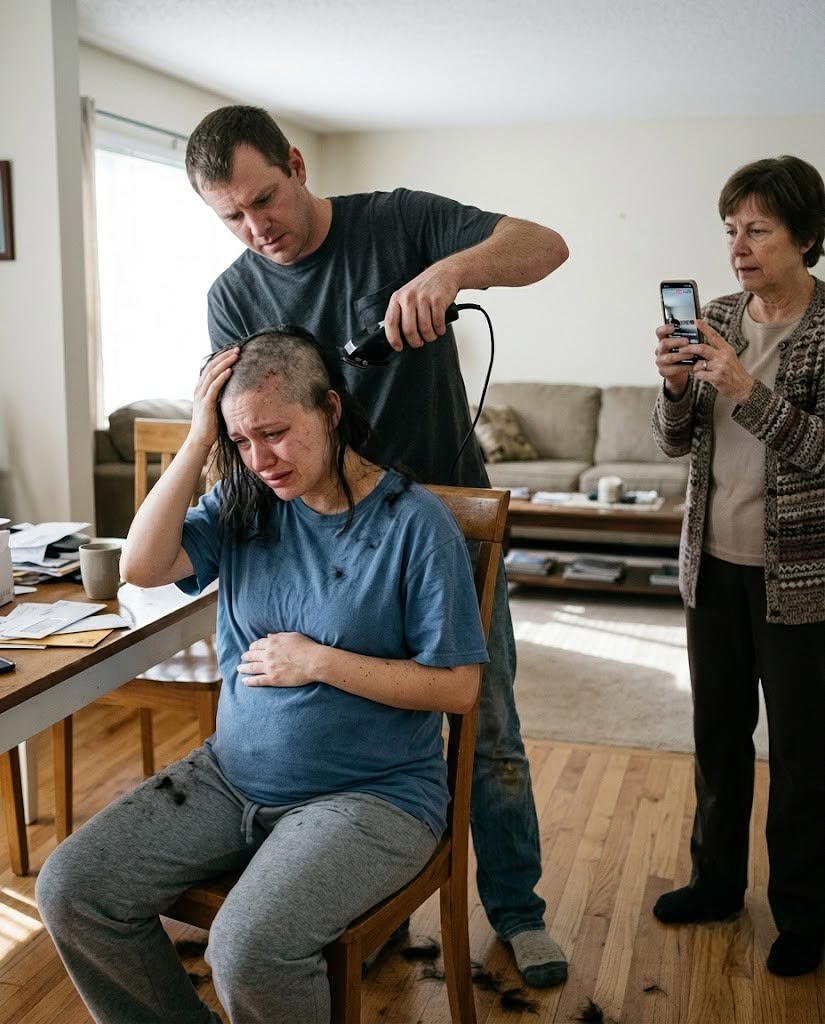
Why had my husband shaved my head himself?
Why had the nurse said my prenatal records were normal?
Why was the donation page still collecting money?
Those questions had changed the room before I ever opened the door.
At the beginning, the livestream had given my husband and his mother all the power.
They had the phone.
They had the story.
They had my tears.
They had taken the most visible evidence of what had been done to me—my shaved head—and given strangers an entirely different explanation for it.
Cancer, they said.
A sick pregnant wife.
An unborn baby supposedly in danger.
A family asking strangers for help.
It was horrifying because it sounded believable when presented in pieces.
A crying pregnant woman with no hair could make people stop scrolling.
A mother-in-law sounding frightened for her grandchild could make people listen.
A husband standing close to his wife could look supportive if nobody knew he had been the one holding the clippers.
That was the trick.
They didn’t need every detail to survive examination forever.
They only needed the emotional image to work long enough for people to donate.
And until the nurse commented, it had.
I remembered sitting inside the bathroom with my back against the door, staring at the screen while the comments moved so quickly that I had to reread the important ones twice.
The nurse’s first message had almost disappeared among prayers, sympathy, and people asking where they could send money.
Then she posted again.
She made it clearer.
She had seen my records during a normal prenatal visit.
The cancer story was false.
That simple contradiction did more than anything I could have screamed through the door.
It gave the viewers permission to question what they were seeing.
Once that happened, the entire livestream changed direction.
People stopped comforting my husband and his mother and started examining their claims.
One person asked why there had been no mention of treatment.
Another asked why my hair had supposedly needed to be shaved at home.
Someone who said they had already donated wanted proof of the medical crisis.
Then others repeated the nurse’s comment so it couldn’t be buried.
My mother-in-law tried anyway.
She told them there had been a misunderstanding.
She said pregnancy had made me emotional.
She suggested the nurse didn’t understand my entire situation.
But every explanation created another question.
Every question required another explanation.
And every explanation moved them farther from the story they had started with.
My husband had eventually told her to end the stream.
She refused.
That moment told me more than either of them realized.
If her first priority had truly been my health, she would have stopped broadcasting the second I locked myself away crying.
If her first priority had been protecting me, she never would have turned my humiliation into content.
If her first priority had been correcting a misunderstanding, she could have ended the stream as soon as viewers began questioning the story.
Instead, she kept going because too many people were watching.
The audience had become both the reason for continuing and the thing she feared losing.
Then she handed the phone to my husband.
And now he was standing in front of me with it.
I looked at the device rather than at him.
The donation page was still taking money.
That detail had changed something inside me while I was locked away.
My hair was personal.
My scalp was personal.
My tears were personal.
But the money belonged to strangers who believed they were helping a sick woman and a baby facing a medical crisis.
I wasn’t sick with cancer.
There was no cancer diagnosis hidden somewhere outside that bathroom.
There was no private medical truth that the nurse had somehow missed.
The story being used to collect donations was not mine.
My husband shifted the phone slightly.
“Tell them it got exaggerated,” he said.
I looked at him then.
Not the phone.
Him.
“Exaggerated?”
His mother immediately stepped closer.
“You know what he means.”
I did.
He wanted a smaller word for a bigger act.
Exaggerated sounded accidental.
Exaggerated sounded like someone had misunderstood a test result or repeated something incorrectly.
Exaggerated did not sound like a husband taking clippers to his pregnant wife’s hair while his mother filmed her crying.
Exaggerated did not explain why strangers had been told cancer was responsible.
Exaggerated did not explain why donations were still being accepted after the story had been challenged.
I reached for the edge of the towel.
My husband’s eyes dropped to my hand.
His mother noticed too.
“Don’t,” she said quickly.
That one word nearly made me laugh, though nothing about the moment was funny.
She had been willing to show my face when my tears helped her story.
Now she didn’t want viewers seeing what might contradict it.
I loosened the towel.
The fabric dragged lightly across the scraped places on my scalp, and I had to stop myself from flinching.
Earlier, when I had checked the towel in the mirror, tiny dark spots had marked the cloth where the clippers had caught my skin.
I had wrapped it back around my head because I couldn’t stand looking at myself for long.
Not because being bald was shameful.
Because I knew why I was bald.
I knew who had done it.
And I knew thousands of strangers had been given a lie to explain my tears.
My husband lowered his voice.
“You don’t have to do this.”
There it was again.
The calm tone.
The reasonable words.
The suggestion that whatever happened next would be something I was choosing to do to them, rather than a response to what they had already done to me.
I glanced at the phone.
The comments kept moving.
Somebody repeated the question I had asked through the bathroom door earlier: who held the clippers?
Another person wrote that the nurse’s comment was still visible.
Someone else asked whether the fundraising page had been taken down.
My mother-in-law reached toward the phone.
My husband moved it slightly away from her without seeming to think about it.
It was a tiny movement.
But I saw it.
So did she.
For the first time since the livestream began, they were no longer acting like one person with one plan.
She wanted control of the broadcast.
He wanted the problem to stop growing.
Those goals had been compatible when I was locked behind the bathroom door.
They weren’t anymore.
I pulled the towel farther back.
Cool hallway air touched my scalp.
My husband’s expression tightened.
His mother’s hand froze near the phone.
I didn’t make a speech.
I didn’t need one.
“I’m not being treated for cancer,” I said.
The words sounded almost strangely ordinary in the hallway.
That was because the truth was ordinary.
My prenatal visit had been normal.
The extraordinary thing was the story built around it.
My husband started to interrupt.
I kept going.
“I don’t have a cancer diagnosis.”
His mother spoke over me.
“She’s upset right now.”
I turned toward her.
“Stop telling people what I mean.”
She stared at me.
The comments accelerated again.
My husband brought the phone closer to his chest, perhaps instinctively trying to reduce what the microphone could capture.
I stepped forward.
“Keep it where they can hear me.”
He didn’t answer.
My hand remained under my stomach.
The other held the loosened towel against the back of my head.
I could feel my pulse in my scalp.
My knees felt weak, but my voice didn’t.
“He shaved my hair,” I said.
My husband’s jaw tightened.
His mother immediately cut in.
“Because it was already falling out.”
I looked at my husband.
“Was it?”
He glanced toward his mother.
That was enough to tell me he hadn’t expected the question to be directed at him.
For several minutes they had been speaking about me as though I were evidence they owned.
Now he had to either repeat the lie while I stood beside him or refuse to support his mother’s version.
He chose neither.
“This isn’t helping,” he said.
I heard the words and realized how completely the argument had changed.
Not helping whom?
Not helping the pregnancy?
Not helping me?
Not helping the people who had donated?
Or not helping two people whose story was breaking apart in public?
I didn’t ask.
The livestream was doing that work already.
Viewers were posting variations of the same demand: stop avoiding the question.
My mother-in-law told my husband to give her the phone back.
He didn’t.
“End it,” he told her.
“You have it,” she snapped.
Another tiny fracture.
A few minutes earlier, she had refused to shut the broadcast down because leaving abruptly would make them look guilty.
Now the phone was in his hand, and suddenly ending the livestream was his responsibility.
I watched him look at the screen.
His thumb hovered near the controls.
Then a new wave of comments appeared.
The nurse had posted again.
I couldn’t read every word from where I stood, but I saw enough to recognize the same point: my records did not support the cancer story being told about me.
My husband saw it too.
His mother leaned toward the screen.
“She can’t say that,” she muttered.
I almost answered her.
Instead, I looked at the donation page still visible through the livestream interface.
Money was the one part of this that could not be dismissed as a family misunderstanding.
A stranger either donated under the belief that a medical crisis existed or didn’t.
The page either kept accepting those donations or it didn’t.
The story either matched my actual condition or it didn’t.
That clarity steadied me more than anger could have.
“Tell them the fundraiser is still open,” I said.
My husband looked at me sharply.
His mother said my name wasn’t the point, though she had never once treated my identity as separate from the story she was selling.
“Close it,” I said.
My husband rubbed his thumb along the edge of the phone.
“We’ll deal with that.”
“When?”
He didn’t answer.
I took another step closer.
“People are asking now.”
His mother tried to move between us, but the hallway was too narrow for the gesture to feel natural.
She stopped halfway and lowered her voice.
“Think about your baby.”
That hurt differently.
They had already used my unborn baby as part of the fundraising story.
Now she was using the baby again as a reason for me to stop correcting it.
I placed my palm more firmly beneath my stomach.
“I am.”
Nothing else needed to follow.
My husband stared at me for a second, then back at the screen.
The phone had become something none of us expected when the livestream started.
At first, it had been their tool.
It let them choose the angle.
It let them choose the explanation.
It let them turn my tears into proof of an illness I didn’t have.
Now the same device was carrying questions they couldn’t control.
The nurse’s comment existed in front of everyone.
The viewers knew the fundraiser remained active.
They knew I was standing there saying I had no cancer diagnosis.
And they knew my husband had not answered the simplest question of all.
Who held the clippers?
I reached out my hand.
“Give me the phone.”
His mother immediately said no.
My husband looked down at my open palm.
For a second, nobody spoke.
I wasn’t asking for his permission to explain myself.
I wasn’t asking his mother to stop interpreting my face.
I wasn’t asking the viewers to believe me because I was crying.
I was asking for the object they had used to speak for me.
My husband looked at the livestream once more.
The comments kept coming.
Then his fingers loosened.
He placed the phone into my hand.