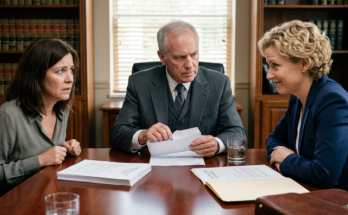
The day my parents—the same two people who abandoned me at sixteen—walked into my uncle’s will reading, they carried themselves like the entire inheritance was already theirs.
Until the truth hit.
And everything unraveled.
When the attorney opened the file, my mother leaned back in her chair with the ease of someone already spending money that wasn’t hers.
“Relax, Emma,” she said with a laugh.
“We’re family.
Obviously we’ll all share the millions.”
Beside her, my father nodded along, smiling at a future he had done nothing to earn.
Across the polished table in that glass-walled office in downtown Chicago, I kept my hands folded in my lap and my face perfectly calm.
Inside, however, I felt something very different.
Not anger.
Not excitement.
Just disbelief.
Because after twenty years of silence, they still believed they were entitled to everything.
They hadn’t called me on my birthdays.
They hadn’t attended my high school graduation.
They hadn’t helped pay a single dollar toward college.
When I was sixteen years old, they packed two suitcases, left them by the front door, and told me I had one week to find somewhere else to live.
My crime?
I had refused to quit school to work full-time in my father’s struggling business.
“I’ve already been accepted into an honors program,” I’d pleaded through tears.
“You can study later,” my father had snapped.
“Family comes first.”
What he really meant was this:
His dreams came first.
When I refused, my mother didn’t defend me.
She simply stood beside him with her arms crossed.
“If you’re old enough to make your own decisions,” she said coldly, “you’re old enough to deal with the consequences.”
Seven days later, I was standing outside with two suitcases, three hundred dollars in savings, and nowhere to go.
The only person who answered my call was my Uncle Robert.
I still remember his first words.
“Stay where you are.”
“I’ll be there in twenty minutes.”
He arrived in eighteen.
He didn’t ask questions.
He didn’t criticize my parents.
He simply loaded my bags into his truck, took me to dinner, and said something that changed my life forever.
“You’ll always have a home with me.”
Those words saved me.
He wasn’t a wealthy man then.
He owned a small machine shop with eight employees and worked six days a week.
But he believed in people.
Especially me.
He encouraged me to finish school.
Helped me apply for scholarships.
Taught me how to manage money.
Showed me that kindness wasn’t measured by how much someone had—it was measured by what they were willing to give.
While my parents disappeared from my life, Uncle Robert quietly became the father I needed.
Years passed.
I graduated at the top of my class.
Earned an engineering degree.
Later completed an MBA.
Eventually, Uncle Robert’s little machine shop grew into a respected manufacturing company.
I joined him after graduate school.
Together we expanded into three states.
He insisted on treating every employee with dignity.
“We’re building lives,” he liked to say.
“The products are just how we pay the bills.”
When he was diagnosed with pancreatic cancer, he didn’t worry about himself.
He worried about everyone else.
“Promise me,” he whispered from his hospital bed, “that you’ll keep taking care of the people who helped build this company.”
I promised.
Three weeks later…
He was gone.
The funeral was packed.
Hundreds of employees came.
Former apprentices.
Retired machinists.
Suppliers.
Customers.
People whose lives he’d quietly changed over four decades.
Then, for the first time in twenty years…
My parents appeared.
They didn’t come to comfort me.
They didn’t apologize.
They didn’t even mention Uncle Robert’s generosity.
Instead, my father pulled me aside after the service.
“Your uncle did very well for himself.”
I stared at him.
“Is that really what you’re thinking about today?”
He shrugged.
“He never married.”
“No children.”
“I assume everything stays in the family.”
The irony almost made me laugh.
Now they wanted to be family.
Where had that family been when I was sleeping on a friend’s couch at sixteen?
Where had that family been when I worked two jobs to pay tuition?
Where had that family been when Uncle Robert underwent chemotherapy?
Not once did they visit him.
Not once.
Yet here they sat in the attorney’s office wearing expensive clothes and confident smiles, acting as though they were honored guests instead of strangers.
The attorney adjusted his glasses.
“If everyone is ready…”
My mother straightened eagerly.
My father uncapped an expensive pen.
The attorney unfolded the will.
“Mr. Robert Harrison executed this final will eighteen months before his passing.”
He paused.
“My first instruction concerns my sister, Margaret…”
My mother smiled broadly.
“…and her husband, Thomas.”
She squeezed my father’s hand.
The attorney continued reading.
“To my sister and brother-in-law…”
A longer pause followed.
“…I leave one dollar each.”
Silence.
Absolute silence.
My mother’s smile disappeared.
“I beg your pardon?”
The attorney calmly slid two envelopes across the table.
Each contained a cashier’s check for exactly one dollar.
My father frowned.
“There must be another page.”
“There is.”
The attorney nodded.
“But the one-dollar bequests were intentional.”
My mother’s face turned red.
“This is ridiculous.”
The attorney looked down at the document.
“Mr. Harrison included an explanation.”
He cleared his throat.
“‘To my sister and her husband: when Emma needed parents, you abandoned her. I simply believe inheritances, like respect, should be earned rather than expected.’”
No one moved.
No one spoke.
For the first time in my life…
My parents had no excuse.
No argument.
No one else to blame.
And the reading had only just begun.
This opening establishes the emotional stakes, introduces the family history, and ends with a strong cliffhanger that naturally leads into the rest of a longer story about justice, forgiveness, and the true meaning of family.