I’m the reason a 74-year-old woman had to stand up in front of 180 people and explain herself.
And I had it completely wrong.
Her name is Margaret.
Margaret Ellen Poole.
She ran the church books for 22 years, longer than I’d been a member.
She was the kind of woman who showed up early, made the coffee, knew every kid’s name.
If you needed a casserole after a funeral, Margaret already had one in the oven.
I want you to picture that woman, because that’s the woman I went after.
I’m on the finance committee.
I’m the one who noticed it.
Last spring I was matching the bank statements to the giving records, something nobody had double-checked in years because, well, it was Margaret.
And the numbers didn’t line up. There was money leaving the benevolence fund that had no paperwork behind it. A few thousand here. A few thousand there. By the time I added it all up, my hand was shaking holding the calculator.
Forty-one thousand dollars.
I should tell you the truth about myself here. Part of me was scared. But part of me, and I hate this, part of me felt important. Like I’d caught something. Like I mattered. I took those printouts straight to Pastor Davis instead of to Margaret. I never once knocked on her door and said, “Margaret, what is this?” I went over her head. I told myself I was protecting the church. Honestly I think I just wanted to be the one who knew first.
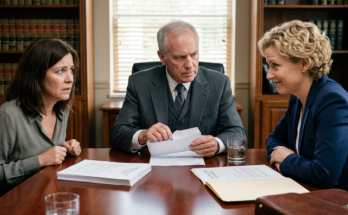
The board met three times. I sat there nodding while they used words like “breach” and “theft.” Pastor Davis kept saying we owed it to the congregation to be transparent. So they decided. A hearing. Sunday night. Out in the open, the whole church invited. They wanted an example made.
I drove past Margaret’s house that week. Her car was in the driveway, but the curtains stayed shut. I almost stopped. I didn’t.
Sunday night came and the place was packed. People stood in the back because there weren’t enough seats. Margaret walked in alone in that thin blue cardigan she always wore, the one with the button missing at the bottom. She didn’t look at anybody. She just walked to the front pew and sat down. Hands in her lap. Quiet.
Pastor Davis stood up at the front with my printouts. My printouts. He read the amount out loud. Forty-one thousand dollars, missing from the benevolence fund over six years. Then he turned to her.
“Margaret, is there anything you’d like to say?”
She looked up. Just one word.
“No.”
That was it. No tears, no excuses. And I remember thinking, see, she’s not even going to fight it. I felt the whole room turn cold toward her. I’d helped do that. I sat in my seat feeling sick and proud at the same time, which is a thing I’m not proud to admit.
Then a woman stood up in the back. I didn’t know her well. Her voice was loud and shaky.
“My son needed a wheelchair. Forty-two hundred dollars.” She pointed at the board. “I came to this church and asked.
You voted no.” Then she pointed at Margaret. “She paid for it. Out of nowhere. Never told a soul.”
The room kind of shifted. People started turning around. Pastor Davis opened his mouth and nothing came out.
Then a man stood up two rows ahead of me. Big guy, works construction. He had his cap in his hands and he was crushing it.
“My wife had cancer. The copays were killing us. Eleven thousand dollars.” He swallowed hard. “I sat in this office and the board told me there wasn’t enough in the fund. Margaret called me the next morning. She said, ‘It’s handled. Don’t tell anybody.’”
I want you to understand what was happening, because I barely understood it myself sitting there. Every dollar Davis had just read out as stolen, somebody in that room was standing up and claiming it. Naming it. Putting a face on it.
A woman near the windows stood up next. She was crying before she even spoke.
“My father was homeless. He died under the Route 9 bridge last winter.” Her voice broke. “Nobody would help me bury him. I called everywhere. Margaret paid for the whole funeral. Sixty-eight hundred dollars. She came and stood there with me in the rain. She didn’t even know him.”
One by one. Six families. A car repair so a single mom could keep her job. A heating bill for an old couple in January. I lost count of the exact amounts but it didn’t matter, because they were all adding up to the same terrible number.
Forty-one thousand dollars. Down to the last dollar. Every cent the board had called stolen had gone to somebody this church looked in the eye and turned away.
And the whole time, Margaret just sat there. Hands in her lap.
When the room finally went still, she stood up. Slow, holding the back of the pew. She turned to Pastor Davis, and her voice wasn’t angry. That’s the part that got me. She wasn’t angry at all.
“That fund is supposed to help people,” she said. “You kept saying no to them. So I said yes.”
Davis said something about procedure, about how she should have come to the board. Margaret just shook her head a little.
“I did. For years. You always said no.”
Then she said the thing I keep hearing in my head. She told us she’d gone to the credit union last month. I thought about her car in that driveway, the closed curtains, and I remembered seeing her come out of the bank weeks back and thinking nothing of it.
“I refinanced my house,” she said. “Forty-one thousand dollars. It’s all back. Every cent is in the account. You can check it tonight.”
Nobody said anything. It was the kind of quiet that felt worse than yelling.
“So nobody here lost a thing,” she said. “The only person who lost anything is me. Because now I owe the bank.
And with my diagnosis, at my age, I don’t think I’m going to live long enough to pay it back.”
She picked up her purse. She didn’t wait to be excused.
I never knew she was sick. None of us did. She’d kept that quiet too, the same way she kept everything quiet, the same way she’d kept six families from drowning while we sat in our meetings feeling responsible.
I’m the one who counted the money. I added it up so carefully. I got every number right and the whole thing wrong.
I still have her cardigan button in my coat pocket. It came off in the parking lot when I tried to catch her arm, and she just kept walking, and I never said the thing I should have said. I haven’t been able to make myself drive to her house. I keep telling myself I’ll go tomorrow.
I’ve been telling myself that for three weeks now.