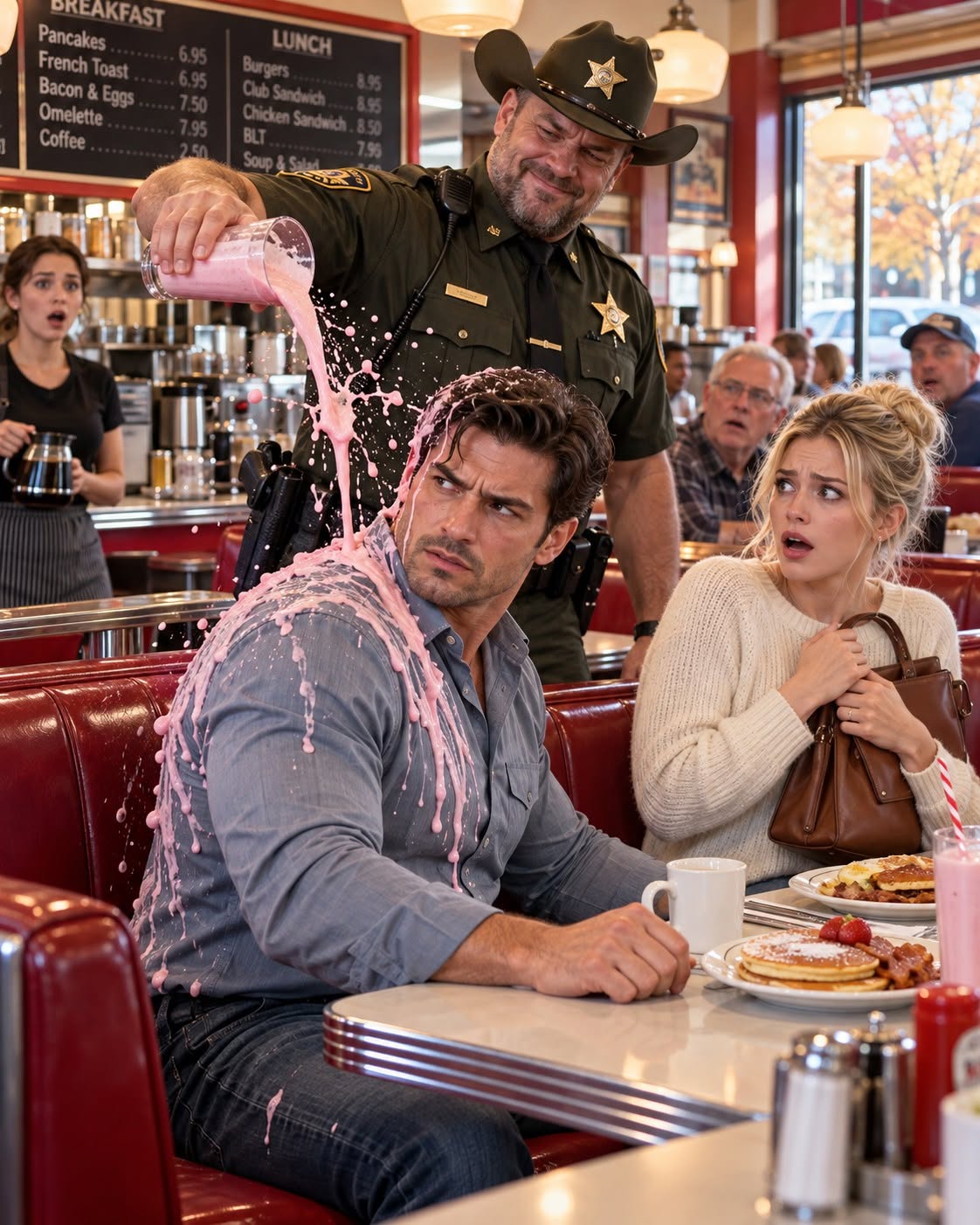
Someone at JAG picked up, addressed me by name, and fell utterly silent the moment I told him Sheriff Dominic Vance’s badge number.
For three seconds, neither of us spoke.
Then a familiar voice said, “Logan, where are you?”
“Outside the Rusty Spoon in Bellwether.”
“Are you injured?”
“No.”
“Is your wife with you?”
I looked through the windshield. Amelia sat rigidly in the passenger seat, staring at the diner’s front window.
Her expression had lost its irritation. She looked pale now, and not because of the cold October light.
“Yes.”
“Don’t discuss this in the vehicle. Can you get somewhere private?”
“I can.”
“Do that. And don’t contact the sheriff’s office directly.”
My fingers tightened around the phone.
“What’s happening?”
“I can’t explain over an unsecured line. But the badge number you gave me belongs to a former deputy whose credentials were reported missing fourteen months ago.”
I turned toward the diner.
Dominic Vance stood near the entrance, one hand resting on the counter while Nora poured him another coffee. He had changed nothing about his posture. He looked like a man who had just finished an ordinary lunch.
“His badge is active,” I said.
“That’s the problem.”
The call ended.
For a moment, I listened to the faint ticking of the SUV’s cooling engine. Beside me, Amelia remained perfectly still.
“Who was that?” she asked.
“JAG.”
Her eyes moved toward mine.
“You called them?”
“Yes.”
“Why?”
“Because I wanted to know why a sheriff was wearing a badge that may not belong to him.”
Her mouth tightened. “You always do this.”
“Do what?”
“Turn something simple into a situation.”
I studied her reflection in the side window. “He poured a milkshake over me in public.”
“And you walked away.”
“That was the appropriate decision.”
“No.” She laughed once, without humor. “It was the decision you always make. You let people treat you however they want, and then you pretend you’re above it.”
I heard the words, but I also heard the space between them.
She was angry.
She was frightened.
And she knew more than she was saying.
I started the SUV.
“Where are we going?”
“Home.”
“I have an appointment at two.”
“With whom?”
She reached for her phone, but her hand stopped before touching it. “It doesn’t matter.”
“That’s becoming a pattern.”
Her gaze sharpened. “What is that supposed to mean?”
“Nothing yet.”
I pulled away from the diner.
Bellwether was a small town built along a highway that had once carried most of the traffic between the northern ranches and the rail yards. Now, the newer interstate bypassed us, leaving behind quiet storefronts, weathered signs, and a population that knew one another’s business before breakfast.
I had chosen the town because it was quiet.
I had chosen the house because its garage was large enough for my tools.
I had chosen Amelia because, for a long time, I believed she was the one person who understood why I wanted to leave my former life behind.
That belief had started to feel less like a truth and more like a habit.
Neither of us spoke during the drive.
When we reached the house, Amelia went inside without waiting. I parked beside the detached garage and removed my flannel shirt. The fabric was stained pink and cold against my skin.
Inside the garage, the familiar scent of oil, rubber, and sawdust steadied me. I hung the shirt over the back of a chair, washed my hands, and opened the locked cabinet beneath my workbench.
The retirement documents were still there.
So was the small metal case I had not opened in three years.
I lifted the lid.
Inside lay my service identification, a commendation ribbon, two old photographs, and a sealed envelope bearing the Naval Legal Service Command insignia.
The envelope had been given to me when I retired.
I had never opened it.
At the time, the officer who handed it over had said, “If you ever see a name from your past surface in a place it doesn’t belong, call us before you act.”
I had thought it was a standard precaution.
Now, Dominic Vance’s badge number seemed to stare at me from the memory of a diner receipt.
I took out my phone and called the number JAG had given me.
This time, the voice belonged to Commander Elias Reed, a man I had worked with during my final deployment. He had been younger then, though his calm had always made him seem older.
“Logan,” he said. “You’ve managed to stay out of trouble for three years.”
“I was trying to.”
“That makes two of us. Tell me exactly what happened.”
I did.
I left out nothing: the time, the witnesses, Dominic’s words, Amelia’s reaction, and the badge number.
When I finished, Reed asked, “Did Vance mention your name?”
“He called me ghost.”
“That may be a coincidence.”
“I don’t believe in coincidences involving missing credentials.”
“No. Neither do I.”
A floorboard creaked behind me.
I turned.
Amelia stood in the open doorway.
She had changed clothes. Her hair was tied back, and a small suitcase rested beside her leg.
The sight of it cut through every other thought.
“Who are you talking to?” she asked.
“An old colleague.”
“About me?”
“About Dominic.”
Her face tightened at the name.
Reed heard the silence.
“Logan,” he said, “we need to meet in person. I’ll be in Helena tonight. Don’t go to the sheriff’s office. Don’t confront Vance. And don’t sign anything your wife puts in front of you.”
Amelia’s eyes flicked toward my desk.
I ended the call.
She stepped into the garage. “You think I’m trying to trick you?”
“I don’t know what you’re trying to do.”
“You could ask.”
“I’ve been asking for three years.”
That landed harder than I intended.
She looked down at the suitcase.
“Where are you going?”
“My sister’s.”
“Why?”
“Because I need space.”
“After what happened at lunch?”
“Because of what happened before lunch.”
The wind pushed dry leaves beneath the garage door. One caught against her shoe.
“What happened before lunch?” I asked.
She folded her arms. “You’ve been distant.”
“I work long hours.”
“You don’t talk to me.”
“I tried.”
“When?”
“Last month, when I asked why you started receiving calls from the county office. You said it was none of my business.”
“It was complicated.”
“Then tell me now.”
She looked toward the house, where her phone was charging on the kitchen counter.
“There are things you don’t understand.”
“Help me understand.”
Her eyes filled, but she did not cry. Amelia hated crying in front of people. Even when her father died, she had stepped outside the church before allowing herself to break.
“Dominic said he could help,” she whispered.
“With what?”
She shook her head. “I can’t.”
“That answer is no longer enough.”
She looked at me then, and for the first time since the diner, the anger fell away. What remained was exhaustion.
“Your mother’s house,” she said.
I said nothing.
After my mother died, I had inherited the old property outside town. It was a narrow strip of land with an abandoned farmhouse and a barn leaning toward the creek. I had planned to sell it, but paperwork complications had delayed everything.
“What about it?”
“Dominic said there was a problem with the title.”
“There isn’t.”
“He showed me documents.”
“Did you have them reviewed?”
“He said the county could seize the property if the back taxes weren’t paid.”
“The taxes are current.”
“I know that now.”
I stared at her.
She pressed her lips together. “I signed something.”
The garage seemed to grow smaller.
“What did you sign?”
“I don’t know.”
“Amelia.”
“A power-of-attorney form, I think. Or a temporary authorization.”
“You think?”
“I was upset. Dominic told me the matter could be handled quietly if I cooperated.”
“Cooperated with what?”
She took a breath. “He wanted access to the property.”
“For what?”
“He said there were old county records stored in the barn.”
“That barn has been empty since my mother died.”
“I know.”
“Then why would he want access?”
“I don’t know.”
I walked past her into the house.
On the kitchen counter, beside a bowl of untouched apples, lay a white envelope. The county seal had been printed in blue ink. My name appeared across the front.
Amelia followed me.
“Don’t,” she said.
I picked it up.
“You brought this home?”
“I didn’t know what else to do.”
“Why didn’t you tell me?”
“Because you would have done exactly what you’re doing now.”
“What, read a letter addressed to me?”
“Become someone else.”
The sentence settled between us.
I opened the envelope.
Inside was a notice from the Broadwater County Land Office, stating that a transfer request had been filed against the property. The request sought temporary control of the land for “historical records preservation and municipal infrastructure assessment.”
At the bottom, under the signature of the county clerk, was a handwritten note.
Please contact Sheriff Vance immediately.
I read it twice.
Then I noticed the date.
The request had been filed six weeks earlier.
Six weeks ago, Amelia had begun avoiding my questions. Six weeks ago, Dominic had started appearing at the garage under the pretense of needing routine vehicle maintenance for county trucks.
Six weeks ago, he had asked me whether I still visited my mother’s property.
I had assumed it was small-town conversation.
I had been wrong.
“Where are the original forms?” I asked.
“I gave them to Dominic.”
“Why?”
“He said the clerk needed them.”
“Did the clerk confirm that?”
“No.”
“Did you sign anything with my name on it?”
She looked away.
“Amelia.”
“I don’t know.”
The answer frightened me more than a confession would have.
I placed the notice on the table and took out my phone.
“Don’t call him,” she said.
“I’m not.”
“Then who?”
“The county clerk.”
Her hand closed around my wrist.
It was the first time she had touched me all day.
“Please,” she said. “Not yet.”
I looked at her fingers, then at her face.
“What are you afraid of?”
She released me.
“Being wrong.”
“That’s not the whole answer.”
“No.” She swallowed. “I’m afraid that if you look too closely, you’ll find out I made a choice I can’t undo.”
I did not call the clerk.
Instead, I asked, “What choice?”
She sat down at the kitchen table. For several seconds, she watched the sunlight move across the wood.
“When Dominic first approached me, he said he had evidence that you were hiding money.”
I felt nothing at first. Then a coldness moved slowly through my chest.
“What money?”
“He said your retirement account had been transferred through an overseas bank.”
“That’s absurd.”
“I know that now.”
“You believed him?”
“I believed the documents.”
“What documents?”
“Statements. Account numbers. Your name.”
I opened my mouth, then closed it.
The account numbers mattered.
My retirement funds were not held overseas. But several years earlier, during a classified assignment, a temporary financial account had been created under a restricted identity. After I retired, the account had been closed and folded into a standard federal transfer.
Only a handful of people had known about it.
No one in Bellwether should have been able to produce statements connected to it.
“What did he want you to do?” I asked.
“Find out where you kept your records.”
“And you did?”
“I looked through the study.”
The words were quiet.
She did not need to explain the rest.
The study had been locked since the day we moved in. Not because I distrusted her, but because some files could not be left in ordinary drawers. Retirement records, medical clearance documents, and old operational correspondence had been stored there.
“Did you open the cabinet?”
“Yes.”
“When?”
“Two weeks ago.”
“What did you take?”
“Nothing.”
“Amelia.”
“I took photographs.”
A deep disappointment settled over me—not because she had opened the cabinet, but because she had done it while believing a man who had spent months circling our lives.
“Where are the photographs?”
She reached into her handbag and removed her phone.
Before she could unlock it, a vehicle slowed outside the house.
We both turned toward the window.
A white county sedan passed our driveway without stopping.
Amelia’s hand began to tremble.
“That’s him,” she said.
“Dominic?”
“No.”
The sedan continued toward the road leading out of town.
“Who?”
She stared after it.
“The man who gave Dominic the documents.”
“What man?”
“I never learned his name.”
“You met him?”
“Once.”
“Where?”
“At the courthouse.”
“When?”
“The day I signed the form.”
“Describe him.”
She closed her eyes, trying to remember. “Gray suit. Brown leather folder. He had a scar near his chin.”
“That’s all?”
“He called Dominic by another name.”
“What name?”
“Captain.”
The word hung in the room.
I returned to the metal case in the garage and removed one of the old photographs.
It showed six men standing outside a naval operations building years earlier. Most faces were turned away from the camera. The man at the far end wore civilian clothes and stood half a step apart from the others.
A faint scar curved beneath his chin.
I had seen him before.
Not in Bellwether.
Not at the courthouse.
In a briefing room overseas, seven years earlier, when a contractor named Adrian Vale had been questioned about missing intelligence funds.
Vale had never been charged. The investigation had collapsed after two witnesses changed their statements, and I had been reassigned soon afterward.
Reed had once told me, “Some people disappear because they’re innocent. Others disappear because the wrong people help them.”
I returned to the kitchen.
Amelia was still holding her phone.
“Show me the photographs.”
She unlocked the screen.
The first image showed a bank statement bearing my name. The second showed a copy of my retirement authorization. The third showed a handwritten list of dates and locations.
The fourth image made me stop.
It was a close-up of a document Amelia had photographed inside my locked cabinet.
The page was old, folded, and marked with a red classification stamp.
Across the bottom, in handwriting I recognized, someone had written:
VALE—BELLWETHER PROPERTY—PHASE TWO.
I had never seen that note before.
But I knew the signature.
It belonged to the officer who had handed me the sealed envelope on the day I retired.
At that moment, Amelia’s phone chimed.
A message appeared from an unknown number.
You should have left before Logan learned about the property.
Amelia looked at me.
A second message followed.
The original file is still in the barn. Ask him what his mother was protecting.
I read the words twice.
Then, beneath them, a location pin appeared.
It marked the old farmhouse beyond the creek.
I took a screenshot of the message and sent it to Commander Reed.
His reply arrived almost immediately.
Do not go alone. Do not enter the barn until I arrive.
I showed Amelia.
She shook her head. “If we wait, they’ll remove whatever is inside.”
“They may already know we found it.”
“Then we go now.”
Her fear had finally overcome her hesitation. That made the decision easier.
I retrieved my service pistol from the locked compartment beneath the workbench, checked the magazine, and concealed it beneath my jacket. Amelia noticed but said nothing.
The drive to the property took eleven minutes. We left the SUV beside the collapsed fence and crossed the field on foot. The farmhouse stood dark against the afternoon sky, its windows clouded with dust.
The barn doors were secured with a new padlock.
I knelt and examined it.
“No rust,” I said. “Recently installed.”
Amelia stepped closer. “Can you open it?”
“I can.”
Before I reached for my tools, a sound came from inside.
One slow scrape.
Then another.
Someone was moving across the barn floor.
I pulled Amelia behind the stone foundation and raised one finger to my lips.
A shadow passed between the gaps in the boards.
Then a man spoke from inside.
“Logan,” he called calmly. “You took longer than I expected.”
Amelia’s hand closed around my arm.
The voice continued.
“Come in alone, and your wife gets to leave.”
I looked toward the tree line.
A second figure stood there, watching us.
And beneath his raised collar, I saw the scar near his chin.
-END OF PART 2
I kept my eyes on the figure beneath the trees.
The scar under his chin was only a pale crescent in the fading light, but it was enough. Adrian Vale had always carried his head slightly to one side, as if listening for a second conversation beneath the first.
He had been presumed out of the country for years.
Yet there he stood, less than a hundred feet away, watching the barn.
“Logan,” the voice inside called again. “You heard me.”
Amelia’s fingers tightened around my sleeve. “What do we do?”
I lowered my voice. “You stay here.”
“No.”
“Amelia—”
“I’m not hiding behind you while you walk into that building.”
“This isn’t about hiding.”
“It is to me.”
The words came out softly, but they carried the exhaustion of the entire afternoon. She had spent years feeling excluded from a life she sensed but did not understand. Now the door had opened, and she was determined not to remain outside it.
I looked at her face. She was frightened, but she was no longer avoiding the truth.
That mattered.
“We don’t go in separately,” I said. “We stay where we can see each other.”
She nodded.
The man in the tree line shifted. He was older than I remembered Vale being, though memory had preserved him at the age he’d been during the investigation. His brown hair was now threaded with gray, and his suit had been replaced by a dark jacket and work boots.
He lifted both hands, showing they were empty.
“I’m not here to cause trouble,” he said.
“You followed us.”
“I came to make sure the documents were found by someone who could understand them.”
“Then step into the open.”
Vale did so slowly. The last light caught the scar beneath his chin.
Amelia inhaled beside me.
“You know him,” she whispered.
“Yes.”
Vale stopped several yards away. “I expected Commander Reed to arrive first.”
“He’s on his way.”
“That gives us very little time.”
“Time for what?”
He glanced toward the barn. “To prevent a bad decision from becoming a permanent one.”
The voice inside the building spoke again.
“Don’t listen to him, Logan. Vale has always been good at making himself sound reasonable.”
Vale’s expression tightened. “Dominic.”
The name settled the last uncertainty.
The sheriff stepped into view between the barn doors. He had removed his uniform jacket, leaving a white shirt and dark trousers. Without the badge and shoulder insignia, he looked less imposing, but not less dangerous to the truth.
He held a folder in one hand.
“Your wife signed a property authorization,” Dominic said. “You have no right to interfere with the county’s preservation work.”
“This is private land,” I replied.
“Not anymore.”
“She signed nothing granting you access to the barn.”
Dominic looked toward Amelia. “You signed an authorization for an inspection.”
“I signed what you told me was a tax document,” she said.
His face remained composed, but the hand holding the folder shifted.
“That is an unfortunate misunderstanding.”
“No,” she replied. “It’s a deliberate one.”
The statement cost her something. I could see it in the way her shoulders lifted and held.
Dominic’s gaze moved back to me. “You should have stayed at home, Logan. You were happier there.”
“I was uninformed there.”
“You were retired.”
“I am.”
“Then act like it.”
There was a time when those words might have pulled me toward anger. Instead, I noticed what Dominic did not say. He never asked whether I had contacted JAG. He already knew.
He had been watching our house.
Possibly the garage.
Possibly Amelia.
“Why did you use a stolen badge?” I asked.
For the first time, something genuine crossed his face.
Vale answered for him. “Because the real sheriff died fourteen months ago.”
Amelia turned toward me.
Dominic’s expression hardened. “That is not relevant.”
“It’s the center of everything,” Vale said. “The original Dominic Vance was a deputy in Broadwater County. He was investigating an old land transfer when his vehicle went off the road. The report called it an accident.”
“And you?” I asked.
“I was hired to help audit county records.”
“By whom?”
Vale looked toward the barn. “By your mother.”
The answer struck more deeply than I expected.
My mother had been dead for four years. She had never mentioned Vale’s name. She had barely spoken about the property after my father died.
“What did she hire you to do?”
“Find out why people were trying to acquire this land.”
Dominic stepped forward. “He’s lying.”
Vale didn’t look at him. “Your mother discovered that the property was being used as a historical marker in a series of altered county records. Land that should have remained in private hands was being transferred through temporary preservation claims. The claims were never completed openly. They were used to create access.”
“Access to what?”
“The creek,” Vale said. “And the old rail corridor beyond it.”
That made no sense. The rail line had been abandoned before I was born.
“Why would anyone want access to an empty corridor?”
“Because it isn’t empty.”
A vehicle appeared on the road beyond the field, headlights cutting through the dusk.
Commander Reed had arrived.
Dominic noticed the lights too. His attention shifted for half a second, and I saw his decision form before he made it.
He dropped the folder.
Not dramatically. Not as a distraction. He simply let it fall into the dirt and stepped backward toward the barn.
“Don’t,” I said.
Dominic stopped.
Amelia moved closer to me.
Reed’s SUV came to a halt near the fence. He exited with a flashlight in one hand and a phone in the other. He had aged since I’d last seen him, but the steady set of his shoulders remained unchanged.
“Logan,” he called. “Everyone all right?”
“Yes.”
“Keep your distance from the barn.”
Dominic looked at Vale. “You brought him here?”
“I didn’t bring anyone.”
Reed approached carefully. His attention settled on Dominic’s face, then on the badge clipped to his belt.
“Sheriff Vance,” he said.
Dominic’s eyes narrowed. “Commander Reed.”
That was the confirmation we needed.
Reed stopped beside us. “You know one another.”
“Not personally,” Dominic replied.
“Then why did you recognize my rank?”
Dominic said nothing.
Reed turned to me. “Are you carrying?”
“Yes.”
“Keep your hands visible.”
I nodded.
His gaze moved to Amelia. “Mrs. Hale?”
She straightened. “Yes.”
“I’m sorry you were placed in this position.”
“I helped place myself here,” she said.
Reed studied her briefly, then looked at the barn. “How many people inside?”
“One,” I said. “Unless there’s another exit.”
“There is,” Vale replied. “At the rear, behind the feed room.”
Reed nodded toward the tree line. “And him?”
“Adrian Vale,” I said.
Reed’s expression changed, though only slightly.
“Mr. Vale,” he said.
“Commander.”
“I was told you died.”
“So was I.”
“Who told you?”
“No one. It was a useful assumption.”
Reed turned to me. “We need to leave. The county dispatcher stopped answering calls ten minutes ago.”
“Is someone coming?”
“Possibly. But we don’t know who would respond.”
Dominic smiled faintly. “You’re making this more complicated than it is.”
“No,” Reed said. “You did that when you impersonated a public official.”
Dominic’s smile disappeared.
Amelia looked at the fallen folder. “That contains the documents?”
“Some of them,” Vale said.
“Then why did you bring me here?”
Vale’s eyes softened. “Because your husband’s mother left instructions.”
He reached into his jacket and removed a folded piece of paper. It was creased and stained, but I recognized the handwriting immediately.
My mother’s handwriting had always leaned slightly forward, as if every sentence were hurrying toward the next.
I took the paper.
Logan,
If you are reading this, then the people I feared have found a way back into the property.
Do not trust the badge. Do not trust any document that says the land is being preserved.
The truth is beneath the floor of the old barn, but it must be found by someone who knows what was lost there.
I read the message twice.
“What was lost?” I asked.
Vale looked at Reed.
Reed’s expression had gone still.
“Your mother was referring to an operation,” he said.
“What operation?”
“An intelligence transfer conducted near Bellwether almost nine years ago.”
I stared at him. “There was no operation here.”
“There was an operation near here. The location was classified.”
“By the Navy?”
“By multiple agencies.”
Dominic gave a quiet laugh from the barn. “There it is. The story he never told you.”
Amelia looked at me.
I could feel her question without hearing it.
Reed answered before I did. “Logan’s mother was not involved in the operation. She discovered evidence afterward.”
“What evidence?” Amelia asked.
“A ledger,” Vale said. “Names, payments, property descriptions, and dates. Enough to prove that someone inside the county had been assisting a private network in moving restricted materials.”
I looked at Dominic. “And the sheriff?”
“The real Sheriff Vance found the ledger,” Vale said. “He gave it to your mother for safekeeping because he believed his office had been compromised.”
“Then he died.”
“Yes.”
“And you disappeared.”
“I was blamed for the missing documents.”
“Were you responsible?”
“No.”
The answer came without hesitation.
Reed said, “Vale was one of several contractors connected to the operation. His financial records were used to make it appear that he had diverted funds. The investigation was closed before the evidence could be challenged.”
“By whom?”
Reed looked at the barn. “That is what we’ve been trying to establish.”
Dominic bent and picked up the folder.
Reed’s voice sharpened. “Leave it.”
Dominic held the folder at his side. “You’re assuming I’m the only person who wants what’s inside.”
“No,” I said. “I’m assuming you’re the only person who deceived my wife to get access to it.”
Amelia flinched, though not at my words. She looked toward the farmhouse.
“I let him into our lives,” she said. “I believed him because he showed me records with your name.”
“He used your fears.”
“I had reasons to be afraid.”
“I know.”
Her eyes met mine. “Do you?”
I wanted to say yes. I wanted to tell her that I understood why a person might believe the worst when someone presented official-looking papers and spoke with calm authority.
But understanding did not erase what she had done.
“I know you were trying to protect yourself,” I said. “I don’t yet know whether you were protecting me.”
She lowered her gaze.
Vale looked away, giving us a moment of privacy even in the open field.
Reed moved toward the barn. “We need to secure the building and document everything.”
Dominic stepped in front of the entrance.
“Not without a warrant.”
“You’re not the lawful sheriff.”
“You can’t prove that.”
Reed held up his phone. “We have enough to start.”
Dominic glanced at the screen, then at Vale.
“Did you tell them about the second ledger?”
Vale’s expression changed.
“What second ledger?” I asked.
Dominic smiled again. “Ask him.”
Vale’s voice was quiet. “There is no second ledger.”
“You always did underestimate how much people remember.”
“Dominic,” Reed said, “move away from the entrance.”
Instead, Dominic opened the folder and removed a single sheet.
He held it out toward Amelia.
“This is your signature,” he said.
She did not move.
“On a document granting authority over the property,” he continued. “If you deny it, you’ll be accused of forgery. If you admit it, your husband loses control of the land.”
He was trying to return her to the place where she had been uncertain and alone.
This time, she did not look at me for rescue.
She walked toward him.
“Show me,” she said.
“Amelia.”
She stopped without turning. “I need to see it.”
Dominic offered the paper.
She read it in silence. Her face changed gradually, first with confusion, then recognition.
“That isn’t my signature,” she said.
Dominic’s mouth tightened. “It’s your signature.”
“No.” She looked closer. “The first letter is wrong.”
“You signed it in a hurry.”
“I always cross the A from the left.” She pointed. “This one starts from the right.”
Dominic snatched the sheet back.
Amelia’s voice grew steadier. “And I never write my middle initial that way.”
“You don’t remember.”
“I do.”
She turned to me. “I did sign a form. But it had three pages. This is one page. The signature was on the last page, below a paragraph about tax authorization.”
Reed came beside her and examined the document. “This page has been separated.”
“Can you prove that?” Dominic asked.
“Not here,” Reed said. “But I can have it examined.”
Dominic folded the paper and put it back in the folder.
“You’re all making a mistake.”
“No,” Amelia said. “I made one mistake. I trusted you without asking anyone else to look. I won’t make another.”
The statement seemed to unsettle him more than any accusation.
A siren sounded faintly in the distance.
Dominic turned toward the road.
Reed said, “That will be state investigators. The county clerk contacted them after I called.”
Dominic’s shoulders relaxed in a way that made me suspicious.
“You think that changes anything?” he asked.
“What happens next depends on what’s in that barn,” Reed replied.
For the first time, Dominic looked genuinely tired.
He glanced toward the dark building, then at me.
“Your mother didn’t tell you the truth,” he said.
“I know.”
“She wasn’t protecting the ledger.”
“Then what was she protecting?”
Dominic looked at Amelia.
“She was protecting the person who carried it.”
Vale’s eyes hardened.
I turned to him. “Who?”
No one answered.
The siren grew louder.
Dominic suddenly stepped away from the entrance. He did not run. He did not resist when Reed directed him toward the approaching vehicles. He simply stood aside, as though the confrontation had ended in a manner he had expected all along.
State investigators arrived minutes later. They separated us, took statements, and secured the barn. Dominic surrendered his badge and service weapon without argument. He did not explain how he had obtained the original sheriff’s credentials. He did not say who had helped him.
Vale remained near the trees until an investigator approached him.
“I’ll answer questions,” he said, “but not here.”
Reed watched him carefully. “You’re coming with us.”
“I expected that.”
Before he left, Vale handed me the folded note from my mother.
“There’s one more thing,” he said.
“What?”
“Your mother asked me to give you this only if Amelia was with you.”
He took a small brass key from his pocket.
I recognized it immediately.
It belonged to the old farmhouse.
“Why would she make that condition?”
“Because she believed you would need someone who knew your present life, not just your past.”
I looked at Amelia.
Her eyes filled, but she held herself together.
“What does it open?” I asked.
“The floorboard beneath the kitchen stove.”
The farmhouse had no working stove. We had not entered the building in years.
Reed came closer. “Logan, we should wait for the investigators.”
I held the key in my palm.
My mother’s final instruction. Dominic’s altered documents. Vale’s return. The note naming Phase Two.
Every answer seemed to lead toward the same dark house.
“We’ll wait,” I said.
It took nearly an hour to search the barn. The investigators found old survey equipment, county forms, and a concealed compartment beneath the feed room floor. Inside was a metal box containing copies of property deeds and a ledger wrapped in oilcloth.
There was no second ledger.
But the box also contained a photograph.
An investigator carried it outside and handed it to Reed.
Reed looked at it, then gave it to me.
The image showed my mother standing beside the farmhouse, younger by several years. Beside her stood Sheriff Dominic Vance—the real one—and a third person whose face had been partly turned away.
I knew the third person.
It was my wife.
Amelia stared at the photograph.
Her face went pale.
“I’ve never been there,” she whispered.
I turned the photograph over.
On the back, my mother had written a date.
The date was nine years earlier.
Amelia and I had not met until six years ago.
Beneath the date were seven words:
She carried the ledger out for me.
-END OF PART 3
I read the sentence again, hoping the words would rearrange themselves into something less impossible.
They did not.
“She carried the ledger out for me.”
Amelia’s breathing became shallow. “Your mother wrote that?”
I nodded.
“I wasn’t there.”
“You were.”
“No.” She pressed a hand to her forehead. “Logan, I would remember.”
Commander Reed took the photograph from me and examined the date. “Nine years ago. March eighteenth.”
Amelia looked at him. “That was before I met Logan.”
“Where were you living?” I asked.
“Seattle.”
“What were you doing?”
“Working at the county records office.”
The answer seemed to draw the air from the space around us.
Reed glanced toward the investigators, who were still working inside the barn. “Mrs. Hale, did you ever handle property records from Montana during that period?”
“I handled thousands of records.”
“Do you remember Broadwater County?”
She closed her eyes.
At first, nothing changed. Then her fingers began moving against her coat sleeve, tracing an unconscious pattern.
“There was a transfer batch,” she said slowly. “Several counties sent files to our office because their records were being digitized.”
“Which records?”
“I don’t know. Land deeds, mineral claims, tax liens. There were too many.”
“Did you ever transport a box?”
Her gaze went to the photograph.
“Maybe.”
“Amelia,” I said gently.
She shook her head. “I’m trying.”
The state investigator assigned to the barn walked over carrying a clear evidence sleeve. Inside was a thin brass key and a small folded receipt.
“We found this in the metal box,” she said. “The receipt is from a bus station in Helena. Dated March nineteenth, nine years ago.”
She handed the sleeve to Reed.
The receipt showed a ticket purchased under the name Amelia Grant.
Amelia made a small sound.
Grant had been her maiden name.
“I took a bus from Helena,” she said. “I remember that.”
“To where?” I asked.
“Seattle.”
“Why were you in Helena?”
“I don’t know.”
The answer was not evasive. It came from genuine confusion.
Reed looked at me. “Memory doesn’t always preserve the event. Sometimes it keeps only the edges.”
Amelia stared at the receipt. “I was sick that week. I had a concussion.”
I turned toward her.
She had never told me that.
“I fell down the stairs at my apartment,” she continued. “The doctors said it was mild. I lost a few days. I remember waking in the hospital, but not much before that.”
“What do you remember about the photograph?” I asked.
She raised her eyes to mine.
“Your mother.”
The words came softly.
“You knew her?”
“I don’t know.”
“You just said her name without asking who she was.”
Amelia looked down again.
“She gave me tea.”
The investigator remained silent. Reed did too.
“What else?” I asked.
“A kitchen. A blue curtain. A radio playing in another room.” She pressed her fingers to her temple. “There was a man. Older. He kept telling me not to worry.”
“Sheriff Vance?” Reed asked.
“I don’t know.”
“And the ledger?” I said.
Her eyes filled. “Someone put it inside my coat.”
A quiet fell over the group.
She continued, slowly, as though each word had to travel a long distance before reaching her.
“Your mother told me I couldn’t take it to the police. She said the wrong people had access to the records. She said I had to carry it to Helena and mail it from there.”
“Did you?”
“I think so.”
“The photograph was taken before you left,” Reed said.
Amelia looked at the image again. “Why don’t I remember any of this?”
“Because you were injured,” Reed replied. “And because someone may have convinced you that forgetting was safer.”
She turned toward me.
“I’m sorry.”
I had expected many things from that day. Suspicion. Anger. Perhaps an explanation that would divide our lives cleanly into before and after.
I had not expected to see the woman I loved grieving memories she had never been allowed to keep.
“You carried it out,” I said. “You protected my mother.”
“But I also let Dominic into our house.”
“Yes.”
Her chin lowered.
“I believed documents with your name on them. I searched your study. I photographed private records.” Her voice shook. “I was so afraid you had been lying to me that I didn’t stop to consider who was giving me the information.”
“I was hiding things from you.”
“I know.”
“Not money. Not another life. But things.”
“That doesn’t make what I did right.”
“No.”
She nodded as though accepting a sentence.
I looked at the photograph. My mother had known Amelia before I did. She had trusted her with something important. Yet over the last year, Amelia and I had allowed fear and silence to turn trust into suspicion.
The truth did not erase that.
But it gave the silence a shape.
Reed stepped aside with me while the investigators continued cataloging the evidence.
“Tell me what the ledger contains,” I said.
“Names connected to an illegal transfer network. The network used local property claims to gain access to abandoned facilities and transportation routes. The intelligence operation you participated in intersected with it because one of the contractors was moving restricted equipment through the rail corridor.”
“Vale.”
“Vale was a contractor, but not the organizer.”
“Who was?”
Reed’s gaze shifted toward Dominic, who sat in the back of a state vehicle under supervision. “The ledger identifies a private security firm that no longer exists. Its owner is dead. Several employees disappeared. The county officials involved have either retired or passed away.”
“And Dominic?”
“Not the original sheriff,” Reed said. “His name is Martin Bell. He was the county undersheriff at the time. He helped create the false preservation claims.”
“Why impersonate Vance?”
“Because the real sheriff had become a liability. Bell knew Vance had given your mother the ledger. After the accident, Bell took the badge and built a new identity around it.”
“For fourteen months?”
“He had help. Records can be altered more easily than people think when the people responsible for checking them are involved.”
I watched the vehicle where Bell sat.
“He knew Amelia had carried the ledger.”
“He knew she had been involved, but he didn’t know where it went. When he found the old property file, he realized the connection to your mother. He approached Amelia through the supposed financial documents.”
“He believed she had access to the ledger.”
“Or knew where your mother hid it.”
“Did she?”
Reed gave me a tired smile. “Your mother did.”
The investigators called us back to the farmhouse.
Inside, the kitchen smelled of dust and cold ash. The old stove stood against the far wall, its iron surface filmed with years of neglect. The brass key fit a narrow lock beneath the stove door.
When I turned it, a panel opened in the floor.
A shallow compartment had been built beneath the kitchen boards. Inside lay a wooden box wrapped in faded blue cloth.
Amelia moved beside me.
“That curtain,” she whispered.
The cloth was the same shade as the curtain in the memory she had described.
I lifted the box out.
It contained three items: a small cassette recorder, a stack of letters tied with twine, and a sealed envelope bearing my name.
My hands tightened around the envelope.
The handwriting belonged to my mother.
I opened it.
Logan,
If this reaches you, then the property has become dangerous again.
I wanted to tell you everything, but I knew what kind of life you had chosen. You spent years serving people who asked you to carry burdens without explaining their weight. When you came home, I wanted you to have one place where no one needed anything from you.
That was selfish of me.
The person in the photograph is Amelia Grant. She helped me when I was frightened and confused. She carried the ledger because she trusted me, though she had no reason to. She did not know you then, and I did not know that she would one day become the person you loved.
If she is with you when you read this, remember that people can be brave before they understand why.
The rest of the letter described the ledger, the property, and the men who had tried to claim it. My mother had preserved copies of every document, but the original ledger had been mailed to a federal investigator in Helena. The box contained proof that the records had been altered, along with a recording made by Sheriff Vance before his death.
I placed the letter on the counter.
Amelia stood very still.
“She knew,” Amelia said.
“She knew you would come into my life?”
“No. She knew what I had done before I remembered it.”
The cassette recorder had no batteries, but one of the investigators found a portable power unit in the evidence van. When the tape began to play, the farmhouse filled with a low hiss.
Then a man’s voice spoke.
“My name is Dominic Vance. If this recording is recovered, I am likely dead or unable to testify. Martin Bell has been using my office to redirect county land claims. He is working with a private group that wants access to the old rail corridor. I have copied the records and placed them with Margaret Hale.”
My mother’s name sounded strange in the sheriff’s voice.
“I am not asking anyone to trust me,” the recording continued. “I am asking them to examine the documents. The ledger proves the pattern. Margaret has arranged for a young records clerk, Amelia Grant, to carry the first copy to Helena. She agreed because she understood that the official channels were compromised.”
Amelia covered her mouth.
The recording continued for another minute, naming dates and locations. Then Vance said something that made me look at Reed.
“The military operation near Bellwether was not responsible for the theft. It was used as cover by people who wanted the investigation to fail. Any officer who pursued the connection would be discredited.”
The tape ended.
No one spoke.
Outside, evening had deepened over the fields. The last light rested on the barn roof before fading completely.
Amelia walked to the window.
“I thought you were hiding money,” she said.
“I know.”
“I thought you had another identity.”
“I did have another identity once.”
She looked back at me.
“I should have told you.”
“Yes.”
“Would you have trusted me if I had told you?”
I considered the question.
“Not immediately.”
She nodded. “That’s honest.”
“I would have wanted to.”
“That’s different.”
“It is.”
She looked down at her hands. “I don’t know how to repair this.”
“Neither do I.”
The admission seemed to bring her some relief.
For three years, I had believed my silence was protecting our marriage. I had treated the past like a locked room and assumed love meant keeping the door closed.
But a locked room did not become harmless because no one entered it.
It only became impossible to understand.
“I can’t promise that everything will return to the way it was,” I said.
“I don’t want that.”
“No?”
“The way it was included me lying to myself and you deciding what I was allowed to know.”
I accepted that.
“We need rules,” she said.
“For what?”
“For what comes next.”
The request was so practical, so unmistakably Amelia, that something inside me loosened.
“All right.”
“No searching each other’s belongings without permission.”
“Agreed.”
“No accepting documents from strangers because they look official.”
“Agreed.”
“No disappearing into the garage when a conversation becomes difficult.”
I almost smiled. “That one is specific.”
“It’s necessary.”
“Agreed.”
She hesitated. “And you tell me the truth about your service. Not every classified detail. Just the parts that affect our life.”
“I can do that.”
“Even when you think I won’t understand?”
“Especially then.”
Her eyes shone.
“I’m sorry I made you feel small,” she said. “At the diner.”
“You didn’t pour the milkshake.”
“I told you to stay seated.”
“You were afraid.”
“I was embarrassed.”
“Both can be true.”
She looked down. “I sided with him because I wanted the scene to end. I thought if I acted like you were insignificant, he would lose interest.”
“Did it work?”
“No.”
“I know.”
She took a slow breath. “I should have stood beside you.”
“Yes.”
“I can’t change that.”
“No.”
“But I can stand beside you now.”
I reached for her hand.
For a moment, she let me hold it without speaking. Her fingers were cold, but they did not pull away.
Outside, Commander Reed approached the window and tapped lightly on the glass.
“Logan,” he said when I opened the door. “We need to talk.”
Amelia released my hand but remained beside me.
Reed noticed.
“The federal investigators have confirmed the ledger is authentic,” he said. “The evidence will be transferred tonight. Martin Bell is being charged with impersonation, fraud, obstruction, and conspiracy. More charges may follow.”
“And Vale?”
“He’ll be questioned. He has agreed to cooperate.”
“Will he be arrested?”
“Not tonight. His testimony connects several names we’ve been unable to reach.”
I looked toward the road. “What happens to the property?”
“The transfer request will be dismissed. The county will restore the original title. Your mother’s documents will become part of the investigation.”
“Can I keep the farmhouse?”
“That depends on what you want.”
The question surprised me.
For years, I had thought of the property as an obligation. A place I visited only to cut weeds or inspect the roof. It had been the setting of secrets I had never understood.
Now it held my mother’s final act of trust.
“I want to keep it,” I said.
Amelia looked at me.
“Not as a museum,” I continued. “As a place where we can start over without pretending the past didn’t happen.”
Reed nodded. “That sounds like a reasonable decision.”
After he left, Amelia and I remained in the farmhouse until the investigators finished.
The blue cloth lay folded on the table. The cassette recorder sat beside it. My mother’s letter rested beneath my hand.
“I remember one more thing,” Amelia said.
“What?”
“The night before I left for Helena.”
I waited.
“Your mother told me there was a person she trusted completely.”
“Who?”
“She wouldn’t tell me his name. She said he had spent his life learning when to move and when to wait.”
A faint smile touched her mouth.
“That sounds like you.”
“My mother had a high opinion of me.”
“She said he had forgotten that waiting was not the same as living.”
The words reached farther into me than I wanted them to.
I had called my three quiet years peace. Perhaps some of them had been peace. But some had been avoidance—a way to ensure that no one could ask me for more than I was willing to give.
Amelia squeezed my hand.
“Are you angry with me?” she asked.
“Yes.”
She nodded.
“But I’m also angry with myself,” I continued. “For being so proud of being misunderstood.”
Her expression softened.
“We may need help,” she said.
“Counseling?”
“Yes.”
“Agreed.”
She glanced toward the darkening window. “And tomorrow, we should go to the courthouse.”
“Why?”
“I need to correct my statement. I need to tell them exactly what I signed and what I didn’t.”
“You don’t have to do that alone.”
“I know.”
This time, when she said it, I believed her.
We left the farmhouse together.
At the edge of the field, I stopped and looked back. The barn stood beneath the rising moon, no longer merely a decaying structure on inherited land. It was a place where my mother had made a difficult choice, where Amelia had once carried a burden she could not remember, and where the truth had finally waited long enough for us to find it.
The next morning, I went to the garage and opened the metal case.
For the first time since retirement, I removed my service identification and placed it on the workbench where Amelia could see it.
She stood in the doorway holding two cups of coffee.
“Is that everything?” she asked.
“No.”
“Enough to begin?”
I looked at her.
“Yes.”
She handed me a cup and leaned against the workbench.
The phone rang before either of us spoke again.
It was Commander Reed.
“The forensic examiner found something else in the wooden box,” he said.
My attention sharpened.
“What?”
“A second photograph.”
“Who is in it?”
“Your mother. Sheriff Vance. Amelia.”
“That’s the same photograph.”
“No,” Reed said. “This one was taken two days later.”
I glanced at Amelia.
“Where?” I asked.
“Outside the Helena bus station.”
“Is there anything unusual?”
“A man is standing behind them.”
“Who?”
Reed paused.
“The photograph was damaged, but the examiner enlarged the image. The man appears to be wearing a Navy service ring.”
My hand closed around the phone.
“Can you send it?”
“I already did.”
The message arrived.
I opened the image.
The figure stood near the station entrance, partly concealed by a column. His face was turned away, but the ring on his right hand was visible.
It bore the insignia of a unit that had been disbanded before I joined the Navy.
Beneath the photograph was a note in my mother’s handwriting:
He watched her leave.
And beneath that:
He was not working for Bell.
I looked at Amelia.
She saw the change in my expression.
“What is it?”
I placed the phone on the workbench between us.
“We have another question to answer.”
She studied the photograph, then lifted her coffee.
“Then we answer it together.”
For the first time in a long while, I believed that the sentence did not mean one person leading and the other following.
It meant walking into the unknown at the same pace.
I closed the metal case—not to hide it again, but to carry it with us when the time came.
Then Amelia and I left the garage and stood in the morning light, facing the road that led toward town.
Behind us, the house was quiet.
Ahead of us, the truth was unfinished.
But it was no longer something either of us had to face alone.
– END OF PART 4 - LET SAY YES AND LIKE, SHARE THIS POST IN FACEBOOK SO THAT WE HAVE THE MOTIVATION TO SHARE MORE STORIES