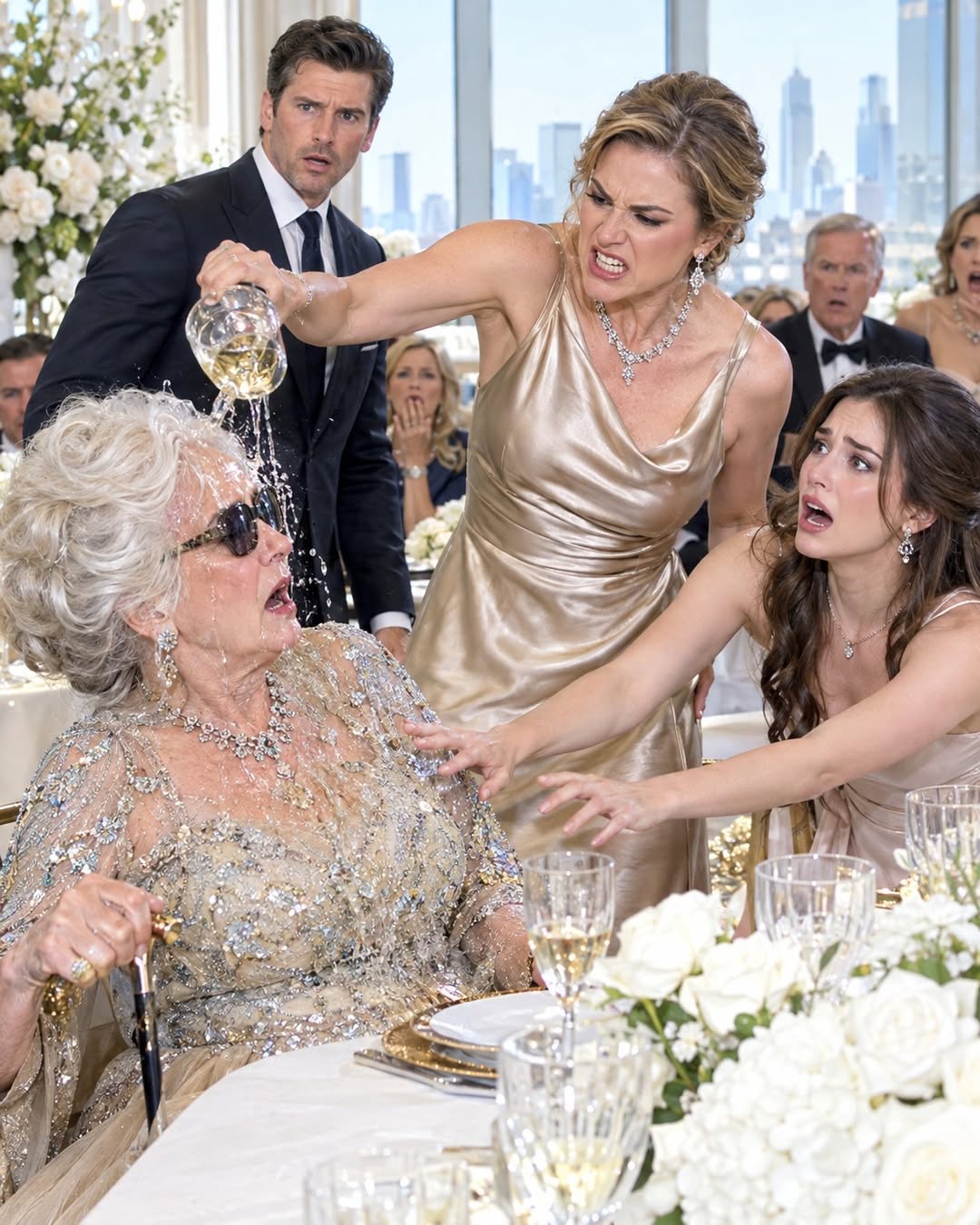
Do you honestly expect my son to marry into a family that brings a blind woman to an engagement dinner like this?”
Victoria Caldwell’s words struck the table like an open-handed slap.
Emily felt the warmth drain from her fingers.
Beside her, her mother, Grace, remained perfectly still behind dark glasses,
one hand resting lightly on her white cane.
Across the table, Victoria wore the same superior smile she had displayed all afternoon inside the private dining room of an upscale restaurant in Manhattan.
The dinner was supposed to celebrate Emily’s engagement to Andrew.
Instead, from the moment Emily’s parents arrived,
Victoria had treated them as though they were applicants being evaluated for entry into some exclusive club.
First, she criticized the simple gray blazer worn by Emily’s father, Robert.
Then she asked him, without embarrassment, how much money he made.
“I have a few distribution businesses,” Robert answered calmly.
Victoria gave a small laugh.
“Oh, distribution. Well, we’re in a very different league. My husband’s construction company handles projects worth hundreds of millions every year.”
Her husband, Charles, looked down.
Andrew did the same.
Emily kept waiting for her fiancé to stop his mother.
She wanted him to remind Victoria that the woman she was humiliating would soon become part of his family.
Instead, Andrew only murmured:
“Mom, just drop it.”
Victoria didn’t.
When a waiter gently explained to Grace where her soup cup had been placed, Victoria made a face.
“See? Everything has to be explained to her. Is my son supposed to spend his life taking care of her too?”
“My mother takes care of herself perfectly well,” Emily replied.
“But she can’t see.”
Grace inhaled slowly.
Three years earlier, she had lost her sight after a rare illness that began with a severe fever and eventually damaged both optic nerves. Her family had consulted specialists in New York, Boston, and even clinics in Europe.
Nothing restored her vision.
But Grace had never asked anyone to pity her.
“Not being able to see doesn’t prevent me from understanding how someone treats other people,” she said quietly. “And today, I’ve learned quite a lot.”
Victoria’s face reddened.
“Are you judging me?”
“I’m learning who you are.”
The silence that followed was brutal.
At that moment, Grace’s cane slipped from beside her chair and fell near Victoria’s feet.
Emily reached for it, but Victoria used the toe of her heel to push it farther away, sending it beneath a side cabinet.
“What an inconvenience.”
“Mrs. Caldwell!” Emily exclaimed.
Andrew caught Emily by the arm.
“Em, please. Don’t make this worse.”
That hurt more than Victoria’s insult.
Victoria lifted her wineglass.
“The truth is, this family simply isn’t on our level.”
Charles finally spoke.
“Victoria, that’s enough.”
But she was already moving.
She tipped the glass.
White wine splashed directly across Grace’s face.
Her dark glasses became wet. Wine ran down her cheeks, along her neck, and across the front of her dress.
“Mom!”
Emily shot to her feet.
Robert did too.
Grace didn’t scream.
She only reached through the air for her husband’s hand.
Robert found it immediately.
He gently wiped Grace’s face, then looked at Victoria with such controlled coldness that every voice in the room disappeared.
“I won’t forget what you just did.”
Victoria laughed.
“Oh, please. It’s not like she can even see the stain.”
Something inside Emily finally broke.
Slowly, she removed her engagement ring.
She placed it on the table.
“It’s over, Andrew.”
“Emily…”
“I’m not marrying you.”
Victoria began protesting loudly, but Robert had already retrieved Grace’s cane.
He helped his wife stand.
Before leaving, he looked directly at Charles.
“Tonight, all of you showed me exactly who you are.”
Twenty minutes later, from the restaurant parking garage, Robert made a call.
“David, first thing tomorrow morning, I want a complete report on Caldwell Construction. Contracts, liabilities, defaults, financing exposure, and every agreement connected to our group.”
No one inside that restaurant knew who the quiet man in the gray jacket truly was.
And they had no idea what was about to happen next.
At eight the following morning, ten senior executives sat around a long conference table on the fifty-first floor of a glass tower overlooking Midtown Manhattan.
At the head sat Robert Whitmore.
The same man Victoria had dismissed as a small-time distributor.
In reality, Robert was the founder and chairman of Whitmore Holdings, a massive American conglomerate with interests in logistics, industrial real estate, infrastructure, hotels, supply-chain financing, and commercial development.
For years, he had stayed away from celebrity magazines and society pages.
He preferred his companies to be famous, not himself.
David, his chief of staff, projected the report onto a large screen.
“Caldwell Construction receives close to sixty percent of its major project revenue from developments where Whitmore Holdings is either an investor, a client, or a financing partner. Their liquidity is weak, several bridge loans mature soon, and they have multiple documented performance delays.”
Robert folded his hands.
“I want one thing made absolutely clear. No illegal retaliation. No pressure on lenders. No threats. We simply stop giving them special treatment.”
The general counsel nodded.
For months, Whitmore Holdings had tolerated missed deadlines, extended payment schedules, and renewed agreements largely because Emily and Andrew were expected to marry.
“Review every contract,” Robert said. “If we’re legally entitled to decline renewal, demand additional guarantees, or enforce existing default provisions, do it. Nothing beyond the law.”
That same afternoon, Charles Caldwell received the first notices.
Two major agreements would not be renewed.
A third would continue only if Caldwell Construction provided stronger guarantees because of prior performance failures.
And Whitmore Capital would not extend a corporate credit facility scheduled to mature within weeks.
Charles spent hours reviewing spreadsheets.
Without those contracts, he couldn’t cover payroll, leased equipment, subcontractor advances, and debt servicing.
“This can’t be coincidence…”
He called Victoria.
“Whitmore has shut us out.”
“Then call their chairman.”
Charles suddenly remembered Robert’s final words from the restaurant.
“Tonight, all of you showed me exactly who you are.”
A chill ran through him.
“Victoria… what’s Emily’s father’s last name?”
“Whitmore. Why?”
Charles typed into his computer:
“Robert Whitmore Whitmore Holdings.”
An old photograph appeared from a national infrastructure summit.
Charles stared.
It was him.
His water glass slipped from his hand.
“Oh my God.”
Victoria rushed into his office.
She looked at the screen and went pale.
“But he told me he was in distribution.”
“Whitmore Holdings started thirty years ago as a regional distribution company,” Charles said. “He never lied. You just decided he wasn’t important.”
Andrew learned the truth that evening.
He called Emily seven times.
She ignored every call.
Meanwhile, Emily accompanied Grace to the Bright Path Foundation, a modest nonprofit center in Brooklyn that Robert had quietly supported for years.
The foundation provided technology training, music instruction, career placement, and independent-living programs for people with visual impairments.
A sixteen-year-old girl named Lily was playing the piano using Braille sheet music.
Grace stopped walking when she heard it.
Before losing her sight, she had played piano every Sunday afternoon.
She hadn’t touched one since.
“Mom,” Emily whispered, “I want to work here.”
“Don’t make decisions because you’re angry.”
“It’s not because of Victoria. Yesterday made me realize how many people probably experience that kind of treatment all the time.”
Grace squeezed her daughter’s hand.
“Then do it for them.”
Two weeks later, Charles’s accountant placed a thick folder on his desk.
“Without new capital, we’ll have to consider Chapter 11.”
Victoria started crying.
“Go see Robert. Apologize.”
Charles looked at her with exhaustion.
“Do you know what the worst part is? If you’d known he was a billionaire, you would’ve treated Grace like royalty.”
Victoria said nothing.
Three days later, Victoria, Charles, and Andrew secured a ten-minute meeting with the chairman of Whitmore Holdings.
They rode a private elevator to the top floor.
When they entered the office, they saw a man seated with his back to them, looking through floor-to-ceiling windows over Manhattan.
“Mr. Chairman,” Victoria began, her voice trembling, “please… have mercy.”
The chair slowly turned.
Andrew stopped breathing.
Victoria stared in horror.
Sitting behind the desk was the man she had mocked, insulted, and dismissed.
The husband of the blind woman she had humiliated with a glass of wine.
But she still hadn’t heard the worst part.
PART 3
When the chair finished turning, nobody spoke.
A brushed-metal plaque rested on the desk.
ROBERT WHITMORE
CHAIRMAN & CHIEF EXECUTIVE OFFICER
WHITMORE HOLDINGS
Charles immediately lowered his eyes.
Andrew seemed to shrink inside his suit.
Victoria opened her mouth several times before words finally came out.
“Mr. Whitmore… I didn’t know…”
“Don’t suddenly become formal with me now,” Robert replied. “At the restaurant, you could barely bring yourself to treat me like I belonged at the table.”
Victoria started to cry.
“I didn’t know who you were.”
Robert studied her for a moment.
“That’s exactly the problem.”
Victoria looked up.
“If you’d known who I was, you would have treated my wife differently. You would have picked up her cane. You would have chosen every word carefully. You probably would’ve spent the evening complimenting our family.”
No one moved.
“But you believed we were people without money or influence,” Robert continued. “So you decided you were free to humiliate us.”
“I’m sorry…”
“I’m not the person who needs your apology.”
Charles stepped forward.
“Mr. Whitmore, what Victoria did was indefensible. But I have employees. Families depend on my company. I’m asking you to reconsider the contracts.”
Robert’s tone remained level.
“Your company isn’t in trouble because your wife threw wine in my wife’s face.”
Charles stared at him.
“The contracts were reviewed because your company had documented delays, missed obligations, and a dangerously fragile capital structure. For months, my group made exceptions because our children were going to marry. Once that relationship ended, the exceptions ended too.”
Charles felt the air leave his lungs.
He couldn’t accuse Robert of inventing violations.
Whitmore Holdings had simply stopped holding Caldwell Construction upright.
Robert opened another folder.
“Your company expanded by borrowing short-term money to fund increasingly large projects. You assumed we would keep renewing contracts and extending favorable financing indefinitely. That wasn’t strength, Mr. Caldwell.”
Robert paused.
“It was dependence.”
Charles lowered his head.
For the first time, he understood that the wealth his family had paraded so proudly was built on a structure far weaker than he wanted to admit.
Victoria stepped forward.
“Let me speak to Grace. I’ll apologize personally. I’ll get on my knees if I have to.”
“No.”
“Please…”
“My wife doesn’t need to see you kneeling.”
Robert’s expression hardened.
“She needed you to treat her like a human being when you thought she had nothing you wanted.”
Victoria began sobbing.
Andrew stepped forward next.
“Mr. Whitmore, I really loved Emily.”
Robert looked directly at him.
“You loved her?”
“I still do.”
“When your mother kicked Grace’s cane away, what did you do?”
Andrew said nothing.
“When she insulted your future mother-in-law because of her blindness, what did you do?”
Silence.
“When she threw wine into her face, what did you do?”
Tears appeared in Andrew’s eyes.
“I told Emily to calm down.”
“Exactly.”
Andrew lowered his head.
“I was wrong.”
“Yes. And sometimes the mistakes we make tell people exactly who we are when we have to choose between doing what’s right and doing what’s comfortable.”
“Please let me speak to Emily once.”
Robert shook his head.
“Emily heard everything she needed to hear that night.”
“I can change.”
“I hope you do. But becoming better doesn’t create an obligation for my daughter to wait for you.”
Andrew started crying.
Robert showed no satisfaction.
There was no victory in his expression.
Only disappointment.
“You think you lost Emily because of your mother,” he said. “You lost her because you chose silence.”
David stepped forward.
“Caldwell Construction’s contracts and financing will proceed according to their legal terms. Whitmore Holdings will offer no new exemptions, extensions, or capital assistance.”
Charles exhaled.
“So… that’s it?”
“Yes.”
Victoria gripped the back of a chair.
“We could lose our home.”
Robert looked straight at her.
“My wife lost her sight. And even after that, she never decided her pain gave her the right to treat another person like garbage.”
Victoria couldn’t answer.
They left the office without another word.
Inside the elevator, the floor numbers descended slowly.
Andrew stared at his shoes.
With every floor, he seemed farther away from Emily.
Victoria cried quietly.
Charles made no effort to comfort her.
When they reached the garage, he turned toward his wife.
“We didn’t start losing everything when Whitmore stopped renewing our contracts.”
Victoria looked at him.
“Then when?”
“When we started believing money made us better than other people.”
Her face tightened.
“Don’t blame all of this on me.”
“I’m not. I’m responsible too. For years, I listened to you speak that way because some part of me liked believing we’d escaped being ordinary.”
That conversation didn’t save their company.
But it was the first time Charles stopped lying to himself.
The following months were painful.
Caldwell Construction sold machinery and investment properties to meet some of its obligations.
Several projects were reassigned to competing contractors.
Their mansion in Greenwich was eventually sold, and Charles and Victoria moved into a modest apartment outside the city.
They didn’t become homeless.
But the luxury dinners disappeared.
So did the overseas vacations, new cars, expensive clubs, and friends who only returned their calls because they thought the Caldwells still had influence.
Andrew found work as an inventory supervisor at a distribution center in New Jersey.
On his first day, he arrived angry at everyone.
A month later, he was unloading pallets alongside other employees when one of his coworkers laughed and said:
“Hey, Mr. College Degree, everybody sweats the same in here.”
Andrew smiled despite himself.
It was true.
Slowly, he began learning something his family had never taught him.
Working in a warehouse didn’t diminish a person’s dignity.
Humiliating someone did.
One afternoon, a newly hired employee entered an order incorrectly.
Andrew almost yelled at him.
Then he stopped.
He remembered Victoria snapping her fingers at the waiter during the engagement dinner.
“Come over here,” Andrew said instead. “I’ll show you how to fix it.”
That night, he thought about Emily.
He wanted to call her.
He didn’t.
For the first time, he understood that apologizing didn’t always mean getting someone back.
Sometimes an apology meant changing even when the person you hurt would never return.
Victoria took longer.
She eventually accepted an administrative position at a neighborhood café owned by an old acquaintance.
She sold almost all of her designer handbags.
No one cared about the Caldwell name anymore.
One morning, an older woman entered wearing dark glasses and carrying a white cane.
Victoria froze.
“Excuse me,” the woman asked, “could you tell me where the register is?”
Victoria slowly walked out from behind the counter.
“About ten feet ahead and slightly to your right. If you’d like, I can walk with you.”
“Thank you.”
Victoria walked beside her.
Then she went into the restroom.
She locked the door and cried.
Not because the woman was Grace.
Because she wasn’t.
She was a complete stranger.
And for the first time, Victoria understood that a blind woman shouldn’t have to be married to a billionaire to deserve basic human respect.
For years, Victoria had believed losing her wealth would be the greatest humiliation imaginable.
Now she knew there was something worse.
Realizing you had been cruel simply because you believed there would never be consequences.
Meanwhile, Emily had started building an entirely different life.
She resigned from her position at a marketing agency and joined the Bright Path Foundation full-time.
Robert offered her an executive role.
She refused.
“I’m starting at the bottom.”
For months, she coordinated workshops, accompanied participants to employment interviews, and negotiated partnerships with companies willing to hire workers with visual impairments.
She also spent a great deal of time with Lily, the teenage pianist.
One Saturday, Lily brought several sheets of Braille music.
“These are for your mom.”
Emily ran her fingers over the raised dots.
“Do you really think she can play again?”
“Your mom didn’t stop understanding music when she lost her eyesight,” Lily replied. “She just needs another route back to it.”
That evening, Emily opened the old upright piano in her parents’ house.
It had remained closed for nearly three years.
“Mom.”
Grace heard the lid rise.
“No, Emily.”
“Just sit with me for five minutes.”
“I don’t want to.”
Emily immediately realized she had touched a painful place.
Before her illness, Grace spent Sunday afternoons playing jazz standards, old love songs, and classical pieces.
After she lost her sight, she never went near the piano again.
“Whenever I think about that piano,” Grace admitted, “I remember the last day I could still see the keys. I thought I’d go to a doctor and everything would eventually return to normal.”
Her voice broke.
“But nothing ever returned to normal.”
Emily sat beside her.
She didn’t promise that Grace would regain her sight.
She didn’t tell her everything happened for some greater reason.
She simply held her hand.
“Then don’t play like the woman you were before.”
Grace turned toward her daughter.
“Play like the woman you are now.”
For several seconds, only the living-room clock could be heard.
Then Grace slowly extended her fingers.
She touched one key.
Then another.
She searched for middle C.
She missed it.
And laughed.
“I haven’t done this in years.”
“You have the whole evening.”
Robert stood silently in the doorway.
Grace tried again.
Fifteen minutes later, a hesitant melody began to emerge.
It lasted less than a minute.
But when it ended, Grace was smiling.
Robert quietly wiped his eyes.
“I thought the illness took this from me too,” Grace whispered.
Emily hugged her.
“It didn’t. It just changed how you reach it.”
Three months later, the Bright Path Foundation hosted a concert to raise money for scholarships, assistive technology, and vocational programs.
Grace agreed to perform a duet with Lily.
When Robert heard, he nearly didn’t believe her.
“Are you sure?”
Grace smiled.
“No. But I’ve spent too much of my life waiting to feel sure.”
The auditorium was full.
There were no celebrities.
No velvet ropes.
No red carpet.
There were families, teachers, students, workers, volunteers, and dozens of people with visual impairments.
When Grace entered with Lily, the room went silent.
She sat at the piano.
Placed her hands on the keys.
And began to play.
It wasn’t technically perfect.
It was better than perfect.
It was a woman taking back a piece of herself she had once believed was gone forever.
When the final note faded, the entire audience stood.
Grace couldn’t see the applause.
But she heard it.
And she smiled.
That night, she finally understood that darkness had not ended her life.
It had forced her to discover another way of living it.
A year after the engagement dinner, Emily received a letter at the foundation.
It was from Andrew.
He didn’t ask for another chance.
He didn’t defend his mother.
He didn’t complain about losing his former life.
He simply wrote:
“I used to believe loving someone meant feeling something powerful for them. Now I understand that love also means standing up when that person needs you beside them. That night, I stayed seated. That was a choice.”
Emily read the letter twice.
Then she put it away.
That afternoon, she visited her parents.
Grace was playing the piano.
“Your voice sounds different,” Grace said as Emily entered. “What happened?”
“Andrew wrote to me.”
Robert immediately appeared from the kitchen.
“What does he want?”
Emily smiled.
“Nothing. He just apologized.”
Grace reached out her hand.
Emily took it.
“Did you forgive him?”
Emily thought for a few moments.
“Yes. I think I did.”
“Are you going back to him?”
“No.”
Grace smiled.
“Then you’ve learned something important.”
“What?”
“Forgiving someone doesn’t mean reopening the door.”
Robert placed three mugs of coffee on the table.
“I’m having that engraved over the entrance to the foundation.”
All three laughed.
Outside, New York continued with its noise, traffic, ambition, crowds, and enormous differences between rich and poor.
Inside, Grace returned to the piano.
Emily thought again about that terrible engagement dinner.
For a long time, she believed it had been the night she lost her future.
Now she understood it was the night she had escaped the wrong one.
She lost an engagement, but she discovered who Andrew was when he had to choose between standing beside her and protecting his own comfort.
Victoria revealed who she was when she believed she was dealing with people who had no power.
Charles learned that a fortune built on appearances could collapse.
Andrew discovered that silence could be a form of cowardice.
And Grace, the only person at the table who couldn’t see, had seen everyone more clearly than anyone else.
Because true class had never been found in the luxury restaurant, the expensive watches, Charles’s mansion, or Robert’s skyscraper.
It existed in a woman who had wine thrown in her face, stood up without lowering herself to the level of the person who humiliated her, and walked away holding the arm of someone who loved her.
Sometimes, the people who spend the most time insisting they are above everyone else discover far too late that money can buy an elegant table, a massive home, designer clothes, and a respected name.
But it can never buy dignity.
And it can never buy humanity.