The plastic blue cup is still sitting on my counter.
It has a little dent near the rim where he dropped it on the linoleum last spring. I haven’t moved it.
I haven’t even washed it.
I keep thinking if I leave it right there, maybe the last eleven months will stay real instead of turning into some kind of cruel, waking nightmare that I can’t find the exit to.
His name is Toby.
He was four years old when he came to me.
He was four years old when he left.
When the social worker showed up that Friday to take him back to his mother, I didn’t want to let go.
I held onto his little hand until my knuckles turned white.
“You’re a good boy, Toby,” I whispered to him. He didn’t say anything back.
He just looked at me with those wide, dark eyes that had seen way too much for a child who should only be worried about bedtime stories and Saturday morning cartoons.
I had spent three hundred and forty dollars of my own money on new shoes, warmer pajamas, and that stuffed bear he carried everywhere. I packed it all. I wanted him to have something that felt like home, even if home was a place that didn’t know how to keep him safe. I watched his car pull away from the curb. I stood there on the porch until the tail lights faded into the twilight of that Tennessee evening.
I prayed that I was wrong. I prayed that maybe, just maybe, people can actually change.
The weekend was quiet. The house felt too big and too empty. I kept catching myself walking into his room to check if he needed an extra blanket.
Monday morning, the phone rang before I even had the coffee brewed. It was the social worker. Her voice sounded thin and brittle. “I need you to come to the office,” she said.
“Is he okay?” I asked. My throat felt like it was full of sand.
“Just come,” she said. She didn’t say anything else. I didn’t wait for a second cup of coffee. I grabbed my keys and drove faster than I ever should have. I didn’t even notice the speed limit signs. All I could see was his face.
When I got to the office, the air felt thick, like a storm was about to break. The worker ushered me into a small room and closed the door. She didn’t sit down. She just stood there, her hands shaking as she reached for a file on her desk.
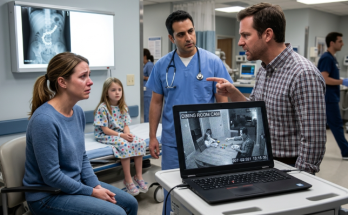
“He was in the ER last night,” she said. She wouldn’t look at me. “Broken collarbone. She said he fell off the porch.”
I felt the room tilt. I reached out to steady myself against the wall, but my hand just hit the cold drywall. “He doesn’t fall,” I said. My voice sounded like it belonged to a stranger. “He’s careful. He learned to be careful.”
She didn’t answer. She just pushed a thick yellow folder across the table toward me. I opened it. There were three prior reports in there. All of them were closed. All of them involved children under the age of five. I looked through the dates. The names were different, but the stories were the same. A bruise here. A fall there. A closed case every single time.
My heart wasn’t just breaking. It was turning into something hard and cold. I looked up at the worker. “Why?” I asked. “Why did you send him back to that?”
She finally looked at me, and her eyes were full of a tired, empty defeat that I will never forget. “The judge who approved the return is her father,” she said.
The silence in that room was louder than any scream. It wasn’t a mistake. It wasn’t a lapse in judgment. It was a system that had been rigged from the start to protect a bloodline instead of a child. I realized then that I hadn’t been fighting a broken system. I had been fighting a machine that was working exactly the way it was designed to.
I left that office and walked out into the bright afternoon sunlight, but it felt like I was still in the dark. I drove home, but I couldn’t bring myself to walk through my front door. I sat in my car for three hours, just watching the wind blow the leaves across the driveway.
I think about that blue cup on my counter every single day. I think about the three hundred and forty dollars I spent to make his life a little bit easier for a few months. I think about the judge sitting in his chambers, probably sipping coffee, while a little boy sat in an ER room with a broken bone and no one to hold his hand.
I am a grandmother. I am a neighbor. I am a foster parent who thought love was enough to fix the cracks in the world. I was wrong. I don’t know where Toby is tonight. I don’t know if his collarbone is healing. I don’t know if he’s scared.
Every time the phone rings, I jump. I expect it to be a police officer or a hospital. I expect to hear that the next fall was the one that finally took him. I walk through my house and see the empty space where his little shoes used to be, and I feel the weight of every single thing I didn’t do. I should have fought harder. I should have called every newspaper in the state. I should have stood on the courthouse steps and shouted until someone listened.
But I didn’t. I just followed the rules. I just did what I was told. And now I’m sitting here in the dark, and the only thing I have left of him is a plastic cup with a dent in the rim, and the knowledge that I let a child go back to a place that was always going to break him.